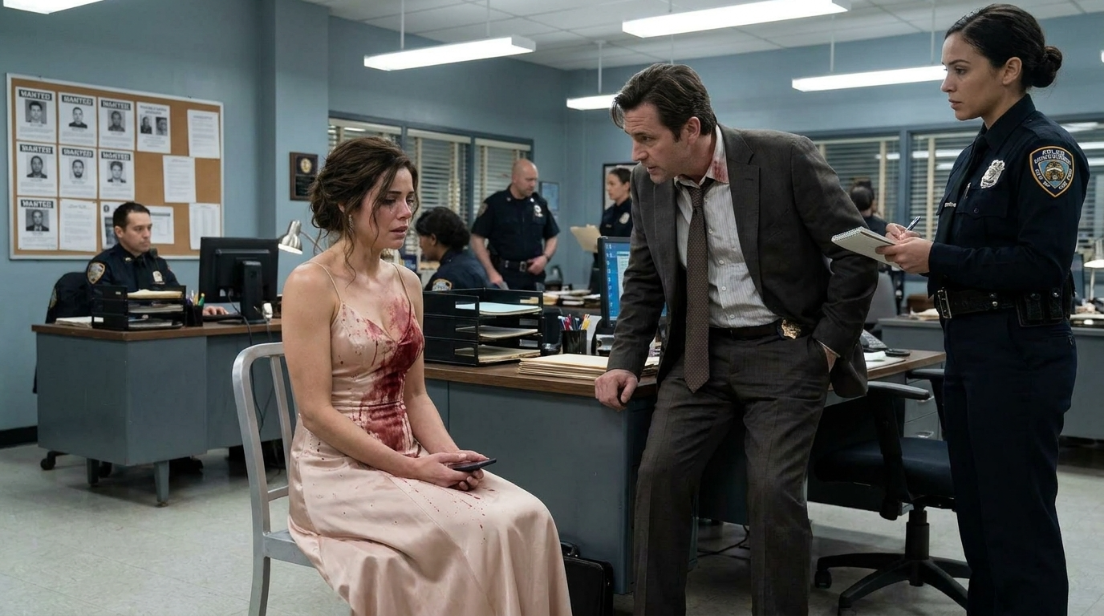
Finding Mom unconscious on a rusty cot, I removed my disguise. My sister didn’t panic; she smirked, sent a text, and right then, the real nightmare walked through the front door…
PART 1

After six years working in Singapore, I landed in Seattle with one suitcase, a carry-on, and a fake identity.
I had seen the online rental listing for my mother’s house while waiting for my connecting flight. The house I had bought for her three years earlier after Dad died, wiring the down payment and every mortgage payment from overseas.
I booked a viewing under the name “Jessica,” put on oversized sunglasses and a baseball cap, and rang the bell.
My younger sister, Valerie, opened the door wearing Mom’s vintage pearl earrings and the gold bracelet Dad gave her on their twenty-fifth anniversary.
“Jessica?” she chirped, putting on her best professional landlord smile. “Come on in. I own the place.”
I kept my head down and walked past her. Three unfamiliar pairs of shoes were piled in the foyer.
“And your mother?” I asked, disguising my voice. “Does she live here?”
Valerie waved a dismissive hand. “Downstairs in the basement. She has severe dementia. I have to give her extra sleep aids so she doesn’t wander and bother the paying tenants.”
The basement door was beside the kitchen. I followed her down without taking off my shoes.
Mom was asleep on a rusted camping cot near the roaring furnace, wrapped in a heavy winter coat even though it was June. She was completely unresponsive, pushed into a stupor by the bottles of unregulated pills sitting on a folding chair next to her.
I suddenly understood why Valerie had kept our video calls so brief and tightly cropped over the last six months.
I couldn’t play along anymore. I slowly took off my sunglasses and let my hair fall.
“She claims the house is hers, Valerie,” I said, my true voice cutting through the damp basement air, “because I bought it for her.”
Valerie spun around. She went dead pale, stumbling back against the washing machine. But then, her shock morphed into something entirely different. A dangerous, desperate smile crept across her face. She pulled out her phone and frantically typed a message to an unknown number.
“You really shouldn’t have come back, Nora,” she whispered.
Instead of calling the police right away, I forced her to gather all her paying tenants in the dining room for a “family dinner” at 7:00 p.m. I was standing at the head of the table, about to project my real bank statements and the forged leases onto the TV screen to expose her.
Then, the heavy oak front door groaned open.
A massive, scarred man in a leather jacket walked into the dining room, stepping directly between me and the exit.
He didn’t hold a police badge.
He didn’t carry a notice from the city.
He tossed a document onto the dining table—the one that was about to turn my entire life upside down…
PART 2
My gaze locked onto the heavy, embossed parchment dominating the center of the mahogany table. An agonizing, tomb-like stillness descended over the dining hall. My sister, Valerie, released a ragged exhale of euphoria, her venomous arrogance reigniting the moment the mountain of a man barricaded our sole escape route.
“You must be the sister,” he rumbled, his voice like crushed gravel. “I’m Julian. And you’re making a huge mistake if you think you’re kicking Valerie out.”
A violent tremor seized my fingers as I smoothed open the crisp margins of the filing. It was a quitclaim deed. Stamped at the conclusion, vivid and stark against the white fiber, was my own signature, verified by a state notary four months prior.
“That’s a lie,” I breathed, the room spinning. “I’ve been in Singapore for six years. I never signed this.”
Julian smiled, a cold, predatory gleam in his eyes. “County clerk accepted it. Notary stamped it. Makes it legal. You owe us the house, sweetheart… or you owe us the money…”
PART 3: THE DEEPER SHADOW
The silence in the room was suffocating.
The three paying tenants sitting around the dining table looked back and forth between me, Valerie, and Julian, sensing the sudden danger in the air. One of them—a young college student—quietly grabbed her purse, stood up, and slipped out the back kitchen exit. The other two quickly followed, retreating upstairs and locking their bedroom doors behind them.
I stood my ground at the head of the table, holding the fraudulent quitclaim deed in my shaking hands.
“How did you get a state notary stamp while I was ten thousand miles away?” I asked, my voice deadly quiet.
Valerie leaned back against the doorway, crossing her arms with a smug, mocking smile. “Do you remember that power of attorney form you signed before you left for Singapore? The one for Dad’s estate execution?”
My heart stopped.
“You modified the second page,” I realized, a cold wave of horror washing over me.
“Julian’s cousin happens to be a licensed notary in King County,” Valerie boasted, adjusting Mom’s pearl earrings. “We attached your notarized signature page from the estate paperwork right onto the quitclaim deed. On paper, Nora, you willingly signed this house over to Julian’s private lending company four months ago as collateral for a two-hundred-thousand-dollar business loan.”
I stared at Julian. “A loan for what?”
Julian took two heavy steps toward me, his massive shadow casting over the table. “Valerie has a bit of a gambling problem, Nora. Online poker, private casinos down in Renton. She ran up a massive debt with my associates. We took a lien on this house to cover her tabs. Either she pays me back two hundred grand by the end of the month, or my firm takes full legal possession of this property and puts your dear old mother in a state asylum.”
The sheer scope of their monstrous plot laid itself bare. Valerie hadn’t just stolen the house to rent it out; she had leveraged our mother’s sanctuary to pay off her own criminal debts. And to ensure Mom didn’t cry for help or wander outside to tell the neighbors, Valerie had been heavily sedating her with unregulated black-market sleeping pills.
“You’re both going to prison,” I said, looking Julian straight in the eye.
Julian let out a low, gravelly laugh. “With what proof? The deed is registered with the county. You’ve been living in Asia for six years. To the local police, this looks like a civil dispute between an absentee landlord and a private lender. If you call the cops, we’ll produce the deed, show them your signature, and have you removed for trespassing.”
“And what about Mom?” I countered, my voice tight with rage. “She’s lying unconscious on a cot near a roaring furnace!”
“Your mother has progressive dementia,” Valerie chimed in, stepping closer to Julian’s side. “I’m her legal caregiver. If the paramedics come, I’ll tell them she took her prescribed sleep medication and got confused. They won’t arrest me, Nora. They’ll just feel sorry for me for having to deal with an ungrateful sister who abandoned her family for six years.”
I looked between the two of them. They thought they had trapped me. They thought that because I had just stepped off an international flight with one suitcase, I was helpless, isolated, and out of options.
What Valerie had forgotten during my six years in Singapore was what I actually did for a living.
I was a senior risk compliance officer for a global logistics conglomerate. My entire job consisted of dismantling corporate fraud, tracking hidden paper trails, and outmaneuvering white-collar criminals who thought they were smarter than the system.
I slowly pulled my laptop out of my leather tote bag and flipped it open on the table.
“What are you doing?” Valerie snapped, her smile faltering slightly.
“I’m showing you why you should have checked my flight itinerary before you sent that text, Valerie.”
FINAL PART: THE SYSTEM CRASHES
Julian snorted, taking another step forward. “Close the laptop, sweetheart. You’re not recording anything, and your fancy tech toys aren’t going to save you.”
“I’m not recording, Julian,” I replied calmly, my fingers flying across the keyboard. “I’m executing a remote access protocol.”
I turned the screen around so both of them could see the display.
A high-definition video feed appeared on the monitor. It was an interior view of the basement. Sitting beside our mother’s cot was a small, black electronic device disguised as an air purifier—a portable cellular uplink camera I had set up ten minutes before forcing Valerie to bring the tenants upstairs.
“That feed is broadcasting live right now,” I said, my voice cold as ice. “It’s streaming directly to the King County Sheriff’s Department, the Special Assault Unit, and Adult Protective Services. They’ve been watching the basement feed—and listening to every single word uttered in this room through the high-gain microphone—for the last twelve minutes.”
Valerie’s face turned from pale to an unsightly shade of green. “You… you’re lying!”
“Check the window,” I said softly.
Right on cue, the faint, rising wail of multiple sirens echoed down the quiet suburban street. Red and blue lights began flashing through the sheer curtains of the front living room windows.
Julian’s eyes widened in sudden, raw panic. He spun around toward the front door, but the heavy thud of heavy boots hit the porch steps before he could take two paces.
“POLICE! OPEN THE DOOR!”
“Julian, do something!” Valerie shrieked, clutching his arm in terror.
Julian roughly shoved her away. “Shut up, you idiot! You told me she didn’t know anything!”
Before Julian could reach the side exit, the heavy oak front door was kicked inward with a deafening crash. Four armed King County Sheriff deputies burst into the foyer, weapons drawn, flanked by two plainclothes detectives and an emergency medical team.
“KNEES! ON THE GROUND! BOTH OF YOU!” a deputy barked, his flashlight cutting through the dim entryway.
Julian immediately raised his hands, dropping heavily to his knees on the hardwood floor. Valerie let out a pathetic, high-pitched sob, dropping her purse as a female officer shoved her to the ground and snapped steel handcuffs around her wrists.
“Nora Vance?” a sharp-eyed female detective asked, stepping past the officers toward me.
“Yes, Detective,” I said, closing my laptop. “My mother is in the basement. She needs immediate medical attention for forced chemical sedation.”
“Medics, downstairs now!” the detective commanded into her radio.
As two paramedics rushed past us toward the basement door with a stretcher, Valerie thrashing against the floor, crying out my name.
“Nora! Please! Tell them it’s a mistake! I’m your sister! I was just trying to protect the house!”
I walked over to where she lay pinned against the floor. I reached down, unclasped my mother’s vintage pearl earrings from her lobes, and pulled Dad’s gold bracelet off her wrist.
“You’re not my sister, Valerie,” I whispered into her ear. “You’re just a squatter who picked the wrong house.”
AFTERMATH: THE HOME RESTORED
Three months later, the damp chill of winter had given way to the warm, golden light of an early Pacific Northwest spring.
The old wooden house in Seattle had been completely transformed. The heavy, suffocating scent of stale air and black-market pills was gone, replaced by the crisp aroma of fresh lavender, lemon oil, and freshly brewed coffee.
The criminal trial had moved with extraordinary speed.
Faced with the live cellular audio recordings, the video evidence of elder abuse, and a forensic paper trail demonstrating forged power of attorney documents, Julian and his cousin pled guilty to felony grand larceny, real estate fraud, and conspiracy. Julian was sentenced to nine years in state prison, while his cousin’s legal license was permanently revoked.
Valerie fared no better. The court convicted her of felony elder abuse, endangerment of a vulnerable adult, and identity theft, sentencing her to six years at the Washington Corrections Center for Women. Under the terms of the criminal restitution order, she was stripped of any future claim to our family’s estate.
I walked down the hallway toward the master bedroom on the main floor.
The room had been completely renovated with a state-of-the-art medical bed, soft linen curtains, and floor-to-ceiling windows that caught the afternoon sun.
Sitting in a comfortable armchair by the window was Mom.
She looked vastly different than she had on that rusted cot in the basement. After three months of intensive medical detoxification, physical therapy, and proper nutrition, her mind had cleared remarkably. The “severe dementia” Valerie had claimed was largely a drug-induced delirium brought on by the high doses of sedatives she had been fed daily. While she still suffered from mild age-related memory loss, she was present, coherent, and peaceful.
“Nora, dear?” Mom called out softly as she heard my footsteps.
“Right here, Mom,” I smiled, stepping into the room and setting a tray of tea and fresh scones on her side table.
She reached out, her hand warm and steady, taking mine and squeezing it tightly. She looked down at her wrist, where Dad’s gold bracelet caught the sunlight, and then up at the pearl earrings sitting safely in her jewelry box on the dresser.
“It’s a beautiful afternoon, isn’t it?” she murmured, looking out at the blooming cherry blossom tree in the front yard.
“It is,” I replied, sitting on the footstool beside her chair. “And it’s your house again.”
Mom smiled—a real, genuine smile that reached her eyes. She reached over, patting my hand gently. “It was always your love that built this house, Nora. I never forgot that, even when it was dark.”
I rested my head against her knee, taking a deep, full breath of the clean spring air.
I had given up six years of my life working overseas to buy her a sanctuary. I had come back expecting a rental property, only to find a war. But as I sat beside my mother in the sunlit room, listening to the gentle hum of the neighborhood outside, I knew that the house was no longer just a building.
It was finally home.