Part 1: The Weight of an Unspoken Promise

I used to believe love could survive any level of disappointment. For eighteen years, I told myself that if I loved my husband enough, stayed patient enough, and carried our family’s burdens without complaining, eventually he would stop looking at me as though I had stolen the life he had always imagined.
I was completely wrong.
Instead, every passing year only made the painful distance between us wider, and our son was the one who quietly paid the highest price.
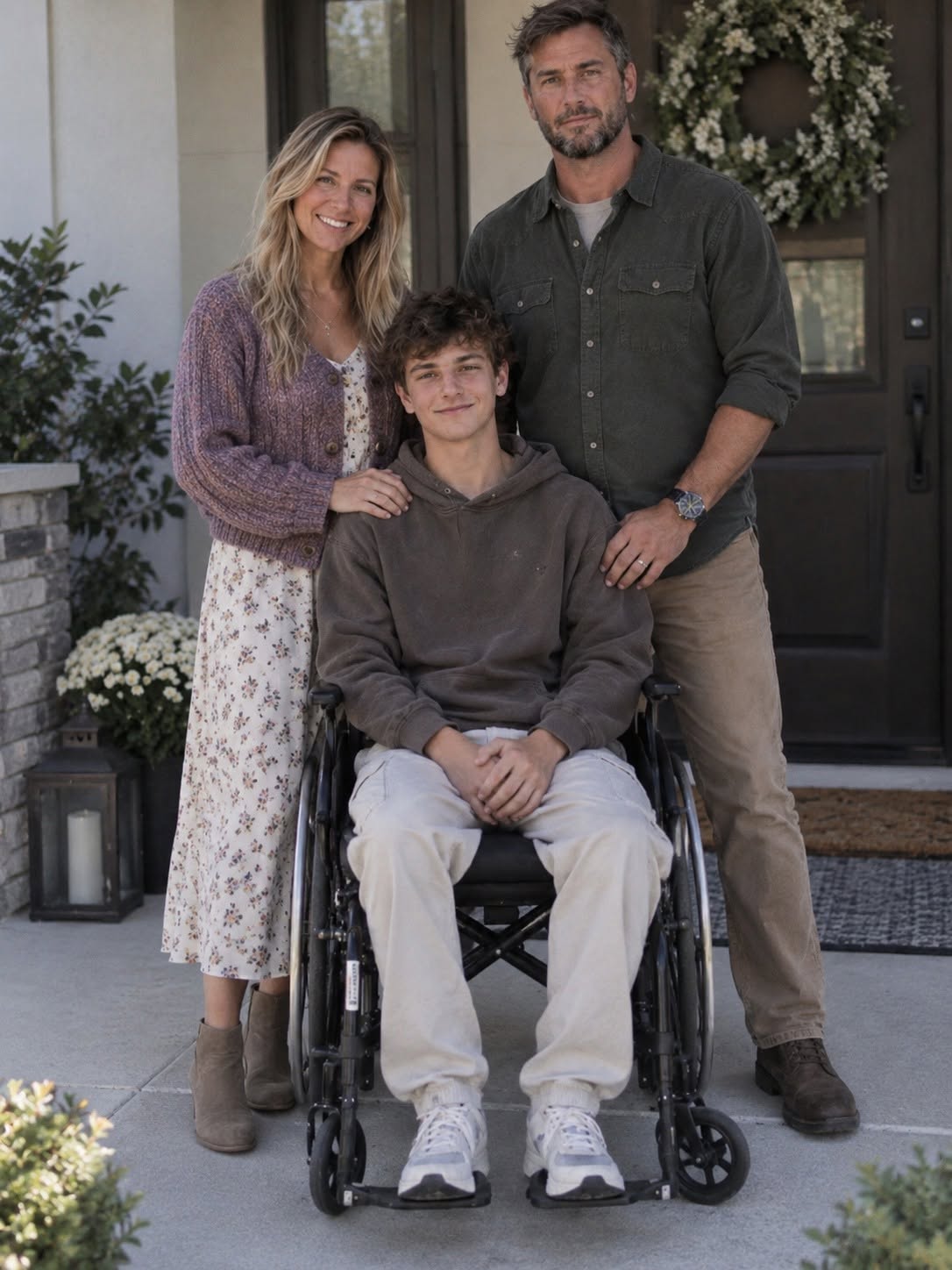
My name is Serena. My son, Connor, has used a wheelchair since he was a little boy, but not once did I look at him and wish he had been someone else. Connor was funny, thoughtful, and incredibly intelligent.
He could easily solve complex problems that left grown adults scratching their heads, and he had an amazing gift for making people laugh when they needed it most. He always noticed when someone was sitting alone, and he remembered little things other people forgot.
To me, he was never a disappointment, he was simply my beloved son.
My husband, Patrick, could never completely let go of the imaginary son he thought he was supposed to have. For eighteen long years, that quiet disappointment followed all of us around our house. Patrick had grown up in a family where high school football was far more than a simple sport, it was a sacred tradition.
His father had been a respected coach in Ohio, and Patrick often told detailed stories about Friday night games under the bright stadium lights. He talked passionately about the sound of the crowd, the smell of the grass, and the excitement of watching his father command the sidelines.
Even after his father passed away, Patrick spoke about those memories as though they were holy rituals. When we were still dating, he once smiled at me and said, “When we have a son, I am going to teach him every single thing my dad taught me.”
I remember smiling back at him because it sounded so sweet at the time. I imagined Patrick throwing a football with our future son in the backyard, and I pictured us attending noisy Friday night games together. Neither of us ever imagined that our life would take a completely different path.
Connor was only three years old when the specialists finally gave us a definitive answer. For years, we had gone from one clinic to another in Phoenix, hoping someone would tell us that his difficulty walking was just a temporary delay.
It was not. I still remember sitting in that small examination room while the specialist explained everything in careful, compassionate words.
I sat there looking at Connor, wondering how anyone could look at that sweet little boy and see anything other than a child who deserved to be loved unconditionally.
Patrick barely spoke a single word during the entire drive back to our home in Scottsdale. For weeks afterward, he buried himself entirely in his corporate job.
At first, I thought he was simply struggling to process the heavy news, so I gave him extra time and space while reminding myself that grief looks different for everyone.
Months passed, and something deep inside Patrick began to change for the worse. First, he completely stopped talking about sports, and then he stopped coming with me to Connor’s physical therapy sessions. Eventually, every small physical setback became my fault.
During one argument in the kitchen, Patrick glared at me and muttered, “If you had just noticed something was wrong sooner, things might be different.”
I shook my head in disbelief and asked, “How can you possibly say that when the doctors told us it was genetic?”
“If you had pushed those specialists harder in the beginning, we would have had better options,” he snapped back, walking away before I could even defend myself. He rarely finished those accusations out loud, but he did not need to because the blame was always hanging heavily between us.
Part 2: The Mask of Humor
As Connor grew older, Patrick became strangely skilled at disguising his bitter cruelty as casual humor. Whenever our neighbors in Arizona talked about their teenage sons making varsity teams or winning regional championships, Patrick would laugh loudly and make a spectacle of himself.
“Well, I guess I will not be spending my savings on football gear after all,” Patrick would announce with a dismissive chuckle.
Our neighbors would laugh awkwardly, not knowing how to react to such a statement. I would force a painful smile to keep the peace, while Connor quietly looked down at his lap.
Sometimes, late at night after Connor had gone to sleep, Patrick would stand by the window looking out into the dark yard. One night, he sighed and said, “You know what hurts me the most, Serena?”
“What hurts, Patrick?” I asked softly, stepping closer to him.
“I see the fathers down the street throwing footballs with their boys every single weekend,” he murmured with envy in his voice.
“I know it is hard to watch other families,” I whispered, trying hard not to cry right in front of him.
He turned toward me with a freezing glare and said, “No, Serena, you really do not know.”
The harsh words themselves were not the worst part of that interaction. It was the cold way he looked at me, as though I had personally robbed him of his bright future. For years, I carried a heavy guilt that never actually belonged to me.
I knew logically that I had not caused Connor’s condition, but when the person you love blames you often enough, a terrible thing happens and you begin to believe them.
Only Connor kept me grounded during those dark years. When he was twelve years old, Patrick made another insensitive remark about sports over dinner, causing Connor to leave the table early. I walked into his bedroom a few minutes later to check on him.
“I am so sorry, sweetheart,” I said gently, sitting on the edge of his bed.
Connor looked genuinely confused and asked, “What are you apologizing for, Mom?”
“For everything that is going wrong in this house,” I replied as tears filled my eyes.
He reached over, squeezed my hand tightly, and smiled gently at me. “Do you know what Coach Callahan told me at the gym today?” he asked.
I wiped my eyes, frowned slightly, and asked, “Who is Coach Callahan?”
“He is the adaptive basketball coach at the community center,” Connor explained proudly. “He said people spend way too much time obsessing over the things they cannot do.”
“And what else did he say?” I asked, feeling a tiny spark of warmth in my chest.
Connor grinned bright and said, “He said because people focus on what they cannot do, they completely miss everything that they can do.”
I laughed through my tears, pulled him into a hug, and said, “That sounds like a very wise coach.”
Connor had an incredible ability to find light almost anywhere, but Patrick rarely cared to notice it.
Part 3: The Gathering Storm
As high school went on, Connor began collecting impressive achievements that should have made any parent burst with pride. He earned academic awards, volunteer recognitions, and prestigious state honors, while his teachers constantly praised his determination.
One afternoon during his senior year, our mailbox was overflowing with official letters from major universities across the country. I gathered the mail, spread the letters across the dining room table, and called out for him.
“Connor, you need to come take a look at the dining table right now!” I yelled excitedly.
He rolled his wheelchair into the room, his eyes widening as he saw the mountain of paper. “Are you seriously telling me all of those are for me?” he asked.
“Every single one of them,” I replied proudly, picking up a gold-stamped envelope. “The top universities in the country are competing for you.”
A few minutes later, Patrick came home from his office, tossed his briefcase onto the couch, and glanced over at the table. “What is all this clutter on the table?” he asked casually.
“These are college acceptances and full scholarship offers for Connor,” I announced, holding my breath.
Connor picked up his favorite letter, but Patrick merely shrugged his shoulders and said, “Good.” Without another word, he turned around and walked straight up the stairs to his bedroom.
There was no congratulations, no warm hug, and no expression of pride whatsoever. I watched Connor carefully to see his reaction, but he just offered a quiet smile.
“I guess that is better than nothing,” Connor said softly, trying to comfort me instead.
Later that evening, after Connor was asleep, I marched into our bedroom and confronted my husband directly. “Could you have possibly acted any less interested in your son’s success today?” I demanded.
Patrick loosened his tie with an irritated sigh and replied, “I do not know what you are making a scene about now, Serena.”
“Our son has top universities practically begging him to attend, and you barely glanced at him,” I said angrily.
“I said good, didn’t I?” he snapped back, sitting down on the edge of the mattress. “That should be enough for him.”
“That is nowhere near enough!” I shouted, completely losing my patience. “Would it have been enough for you if he had scored a touchdown instead of winning an academic award?”
Patrick’s face tightened with sudden anger as he stood up. “Are we seriously going to bring this up again?”
“Yes, because this entire family dynamic has always been about your bruised ego,” I replied, folding my arms tightly across my chest.
He pointed aggressively toward the hallway and yelled, “I did not ask for this kind of life, Serena!”
The room went completely silent as his harsh words echoed off the walls. I froze in place, unable to process his cold declaration.
Patrick turned his back to me and muttered quietly, “I had big dreams for my life.”
“So did I, Patrick,” I whispered back, my voice trembling with exhaustion. “I had dreams too.”
What neither of us realized at that moment was that Connor had heard every single word of our argument from down the hall.
Part 4: The Milestone Birthday
Despite the toxic atmosphere at home, Connor graduated at the very top of his class a few months later. The high school principal stood before hundreds of families and praised Connor’s unmatched resilience and brilliant mind.
The entire audience stood up to give him a roaring ovation, and I cried tears of joy through the ceremony while Patrick clapped politely beside me.
Connor ultimately chose a prestigious university in California known for its groundbreaking engineering and assistive technology research. “I want to design advanced technology that makes life easier for people with mobility challenges,” Connor told me as we packed his room.
“You already make everyone’s life better just by being in it,” I told him gently, kissing his forehead as he smiled back.
The weeks leading up to Connor’s eighteenth birthday passed rapidly. My sister, Valerie, insisted that we throw a big backyard party at our home. “He is becoming an adult, Serena, and that deserves a real celebration with everyone we love,” she insisted.
Patrick surprisingly agreed to the party without raising any objections. For the first time in years, I allowed myself to hope that watching Connor succeed had finally softened Patrick’s heart.
I spent several days preparing the house and baking Connor’s favorite chocolate cake. Valerie decorated the entire backyard with silver balloons, while my brother, Marcus, volunteered to grill food for the guests. Our neighbors, Connor’s high school teachers, and Coach Callahan all arrived with gifts, filling the yard with warmth and laughter.
For a few hours, we looked exactly like the happy family I had spent eighteen years wishing for. Even Patrick seemed relaxed, laughing and chatting naturally with our relatives. Seeing him smile made me wonder if we had finally left the bitterness in the past.
Once dinner ended, everyone gathered around the main patio table as Valerie handed Connor a glass of sparkling cider. “It is time for a birthday toast to the guest of honor!” Valerie announced loudly, raising her glass.
Everyone cheered and raised their glasses in agreement. Patrick stood right beside me, placing his arm around my shoulders in a rare display of affection.
Connor looked around the yard at the smiling faces, thanking several people individually for coming. Then, his calm expression shifted slightly as the chatter gradually died down. He cleared his throat, raised his glass, and looked directly at Patrick and me.
“I want to make a special toast to my parents tonight,” Connor began in a calm tone.
The entire backyard went completely still as people turned their attention to him. Patrick squeezed my shoulder lightly, but Connor took a slow breath and looked straight into his father’s eyes.
“The truth is, I know everything that has been happening in our home for all these years,” Connor said softly.
The fake smile instantly vanished from Patrick’s face, and his arm dropped from my shoulders.
“There is something you two need to know about me,” Connor continued, his voice echoing clearly across the silent yard. “I have heard every single argument you thought happened safely behind closed doors after I went to bed.”
My heart completely stopped as I stared at my son in horror.
“I have heard every cruel joke Dad made about me to the neighbors,” Connor said without a trace of anger. “And I have heard every single time Mom tried to defend me while taking the blame herself.”
I wanted to step forward and stop him to protect him from the pain, but I felt completely frozen in place.
“I know Mom always believed she was successfully hiding Dad’s resentment from me,” Connor said, looking around at our relatives. “But the walls in our house are much thinner than you both realized.”
Patrick swallowed hard, took a small step forward, and pleaded, “Connor, please…”
Connor calmly raised his hand and said, “Please let me finish what I have to say, Dad.”
Part 5: Confronting the Truth
“I also know that Dad blamed Mom for my disability all these years,” Connor revealed openly.
Gasps broke out among our guests as Valerie lowered her eyes in sadness and Coach Callahan folded her arms with a stern expression.
Patrick gave a nervous, embarrassed laugh and said, “Son, this is really not the right time or place for this.”
“I think it is the exact right time,” Connor replied firmly. “You have spent eighteen years making Mom carry this heavy burden in private, and I will not let her carry it anymore.”
I felt hot tears streaming down my face, but Connor looked at me with immense warmth and whispered, “It is okay, Mom.”
He turned his focus back to Patrick and said, “I know you dreamed about coaching a varsity football star, just like Grandpa did with you. And I know every time you saw other fathers playing sports with their sons, you looked at Mom like she had stolen your entire future.”
Patrick’s face turned bright red as he stammered, “I was just deeply disappointed with how things turned out!”
“No, Dad,” Connor corrected him instantly. “You were not just disappointed, you were cruel.”
The harsh truth of that word hung heavily in the air, leaving the entire yard in stunned silence. Valerie broke the stillness by stepping forward and saying, “He is completely right, Patrick. Serena has spent eighteen years carrying a guilt that never belonged to her.”
Marcus shook his head in regret and added, “We all saw pieces of your resentment over the years, Patrick, and I deeply regret not calling you out on it sooner.”
Connor looked down at his lap and continued, “I used to wonder why I was never good enough for you, Dad. I thought if I got better grades, maybe you would care, so I worked hard until I became valedictorian. I thought if I earned full scholarships, you would be proud, so I pushed myself relentlessly.”
A quiet sob escaped my throat as Connor looked back up at his father.
“I thought if I volunteered, helped everyone around me, stayed positive, and never complained about my wheelchair, maybe my father would finally love me,” Connor said, his voice briefly trembling. “But eventually, I realized that the problem was never me. The problem was the ghost of a son you refused to let go of.”
Patrick stared at the ground, his voice barely audible as he murmured, “It is not that I did not love you, Connor…”
“I know you loved me in your own way,” Connor replied calmly. “But love is not something a child should have to constantly guess about. You told Mom that she ruined your life, and you said you never asked for this family.”
“I was just angry and overwhelmed!” Patrick defended himself weakly.
“You were angry for eighteen straight years?” Connor asked directly.
Patrick had no answer to give, remaining completely silent under the gaze of his friends and family.
Connor reached down to the side pouch of his wheelchair and pulled out a neatly organized stack of folded papers. “I have actually been keeping something private since I was ten years old,” he announced, unfolding the top sheet.
“What are those papers, Connor?” I asked in a quiet whisper.
“Every year on my birthday, I wrote letters to my future self,” Connor explained gently. “They were the kind of letters I secretly hoped I would never need to read.”
He cleared his throat and read the first letter aloud: “Dear Future Me, Dad did not come to my adaptive sports game today, but Mom cheered loud enough for both of them. Do not ever let his absence make you think you are worth less.”
I covered my face as tears spilled over my hands, while Valerie openly wept nearby.
Connor picked up another sheet and read: “Dear Future Me, if Dad ever tells you he is proud of you, remember how many years Mom waited to hear those exact same words.”
Patrick covered his face with both hands as Connor unfolded a final paper: “Dear Future Me, do not grow up to be someone who blames others for the life you were given. Be thankful for the people who stayed by your side.”
Part 6: A New Dawn
The entire backyard was filled with quiet weeping as Connor carefully folded his letters and placed them back into his pouch.
“Mom spent eighteen years trying to protect you and shield your reputation,” Connor said, looking at me with unconditional love.
“I was not trying to protect his ego, Connor,” I sobbed, shaking my head. “I was just terrified of accepting that our family was broken.”
“You were protecting him, Mom,” Connor insisted gently. “You kept telling everyone that Dad was just stressed out from work, but you do not have to make excuses for him anymore.”
Connor turned his attention back to Patrick one last time. “I do not hate you, Dad, but I will never stand by and watch you project your disappointment onto Mom again.”
Patrick took a hesitant step forward, tears running down his cheeks as he confessed, “I was completely wrong, Connor. I spent almost two decades mourning a life that never existed, and while I was busy doing that, I completely missed the incredible son standing right in front of me.”
Patrick turned to face me directly and said, “I blamed you, Serena, because blaming myself for my own bitterness was too painful to face.”
Hearing those words after eighteen years did not bring me joy, it simply left me feeling completely exhausted. “You made me believe that I had failed as a wife and a mother,” I said quietly.
“I know I did, and I am so deeply sorry,” Patrick replied, lowering his head in shame.
Coach Callahan stepped up next to Connor, placed a reassuring hand on his shoulder, and spoke up. “I have coached hundreds of athletes over my career, Patrick. Some became great players, but very few became the kind of human being that everyone else aspires to be. Your son is already an extraordinary man, and you should have been proud of him every single day.”
Several guests nodded in agreement, and Marcus began clapping softly. Soon, the entire yard erupted into genuine applause for Connor, celebrating the strong young man he had become despite the toxicity he had endured.
After our guests eventually departed, Patrick approached Connor and me near the back porch. “I called a family counselor tonight and made an individual appointment for myself,” Patrick stated softly. “I should have done this years ago, but if you both allow me, I want to spend the rest of my life earning back your trust.”
“I do not know what will happen to our marriage moving forward, Patrick,” I answered honestly. “Some wounds do not just disappear because you finally say the right words.”
“I completely understand,” Patrick replied humbly.
He turned to Connor, but Connor spoke first: “Forgiveness does not mean pretending the last eighteen years never happened, Dad. If you are truly serious about changing, start by apologizing properly to Mom.”
Patrick looked at me with absolute sincerity and said, “I am so deeply sorry for everything, Serena.” There were no excuses or self-pity in his voice, just the simple apology I had waited nearly two decades to hear.
The next morning, I walked into the garage and found Patrick quietly assembling a custom storage unit for Connor’s university dorm room. He looked up, held up a tape measure, and said, “I looked up Connor’s dorm floor plan online to make sure this fits under his desk.”
It was not a grand gesture that erased eighteen years of emotional neglect, but it was the very first time I had seen Patrick invest effort into Connor’s real future instead of mourning an imaginary past. Whether our marriage would ultimate survive remained uncertain, but the heavy emotional burden I had carried for twenty years was finally gone.
A few weeks later, we drove Connor to his university campus in California. Patrick helped unload every single box and spent an hour carefully adjusting the dorm furniture so Connor could navigate his wheelchair with total ease.
Before we said goodbye, Patrick pulled Connor into a tight hug and whispered, “I am so incredibly proud to be your father, son.”
Connor smiled warmly and replied, “Thank you, Dad.”
As I watched Connor roll confidently toward his new residence hall, smiling with the same gentle strength he had carried since childhood, I realized a profound truth. My husband had spent eighteen years grieving an imaginary child, while I had been blessed with the extraordinary son who was real.
Connor did not need to win a football game or stand under stadium lights to prove his worth. He had accomplished something far greater by learning to thrive without letting someone else’s bitterness define his life. On his eighteenth birthday, he finally gave me the ultimate gift: the absolute permission to put down a burden that was never mine to carry.
THE END.