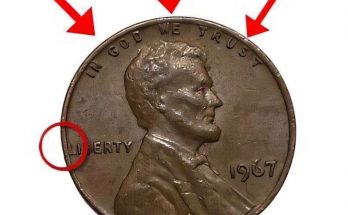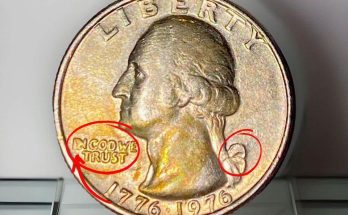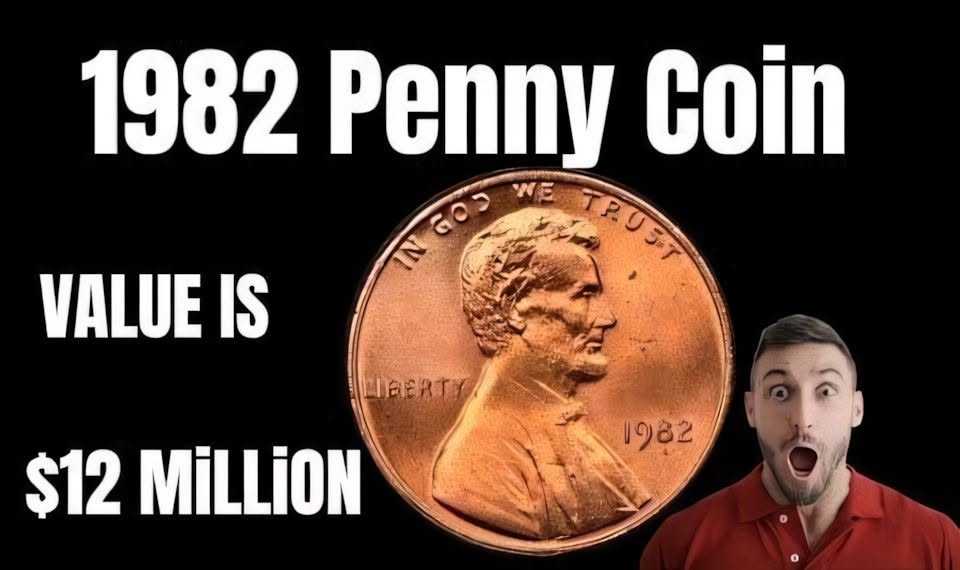
The claim that a single 1982 penny is worth $12 million makes for phenomenal clickbait, but from a numismatic perspective, it is a complete fantasy. No Lincoln cent in history has ever sold for anywhere near $12 million. The record for a 1982 cent remains a rare error coin that fetched around $18,800, while the absolute record for any U.S. cent is $2.3 million (for a rare 1793 Birch Cent).
Here is a breakdown of why this claim circulates, what actually happened to pennies in 1982, and how to spot a genuinely valuable 1982 error coin.
Why 1982 Was a Chaos Year for the U.S. Mint
In 1982, soaring copper prices forced the U.S. Mint to change the metal composition of the penny mid-year to save money.
-
Pre-1982 (Brass): 95% copper, 5% zinc. These weigh 3.11 grams.
-
Post-1982 (Zinc): 97.5% zinc, 2.5% copper plating. These weigh 2.5 grams.
To complicate matters further, the Mint changed the lettering style (font size) on the coins mid-production, creating two distinct design variations: Large Date and Small Date.
Because both copper and zinc blanks were struck at multiple mint facilities using both date styles, the Mint produced seven standard varieties for general circulation in massive quantities (over 16 billion pennies total):
The “Holy Grail” Discovery: The 8th Variety
The Mint never intended to strike a 1982 Small Date in copper at the Denver Mint (“1982-D Small Date Copper”). According to official plans, Denver was supposed to transition entirely to zinc for Small Date coins.
However, in late 2016, a coin collector discovered a single 1982-D Small Date copper penny. A leftover copper planchet (blank) had mistakenly fallen into the press at Denver while the Small Date dies were installed.
Because this transitional error is extraordinarily rare, it generated massive news coverage. When it was auctioned in 2017, it sold for $18,800. A second example surfaced a few years later and fetched a similar high price. Over time, viral social media posts exaggerating this headline turned $18.8k into “18 million” or “$12 million.”
How to Identify the 1982-D Small Date Copper Penny
If you want to check your pocket change, you need to verify three specific features. All three must be present for the coin to be valuable:
-
Mint Mark: It must have a “D” under the date (indicating the Denver Mint).
-
Small Date Design: Look at the numerals:
-
Small Date: The numbers are delicate, and the top curve of the “8” is visibly smaller than the bottom curve. The “2” has a subtle curve at its base.
-
Large Date: The numbers are thicker and closer to the rim. The top and bottom loops of the “8” are almost identical in size.
-
-
Weight: You must use a digital scale that measures to 0.01 grams.
-
If it weighs 2.5 grams, it is common zinc (worth 1 cent).
-
If it weighs 3.11 grams, you have found a transitional copper error.
-
Understanding Penny Values
-
99.99% of 1982 Pennies: Worth face value (1 cent) or about 2 cents in raw melted copper value (though melting U.S. currency is illegal).
-
Mint State/Uncirculated Varieties: High-grade specimens certified by grading services (PCGS/NGC) can sell for $10 to $100+.
-
1982-D Small Date Copper Error: Worth $10,000 to $20,000+ depending on condition.
While the $12 million claim is a myth born of online exaggeration, checking your 1982 pennies is still worth the effort—finding an $18,000 mistake in a jar of spare change is still an incredible prize.