The Chair Scraping Across the Floor
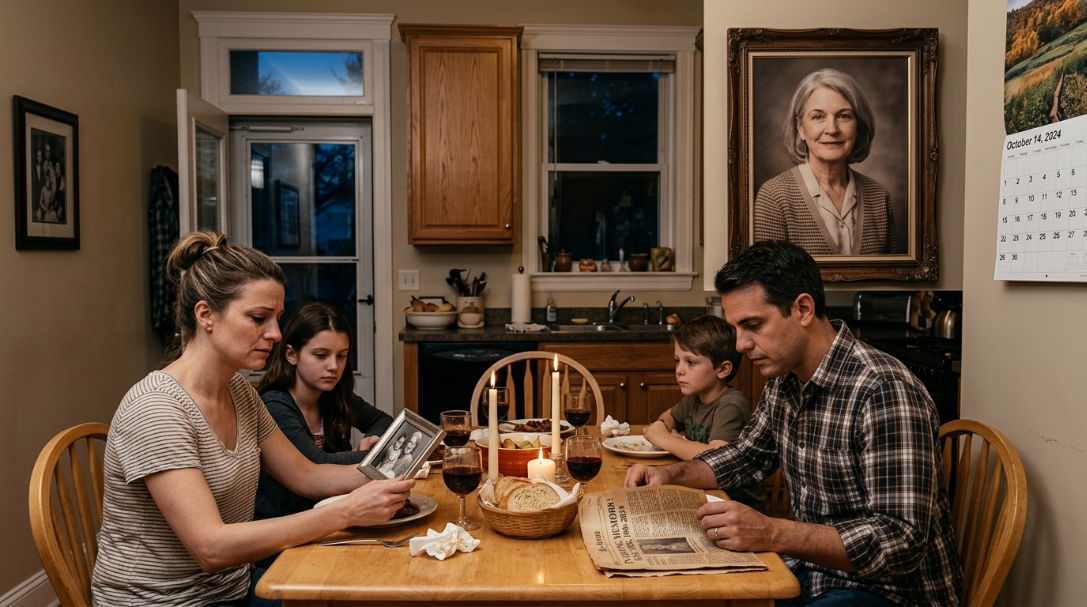
The dining room still smelled of rosemary, beef stew, warm bread, and candle wax when my daughter-in-law told me to leave my own table.
Dylan’s spoon stopped halfway to his mouth.
Sarah’s nervous laugh vanished.
My son, Edward, stared down at the plate I had filled for him as though the potatoes had suddenly become the most fascinating objects in Chicago.
Linda remained standing at the head of the table.
My husband’s chair.
Anthony had sat there for thirty-seven years. He had graded history essays in that chair, carved Thanksgiving turkeys in that chair, and fallen asleep in that chair while pretending to watch late-night baseball.
Linda had chosen it deliberately.
She rested both hands on the polished walnut table and looked directly at me.
“I’m the one in charge of this house now.”
Her voice carried the confidence of someone announcing a decision that had already been approved.
Edward shifted, but he still did not look at me.
Linda pointed toward the back door.
“Take your plate outside and eat with your friend.”
For a moment, nobody breathed.
Through the glass panes of the back door, I could see the yellow porch light glowing above the steps. Beyond the fence stood the small blue house belonging to my closest friend, Nora Quinn. Linda had complained about Nora twice since arriving that morning.
“She’s always looking over here.”
“She asks too many questions.”
“You shouldn’t tell neighbors our family business.”
Our family business.
The phrase sounded almost funny considering Linda had spent the day walking through my rooms with a measuring tape.
The guest bedroom was too small. The upstairs bathroom had bad lighting. The closet was unacceptable. The curtains were old. The kitchen needed new cabinets. The family room should be converted into Dylan’s gaming room.
Then she had announced that she and Edward should take my bedroom because it had an attached bathroom.
I had said no.
She had smiled as though I had merely delayed the discussion.
Now she was ordering me to eat outside.
The insult hurt.
Edward’s silence hurt more.
For years, I had confused keeping the peace with protecting my family.
I had swallowed Linda’s cutting remarks at Christmas. I had changed birthday plans because the restaurant I chose was “embarrassingly old-fashioned.” I had apologized after Linda insulted me because Edward always looked exhausted when we argued.
“Can’t you two just get along?” he would ask.
What he meant was: Mom, can’t you give in?
And I usually did.
I gave in because he was my only child.
I gave in because Anthony had died and I could not bear the thought of losing Edward too.
I gave in because Dylan and Sarah were the two bright windows in a house that had felt dark for almost four years.
But that evening, watching my forty-three-year-old son lower his eyes while his wife tried to remove me from the table Anthony and I had bought at a church auction, I finally understood something.
Peace required respect from both sides. Surrender required only my silence.
I did not shout.
I did not remind Edward that I had worked two jobs during his first year of college.
I did not list the soccer practices, emergency-room visits, forgotten lunches, tuition payments, or nights Anthony and I had stayed awake waiting to hear his key in the front door.
I simply smiled.
Linda mistook it for defeat.
At exactly 6:48 p.m., I folded my napkin beside my plate and pushed back my chair.
“Where are you going?” Sarah whispered.
I touched her shoulder gently.
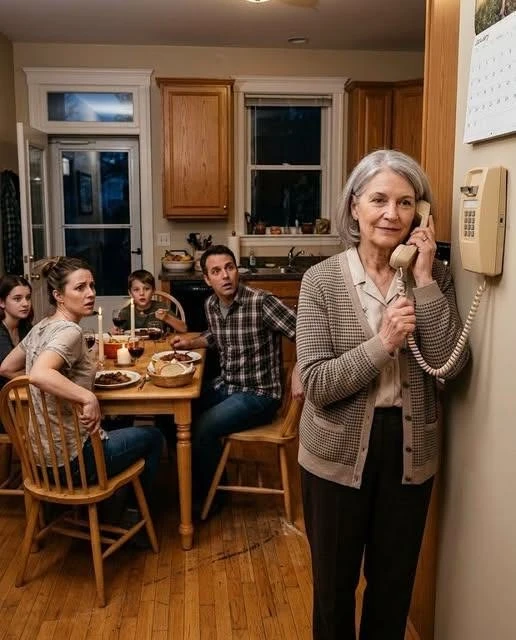
“Only to make a phone call.”
I walked into the kitchen.
The old cream-colored wall phone still hung beside the pantry. Anthony had refused to remove it even after we both bought cell phones.
“A house should always have one telephone that knows exactly where it belongs,” he used to say.
My hand did not tremble as I lifted the receiver.
Behind me, Linda leaned against Anthony’s chair with a satisfied expression.
She apparently believed I was calling Nora to ask whether I could finish my dinner next door.
Edward finally looked up.
“Mom,” he said. “Who are you calling?”
I dialed a number I had memorized years earlier.
Gabriella answered on the second ring.
“Margaret?”
Her voice was alert.
She had been expecting this call, although neither Edward nor Linda knew that.
“Gabriella,” I said quietly, keeping my eyes on Linda, “it’s time.”
Linda’s confident expression tightened.
There was a pause on the line.
Then Gabriella asked the question Anthony had instructed her to ask if this day ever came.
“Has Edward claimed authority over the house?”
I looked at my son.
He had gone pale.
“Yes.”
“Has anyone attempted to remove you from a room or restrict your access?”
“Yes.”
“Are Dylan and Sarah present?”
“Yes.”
Gabriella took a slow breath.
Her next words came clearly through the receiver.
“Then I am opening Anthony’s sealed file.”
Edward pushed away from the table so quickly that his chair scraped across the hardwood floor.
“No.”
The word burst from him.
Linda turned toward him.
“What’s wrong?”
Edward stared at the telephone as if it were a loaded weapon.
“Mom, hang up.”
Gabriella heard him.
“Margaret,” she said, “do not disconnect.”
Edward entered the kitchen.
I held the receiver tighter.
He tried to smile, but his face looked wrong. Too stiff. Too white.
“You’re overreacting,” he said. “Linda was frustrated. Everyone’s tired. We can talk about this.”
“Were you planning to talk before or after I ate outside?”
“Mom.”
“Why are you afraid of Gabriella?”
“I’m not.”
“You look afraid.”
Linda appeared behind him.
She crossed her arms.
“Who is Gabriella?”
Edward did not answer.
That was the first moment Linda realized she did not know everything her husband knew.
Gabriella spoke again.
“I will be there in twenty minutes. Do not sign anything. Do not surrender your keys. Do not leave the property.”
“What exactly is she bringing?” I asked.
“The revocation documents, the trust declaration, and the red envelope.”
Edward’s hand closed around the edge of the counter.
“Gabriella,” he said loudly, leaning toward the receiver, “you have no authority to open that envelope.”
“I have written authority from both of your parents.”
“My father is dead.”
“Yes,” Gabriella answered. “That is why his instructions matter.”
Edward reached for the phone.
I stepped back.
“Don’t touch me.”
He froze.
Those three words seemed to affect him more than a scream would have.
Dylan rose from the table.
“Dad?”
Edward turned.
My grandson looked sixteen and six years old at the same time. Tall enough to look his father in the eye, but frightened enough to grip the back of his chair with both hands.
“What’s in the envelope?” Dylan asked.
“Nothing,” Edward said too quickly.
Sarah stared at him.
“If it’s nothing, why are you scared?”
Edward’s eyes flicked toward her.
“I’m not scared.”
Linda let out an irritated breath.
“This is ridiculous. We moved in twelve hours ago, and she’s already calling lawyers because I told her we need boundaries.”
“You told her to leave her own dining room,” Dylan said.
Linda turned on him.
“Stay out of this.”
“No,” I said.
The room fell silent.
Linda looked at me.
I had spent years speaking softly around her. She had mistaken softness for weakness so often that she no longer recognized the difference.
“You do not silence my grandchildren in my home,” I said. “You do not take Anthony’s chair. You do not assign my bedroom to yourself. And you do not order me outside.”
Her lips parted.
I continued.
“You arrived this morning as guests. You will behave like guests until Gabriella arrives.”
Linda gave a short, disbelieving laugh.
“This is Edward’s family home.”
“No. It is my home.”
“You were going to leave it to him anyway.”
Edward closed his eyes.
Only for a second.
But I saw it.
I saw the anger he was trying to hide—not at Linda, but at the fact that she had said too much.
I turned toward him.
“What have you told her?”
“Mom, please.”
“What have you told your wife about my house?”
Linda looked between us.
“He told me Anthony wanted Edward to have it.”
A coldness spread through my chest.
“Anthony never said that.”
“Yes, he did.”
“Were you there?”
“No, but Edward—”
“Anthony never said that,” I repeated.
Edward’s face hardened.
“Dad always said the house would stay in the family.”
“It will.”
“Then what is the problem?”
“The problem is that I am still alive.”
No one spoke.
Outside, a train horn sounded somewhere beyond the neighborhood, low and distant.
The candles continued burning beside the untouched stew.
Then the doorbell rang.
Edward glanced at the kitchen clock.
Only twelve minutes had passed.
“That can’t be her,” he said.
But I already knew it was.
Gabriella had not been twenty minutes away.
She had been waiting three streets from my house.
Chapter Two
The Red Envelope
Gabriella Ruiz stood on my porch wearing a dark wool coat and holding a leather case against her side.
Two people waited behind her.
The first was a woman in a gray suit whom I recognized as Celeste Morgan, a private investigator and retired Chicago police detective.
The second was a uniformed security officer.
Linda stared at them.
“What is this?”
Gabriella stepped inside after I invited her.
She was fifty-one, with silver beginning to appear in her black hair and the composed expression of a woman who had spent most of her career refusing to be intimidated.
Anthony had first met her when she was fourteen.
She had been one of his students at Franklin High School, angry at the world, failing nearly every subject, and sleeping in her aunt’s laundry room after her mother was evicted.
Anthony tutored her for free.
Years later, Gabriella graduated from law school and returned to our kitchen with a bottle of wine and tears in her eyes.
“You were the first person who made me believe my future was real,” she had told him.
After that, she became our lawyer, our friend, and eventually the keeper of the secrets Anthony did not trust anyone else to hold.
Gabriella looked around the dining room.
Her gaze paused on Linda in Anthony’s chair.
“Mrs. Bell,” she said, “please stand.”
Linda blinked.
“Excuse me?”
“That chair belongs to Margaret.”
“You’re a lawyer, not a furniture inspector.”
“No,” Gabriella said. “I am the trustee of the Bell Residential Protection Trust.”
Edward’s jaw tightened.
Linda turned toward him.
“The what?”
Gabriella placed her leather case on the table.
“The legal entity that owns this property.”
Linda looked at me.
“You said the deed was in your name.”
“The recorded deed identifies me as the life beneficiary,” I said. “The trust holds the controlling interest.”
“That makes no sense.”
“It does when explained by someone who understands it.”
Linda stood reluctantly.
I returned to my chair.
Gabriella opened her case and removed several folders.
The last object she placed on the table was a thick red envelope sealed with dark wax.
Anthony’s initials had been pressed into the center.
A.B.
Edward stared at it.
The fear on his face was no longer subtle.
Gabriella handed him a document.
“This is formal notice that your family’s permission to occupy the property has been revoked.”
Linda snatched the pages from him.
“You can’t evict us after one day.”
“You have not established tenancy. You were invited as temporary guests under a written license Margaret executed this morning.”
“A written license?”
Gabriella looked at me.
I walked to the sideboard and opened the top drawer.
Inside lay the document Edward had signed shortly after arriving, when I told him it was required by my homeowner’s insurance.
He had barely read it.
Linda had not read it at all.
The agreement stated that their presence was temporary, created no ownership interest, and could be ended immediately if any occupant threatened, coerced, intimidated, or attempted to displace me.
Linda scanned the final paragraph.
Her face reddened.
“You tricked us.”
“No,” Gabriella said. “Margaret protected herself.”
Edward placed both palms on the table.
“We have nowhere to go tonight.”
Gabriella studied him.
“You told your mother you had been dismissed from your position and could not afford a hotel.”
“That’s true.”
“Is it?”
Edward did not answer.
Gabriella removed another sheet.
“This afternoon, your brokerage account transferred forty-two thousand dollars into a private checking account ending in 4419.”
Linda slowly turned toward him.
“You said those accounts were frozen.”
Edward glared at Gabriella.
“How did you get that?”
“I did not access your accounts. The information was included in a court filing made this morning by your former employer.”
“What court filing?” Linda demanded.
Edward ignored her.
Gabriella continued.
“You have access to money. You can obtain accommodations for your family.”
“Dad,” Dylan said, “you told us we had twelve dollars.”
Edward’s shoulders stiffened.
“That money is for legal fees.”
“What legal fees?” Sarah asked.
Again, he said nothing.
The house seemed to contract around us.
Linda’s anger shifted direction.
“Edward.”
He rubbed one hand across his mouth.
“I was going to explain.”
“You told me the company locked everything.”
“They did.”
“She just said you moved forty-two thousand dollars.”
“It’s complicated.”
Gabriella spoke gently to the children.
“Dylan, Sarah, you have done nothing wrong. None of this is your fault.”
Linda slapped the papers onto the table.
“We’re not going anywhere. Margaret invited us, and she is clearly confused. She signed something she didn’t understand.”
Gabriella’s expression changed.
Not much.
Only a slight narrowing of the eyes.
But Edward saw it.
“Linda,” he said sharply, “stop talking.”
She faced him.
“Why? That’s what you said.”
Silence crashed over the room.
I looked at Edward.
“What did you say?”
Linda’s breathing became uneven as she realized she had stepped into something larger than an argument over bedrooms.
“He said you’ve been forgetting things,” she replied. “That you’ve become emotional since Anthony died. That we might need to help with your finances.”
I felt the words like small blades slipping between my ribs.
Edward looked at me.
“Mom, I was worried.”
“You told her I was incompetent?”
“I did not use that word.”
“What word did you use?”
He glanced at the red envelope.
Gabriella answered for him.
“Declining.”
My son’s eyes flashed.
“You don’t know what I said.”
Gabriella opened a thin folder.
“On Wednesday, you contacted Dr. Samuel Prentice and requested an evaluation of your mother’s decision-making capacity.”
Linda stared at him.
“You told me the appointment was already arranged.”
“It was a precaution.”
“You contacted my doctor?” I asked.
Edward’s voice became softer.
That was always his most dangerous tone.
“Mom, after Dad died, you stopped going out. You forgot Sarah’s recital last spring. You left the oven on once.”
“My husband of forty-two years had died three months earlier.”
“You were struggling.”
“I was grieving.”
“You needed help.”
“I needed my son.”
His face twitched.
For one second, I saw shame.
Then it vanished beneath defensiveness.
“I am trying to protect you.”
Gabriella tapped the red envelope.
“Anthony believed you might say that.”
Edward’s head snapped toward her.
“What does that mean?”
“It means your father described the exact language you would use if you ever attempted to take control of Margaret’s property.”
“That’s impossible.”
“He knew you well.”
Edward looked at me.
“Mom, do not let her open that.”
The desperation in his voice frightened Sarah.
She stepped closer to Dylan.
I wanted to ask what Anthony had known.
I wanted to ask why he had hidden it from me.
But part of me already understood.
During the final year of his life, Anthony had become quiet whenever Edward discussed money. He had changed the password to our filing cabinet. He had made three unexplained trips downtown.
Once, I had found him sitting in the basement with a stack of papers spread around him.
When I asked what was wrong, he had smiled and said, “Just making sure you’ll always be safe.”
I had thought he was talking about insurance.
Now Gabriella placed one finger beneath the wax seal.
Edward moved toward her.
The security officer stepped between them.
“Do not,” the officer said.
Edward stopped.
Gabriella looked at me.
“Anthony instructed me to open this only if Edward attempted to establish control over your home, restrict your movement, question your capacity, or pressure you into signing financial documents.”
My heart began beating harder.
“Has that threshold been met?” she asked.
I looked at Edward.
My son.
The baby whose first cry had made Anthony laugh and sob at the same time.
The boy who used to crawl into our bed during thunderstorms.
The teenager who had once driven three hours home from college because I had pneumonia.
I searched his face for that boy.
All I found was a man terrified of an envelope.
“Yes,” I whispered.
Gabriella broke the seal.
Inside were four objects.
A flash drive.
A pharmacy receipt.
A folded copy of a property deed.
And a handwritten letter addressed to me.
Beneath my name, Anthony had written seven words.
Margaret, if this is open, Edward has begun.
Chapter Three
What My Husband Knew
My knees weakened.
Gabriella guided me into my chair.
For several seconds, I could not look away from Anthony’s handwriting.
The letters slanted slightly to the right. He had always pressed too hard with a pen, leaving indentations on the pages beneath whatever he wrote.
I touched the envelope.
“Did he write this before he died?”
“Eleven weeks before,” Gabriella said.
Edward began pacing.
“This is insane. Dad was sick. He was taking medications that affected his judgment.”
“You told me he was perfectly lucid,” Linda said.
“That was different.”
“How?”
“Linda, not now.”
“No. Right now. You moved us into this house. You told me your mother was going to sign it over. You told me Anthony had promised it to you.”
Edward looked at the children.
“We are not having this discussion in front of them.”
Dylan gave a bitter laugh.
“You lied to us about being broke.”
“I said not now.”
Gabriella removed the flash drive.
“Anthony recorded three video statements. He also preserved financial records and correspondence.”
“Correspondence with whom?” I asked.
“Edward.”
My son stopped pacing.
“I never wrote Dad anything.”
Gabriella met his eyes.
“Not under your own name.”
Linda’s expression changed.
Edward said nothing.
Gabriella unfolded the property deed.
“This is a copy of a quitclaim deed submitted to the Cook County recorder’s office approximately five months before Anthony died.”
My name and Anthony’s name appeared as grantors.
Edward’s name appeared as the recipient.
The signatures looked almost perfect.
Almost.
I recognized the curve of Anthony’s A, the short line he made across the B, and the way my own signature dropped at the end.
But I had never signed that paper.
“That’s forged,” I said.
Linda lowered herself slowly into a chair.
Edward shook his head.
“I’ve never seen that.”
“The filing was rejected because the notarization number belonged to a notary who had died two years earlier,” Gabriella said. “The return address was a private mailbox rented using a copy of your driver’s license.”
“Anyone could have used it.”
“Yes.”
“Then why are you looking at me?”
“Because the digital version was created on your office computer.”
Edward’s breathing changed.
He looked toward the front door.
Celeste noticed.
“You should stay,” she said.
“I’m getting some air.”
“The moment you leave, the documents will be delivered to the investigators handling your former employer’s fraud case.”
Edward froze.
“What fraud case?” I asked.
Gabriella’s gaze remained on him.
“Edward served as regional financial director for Oakhaven Senior Communities.”
“I know where he worked.”
“What he did there is why he told you he lost his job.”
Edward’s voice sharpened.
“I was laid off.”
“No,” Gabriella said. “You were dismissed after an internal audit discovered irregular property transfers involving elderly residents.”
Linda gripped the edge of the table.
“What property transfers?”
Gabriella opened another folder.
“Oakhaven offered financial-management services to residents who could no longer maintain their homes. In at least nine cases, properties were transferred into shell companies shortly before the owners died or were declared incompetent.”
I stared at Edward.
“That has nothing to do with me,” he said.
“One of the shell companies was registered to an address used by your consulting business.”
“That was an administrative error.”
“Nine administrative errors?”
“I had hundreds of clients.”
“You had access to their signatures, medical records, relatives’ contact information, and financial vulnerabilities.”
Edward looked at me.
“Mom, she is twisting an investigation that has not proven anything.”
Gabriella placed the pharmacy receipt on the table.
“This receipt is from the pharmacy Anthony used during the final year of his life.”
A line had been circled in red.
Medication collected by: Edward Bell.
I remembered that day.
Anthony had been tired. Edward had offered to collect his prescription after work.
“What does that prove?” Edward demanded. “I picked up medicine for my father.”
Gabriella’s voice remained controlled.
“The medication dispensed by the pharmacy was not the medication later found in Anthony’s bottle.”
The room tilted.
“What are you saying?” I asked.
Gabriella turned to me.
“We do not yet know exactly what happened. Anthony became suspicious after two episodes of dizziness and disorientation. He removed one tablet from the bottle, placed it in a sealed container, and gave it to me.”
“You had his medicine tested?”
“After he died.”
My mouth went dry.
“And?”
“The tablet did not match his prescription.”
Sarah made a small sound.
Linda looked horrified.
Edward slammed his hand onto the table.
“This is disgusting.”
No one moved.
“You’re accusing me of killing my father?”
“I have not accused you of anything,” Gabriella said. “I am telling Margaret what Anthony documented.”
“He died of heart failure.”
“His death was attributed to cardiac complications without a full toxicology examination.”
“He had a weak heart.”
“Yes.”
“You’re trying to turn a sick man’s paranoia into murder.”
I looked at Edward.
“Did Anthony ever accuse you?”
“No.”
“Did he ask you about the medicine?”
“No.”
“Did he know about the forged deed?”
“I don’t know.”
“Did you create it?”
“No.”
His answers came quickly.
Too quickly.
Anthony used to tell his students that liars often feared silence more than truth.
A truthful person considered a question.
A liar rushed to bury it.
I unfolded the handwritten letter.
Gabriella touched my wrist.
“You do not have to read it tonight.”
“Yes,” I said. “I do.”
The paper shook in my hands.
My dearest Margaret,
If you are reading this, then I was right about something I desperately wanted to be wrong about.
I have discovered evidence that Edward has been attempting to obtain control of our home and possibly other properties belonging to people under his professional care. I confronted him indirectly, hoping he would stop. Instead, he became more careful.
I did not tell you because I knew you would defend him before you protected yourself. That is not weakness. It is the danger of being a good mother to a son who has learned to use your love as a hiding place.
I pressed my fingers against my mouth.
Edward turned away.
The letter continued.
I do not know whether Edward altered my medication. I only know that the pills changed after he collected them and that he became unusually interested in my will, our insurance, and your medical history.
I have asked Gabriella to preserve everything.
If Edward never acts against you, this envelope will remain sealed, and I will be grateful that my suspicion died with me.
But if he questions your mind, pressures you to sign documents, or tries to remove you from the house, believe the evidence before you believe his explanations.
My vision blurred.
The final paragraph was shorter.
You spent your life teaching our son that home was the place where he would always be loved. I am afraid he may have mistaken that promise for ownership.
Do not surrender because you are afraid of being alone.
You are stronger than you know, and you will not be alone.
Always yours,
Anthony
I lowered the letter.
No one spoke.
Edward stood by the window, his back to me.
I wanted him to turn around.
I wanted to see tears.
I wanted him to call the entire thing a terrible misunderstanding and explain it in a way that made sense.
He did turn.
But there were no tears in his eyes.
Only anger.
“You trusted a dead man’s suspicions more than your living son.”
The cruelty of that sentence cut through my grief.
“Your father trusted evidence,” I said.
“And what evidence is there? A rejected deed anyone could have created? A pill that could have been switched by anyone? Some investigation at work?”
Gabriella placed the flash drive beside the letter.
“There is more.”
Edward looked at the drive.
His expression betrayed him.
Dylan noticed.
“What’s on it, Dad?”
“I don’t know.”
“But you recognize it.”
“No.”
“You do.”
Edward stepped toward him.
“Enough.”
Dylan did not move.
My grandson was trembling, but his voice remained steady.
“I saw one like that in your desk.”
Edward’s face emptied.
“When?” Linda asked.
Dylan swallowed.
“The night Dad said we had to leave our apartment.”
Edward stared at him.
“You went through my desk?”
“I was looking for the charger you took.”
“What did you see?”
“A red flash drive. And a folder with Grandma’s name on it.”
Edward’s anger sharpened into something frightening.
“What else did you take?”
Dylan’s face changed.
That was when I understood.
He had taken something.
Edward understood too.
He crossed the room.
Dylan backed away.
Celeste stepped between them.
“Do not approach the boy.”
“He stole private property.”
“He is your son.”
“That does not give him the right—”
“Edward,” I said.
He turned toward me.
“Leave my house.”
“Mom—”
“Take whatever you brought this morning and leave.”
Linda looked at the children.
“We can’t drag them to a hotel in the middle of the night.”
“You have forty-two thousand dollars.”
“That’s his money. I don’t have access to it.”
Edward glared at her.
Gabriella spoke.
“A hotel has been reserved for Linda, Dylan, and Sarah for seven nights. The room is paid through a family-protection account Anthony created.”
Edward laughed without humor.
“Of course he did.”
“The reservation does not include you.”
Linda stared at Gabriella.
“Why not?”
“Because Anthony’s instructions identify Edward as the potential threat.”
Edward grabbed his coat.
“You’re all insane.”
He headed toward the hallway.
Linda called after him.
“Where are you going?”
He kept walking.
“Edward!”
The front door slammed.
A moment later, his car engine started.
Linda stood in the center of my dining room, suddenly looking much smaller than she had while sitting in Anthony’s chair.
Dylan reached into his sweatshirt pocket.
He pulled out a tiny black memory card.
“Is this what Dad is scared of?”
Chapter Four
The Files Dylan Stole
Edward had told everyone that Dylan was careless.
He forgot homework. He misplaced his keys. He left wet towels on the bathroom floor and empty glasses beside his bed.
What Edward never understood was that his son noticed everything.
Dylan placed the memory card on the table.
“I copied Dad’s computer three weeks ago.”
Linda looked at him as though he had confessed to a crime.
“Why?”
“Because he kept lying.”
“What lies?”
“He said we were moving because the building was being renovated. Then I heard him tell someone on the phone that the landlord was changing the locks.”
Linda sat down.
“He told me the landlord agreed to wait.”
“He didn’t.”
“How do you know?”
“I checked the email on Dad’s laptop.”
Edward had stopped paying rent four months earlier.
The family had not been evicted because he lost his job. He had stopped paying while he was still receiving his full salary.
There were notices from creditors, messages from attorneys, and repeated demands from Oakhaven’s investigators.
Dylan had copied everything he could find.
“Dad caught me in his office once,” he said. “He asked why I was near his computer. He looked… different.”
“How?” I asked.
“Like he hated me.”
Linda closed her eyes.
“He doesn’t hate you.”
“You didn’t see him.”
Sarah sat beside her brother.
Dylan continued.
“After that, I started checking because I thought maybe Dad was in trouble. Then I found documents with Grandma’s name.”
“What kind of documents?” Gabriella asked.
“Medical forms. Bank statements. A paper that said she shouldn’t make decisions by herself.”
My stomach tightened.
“Did it have a doctor’s signature?”
“Yes.”
Gabriella looked at Celeste.
“Dr. Prentice?”
Dylan nodded.
Gabriella’s lips pressed together.
The doctor had not yet evaluated me.
Any signed opinion about my competence would either be blank, falsified, or prepared in advance.
Linda rubbed her forehead.
“He told me the doctor had already seen Margaret.”
“When?” I asked.
“He said you had an appointment after you fell in the kitchen.”
“I slipped on water.”
“He said you couldn’t remember why you were on the floor.”
“I remembered perfectly.”
“He said—”
“Linda,” I interrupted, “did you ever ask me?”
She looked at me.
“No.”
“Why?”
Her eyes dropped.
“Because it was easier to believe him.”
That answer contained more honesty than I expected.
Gabriella inserted Dylan’s memory card into her secured laptop.
Dozens of folders appeared.
Some were labeled with initials.
Others had street addresses.
One folder carried my full name.
MARGARET ELAINE BELL.
Inside were scans of my driver’s license, pension statements, property-tax records, insurance information, and medical correspondence.
There was also a draft petition seeking emergency guardianship over me.
The petitioner’s name was Edward Bell.
The proposed financial guardian was Linda.
She stared at the screen.
“I have never seen that.”
Gabriella opened the creation history.
The document had been prepared eight days earlier.
Linda’s electronic signature appeared at the bottom.
“That’s not my signature.”
“It resembles the one on your tax returns,” Gabriella said.
“Edward files our taxes.”
Dylan gave a hollow laugh.
“He files everything.”
Another document was titled FAMILY HOUSING STABILIZATION AGREEMENT.
The language appeared harmless at first. It described shared expenses, home repairs, family support, and the preservation of multigenerational property.
Buried on page fourteen was a clause transferring controlling authority over the Bell Residential Protection Trust to Edward upon any finding of diminished capacity.
Page sixteen granted Linda the right to remain in the house permanently.
Page eighteen authorized the sale or refinancing of the property.
At the bottom was a space for my signature.
Linda covered her mouth.
“He told me it was a family budget.”
“Did you sign it?” Gabriella asked.
“He gave me one page.”
“The signature page?”
“Yes.”
“Then he attached it to this document.”
Linda looked physically ill.
I felt no satisfaction.
She had been cruel to me. Entitled. Arrogant.
But I knew what it was like to discover that a marriage had contained rooms you had never been allowed to enter.
Anthony and I had argued. We had disappointed each other. We had carried private fears.
But we had never used love as camouflage.
Dylan pointed at another folder.
“That one.”
It was labeled A.B. LEGACY.
The folder contained scanned copies of Anthony’s medical records, his will, his insurance policy, and the rejected deed.
There were also audio recordings.
Gabriella selected the earliest file.
Edward’s voice filled the dining room.
“Dad, you and Mom need to simplify things.”
Anthony answered, sounding tired.
“We already have.”
“You have too many protections. The trust makes everything difficult.”
“It makes theft difficult.”
A pause followed.
Edward’s recorded voice became colder.
“You think I would steal from you?”
“I think you have started believing that anything I own should already belong to you.”
“That’s not fair.”
“Then stop asking me to sign it over.”
The recording ended.
Linda stared at the laptop.
Gabriella played a second file.
Edward was speaking again.
“You don’t understand how much pressure I’m under.”
“Then tell me.”
“I need temporary access to the property.”
“No.”
“You haven’t even heard the amount.”
“No amount changes my answer.”
“I’m your son.”
“That is why I am saying no instead of calling the police.”
The recording clicked off.
Dylan whispered, “Grandpa knew.”
“Yes,” I said.
Anthony had known.
And I had slept beside him every night without understanding the fear he carried.
A third audio file was dated six days before Anthony’s death.
His voice sounded weaker.
“Why did you pick up my prescription?”
“You asked me to.”
“I asked Margaret.”
“She was tired.”
“The pills are different.”
“Different pharmacy supplier.”
“I called them.”
Silence.
Then Edward said, “You should stop worrying Mom with this.”
“Do not use her to threaten me.”
“I’m trying to protect both of you.”
“You keep using that word when you mean control.”
The recording ended abruptly.
Sarah began crying.
Linda pulled her close.
I rose from the table and walked into the kitchen because I could not let the children watch me fall apart.
My hands gripped the sink.
Anthony had been afraid.
He had tried to protect me even while questioning whether his own son might be hurting him.
I remembered the week before he died.
He had dropped a coffee cup because his fingers went numb. He had become dizzy climbing the stairs. One afternoon, he had looked at me across the bedroom and asked whether Edward had visited.
I told him no.
Anthony had whispered, “Good.”
I had assumed he was tired.
How much had I refused to see because the truth would have been unbearable?
Gabriella joined me.
“You are not responsible,” she said.
“I was his wife.”
“You trusted your son.”
“I should have noticed.”
“Anthony intentionally hid this from you.”
“Why?”
“Because he knew you would confront Edward.”
“He was right.”
“And Edward would have destroyed the evidence or changed his methods.”
I stared through the kitchen window.
Nora’s porch light was still on.
“What happens now?”
“Celeste will deliver copies of the files to the appropriate investigators.”
“And Anthony?”
“We request a review of his death.”
The words made the room colder.
“An exhumation?”
“Possibly.”
I closed my eyes.
Anthony had hated hospitals, needles, and funeral homes. He had asked for a simple burial beneath the maple trees at Saint Matthew’s Cemetery.
The thought of disturbing him felt like another betrayal.
But so did leaving the truth buried.
“Do it,” I said.
Gabriella studied my face.
“Are you certain?”
“No.”
That was the truth.
“But do it anyway.”
From the dining room came Linda’s voice.
“Gabriella, there’s another folder.”
We returned.
The file she had opened was labeled EXIT PLAN.
Inside were airline itineraries, passport scans, and wire instructions.
Only one airline ticket had been purchased.
It was in Edward’s name.
The destination was Lisbon.
The departure date was five days away.
Linda looked at the screen.
Her face became completely still.
“He told me we were all going to Milwaukee.”
Dylan stared at his father’s one-way ticket.
“He was leaving us.”
Gabriella opened the wire instructions.
The recipient account belonged to a company in Portugal.
The scheduled amount was 3.8 million dollars.
At the bottom of the page was a handwritten note.
TRANSFER AFTER M.B. DECLARED.
M.B.
Margaret Bell.
Declared incompetent.
Linda looked at me.
For the first time since entering my house, she did not look superior.
She looked terrified.
“He wasn’t moving us in here because we had nowhere else to go,” she whispered.
“No,” Gabriella said.
“He was moving us in because he needed access to Margaret.”
Dylan shook his head.
“No.”
Linda held Sarah tighter.
Gabriella scrolled further.
A final document appeared.
It was a letter addressed to investigators.
Edward had written that Linda had developed an unhealthy obsession with my house, manipulated my medical records, pressured him to obtain guardianship, and independently created the forged documents.
Linda read the first page.
Then the second.
When she reached the end, she made a sound I will never forget.
Not a sob.
Not a scream.
It was the sound of a human being realizing that the person sleeping beside her had built an escape route out of her body.
“He was going to blame me,” she whispered.
No one answered.
Because there was nothing to say.
Edward had not simply planned to leave his wife.
He had planned to bury her beneath his crimes.
Chapter Five
The Woman in My Husband’s Chair
Linda did not apologize that night.
Not immediately.
She sat at my table with both hands wrapped around a cold cup of coffee while Gabriella and Celeste copied the files.
Dylan and Sarah packed overnight bags.
The security officer checked every window and changed the entry code Edward had used that morning.
At 9:17 p.m., Edward called Linda.
Her phone rang on the table.
No one moved.
It stopped.
Thirty seconds later, it rang again.
Then again.
On the fourth call, Linda answered and put the phone on speaker.
“Where are you?” she asked.
“At a hotel.”
“Which hotel?”
“Why?”
“So I know where my husband is.”
Edward exhaled.
“Linda, I need you to take the children and leave my mother’s house.”
“That was already the plan.”
“Do not go with Gabriella.”
“Why?”
“She is manipulating Mom.”
“Did you buy a ticket to Lisbon?”
Silence.
“Where did you get that?”
“Did you buy it?”
“That trip was for work.”
“You don’t have a job.”
“It was a consulting opportunity.”
“One-way?”
“I planned to book the return later.”
“Were you going to take us?”
“Of course.”
“There is only one ticket.”
“Linda, listen to me. The files on that computer were drafts. They don’t mean anything.”
“You wrote a letter blaming me.”
Another silence.
Then Edward’s tone changed.
Softer.
More intimate.
The voice he used when he wanted Linda to remember the man she had married instead of the man in front of her.
“Baby, you’re upset.”
Linda’s jaw tightened.
“Don’t call me that.”
“You don’t understand what Gabriella is doing. My father hated me. He poisoned Mom against me before he died.”
“Your father recorded you asking for the house.”
“I was trying to help.”
“He recorded you talking about his medication.”
“He was confused.”
“You said he was lucid when he promised you the property.”
Edward said nothing.
Linda looked at me.
Shame moved across her face.
“I told Margaret to eat outside,” she said.
“What?”
“I told her this was my house and ordered her outside.”
“Why would you say that?”
She closed her eyes.
I could almost see the pieces fitting together.
“Because you told me she needed to understand that things had changed.”
“I never told you to humiliate her.”
“You said if I didn’t establish authority immediately, she would manipulate the children against us.”
“That is not what I meant.”
“You told me to sit in Anthony’s chair.”
Edward’s breathing became audible.
“You chose that.”
“No. You told me it would make a statement.”
Dylan looked away.
Sarah began crying again.
Linda continued, her voice breaking.
“You told me to demand the bedroom. You told me to criticize the house. You told me Margaret had been controlling you your entire life and that she would only respect strength.”
“Linda, stop.”
“You wanted her angry.”
“I wanted boundaries.”
“You wanted her to react so you could tell a judge she was unstable.”
The silence that followed was his answer.
Linda pressed her fist against her mouth.
“You used me.”
Edward’s voice became flat.
“You were happy to do it.”
The cruelty landed exactly where he intended.
Linda flinched.
I saw guilt in her face because part of what he said was true.
She had enjoyed the authority.
She had walked through my house imagining renovations. She had claimed Anthony’s chair. She had pointed toward the door.
Edward had manipulated her.
But he had not invented her contempt.
Linda straightened.
“Yes,” she said. “I was happy to do it.”
Dylan looked at her.
She kept her eyes on the phone.
“I wanted the house. I believed we deserved it. I was angry that Margaret had security while we were losing everything. I was cruel because being cruel made me feel less afraid.”
Her voice shook.
“But I did not forge her signature. I did not alter anyone’s medicine. And I did not create a plan to abandon my children.”
Edward’s mask slipped.
“You ungrateful—”
Linda disconnected the call.
The room remained silent.
She placed the phone on the table.
Then she stood and faced me.
“I’m sorry.”
I waited.
She seemed to expect me to rescue her from the discomfort.
I did not.
“I’m sorry for what I said tonight,” she continued. “And for what I’ve said before.”
“What exactly are you sorry for?”
Her cheeks flushed.
Gabriella watched quietly.
Linda looked toward Anthony’s empty chair.
“I’m sorry I sat there.”
“That is furniture.”
“It wasn’t to you.”
“No.”
“I knew that.”
That admission mattered.
She took a breath.
“I’m sorry I treated your grief like weakness. I’m sorry I believed Edward when he said you were confused without ever asking you. I’m sorry I looked at everything you built and thought your age made it available.”
Her eyes filled with tears.
“And I am sorry I told you to eat outside.”
I looked at her for a long time.
Forgiveness is often described as a door.
That night, mine remained closed.
But I did not lock it forever.
“I believe you are sorry,” I said. “That is not the same as saying everything is repaired.”
“I know.”
“You and the children may stay tonight because it is late. Tomorrow, Gabriella will take you to the hotel.”
Linda nodded.
“Thank you.”
“Do not thank me yet.”
She looked confused.
“You are going to tell investigators everything you know,” I said. “Not only what makes you look innocent.”
Fear passed through her face.
“I don’t know much.”
“You knew enough to help Edward pressure me.”
“I didn’t know he was committing crimes.”
“You signed documents without reading them. You repeated lies about my health. You participated in a plan to establish control over this house.”
Her chin trembled.
“Yes.”
“If you want my help protecting Dylan and Sarah, you will tell the whole truth.”
“I will.”
“Even if the truth costs you.”
She lowered her eyes.
“Yes.”
I glanced at the cold stew.
Dinner had begun less than three hours earlier.
In that time, my daughter-in-law had ordered me outside, my son had been exposed as a suspected fraud, and my dead husband had reached across four years to warn me.
The candles had nearly burned down.
I extinguished them one by one.
“Everyone needs sleep,” I said.
Gabriella touched the red envelope.
“There is one video statement we have not watched.”
Edward’s fear of the flash drive returned to me.
“What is it?”
“Anthony labeled it Final Contingency.”
“Why didn’t you play it?”
“Because he instructed me to wait until Margaret was alone.”
Linda looked at me.
“I’ll take the children upstairs.”
“No,” Gabriella said. “Not yet.”
She turned the laptop around.
A small file sat at the bottom of the folder.
It was not a video.
It was a photograph.
The image showed Edward standing outside the pharmacy where Anthony’s prescription had been collected.
Beside him stood Dr. Samuel Prentice.
My doctor.
The man Edward had contacted to declare me incompetent.
According to the timestamp, the photograph had been taken three days before Anthony’s death.
Linda stared at the screen.
“Edward said he didn’t know Dr. Prentice until this year.”
Gabriella looked at me.
“How long has Prentice been your physician?”
“Four years.”
“Who recommended him?”
I already knew the answer.
Edward.
Chapter Six
The Doctor Who Asked the Wrong Questions
I had first visited Dr. Samuel Prentice six months after Anthony died.
Edward arranged the appointment.
“You need someone closer to home,” he had told me. “Someone who understands older patients.”
At the time, I was sleeping badly, forgetting meals, and crying without warning. The doctor’s office had soft lighting, expensive chairs, and classical music playing in the waiting room.
Dr. Prentice was patient.
He asked about my grief, my blood pressure, my sleep, and my memory.
During later appointments, however, the questions changed.
Did I ever become confused about dates?
Had I misplaced important documents?
Did I trust my family to make financial decisions?
Had I considered giving Edward power of attorney?
I assumed these were ordinary questions for a widow approaching seventy.
Now I remembered something else.
Dr. Prentice had rarely looked at me while I answered.
He had looked at Edward.
Even when my son was not in the room, the doctor seemed to know details I had never shared.
The oven incident.
The forgotten recital.
A check I wrote twice.
Small mistakes transformed into a pattern.
The next morning, Gabriella arranged for me to be examined by an independent geriatric specialist.
I completed memory tests, reasoning exercises, financial questions, and a full physical examination.
The specialist smiled when we finished.
“Mrs. Bell, your cognitive performance is above average for your age.”
“Am I declining?”
“We are all aging. That is not the same as incapacity.”
He documented that I understood my finances, property, medical choices, and legal rights.
The report would become important later.
At noon, Celeste called.
Dr. Prentice’s office had closed unexpectedly.
His receptionist claimed he had left for a family emergency.
His car was gone.
So was his passport.
Gabriella requested that law enforcement flag his travel documents.
By two o’clock, Edward’s photograph had been distributed to investigators working on the Oakhaven case.
At three, Linda gave her first formal statement.
I did not attend.
Instead, I returned home with Dylan and Sarah.
The hotel had been arranged, but neither child wanted to go immediately.
“Can we stay until Mom finishes?” Sarah asked.
I said yes.
We entered through the kitchen.
The dining room had been cleaned, but I could still see the previous evening in every object.
Linda’s hands on the table.
Edward’s pale face.
Anthony’s red envelope.
Dylan helped me carry groceries inside.
“You didn’t have to come,” I said.
“I wanted to.”
He placed a carton of milk in the refrigerator.
“Grandma?”
“Yes?”
“Did Grandpa hate Dad?”
The question hurt.
“No.”
“He made a file about him.”
“Because he was afraid.”
“Can you be afraid of someone and still love them?”
“Yes.”
Dylan nodded slowly.
“I think I understand.”
He sat at the kitchen table.
“Dad used to be different.”
“I know.”
“When?”
I poured two glasses of water.
“Your father was a gentle boy.”
Dylan gave me a skeptical look.
“He cried when a bird flew into our window. He once spent an entire afternoon building a shelter for a stray cat. When he was twelve, he returned a wallet containing three hundred dollars.”
“What happened?”
I had asked myself that question thousands of times.
“People rarely become someone else all at once,” I said. “They make small choices. Then they defend those choices. Then they make larger ones to protect the smaller ones.”
“Grandpa said Dad learned to use your love as a hiding place.”
“Yes.”
“Did you let him?”
The honesty of the question startled me.
“I think I did.”
“Why?”
“Because admitting someone you love is hurting others can feel like admitting your love failed.”
“Did it?”
“No.”
I sat across from him.
“My love did not make your father dishonest. But my refusal to confront him may have made dishonesty easier.”
Dylan looked down at his hands.
“I stole the files.”
“You copied evidence.”
“I also took cash.”
I remained silent.
“Two hundred dollars,” he said. “From Dad’s desk.”
“Why?”
“I thought Mom might need it.”
“Does she know?”
“No.”
“Then you will tell her.”
He nodded.
“And you will return it to investigators.”
“What if Dad gets mad?”
“Your father is already angry.”
“He’ll say I betrayed him.”
I reached across the table.
“Protecting the truth is not betrayal.”
His eyes filled.
“I don’t want him to go to prison.”
“I know.”
“But I don’t want him to hurt anyone else.”
“I know that too.”
The front door opened.
Sarah ran into the kitchen.
She had been upstairs collecting a stuffed rabbit she had left in the guest room.
“Grandma, someone moved the box.”
“What box?”
“The wooden one from Grandpa’s closet.”
I stood.
Anthony had kept an old cedar document box on the top shelf of our bedroom closet.
After his death, I had placed his watches, cuff links, military photographs, and wedding ring inside.
“Where is it?”
“In Mom and Dad’s suitcase.”
We went upstairs.
One suitcase remained beneath the guest-room bed.
Inside were Linda’s clothes, two unopened bottles of wine, and Anthony’s cedar box.
The lock had been broken.
His watches were still there.
So were his cuff links.
His wedding ring was gone.
Beneath the velvet tray, a rectangular space had been cut into the wood.
Something had once been hidden there.
Now it was empty.
Dylan stared at it.
“Did you know that compartment was there?”
“No.”
I called Gabriella.
She arrived with Celeste twenty minutes later.
Celeste examined the broken lock.
“The damage is fresh.”
“Edward took it?” Sarah asked.
“Possibly,” Gabriella said.
“What was inside?” I asked.
Gabriella looked at the hidden compartment.
“I don’t know.”
“Anthony never told you?”
“No.”
Celeste photographed the box.
Dylan crouched beside the suitcase.
“Dad packed this one.”
“How do you know?” Linda asked from the doorway.
She had returned without us hearing.
“Because he told me not to touch it.”
Linda stepped into the room.
Her face looked exhausted.
“I finished my statement.”
“What did you tell them?” Dylan asked.
“Everything I could remember.”
“Even the bad stuff?”
“Especially the bad stuff.”
She noticed the box.
“What happened?”
“Edward took something from Anthony’s belongings,” I said.
Linda stared at the empty compartment.
Then her expression changed.
“I think I know what it was.”
We all looked at her.
“Three nights ago, Edward was holding a small black notebook. When I entered the room, he shoved it into his coat.”
“A notebook?” Gabriella asked.
“He said it was a list of old family phone numbers.”
“What did it look like?”
“Leather. Worn edges. There was a gold line around the cover.”
I knew that notebook.
Anthony had carried it during the final year of his life.
He called it his retirement journal.
I had never read it.
Not because he forbade me, but because married people sometimes preserve small islands of privacy.
“What was written inside?” I asked.
“I only saw one page,” Linda said.
“What did it say?”
Her eyes shifted toward me.
“A list of names and property addresses.”
Gabriella became very still.
“Were any amounts written beside them?”
“Yes.”
“How many names?”
“I don’t know. At least twenty.”
Celeste closed the suitcase.
“Edward did not come here only for Margaret’s signature.”
Gabriella nodded.
“He came for Anthony’s ledger.”
“Why?”
“Because Anthony may have identified every property connected to the Oakhaven fraud.”
My husband had not merely suspected Edward.
He had investigated him.
Chapter Seven
Anthony’s Last Investigation
Anthony had always loved lists.
Grocery lists. Reading lists. Chore lists. Lists of household repairs organized by urgency and cost.
During his years as a history teacher, he kept small notebooks filled with quotations, dates, and observations about his students.
When he retired, the notebooks changed.
He began writing down neighborhood property sales and newspaper articles about nursing homes.
I had teased him.
“You need a hobby that doesn’t involve municipal records.”
He smiled.
“This is a hobby.”
It had not been.
Gabriella searched Anthony’s old email account and found messages sent to former Oakhaven residents and their families.
He had contacted them discreetly.
One woman, Evelyn Porter, had transferred her bungalow to a property company after being told the company would pay her medical debts.
The company sold the house six weeks later for four times the amount she received.
Another resident, Harold Dunn, supposedly signed his home away two days after suffering a stroke that left him unable to hold a pen.
A third, Marjorie Estes, died believing her house would pass to her niece. The property had already been transferred through a document bearing a witness signature from an Oakhaven employee.
Anthony noticed that the same collection of shell companies appeared repeatedly.
He also noticed that Edward had approved payments to outside consultants connected to those companies.
My husband had been following the money.
“He should have told me,” I said.
Gabriella and I sat in my living room while snow began tapping softly against the windows.
“He was trying to protect you.”
“That excuse sounds different when Anthony uses it.”
“Because Anthony protected your choices. Edward tried to replace them.”
I looked at my husband’s empty chair beside the fireplace.
“Did Anthony believe Edward killed those people?”
“No. The scheme appears to have targeted residents already near death or incapable of defending themselves.”
“Easy victims.”
“Yes.”
“And then he chose me.”
Gabriella hesitated.
“Your house may have been more than another property.”
“What do you mean?”
She opened a map.
Our house stood on a quiet block of brick homes, old trees, narrow alleys, and small gardens.
Several nearby parcels were highlighted.
Anthony and I had purchased our house for ninety-eight thousand dollars when Edward was two.
It was worth considerably more now, but not enough to explain a multimillion-dollar escape plan.
Gabriella pointed to the highlighted blocks.
“The city approved preliminary plans for a transit redevelopment corridor last year. A private consortium has been acquiring property through intermediaries.”
“I received letters offering to buy.”
“So did many neighbors.”
“I threw them away.”
“Edward’s former company owns options on several parcels.”
My skin prickled.
“What does that mean?”
“If the redevelopment proceeds, your lot becomes essential to combining the eastern section.”
“How essential?”
“Without access through your property and Nora’s, the developers cannot create the required service road.”
I looked through the window toward Nora’s blue house.
“How much is the land worth?”
“Today? Perhaps nine hundred thousand dollars.”
“And if the project is approved?”
“Potentially eight to twelve million.”
I sat back.
Linda had not been measuring bedrooms because she wanted a larger closet.
Edward had not been desperate merely for a place to sleep.
They believed my house was the final piece of a much larger transaction.
“Did Anthony know?”
“Yes.”
“How?”
“He discovered the project while investigating the shell companies.”
“Was Edward involved in the development?”
“His name does not appear publicly. But one of the companies in Dylan’s files controls three nearby options.”
I thought of the Lisbon transfer.
Three-point-eight million dollars.
“He planned to sell my house.”
“Or use it to complete the land assembly.”
“And declare me incompetent first.”
“Yes.”
The scale of it felt unreal.
I had considered my home valuable because Anthony’s laughter remained in the walls.
Edward valued it because a road could be built through my kitchen.
Nora arrived carrying a pot of soup.
She took one look at my face and placed the pot down.
“What happened?”
I told her everything.
Nora listened without interrupting.
She was seventy-two, a retired accountant with blunt gray hair and the patience of someone who had spent four decades correcting other people’s arithmetic.
When I finished, she looked toward her own house.
“I received an offer yesterday.”
Gabriella leaned forward.
“From whom?”
“A company called Lake Meridian Holdings.”
Gabriella and Celeste exchanged a glance.
That name appeared in Dylan’s copied files.
“What did they offer?” I asked.
“Two million.”
“For your house?”
“Yes.”
“Why didn’t you tell me?”
“I thought it was a scam.”
“Did you accept?”
Nora looked offended.
“Of course not. I’ve just finished replacing the roof.”
Despite everything, I laughed.
The sound startled me.
It was the first time I had laughed since Linda pointed toward the back door.
Nora squeezed my hand.
Then her expression became serious.
“The representative knew things about you.”
“What things?”
“He said you would probably sell soon because your family circumstances were changing.”
Gabriella asked, “When was this?”
“Yesterday morning.”
Before Edward moved in.
The scheme was already in motion.
“What else did he say?” I asked.
“He said your son would help you make the right decision.”
Cold settled in my stomach.
Nora reached into her purse and removed a business card.
The representative’s name was Marcus Dane.
Celeste photographed it.
“I know that name,” Linda said from the hallway.
She had entered quietly.
“Who is he?” Gabriella asked.
“Edward’s friend.”
“How close?”
“They played golf together. Edward said Marcus worked in commercial real estate.”
“Did they discuss Margaret’s house?”
“Not in front of me.”
“Did Marcus ever visit your apartment?”
“Yes.”
“When?”
Linda thought.
“About four months ago. Edward told me to take the children to dinner.”
“Did you?”
“Yes.”
“What happened afterward?”
“Edward was excited. He opened champagne.”
“Did he tell you why?”
“He said our problems were almost over.”
Linda sat across from me.
“I thought he had found an investor.”
“For what?” I asked.
“A senior-living consulting company.”
The room went silent.
“What was the company called?” Gabriella asked.
Linda hesitated.
“Homeward Solutions.”
Gabriella’s face changed.
One of the shell companies that had taken Oakhaven residents’ homes was Homeward Asset Solutions.
“Did you sign incorporation documents?” Gabriella asked.
Linda’s eyes widened.
“Edward asked me to sign forms for tax purposes.”
“When?”
“Six months ago.”
“Did you read them?”
“No.”
Nora muttered something under her breath.
Linda flinched.
“I know.”
“Do you?” Nora asked. “Because yesterday you ordered Margaret to eat outside while you sat in her husband’s chair.”
Linda’s face turned red.
“I apologized.”
“An apology doesn’t erase appetite.”
“Nora,” I said.
She looked at me.
“Let her speak.”
Linda took a breath.
“Edward handled our finances from the beginning. He said I was terrible with money.”
“Were you?” Gabriella asked.
“I spent too much. But he encouraged it. Cars, vacations, private school, clothes. Whenever I worried, he said his bonuses covered everything.”
“Why?”
“I don’t know.”
I did.
Debt created dependence.
Luxury could be another kind of cage.
Edward gave Linda everything she wanted until she stopped asking where it came from.
Then, when the money disappeared, he gave her someone to blame.
Me.
“The old woman sitting on a paid-off house while her grandchildren suffered,” I said.
Linda looked at me.
“That’s what he said.”
“Did you believe him?”
“Yes.”
“Why?”
“Because I wanted to.”
Her honesty was brutal.
And useful.
Gabriella’s phone rang.
She listened for less than a minute.
When she disconnected, her face had gone pale.
“What is it?” I asked.
“Investigators located Dr. Prentice.”
“Where?”
“At O’Hare Airport.”
“Was he leaving?”
“He was attempting to board a flight to Montreal.”
“Did they stop him?”
“Yes.”
“And Edward?”
“His car was found in the long-term parking garage.”
Linda stood.
“Is he at the airport?”
“No.”
“Then where is he?”
Gabriella looked toward the stairs.
“According to parking records, Edward left the airport in another vehicle shortly after midnight.”
Nora glanced toward the ceiling.
“You changed the locks?”
“Yes.”
“The windows?”
“Secured.”
“The basement entrance?”
My breath stopped.
The basement had an exterior coal door beneath the back porch.
Anthony had sealed it years earlier.
Or I thought he had.
We rushed into the kitchen.
The basement door stood open.
A trail of melted snow marked the steps.
Someone had entered my house.
From below came the sound of wood breaking.
Edward had come back for the ledger.
Chapter Eight
Beneath the House
Celeste ordered everyone away from the basement door.
She drew a compact firearm from beneath her coat and called the police.
The security officer moved toward the back porch.
Dylan pulled Sarah behind him.
Linda whispered, “Edward?”
A heavy crash sounded below.
Then silence.
Celeste called down.
“Edward Bell, the police are on the way. Come upstairs with your hands visible.”
No answer.
The basement held Anthony’s workbench, holiday decorations, old schoolbooks, paint cans, and decades of objects we had never been able to throw away.
It also held a second staircase leading to the rear storage room.
Edward knew every corner.
“He could get out through the coal door,” I said.
“The security officer is covering it,” Celeste replied.
Another sound came from below.
A drawer opening.
Then Edward spoke.
“Mom.”
His voice rose through the darkness.
“I need to talk to you alone.”
Linda stepped toward the doorway.
Celeste blocked her.
“Stay back.”
“Edward,” I called, “come upstairs.”
“Send Gabriella away.”
“No.”
“She’s lying to you.”
“Come upstairs.”
“I found Dad’s journal.”
Everyone froze.
“Bring it with you,” Gabriella said.
Edward laughed.
“You’d like that.”
“Your children are here,” I said. “Do not frighten them.”
“I’m trying to save this family.”
Dylan’s face twisted.
“Then why were you leaving without us?”
Silence.
Edward had not known Dylan was in the kitchen.
“Son,” he called, “you don’t understand.”
“Stop calling me that.”
Linda closed her eyes.
The words struck Edward harder than any accusation.
“You copied my computer,” he said.
“Yes.”
“You had no right.”
“You lied.”
“I was protecting you.”
“From what?”
“From losing everything.”
Dylan looked at me.
“We already did.”
Police sirens approached.
Edward heard them.
“Mom, come downstairs now.”
“No.”
“I will destroy the journal.”
My heart pounded.
“Then destroy it.”
Gabriella looked at me.
So did Linda.
Edward did not answer.
I continued.
“If Anthony wrote the truth, burning the paper will not change what happened.”
“You think Dad was some hero?”
“I think he was frightened of you.”
“He was a hypocrite.”
“Come upstairs.”
“He hid things from you.”
“So did you.”
“You don’t know what he did.”
The police vehicles stopped outside.
Red and blue light flashed across the kitchen walls.
Edward’s voice became urgent.
“Mom, if you let them take me, you will regret it.”
There it was.
Not love.
Not remorse.
A threat.
“I already regret many things,” I said. “Protecting you from consequences is one of them.”
Footsteps pounded up the basement stairs.
Celeste raised her weapon.
Edward appeared in the doorway holding Anthony’s black notebook in one hand and a metal fireplace poker in the other.
Linda gasped.
He looked nothing like the son in my memories.
His coat was wet with snow. Dust covered his trousers. Blood ran across one knuckle where he had broken open cabinets.
His eyes moved rapidly across the room.
Celeste.
Gabriella.
Linda.
The children.
Me.
“Put down the poker,” Celeste said.
Edward stared at Dylan.
“You did this.”
Dylan’s face went white.
“No,” I said. “You did.”
Police entered through the front hallway.
Edward backed toward the basement.
“Stay away.”
“Drop it,” an officer ordered.
Edward lifted the notebook.
“This proves Dad was stealing.”
Gabriella frowned.
“What?”
“He took money from Oakhaven residents.”
“No,” I said.
“You don’t know that.”
“Neither do you.”
“I read it.”
“Then put it down.”
Edward looked at me.
“Dad created the shell companies.”
For a second, the statement made no sense.
Then it struck the room with the force of an explosion.
Linda stared at him.
“You said they were connected to your consulting business.”
“They were connected to him first.”
Gabriella’s voice sharpened.
“Explain.”
“Dad recruited the residents. He convinced them to transfer their homes. He kept records because he ran the entire thing.”
“You expect us to believe a retired history teacher operated a multimillion-dollar property scheme?” Nora demanded.
“He wasn’t just a teacher.”
My skin prickled.
“What does that mean?”
Edward smiled.
It was a terrible expression.
“You never knew him.”
Police moved closer.
Edward pressed the fireplace poker against his own throat.
Sarah screamed.
“Back up!” he shouted.
The officers stopped.
Linda covered Sarah’s eyes.
Edward held the notebook toward me.
“Ask Gabriella why Dad had accounts in Switzerland.”
I looked at her.
She appeared genuinely shocked.
“I know of no Swiss accounts.”
“Ask her why he met Oakhaven residents before I even started working there.”
“Because he investigated you,” I said.
“No. Because he chose them.”
“Edward—”
“You think I became this by myself?”
His voice cracked.
For the first time, I heard something beneath the anger.
Pain.
Or the performance of pain.
“He taught me everything,” Edward said. “How to identify people no one would believe. How to bury ownership. How to make theft look like consent.”
Gabriella shook her head.
“You are lying.”
“Read the book.”
“Put it down.”
“Read it!”
He threw the notebook across the kitchen.
It struck the table and slid toward me.
The fireplace poker dropped slightly.
Celeste moved.
Two officers rushed Edward.
He swung once, striking the edge of a cabinet before they forced him to the floor.
Sarah screamed his name.
Dylan stood frozen.
Linda turned away, pressing both hands over her mouth.
The officers handcuffed Edward.
As they pulled him upright, he looked at me.
“Read it, Mom.”
His face was inches from mine.
“You’ll learn who your husband really was.”
They led him outside.
I watched my son disappear beneath flashing lights.
Only when the front door closed did I realize I was holding Anthony’s notebook.
The leather was worn smooth.
A gold line framed the cover.
I opened it.
The first page carried Anthony’s handwriting.
THE HOMES WE COULD NOT SAVE.
Beneath the title were twenty-three names.
Beside each name was a property address and an amount.
At the bottom of the page, Anthony had written:
Total stolen through Edward’s network: $17,840,000.
My legs almost gave way.
Edward had told the truth about one thing.
Anthony had kept a ledger.
But not of money he stole.
It was a record of every person his son had robbed.
Chapter Nine
The Names
The notebook contained more than addresses.
Anthony had written brief histories beside every name.
Evelyn Porter: librarian, widowed, three daughters.
Harold Dunn: Korean War veteran, loved woodworking.
Marjorie Estes: taught piano for fifty-six years.
Calvin and Rose Mercer: married sixty-one years, no surviving children.
They were not targets to Anthony.
They were people.
He recorded their favorite books, former jobs, relatives, illnesses, and the circumstances under which their properties had been transferred.
At the end of each entry, he wrote the name of a shell company.
Homeward Asset Solutions appeared eight times.
Lake Meridian Holdings appeared five.
There were others.
The final entry was mine.
Margaret Bell.
Anthony had written only one sentence beneath my name.
Edward’s next intended victim, unless I stop him.
I closed the notebook.
The police allowed Linda and the children to speak briefly with Edward before taking him away.
Dylan refused.
Sarah went because she was afraid she would never see her father again.
Linda returned from the police vehicle with mascara streaked across her face.
“What did he say?” I asked.
“He told Sarah this was all a misunderstanding.”
“And to you?”
“He said I should remember which side I’m on.”
Nora snorted.
“His.”
“Yes.”
Linda sat at the kitchen table.
“He asked whether I had told investigators about Marcus.”
“Did you?”
“Yes.”
“What else?”
“He said if I helped him, we could still leave together.”
“Do you believe him?”
“No.”
Her answer came immediately.
Then she looked at Dylan.
“But part of me wanted to.”
Dylan turned away.
Linda began crying.
“I know what that makes me.”
“It makes you frightened,” I said.
She looked at me with surprise.
“It also makes you responsible for what you choose next.”
The police sealed the basement and collected the broken cedar box, Anthony’s ledger, and several objects Edward had disturbed.
In a drawer beneath the workbench, they found a second mobile phone wrapped in plastic.
It belonged to Edward.
The phone contained messages with Marcus Dane and Dr. Prentice.
The earliest conversations dated back almost six years.
One message from Marcus read:
OLD MAN IS ASKING QUESTIONS.
Edward replied:
LET HIM. HE WON’T BE A PROBLEM MUCH LONGER.
The message had been sent seventeen days before Anthony died.
Gabriella did not show me immediately.
She waited until the children had left with Linda for the hotel.
When she finally placed the printed exchange in front of me, I felt something inside me become still.
Not numb.
Focused.
“Did Edward kill Anthony?” I asked.
“We do not know yet.”
“What do you believe?”
Gabriella hesitated.
“I believe he knew Anthony was in danger.”
“That was not my question.”
She looked at me.
“Yes,” she said. “I believe Edward may have contributed to his death.”
The words did not produce the explosion I expected.
Instead, memories began rearranging themselves.
Edward visiting Anthony alone.
Edward offering to organize medication.
Edward discouraging a second medical opinion.
Edward insisting that Anthony sign updated insurance documents.
Edward becoming angry when Anthony refused.
And me, standing between them, pleading for peace.
“Why didn’t you tell me about the messages?” I asked.
“We only recovered them tonight.”
“Why didn’t Anthony show me the ledger?”
“He believed you would confront Edward before he had enough proof.”
“He was right.”
“Margaret—”
“I defended Edward when Anthony tried to warn me.”
“You did not understand what he was saying.”
“Because I did not want to.”
Gabriella sat beside me.
“Four months before Anthony died, he asked me what would happen if someone attempted to obtain the house by declaring you incompetent.”
“What did you tell him?”
“That we could create protections.”
“The trust.”
“Yes.”
“Did Edward know?”
“Not the details.”
“Then how did he know there was a sealed file?”
“Anthony told him.”
I stared at her.
“Why?”
“Because Anthony hoped the warning would stop him.”
It had not.
Instead, Edward had spent four years trying to locate the evidence.
His sudden request to move into my house was not only about the deed.
He believed Anthony had hidden something here.
The ledger.
Perhaps the cedar box.
Perhaps evidence we still had not discovered.
Gabriella opened the notebook again.
“Look at the dates.”
Each entry included three dates.
Property transfer.
Property sale.
Restitution.
“What is restitution?” I asked.
“Payments.”
“To whom?”
“Some victims received anonymous payments after losing their homes.”
“From Anthony?”
“It appears so.”
“With what money?”
Gabriella studied the totals.
“That is what I do not understand.”
Anthony and I lived comfortably but modestly. Two teacher pensions. Savings. Life insurance. No secret fortune.
Yet the ledger showed payments totaling more than two million dollars.
Nora returned from checking her house.
She studied the figures.
“These aren’t full repayments,” she said. “They look like percentages.”
“Percentages of what?” I asked.
“Recovered funds.”
She examined several entries.
“Anthony may have redirected money from the shell companies.”
Gabriella frowned.
“How?”
“If he discovered accounts Edward controlled, he might have found a way to freeze or intercept transfers.”
“He was a retired teacher.”
Nora shrugged.
“He was also the most stubborn man I ever met.”
That was true.
At the back of the notebook, one page had been folded shut.
I opened it.
Inside was a hand-drawn map of our neighborhood.
My house and Nora’s were circled.
A line extended toward the planned transit corridor.
Beside the line, Anthony had written:
The house is bait. The road is the trap.
Below that:
G.R. must not open Final Contingency until Margaret chooses truth over Edward.
G.R.
Gabriella Ruiz.
I looked at her.
“What is the Final Contingency?”
“The video Anthony instructed me to watch with you alone.”
“Why did he tie it to a choice?”
Gabriella’s eyes filled with sadness.
“Because he was not certain you would let Edward face the consequences.”
The accusation hurt because it was fair.
“How would he know?”
“He said Edward would eventually force you to choose between your son and the truth.”
I looked at the front door through which the police had taken Edward.
“And if I chose Edward?”
“The video would have remained sealed.”
“Why?”
“I don’t know.”
“Play it.”
“Margaret—”
“Tonight.”
Gabriella glanced at the clock.
It was after midnight.
“I don’t think you should watch it alone.”
“Nora is here.”
“I meant without family.”
Nora sat beside me.
“I’ve been her family longer than Linda has.”
Gabriella hesitated.
Then she opened her laptop and inserted Anthony’s flash drive.
The video file appeared.
FINAL CONTINGENCY.
She clicked play.
Anthony appeared on the screen.
He was sitting at his workbench in the basement.
He looked tired, but his eyes were clear.
“Hello, Maggie,” he said.
At the sound of his voice, I stopped breathing.
He smiled faintly.
“If Gabriella is playing this, then you finally chose the truth over protecting Edward.”
Tears filled my eyes.
Anthony leaned closer to the camera.
“I am sorry that I made you choose so late.”
He placed a black folder on the workbench.
“What I am about to tell you will change what you believe about our marriage, our money, and the house.”
Nora gripped my hand.
Anthony continued.
“Edward did not create the property scheme.”
My heart stopped.
“He inherited it.”
Chapter Ten
The Sin Before Our Son
Anthony paused in the recording.
For several seconds, he looked down at his hands.
“I need to begin before Edward was born,” he said.
I felt Nora’s fingers tighten around mine.
“In 1978, four years before I met you, I worked evenings for a small property law office while finishing my teaching degree. The attorney who employed me specialized in acquiring distressed homes.”
I had known about the job.
Anthony once described it as filing paperwork for a lawyer who shouted too much.
He had never told me the rest.
“The lawyer’s name was Leonard Dane.”
Marcus Dane’s father.
Anthony continued.
“Leonard identified elderly owners with unpaid taxes, medical debts, or no close family. He approached them with offers of assistance. The documents they signed transferred far more than they understood.”
My stomach turned.
“I told myself I was only a clerk. I typed deeds. I delivered papers. I witnessed signatures.”
His voice broke.
“But I knew.”
Nora whispered, “Oh, Anthony.”
“I knew the people were being deceived, and I remained silent because Leonard paid me more in one week than my father earned in a month.”
Anthony looked directly into the camera.
“One woman lost her home because of a document I prepared. Her name was Beatrice Ruiz.”
Gabriella made a sound beside me.
Her mother’s surname.
“Beatrice was Gabriella’s grandmother,” Anthony said. “Her family was evicted. Her daughter—Gabriella’s mother—fell into poverty. Years later, when Gabriella entered my classroom, I recognized the name.”
Gabriella covered her mouth.
“He never told me.”
On the screen, Anthony’s eyes filled with tears.
“I helped Gabriella because she deserved help. But kindness does not erase guilt.”
He explained that Leonard Dane’s operation ended after a tax investigation, but most victims never recovered their properties.
Anthony kept copies of records.
For decades, he secretly followed the companies created from Leonard’s network.
When Edward joined Oakhaven, he discovered several dormant entities and old files in Anthony’s basement.
He also discovered that Leonard’s son Marcus had rebuilt the operation.
“Edward learned about my silence,” Anthony said. “He used it to control me.”
I closed my eyes.
My son had not inherited a criminal business.
He had inherited a secret.
Anthony continued.
“Edward told me that if I reported him, he would reveal my role in the original thefts. I was afraid you would learn what I had done. I was afraid Gabriella would learn why I first recognized her name.”
Gabriella was crying openly now.
“He let me believe I was special,” she whispered.
“You were,” I said.
“But guilt brought him to me.”
“Guilt may have opened the door. Love kept him there.”
She looked at the screen.
Anthony seemed to answer.
“My shame brought Gabriella to my attention. Her courage made me love her like a daughter.”
Gabriella lowered her head.
The video continued.
Anthony had spent years secretly paying restitution to surviving victims of Leonard’s network.
He used money from an investment account I did not know existed.
The original money came from Leonard Dane.
Before the attorney died, he had transferred several company shares and parcels to Anthony in exchange for silence.
Anthony accepted.
Then he spent the next thirty years trying to return the value to the families who had been harmed.
“He told me we lost money during a bad investment,” I whispered.
Nora nodded sadly.
“He was probably moving it into restitution.”
I remembered years when vacations disappeared from our plans, when Anthony took summer-school positions, when we drove cars until the floorboards rusted.
I had thought we were merely frugal.
My husband had been paying debts he never told me existed.
“The final properties controlled by Leonard’s network are the parcels around our house,” Anthony said. “Marcus and Edward intend to combine them for redevelopment. They believe Margaret’s home is the missing piece.”
He lifted the black folder.
“I allowed them to believe the house would complete the project.”
Gabriella leaned closer.
Anthony explained that the planned service road could never legally cross our property.
Years earlier, he had worked with the city and a conservation organization to establish a buried historical easement connected to a nineteenth-century school foundation beneath our yard.
The redevelopment corridor could proceed only through a different set of parcels.
Parcels secretly owned by the Bell Residential Protection Trust.
“The house is bait,” Anthony repeated. “The road is the trap.”
Edward and Marcus believed acquiring my house would unlock millions.
In reality, their attempts to buy surrounding properties had driven up the value of trust-owned land elsewhere.
The trust now held assets worth more than twenty-six million dollars.
I stared at the screen.
Anthony and I had spent our lives clipping coupons while a trust connected to stolen land grew quietly around us.
But Anthony did not intend the money for me.
“The full value belongs to the families Leonard harmed and the families Edward later targeted,” he said. “Gabriella has authority to distribute it once Edward makes a documented attempt against Margaret.”
The dining-room insult.
The guardianship papers.
The forged deed.
My call.
They had triggered the trust.
At 6:48 p.m., when I told Gabriella it was time, I had not merely begun an eviction.
I had activated a restitution fund worth twenty-six million dollars.
Anthony looked exhausted.
“There is one more truth.”
I braced myself.
“I did not die believing Edward altered my medicine.”
Gabriella’s head snapped toward the screen.
Anthony continued.
“I knew he did.”
The room became perfectly silent.
“I confronted Dr. Prentice. He admitted Edward paid him to replace one medication with another that would worsen my heart condition gradually. Prentice believed it would appear natural.”
My stomach convulsed.
Nora reached for me.
Anthony raised one hand toward the camera as though trying to calm me.
“I stopped taking the tablets. I preserved them. I recorded Prentice’s admission.”
“Then why did Anthony die?” I whispered.
The video answered.
“My heart is failing on its own. The damage cannot be reversed. Edward’s attempt did not cause my final illness, but it may have shortened my time.”
I began sobbing.
He had known.
He had known his own son tried to kill him.
And he had continued sitting at our table, smiling at his grandchildren, pretending the family was intact.
“Why didn’t you go to the police?” Gabriella asked the screen.
Again, Anthony seemed to answer.
“I did not report Edward immediately because Prentice refused to testify, and the physical evidence alone might not have been enough. More shamefully, I hoped Edward would stop.”
His face twisted with regret.
“I made the same mistake Margaret made. I confused protecting our son with saving him.”
I pressed Anthony’s letter to my chest.
“We both did,” I whispered.
Anthony looked into the camera.
“Maggie, you may hate me after this.”
“No.”
“You may believe our marriage was built on a lie.”
“No.”
“I should have trusted you with the truth.”
“Yes,” I sobbed. “You should have.”
“But every day I loved you was real.”
I could barely see the screen.
“Every lunch packed, every winter morning, every argument about the thermostat, every evening on the porch—real.”
Nora began crying too.
“The house was never the most valuable thing we built,” Anthony said. “The most valuable thing was the life inside it.”
His final words were for Edward.
“If my son is watching this someday, I need him to know that I loved him until my last breath. But love does not require Margaret to lie for him. Love does not require the world to remain unsafe so he can remain comfortable.”
Anthony reached forward.
Before turning off the camera, he said one final sentence.
“Home is not the place where consequences disappear.”
The screen went black.
Chapter Eleven
What Linda Knew
By morning, the video had changed all of us.
Gabriella learned that the man she considered a second father had first entered her life because of guilt.
I learned that my marriage had contained a secret older than our first kiss.
Linda learned that Edward’s crimes began years before their financial collapse.
Dylan and Sarah learned nothing about the video.
Not yet.
Some truths belong to children eventually, but not all at once.
Gabriella delivered Anthony’s recording of Dr. Prentice’s confession to investigators.
The doctor denied everything for six hours.
Then he learned Edward’s second phone had been recovered.
The messages included payment schedules, medication photographs, and a discussion about making Anthony’s symptoms appear consistent with natural heart failure.
Dr. Prentice requested an attorney.
By evening, he began negotiating.
Edward remained in custody on charges connected to fraud, forgery, attempted exploitation of a vulnerable adult, and obstruction.
More charges were expected.
Marcus Dane disappeared.
His office was empty.
His home had been cleared out.
But his private aircraft had not left the country, and banking authorities froze several accounts linked to Lake Meridian Holdings.
The twenty-six-million-dollar trust became temporarily inaccessible while courts determined which victims and heirs were entitled to restitution.
I did not care about the money.
At least, I told myself I did not.
Then I met Evelyn Porter.
She was eighty-three and living in a small room at her daughter’s apartment.
Anthony’s notebook identified her as the first Oakhaven resident Edward targeted.
Gabriella arranged the meeting.
Evelyn arrived using a walker, accompanied by her eldest daughter.
She sat in my living room and examined Anthony’s photograph on the mantel.
“He came to see me,” she said.
“When?”
“About six months before he died.”
“What did he tell you?”
“That he was trying to repair something his family had done.”
“Did he say Edward’s name?”
“No. He was ashamed.”
She looked at me.
“I thought he was ashamed of himself.”
“He was.”
“But he was also ashamed of your son.”
“Yes.”
Evelyn reached across the space between us.
“Your husband returned thirty-two thousand dollars to me.”
I stared at her.
“He told me it came from an anonymous fund,” she continued. “It wasn’t enough to get the house back, but it paid my medical debt.”
“That was Anthony.”
“I know now.”
She squeezed my hand.
“I wanted you to know he did not only keep records. He helped people.”
After Evelyn left, I sat alone for a long time.
Anthony had carried guilt through our entire marriage.
It explained things I once thought were quirks.
His discomfort around wealthy developers.
His insistence on reading every contract.
His anger when people described elderly homeowners as obstacles to progress.
He had spent decades fighting the kind of man he once helped.
He had also failed to tell me.
Both truths existed together.
Love did not require me to choose only one.
Linda came to the house that evening.
She stood on the porch until I invited her inside.
“I need to tell you something,” she said.
We sat at the dining-room table.
She avoided Anthony’s chair.
“What is it?”
“I remembered where I heard Marcus talking about the house.”
“When?”
“At our anniversary dinner last year. Edward invited him.”
“Why?”
“He said Marcus might invest in Edward’s consulting company.”
“What did you hear?”
“I went into the hallway to call the babysitter. Marcus was in a private room with Edward. The door wasn’t completely closed.”
She took a breath.
“Marcus said, ‘Once the old woman is declared, the corridor closes.’”
My hands tightened.
“What did Edward say?”
“He said you would never agree to an evaluation.”
“And Marcus?”
“He said grief made people look unstable if you asked the right questions.”
Dr. Prentice’s questions.
The forgotten recital.
The oven.
My tears.
Every ordinary moment of grief had been collected and shaped into evidence.
“Why didn’t you tell me?”
“I didn’t understand.”
“Did you ask Edward?”
“Yes. He said they were discussing an Oakhaven resident.”
“And you believed him?”
“I wanted the dinner to continue.”
Her answer reminded me of myself.
“How many times did you choose comfort over a question?” I asked.
Linda looked down.
“Too many.”
She removed a key from her purse.
“I found this sewn into the lining of Edward’s old travel bag.”
It was a small brass safe-deposit key.
A number had been engraved on one side.
Gabriella traced it to a bank downtown.
The box was registered to Homeward Solutions.
Linda was listed as an authorized user.
“I never opened it,” she said.
“Your name is on the account,” Gabriella replied.
“Edward must have added it.”
“You still have access.”
“Will I be arrested?”
“I don’t know.”
Linda looked at me.
“I’ll open it.”
The following morning, accompanied by Gabriella and two investigators, Linda entered the bank vault.
The box contained passports, cash, property records, and a second set of identity documents.
There was also a life-insurance policy.
The insured person was Linda.
The beneficiary was Edward.
The policy was worth five million dollars.
Linda stared at it.
“I didn’t buy this.”
The application included her medical history and signature.
The signature was forged.
The policy had been issued eleven months earlier.
A second document showed that Edward had purchased a remote cabin in northern Wisconsin under Marcus Dane’s company.
The investigators found messages discussing a family trip to the cabin.
Only Edward held a return ticket.
The realization moved slowly through Linda.
“He wasn’t only going to blame me.”
Gabriella said nothing.
Linda’s face lost all color.
“He was going to kill me.”
The investigators did not confirm her conclusion.
They did not need to.
Inside the box was a handwritten schedule.
MILWAUKEE — FRIDAY.
CABIN — SATURDAY.
L. INCIDENT — SUNDAY.
M.B. PETITION — MONDAY.
TRANSFER — TUESDAY.
L. incident.
Linda.
My daughter-in-law gripped the edge of the vault table.
Her knees buckled.
I caught her before she struck the floor.
The woman who had ordered me out of my own house collapsed in my arms.
For one second, I considered stepping away.
Then I remembered Anthony’s words.
Home was not where consequences disappeared.
But neither was it where frightened people were denied mercy.
I held her until she could stand.
Chapter Twelve
The Deal
Linda agreed to cooperate fully.
Her attorney negotiated limited immunity for documents she had signed without reading, provided she admitted her role in pressuring me and testified against Edward.
She did not escape consequences.
The court froze her accounts.
She surrendered her passport.
She moved with Dylan and Sarah into a modest furnished apartment paid for through a victim-protection fund rather than Anthony’s trust.
For the first time in years, Linda had no housekeeper, no luxury car, no private-school social circle, and no husband controlling the bills.
She found work answering phones at a dental office.
“I hate it,” she told me one afternoon.
“Then find another job.”
“I haven’t worked in seventeen years.”
“You have begun now.”
She looked at me.
“You don’t feel sorry for me.”
“I feel many things for you.”
“Is forgiveness one of them?”
“Not yet.”
She nodded.
“That’s fair.”
Dylan returned the two hundred dollars he had taken.
He also began therapy.
Sarah refused to sleep without the hallway light on and asked repeatedly whether her father still loved her.
Linda struggled to answer.
I answered differently.
“Your father’s choices are not a measurement of your worth.”
“Will he come home?”
“No.”
“Ever?”
“I don’t know.”
She cried against my shoulder.
I did not tell her that prosecutors were considering charges that could keep Edward in prison for decades.
Edward requested to speak with me.
I refused three times.
The fourth request arrived as a handwritten letter.
Mom,
Gabriella has poisoned you against me. Dad built this entire situation because he could not accept that I was more capable than he was.
I made mistakes. I moved money to protect my family. I signed documents because the system is designed to punish people who hesitate.
Linda knew more than she admits.
Dylan stole confidential files.
You are allowing strangers to destroy your son.
Visit me once.
E.
There was no apology.
No mention of Anthony’s medication.
No concern for the families who lost their homes.
No question about Dylan or Sarah.
Only blame arranged into paragraphs.
I placed the letter in a drawer.
Two weeks later, Gabriella called.
“Edward wants to make a deal.”
“What kind?”
“He will provide Marcus Dane’s location and access to offshore accounts.”
“In exchange for what?”
“A reduced sentence.”
“That is for prosecutors to decide.”
“He also requested that the trust provide Linda and the children with two million dollars.”
I was surprised.
“That sounds almost generous.”
“There is a condition.”
“Of course.”
“You must publicly state that Anthony was the original architect of the property scheme.”
I went cold.
“He wants to shift blame to his father.”
“Yes.”
“Can he prove it?”
“He can prove Anthony participated in Leonard Dane’s operation when he was young. The video already confirms that.”
“But Anthony spent his life repairing the harm.”
“A courtroom does not always preserve moral distinctions as neatly as we would like.”
“What happens if I refuse?”
“Edward may withhold information that could recover millions for victims.”
He was using dead people and stolen homes to bargain for control of his father’s memory.
It was exactly the kind of choice Anthony predicted.
My son or the truth.
Except Edward misunderstood the choice.
I did not need to protect Anthony from the truth.
Anthony had already confessed it.
“Tell Edward I will testify publicly about everything Anthony did,” I said.
Gabriella was silent.
“Everything?”
“His participation. His silence. His restitution. His investigation. All of it.”
“That may damage his reputation.”
“Reputation is not truth.”
“And Edward’s condition?”
“I reject it.”
“We may lose access to funds.”
“Then prosecutors will find another way.”
Gabriella exhaled.
“Anthony would be proud of you.”
“I wish he had trusted me sooner.”
“So do I.”
The next morning, Edward called from jail.
I accepted.
His voice sounded distant.
“Why won’t you help Linda and the kids?”
“I am helping them.”
“You rejected the money.”
“I rejected your lie.”
“Dad started everything.”
“He participated in Leonard’s crimes.”
“He taught me.”
“No. He hid his guilt. You discovered it and made your own choices.”
“You always take his side.”
“He is dead, Edward.”
“And I am your son.”
“Yes.”
The word came out broken.
That was the tragedy.
He was my son.
No amount of evidence could remove the memory of his small hand gripping mine on his first day of school.
Love remained.
But it no longer controlled my decisions.
“You tried to take my home,” I said.
“I was going to protect it.”
“You planned to declare me incompetent.”
“You were grieving.”
“You paid a doctor to falsify evidence.”
Silence.
“You tried to harm your father.”
“He was already dying.”
The words slipped out.
Edward stopped breathing.
So did I.
He had not denied it.
He had justified it.
“You knew,” I whispered.
“Mom—”
“You knew the medicine could kill him.”
“He was suffering.”
“You shortened his life.”
“No. The doctor said—”
“What did the doctor say?”
Edward’s breathing became ragged.
“That it would weaken him. That it might make him sign.”
I closed my eyes.
He had not intended immediate death.
He had intended helplessness.
That was somehow worse.
“Did he sign anything?” I asked.
“No.”
“So you continued?”
“I stopped.”
“Why?”
“He found out.”
“And then?”
“Mom, don’t do this.”
“Did you threaten him?”
“He threatened me first.”
“With the police?”
“With destroying my life.”
“You had already begun destroying other people’s lives.”
“You don’t understand the pressure.”
“Then explain it.”
“I owed Marcus money.”
“How much?”
“More than I could repay.”
“So you gave him elderly people’s homes?”
“It didn’t start that way.”
“Nothing does.”
He began crying.
For years, I had imagined that hearing remorse would save something between us.
But his tears were for himself.
“I need you,” he said.
Those words nearly broke me.
I pressed my hand against my chest.
“You needed me silent.”
“No.”
“You needed my signature, my house, my medical records, and my grief.”
“I’m still your son.”
“Yes,” I whispered.
“And I will grieve you for the rest of my life.”
I disconnected the call.
Then I gave Gabriella permission to provide the recording to prosecutors.
Edward had confessed.
Chapter Thirteen
The Man at the Border
Marcus Dane was arrested forty-eight hours later while attempting to cross into Canada using a false identity.
Edward’s confession gave investigators leverage.
So did Dr. Prentice’s testimony.
So did Linda’s safe-deposit box.
Once Marcus realized Edward had spoken, he began speaking too.
The scheme extended beyond Oakhaven.
More than forty elderly homeowners had been targeted across three states.
Some signed deceptive contracts.
Some signatures were forged.
Some were declared incompetent through medical reports prepared by cooperative physicians.
A few died before they understood that their homes no longer belonged to their families.
Edward had not created the network, but he modernized it.
He digitized records, built prediction models, and ranked potential targets by vulnerability.
Widowed.
Limited family contact.
High property value.
Recent cognitive complaint.
Medical debt.
The list was monstrous because it was ordinary.
The victims had not been selected for weakness of character.
They had been selected because age had made the world less willing to believe them.
My name appeared near the top.
LOW RESISTANCE DUE TO MATERNAL ATTACHMENT.
I read the phrase three times.
Edward believed I would surrender because I loved him.
He was almost right.
Before Anthony’s video, before the forged documents, before Linda’s cruelty became too public to excuse, I might have signed something simply to keep Edward near me.
The knowledge shamed me.
Gabriella disagreed.
“Trusting your child is not shameful.”
“Refusing to see him was.”
“You see him now.”
The federal court appointed Gabriella and two independent administrators to oversee restitution from the Bell trust and frozen accounts.
The combined recovery exceeded forty-one million dollars.
It was not enough to restore every lost home.
Some properties had been demolished.
Some families had scattered.
Some victims had died.
But money returned.
Debts were paid.
Families received compensation.
Several surviving homeowners regained legal title.
Anthony’s name appeared in news reports.
Some described him as a whistleblower.
Others described him as a former participant who spent decades attempting restitution.
Both were true.
When reporters came to my house, I told them the entire story.
“My husband did something wrong when he was young,” I said. “He remained silent when people were harmed. His later good actions mattered, but they did not erase the original harm.”
One reporter asked whether I wanted his name removed from the trust.
“No.”
“Why?”
“Because accountability should not require pretending people are only the worst or best thing they have ever done.”
“What about your son?”
My throat tightened.
“Edward will have to decide what kind of man he becomes after consequences arrive.”
The interview aired nationally.
Three days later, someone threw a brick through my front window.
A note was attached.
YOUR FAMILY STOLE OUR HOME.
The writer was not wrong about the family.
But they were wrong to believe I would hide.
I replaced the window.
Then I invited victims and their families to my house.
Nora thought I was reckless.
Gabriella thought I was brave.
I felt neither.
I felt tired of closed doors.
Fifteen people came.
Evelyn Porter.
The niece of Marjorie Estes.
Harold Dunn’s grandson.
Gabriella’s mother, Elena Ruiz.
She was seventy-four and had spent most of her life believing her family lost their home because her mother failed to pay taxes.
Anthony’s records proved Leonard Dane had deceived Beatrice Ruiz.
Elena stood in my dining room and stared at Anthony’s chair.
“My daughter loved him,” she said.
“He loved her.”
“He knew what happened to my mother.”
“Yes.”
“And he never told us.”
“No.”
“Do you forgive him?”
The question was not mine to answer.
“Some days,” I said.
Elena looked at the chair again.
“I don’t.”
“I understand.”
“But I am grateful he kept the evidence.”
“So am I.”
We stood together in a silence too complicated for comfort.
Then Elena touched the back of Anthony’s chair.
“People think forgiveness is the only peaceful ending.”
“What do you think?”
“I think truth is sometimes enough.”
That evening, after everyone left, Linda arrived to collect Sarah’s coat.
She paused in the dining room.
“You let strangers sit at the table.”
“They are not strangers anymore.”
She looked at the chair she once claimed.
“Do you hate me?”
“No.”
“Why not?”
“Hate would require too much of my remaining time.”
She almost smiled.
“Do you trust me?”
“No.”
The smile disappeared.
“But you let me come here.”
“Trust and access are not the same.”
Linda nodded.
“I started a financial-literacy class.”
“For yourself?”
“And other women at the shelter.”
“What shelter?”
“The victim advocate connected me to one. I volunteer Tuesday nights.”
I studied her.
“Why?”
“Because I spent seventeen years letting Edward tell me ignorance was femininity.”
“That does not excuse what you did.”
“I know.”
“You keep saying that.”
“I’m trying to prove it.”
I handed her Sarah’s coat.
“Proof takes time.”
“I have time.”
“Use it well.”
She reached the front door, then stopped.
“Edward’s trial date was set.”
“Yes.”
“Dylan wants to testify.”
“Do you?”
“No.”
“Then tell him.”
“He says it’s the only way to make things right.”
“Children should not carry their parents’ debts.”
“He’s sixteen.”
“He is still a child.”
Linda’s eyes filled.
“Edward will say Dylan stole evidence.”
“Dylan did steal evidence.”
“He saved us.”
“Both can be true.”
She looked exhausted.
“How do you live with truths that contradict each other?”
I thought of Anthony.
“Without forcing one to erase the other.”
Chapter Fourteen
The Trial
Edward’s trial began eleven months after the night he moved into my house.
By then, winter had passed, returned, and softened again.
The prosecution charged him with fraud, conspiracy, forgery, attempted financial exploitation, obstruction, identity theft, and offenses connected to the alteration of Anthony’s medication.
The murder charge many expected never came.
Medical experts could not prove the altered tablets caused Anthony’s death.
The evidence showed intent to weaken and coerce him, not necessarily to kill.
At first, that felt like a failure.
Then Gabriella reminded me that law and truth were not identical.
The truth did not disappear because a specific charge could not be proved beyond reasonable doubt.
I testified for nearly six hours.
Edward sat at the defense table wearing a navy suit.
He looked older.
His hair had thinned. His face had sharpened. He avoided my eyes until the prosecutor asked about the phone call.
“What caused you to contact Ms. Ruiz on the evening of October twelfth?”
“My daughter-in-law ordered me to leave my dining room.”
“Had she threatened you physically?”
“No.”
“Then why did you consider the situation serious?”
“Because the sentence did not begin that evening. It began with demands for my bedroom, questions about my memory, and documents I had not agreed to sign.”
The prosecutor displayed the guardianship petition.
“Did you authorize this?”
“No.”
“Did you believe yourself incapable of managing your affairs?”
“No.”
“Did your son ever tell you he intended to seek guardianship?”
“No.”
The defense attorney approached.
“Mrs. Bell, you loved your husband deeply.”
“Yes.”
“You continue to protect his reputation.”
“I tell the truth about him.”
“Your husband admitted participating in fraudulent property transfers.”
“Yes.”
“Yet you place primary blame on your son.”
“I place blame according to evidence.”
“Isn’t it possible Anthony manipulated Edward from childhood?”
“Anything is possible. Evidence tells us what is likely.”
The attorney changed direction.
“You have publicly described your son as dangerous.”
“I described his actions.”
“You provided a private telephone call to prosecutors.”
“Yes.”
“A call during which he was emotional.”
“Yes.”
“Did you know it would be recorded?”
“Yes.”
Edward finally looked at me.
Betrayal filled his face.
The attorney continued.
“You deliberately encouraged your son to speak.”
“I asked him questions.”
“You were trying to obtain a confession.”
“I was trying to understand whether he knowingly harmed his father.”
“And when he turned to you for help, you gave the recording to the government.”
“Yes.”
“Why?”
The courtroom became silent.
I looked at Edward.
“Because being his mother did not give me the right to hide what he had done to other people.”
The prosecutor called Dylan.
Linda objected privately, but Dylan insisted.
He described copying his father’s computer.
He admitted taking the money.
He admitted entering files that did not belong to him.
The defense attorney tried to portray him as angry and unreliable.
“Your father disciplined you for poor grades, correct?”
“Yes.”
“You resented him.”
“Sometimes.”
“You wanted your parents to separate.”
“No.”
“Did you ever tell a friend you hated your father?”
“Yes.”
“So you hated him.”
Dylan looked at Edward.
“No.”
“Your own message used the word.”
“I hated what he was doing.”
“What did you believe he was doing at the time?”
“Lying.”
“Teenagers often believe parents lie.”
“He said we had no money while he had forty-two thousand dollars.”
The attorney’s expression tightened.
“He said we were moving because of renovations when we were being evicted. He said Grandpa promised him the house when there were recordings proving Grandpa refused. He said Grandma was losing her mind while preparing fake medical papers.”
The defense attorney returned to the stolen memory card.
“You understood copying the computer was wrong?”
“Yes.”
“But you did it anyway?”
“Yes.”
“Why?”
Dylan’s voice trembled.
“Because every adult in my house kept telling me not to trust what I could see.”
The courtroom went still.
Edward lowered his head.
Linda testified next.
She confessed her own cruelty before the defense could expose it.
“I believed Margaret’s house should become ours,” she said. “I resented her security. I repeated claims about her memory without checking them. On the first night, I told her to take her dinner outside.”
The prosecutor asked, “Why?”
“Because Edward told me establishing authority would help later.”
“Did he tell you about the guardianship petition?”
“He told me it was a family financial plan.”
“Did you read what you signed?”
“No.”
“Why not?”
“Because ignorance allowed me to enjoy the benefits without accepting responsibility for where they came from.”
That answer damaged Edward more than any accusation.
Linda did not present herself as innocent.
She presented herself as complicit, deceived, and accountable.
The jury believed her.
Dr. Prentice testified under an agreement.
He admitted altering Anthony’s medication at Edward’s request.
“He told me he needed his father more compliant,” Prentice said.
“Did he ask you to kill Anthony Bell?”
“No.”
“Did you warn him the substitution could be dangerous?”
“Yes.”
“What did he say?”
Prentice looked toward Edward.
“He said his father’s heart was already failing.”
I closed my eyes.
When the verdict arrived, the courtroom was full.
Guilty on nearly every major count.
Edward remained still as each decision was read.
Linda cried silently.
Dylan gripped my hand.
Sarah had not attended.
At sentencing, victims spoke.
Evelyn Porter described losing the house where she raised her daughters.
Harold Dunn’s grandson described finding his grandfather’s woodworking tools in an online estate sale.
Elena Ruiz described the poverty that followed the theft of her grandmother’s home.
Then Edward spoke.
He stood before the judge and turned toward me.
“For most of my life,” he said, “I believed my father was a good man.”
His voice shook.
“Then I found records proving he had helped steal homes. I saw that he had lied to my mother and to everyone who admired him.”
He looked at Gabriella.
“I learned goodness was a costume.”
Gabriella did not move.
Edward continued.
“I thought money was the only honest thing. People say they love you, but they protect property. They say family matters, but they choose reputation.”
His eyes met mine.
“My mother chose a dead man over her living son.”
Pain moved through me.
But it did not control me.
The judge asked whether he accepted responsibility for his actions.
Edward looked forward.
“I accept that I lost.”
Not that he harmed.
Not that he lied.
That he lost.
The judge sentenced him to thirty-two years in federal prison, with additional state sentences to run partly concurrently.
Edward would be an old man before release.
As officers led him away, he turned.
For one second, the courtroom disappeared.
He was five years old again, standing at the school gate and begging me not to let go of his hand.
Then the image vanished.
The man in chains looked at me.
“Mom.”
I stood.
He waited.
Perhaps he expected forgiveness.
Perhaps rescue.
Perhaps one final lie.
“I love you,” I said.
His face crumpled.
Then I added, “And I will not save you from this.”
They took him away.
Chapter Fifteen
The Last Missing Page
After the trial, the story should have ended.
The criminals had been convicted.
The trust had begun distributing restitution.
My house remained mine.
Linda had found work.
The children were healing.
But Anthony’s notebook contained one mystery.
A page had been removed from the back.
The torn edge appeared between the neighborhood map and the final entry.
For more than a year, no one knew what it contained.
Then Nora decided to replace her furnace.
The contractor entered her crawl space and found a metal document tube tucked behind an old foundation beam.
Anthony’s name was written across it.
Nora called me immediately.
Inside were property diagrams, trust amendments, and the missing notebook page.
Anthony had apparently hidden the tube beneath Nora’s house because he feared Edward would search ours.
The missing page carried a title.
THE ONE PERSON MARGARET MUST NEVER BE FORCED TO SAVE.
Beneath it was Linda’s name.
I read the sentence twice.
“What does that mean?” Nora asked.
Attached to the page was a letter.
Maggie,
If events reach this point, Linda may claim she knew nothing.
That will not be entirely true.
My pulse quickened.
Anthony wrote that Linda had contacted him eight months before his death.
She had discovered payments connected to one of Edward’s companies.
At first, Anthony believed she intended to expose him.
Instead, she asked for money.
Linda demanded two hundred thousand dollars in exchange for remaining silent about irregular property transfers.
I felt physically sick.
“She blackmailed Anthony,” Nora whispered.
The letter continued.
Anthony paid her twenty thousand dollars from a private account while gathering proof.
Linda later demanded more.
When Anthony refused, she threatened to tell Edward that Anthony was investigating him.
According to the letter, she did tell him.
Three days later, Edward collected Anthony’s prescription.
I lowered the paper.
Linda had not merely enjoyed the benefits of ignorance.
She had known there were victims.
She may not have known about the medication plan, but she had exposed Anthony’s investigation to Edward.
The realization rearranged everything again.
Her apology.
Her testimony.
Her work at the shelter.
Had it all been another performance?
Gabriella reviewed bank records.
A payment of twenty thousand dollars had been made from Anthony’s private restitution account to a company registered under Linda’s maiden name.
Linda had never disclosed it.
Because her cooperation agreement required complete truth, the omission could invalidate her immunity.
I called her.
“Come to the house.”
She arrived an hour later.
She noticed the letter on the table.
Her face changed.
“Where did you find that?”
Not What is it?
She knew.
“You blackmailed Anthony.”
Linda sat down.
“I can explain.”
“Then explain.”
She looked toward the windows.
“Edward’s spending was out of control. Creditors were calling. I found transfers from his company to Marcus.”
“So you went to Anthony.”
“Yes.”
“And demanded money.”
“I asked for help.”
“You threatened to remain silent about crimes in exchange for payment.”
“I didn’t know they were stealing houses.”
“What did you think the transfers were?”
“Bribes. Tax fraud. I don’t know.”
“You knew enough to threaten exposure.”
Her eyes filled.
“I was terrified.”
“You received twenty thousand dollars.”
“Yes.”
“Then you told Edward Anthony was investigating him.”
Linda looked down.
“He found the deposit.”
“That is not what Anthony wrote.”
“He questioned me. I panicked.”
“So you told him.”
“Yes.”
“And days later, Edward altered Anthony’s medicine.”
“I didn’t know he would do that.”
“No. But you knew enough to hide the payment from prosecutors.”
She began crying.
“I thought if I told them, they would take the children.”
“You testified under an agreement.”
“I told them everything that mattered to the case.”
“You decided what mattered.”
“I helped convict Edward.”
“You also helped expose Anthony to him.”
“I didn’t know.”
“Stop saying that.”
My voice rose for the first time.
“You did not know because you repeatedly chose not to know. You did not read documents. You did not ask where money came from. You did not question plans that benefited you. And when you discovered something was wrong, you tried to sell your silence.”
Linda stared at me.
“I changed.”
“Perhaps.”
“I’m not that person anymore.”
“Then why did you continue lying?”
She had no answer.
Gabriella informed prosecutors.
Linda’s agreement was reviewed.
Because she had provided substantial assistance and there was no evidence she knew about the medication substitution, she was not charged in connection with Anthony’s harm.
But she was charged with extortion, obstruction, and making false statements.
She pleaded guilty.
Before sentencing, she came to see me one final time.
Dylan and Sarah were staying with me temporarily.
“You’re taking my children,” she said.
“No. The court has placed them with me while your case is resolved.”
“They’ll hate me.”
“They are angry.”
“Did you tell them everything?”
“Yes.”
Her face twisted.
“You could have protected them.”
“From the truth?”
“They’ve already lost their father.”
“Your choices caused this. Not my honesty.”
Linda looked around the dining room.
“The first night, when I told you to go outside, Edward said it would help prove you were emotional.”
“I know.”
“But part of me wanted you gone.”
“I know that too.”
“I thought if I had your house, I would finally be safe.”
I looked at her.
“Safety built by removing someone else is only occupation.”
She began crying.
“Will you ever forgive me?”
“I don’t know.”
“What am I supposed to do with that?”
“Change without making my forgiveness your reward.”
Linda received an eighteen-month prison sentence followed by supervised release.
It was far less than Edward’s punishment.
But for the first time, she faced a consequence no one else could absorb for her.
Dylan was furious with me for several weeks.
“You sent both my parents to prison.”
“No.”
“You found the letter.”
“Yes.”
“You could have burned it.”
“Yes.”
“Why didn’t you?”
“Because your grandfather spent his life learning what silence costs.”
Dylan did not speak to me for two days.
Then he entered the kitchen while I was making soup.
“Did Grandpa really cause Gabriella’s family to lose their house?”
“He helped the man who did.”
“And then he helped her.”
“Yes.”
“Does that make him good or bad?”
“It makes him responsible for both.”
Dylan sat at the table.
“Is Mom responsible for both too?”
“Yes.”
“And Dad?”
“Yes.”
“What about you?”
The question no longer startled me.
“I am responsible for the times I looked away.”
He nodded slowly.
Then he picked up a knife and began slicing bread.
Chapter Sixteen
What the House Became
Two years after Edward’s conviction, I transferred my life interest in the house to a nonprofit foundation.
I did not lose the right to live there.
Instead, the property became the first office of the Anthony and Beatrice Home Protection Center.
Gabriella objected to Anthony’s name at first.
“So did I,” Elena Ruiz admitted.
We discussed it for weeks.
In the end, Elena suggested using both names.
“Let people ask why they are together,” she said. “Then tell them the truth.”
The center provided free legal assistance to elderly homeowners facing coercion, deceptive contracts, guardianship abuse, or property fraud.
The dining room became a conference room.
Anthony’s chair remained at the head of the table, but no one person claimed it.
The guest bedroom became an office.
The basement became secure document storage.
The wall phone stayed exactly where it had always been.
Nora volunteered three days a week, correcting financial statements and frightening dishonest contractors.
Gabriella served as executive director.
I welcomed visitors, made coffee, and sat beside people whose families had begun describing them as confused.
I listened.
Sometimes listening was the first protection they received.
The restitution trust ultimately returned more than thirty-six million dollars to victims and heirs.
The remaining funds supported legal services and affordable housing.
Marcus Dane received forty-five years in prison.
Dr. Prentice lost his medical license and served seven years under a cooperation agreement.
Several Oakhaven executives were convicted.
The company dissolved.
Dylan finished high school and enrolled in college to study investigative journalism.
“Not law?” Gabriella asked.
“Lawyers arrive after the lie,” he said. “I want to find it earlier.”
Sarah joined the school orchestra.
For a year, she refused to play in front of anyone.
Then, during a winter concert, she performed a cello solo.
I sat in the front row.
Linda attended under supervised release after completing her sentence.
She sat six seats away.
We did not embrace.
But when Sarah bowed, Linda and I both stood.
Afterward, Linda approached me.
She looked older, thinner, and less polished.
She worked at a bookkeeping service and continued volunteering at the shelter.
“I completed the repayment,” she said.
As part of her sentence, she had been ordered to return Anthony’s twenty thousand dollars with interest.
“I heard.”
“I also wrote letters to the families.”
“Did they answer?”
“Two did.”
“What did they say?”
“One told me never to contact her again.”
“And the other?”
“She said apologies are easy when prison makes you lonely.”
“What did you tell her?”
“That she was right.”
Linda looked toward Sarah, who was laughing with Dylan.
“Thank you for taking care of them.”
“They are my grandchildren.”
“I know.”
She hesitated.
“Do you trust me now?”
“More than before.”
It was not the answer she wanted.
But she accepted it.
“Can I come for Christmas dinner?”
The question carried echoes of the night everything began.
I considered it carefully.
“Yes.”
Her eyes filled.
“There will be conditions,” I said.
“Of course.”
“No financial discussions. No pressure on the children. No pretending the past did not happen.”
“I understand.”
“And Anthony’s chair is not yours.”
A small, sad smile appeared.
“I know.”
Christmas arrived beneath heavy snow.
Dylan came home from college.
Sarah played carols badly on purpose until everyone laughed.
Nora brought a pie she claimed was homemade, although the bakery label remained stuck to the bottom.
Gabriella brought Elena.
Linda arrived early and asked where she should sit.
“Anywhere except the head,” Nora said.
Linda chose the chair beside Sarah.
Before dinner, I carried Anthony’s old place setting into the room.
For years, I had kept his chair empty.
That night, I placed his photograph there instead.
Not because I believed he had been perfect.
Not because I had forgotten the secret he kept.
But because truth had finally made room for the whole man.
The young clerk who remained silent.
The teacher who changed Gabriella’s life.
The husband who lied to me.
The father who loved a dangerous son.
The investigator who preserved the names of forgotten victims.
The man who spent decades repairing harm he could never fully undo.
We ate beef stew, warm bread, and rosemary potatoes.
The same meal I had cooked the night Linda moved in.
Halfway through dinner, the wall phone rang.
Everyone fell silent.
For one strange second, we were back at 6:48 p.m.
Linda looked toward the kitchen.
Dylan’s spoon paused.
Sarah stopped laughing.
I rose and answered.
It was a woman named Helen Murray.
She was seventy-nine and lived across town.
Her nephew had moved into her house after losing his job.
That morning, he had taken her bank card and told her she was too old to manage her money.
A neighbor had given her our number.
“I don’t know whether this is serious,” Helen whispered. “He says I’m overreacting.”
I looked into the dining room.
At the family gathered around the table.
At Linda, who had once pointed toward my back door.
At Dylan and Sarah, who had survived the collapse of every lie their parents built.
At Gabriella, whose family name Anthony had carried like a wound.
At Elena, who had chosen truth without being forced to call it forgiveness.
“It is serious,” I told Helen. “Do you feel safe tonight?”
“I don’t know.”
“Then listen carefully. Do not sign anything. Do not give him your keys. Do you have somewhere you can go?”
“My friend lives next door.”
“Call her. I will also contact Gabriella.”
Helen began crying.
“I feel foolish.”
“You are not foolish.”
“I let him move in because he’s family.”
“I understand.”
“What if he gets angry?”
“He may.”
“What if he says I’m betraying him?”
I looked at Anthony’s photograph.
“Protecting yourself is not betrayal.”
After the call, I returned to the table.
“What happened?” Sarah asked.
“Someone needs help.”
“Are you leaving?”
“For an hour.”
Nora stood.
“I’m coming.”
Gabriella reached for her coat.
“So am I.”
Linda looked at me.
“Do you need another person?”
I studied her face.
Not because I had forgotten.
Because I remembered.
“Yes,” I said. “You may come.”
She rose.
At the back door, she stopped.
The porch light illuminated the snow.
“I think about that first night every day,” she said.
“So do I.”
“I thought sending you outside meant I had won.”
“You believed the house belonged to whoever controlled the room.”
“I was wrong.”
“Yes.”
She looked back at the table.
“What makes a house yours?”
Once, I might have answered with names on a deed.
Mortgage payments.
Property taxes.
Years spent repairing roofs and painting walls.
Those things mattered.
But they were not the final answer.
“A house becomes a home when the people inside are allowed to remain human,” I said. “Not useful. Not obedient. Not silent. Human.”
Linda nodded.
We stepped outside together.
Snow fell across the yard where developers had once planned to build a road.
The historic easement remained in place.
No bulldozers would pass through Anthony’s garden.
No tower would rise over Nora’s blue house.
The neighborhood remained imperfect, aging, stubborn, and alive.
Before closing the door, I glanced once more at the dining room.
Anthony’s photograph rested in the chair.
For years, I believed my greatest fear was being left alone inside that house.
I had tolerated insults, ignored warnings, and protected my son because I thought losing him would leave nothing behind.
But Anthony had been right.
I was not alone.
I had Nora.
Gabriella.
Dylan.
Sarah.
Elena.
The victims whose names had become people around my table.
Even Linda, in the uncertain and carefully guarded place where accountability might someday grow into something better.
Edward remained my son.
I wrote to him twice a year.
I told him about the children, the center, and the people we helped.
For a long time, he responded only with accusations.
Then, in the sixth year of his sentence, one letter arrived containing a single sentence.
I have spent my whole life believing love meant I should never be allowed to lose.
There was no apology.
But there was, perhaps, the first honest thing he had said in years.
I placed the letter in the red envelope beside Anthony’s.
Not as forgiveness.
Not as proof of redemption.
As a beginning.
Then I returned to the kitchen, lifted the wall phone, and called Gabriella.
A woman across town was afraid of being removed from her own life.
This time, she would not have to wait until the dinner was cold, the documents were signed, or the locks had been changed.
This time, someone already believed her.
And when Linda, Nora, Gabriella, and I crossed the snowy yard toward the car, I finally understood what Anthony had tried to teach me from beyond the grave.
A home is not protected by keeping everyone inside.
It is protected by knowing exactly when someone must be made to leave.