PART 1

“If he fainted, he should learn not to challenge me again.”
That was the first thing my ex-husband told me when I found our daughter lying next to his front door in the pouring rain.
It was seven-ten in the evening in Phoenix. I had just returned from a training session in Flagstaff, and all I wanted was to pick up Samantha, my fifteen-year-old daughter, take her home, and have something warm to eat together.
I had told Derek that afternoon, “I’ll pick her up between seven and seven-fifteen.”
“Okay,” he had replied coldly.
Since our divorce four years earlier, I had avoided arguing with him. My main priority was making sure Samantha felt she still had two supportive parents.
When I parked in front of Derek’s house, I saw the garage closed, the porch light on, and then I saw my daughter. She was lying on her side on the wet concrete, her backpack resting a few feet away, and she was wearing only one shoe.
I ran out of the car and dropped to my knees, taking her face in my hands. “Samantha! Oh my god, Samantha, my love, open your eyes!”
She did not respond at all.
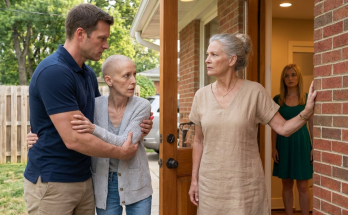
Derek appeared in the doorway a moment later, and behind him stood his new wife, Brenda, with her arms crossed tightly over her chest.
“What happened to her?” I screamed, trying to lift my daughter.
Derek did not even come near us. “She’s being punished for her behavior.”
“She’s completely unconscious!” I shouted back.
“Don’t exaggerate, Laura,” Brenda chimed in from the doorway. “She got dramatic because we took her cell phone away.”
My hands trembled violently as I dialed emergency services on my phone.
“Don’t make a scene in the neighborhood, Laura,” Derek said. “It will pass in a few minutes.”
“How long has she been out here?” I demanded, holding the phone to my ear.
Neither of them answered me.
The paramedics arrived minutes later with their sirens flashing. While they were checking Samantha’s vitals, one of the first responders, a man named Brian, looked at Derek with a strange expression on his face.
“Did you call emergency services tonight, sir?” Brian asked.
“No, I didn’t,” Derek answered curtly.
Brian stood watching him for a long moment before turning back to help load Samantha onto the stretcher. When they put my daughter in the ambulance, Brian stepped closer to me.
“Ma’am, is he your husband?” Brian asked softly.
“He’s my ex-husband,” I answered.
“I’ve been to this house before,” Brian confessed.
I felt a sickening void in my stomach. “Because of Samantha?”
Brian’s partner called out to him before he could answer my question, forcing him to hurry back to the vehicle.
Derek caught up with me as I was heading toward my car to follow the ambulance. “Don’t try to use this to take custody away from me, Laura.”
“I’m not starting a political fight,” I said, staring at him with pure disgust. “I’m finding out what you two did to my daughter.”
In the emergency room, Samantha finally woke up, looking terribly pale and scared. “Is my dad here?”
“No, sweetheart,” I reassured her gently.
She closed her eyes, letting out a long, relieved sigh.
“What happened back there, my love?” I asked, holding her cold hand.
“Brenda said I was disrespectful because I rolled my eyes during dinner,” Samantha whispered softly. “They took my phone away and said I couldn’t come back inside until I learned my lesson.”
“How long were you outside?” I asked.
“I don’t know,” she replied. “It started to rain really hard, and then they left.”
“Wait, did you say they left the house?” I asked, completely shocked.
She nodded weakly. “Mom, please don’t send me back with them ever again.”
Later that night, after Samantha fell into a deep sleep, a nurse handed me her wet backpack. In the back pocket, I found a neatly folded sheet of paper with handwritten notes, dates, and phrases.
“Tuesday: they wouldn’t let me in.”
“Friday: I was punished by not being given dinner.”
“Sunday: They took my cell phone.”
“Wednesday: Brenda said that Mom wasn’t going to believe me.”
Below those entries was one last chilling line: “If they do it again, I have to endure it until someone sees me.”
I remained completely motionless in the hospital chair. That terrible night had not been the first time they locked her out. And at that moment, I still didn’t know that Derek had left evidence of something much worse.
I remembered all the times Samantha had remained silent whenever her father was mentioned over the last few months. I had stupidly interpreted that silence as typical teenage anger and difficulty adjusting to two homes with different sets of rules. Suddenly, every convenient explanation I had accepted began to feel like a dire warning I had foolishly chosen to ignore.
PART 2
At seven the next morning, I called Naomi Parker, the lawyer who had guided me through my divorce. I explained everything that had transpired the night before.
“Don’t go to Derek’s house under any circumstances,” Naomi advised me firmly. “Don’t threaten him, don’t post anything on social media, and don’t send him twenty angry text messages. If this ends up in family court, we need strategic action, not an emotional fight.”
It hurt to hear her words, but I knew she was right.
Two hours later, while Samantha was still resting, Naomi called me back with urgent news. “Laura, there is something you need to know. The paramedic you spoke with yesterday, Brian, filed a report with the Child Protection Agency because he remembered a previous call from that exact same address.”
“Was that call because of Samantha too?” I asked nervously.
“Yes, it was a few months ago,” Naomi confirmed.
I froze in shock. Derek had told me back then that Samantha had felt dizzy from skipping breakfast, and he assured me I didn’t need to worry about it, so I believed him.
Naomi later obtained an official copy of the child welfare report. It didn’t state that anyone had physically struck my daughter, but it contained something far more disturbing. The report noted that Samantha was noticeably fearful, barely spoke, and Derek’s explanation didn’t quite match what the medical crew observed at the scene.
A note from her high school guidance counselor also surfaced shortly after. Three months earlier, Samantha had asked the counselor if a father could legally bar his child from entering the house as punishment and cut off all communication.
I felt like I couldn’t breathe as the full picture came into focus. For months, I had repeatedly told her to give her dad a chance, not to turn every house rule into a war, and that Brenda had the right to set boundaries in her home. I wanted so badly to be the reasonable ex-wife that I ended up ignoring the obvious cries for help my daughter had been showing me for a long time.
During the following week, I systematically collected text messages, visitation schedules, school records, and medical files, building a detailed timeline in a yellow notebook.
Then Derek called my phone. “What exactly do you think you’re doing, Laura?”
“I am protecting our daughter,” I stated coldly.
“You’re actively turning her against me,” he claimed angrily.
“The paramedics found her unconscious outside your house in the rain, Derek,” I reminded him.
“She was perfectly fine, and you know it,” he argued.
“Then explain to me why you didn’t call an ambulance yourself,” I challenged.
There was a long silence on the line. For the very first time, I heard real fear in his voice.
That night, I received an automated notification email from an old supermarket rewards account that Derek and I had shared when we were married. I almost deleted it, until I happened to notice the exact time of the purchase. It was timestamped at 7:02 p.m. at a grocery store located almost twenty minutes away from his house, listing two steak cuts, a bottle of wine, snacks, and expensive cheese.
The receipt proved that while Samantha was lying unconscious in the rain, Derek was not supervising her punishment as he later claimed, but was actually out buying luxury food for dinner.
But that wasn’t even the worst part. Through the open legal file, Naomi obtained several documents that Brenda had kept as a formal conduct record for Samantha. Entire pages described my daughter as manipulative, aggressive, unstable, and deeply defiant.
One note written by Brenda read: “Samantha refused to come inside and voluntarily decided to stay outside.”
However, in a text message Derek sent to the school counselor on that exact same day, he had written: “We banned her from entering the house until she understood that there are strict consequences here.”
They had produced two completely contradictory versions of the same event. Another note claimed that Samantha had screamed loudly and broken household items. Yet on that same day, her high school recorded that she arrived extremely quiet, anxious, and requested to spend her lunch break in the counselor’s office.
They weren’t simply punishing my daughter. They were deliberately constructing a false narrative where Samantha was always the problem, so that anything she revealed later would look like an exaggerated lie.
Our provisional court hearing was scheduled for the following Thursday. The night before we went to court, Samantha walked into my bedroom with visibly swollen eyes.
“Mom, there’s something critical I haven’t told you yet,” she confessed quietly.
I sat up on my bed immediately. “Tell me everything, sweetie.”
She looked nervously down the hallway, as if she were still terrified that someone might overhear us. “The first time the ambulance came, my dad made me promise not to tell you why I had felt sick.”
“Why did he do that?” I asked softly.
Samantha opened her mouth, but it took her several seconds to finally form the words. “Because Brenda recorded everything that night on her home camera.”
When she explained where that video was stored, I realized our whole legal case was about to change completely.
PART 3
Samantha explained that Brenda had installed a security camera in the living room to keep an eye on their pet dog when they were out. It wasn’t hidden at all, as I had seen it sitting on a shelf myself. What I never imagined was that it routinely recorded their intense arguments with my daughter.
“After the first ambulance left,” Samantha said, “I heard Brenda say that she was going to delete the recording because it looked really bad for them.”
“Did you actually see the video?” I asked carefully.
“I saw a piece of it,” Samantha recalled. “My dad played it on the TV to try to prove to me that I was just exaggerating my sickness.”
“What was happening on the screen?” I pressed gently.
Samantha clasped her hands together tightly. “I was sitting on the living room floor, telling them I felt really sick, but Brenda said I was just acting. My dad told me that if I kept up the dramatic routine, I was going to lose my cell phone for the whole month.”
I didn’t force her to continue talking about it. I immediately sent a detailed text to Naomi. Her response was instantaneous, warning us that we shouldn’t attempt to access any digital accounts or recover files on our own, but rather report the existence of the video to the legal authorities so they could formally request it.
The next morning, the family court in Phoenix was filled with thick folders, quiet murmurs, and anxious people. I wore a formal navy blue blazer I hadn’t worn since our divorce, while Derek arrived in an expensive gray suit. Brenda sat right next to him, completely avoiding my gaze.
Samantha remained outside the courtroom, accompanied by an experienced child protection psychologist.
Derek’s attorney presented their narrative, painting a picture of an overprotective mother, a rebellious teenager, and a disciplined father. According to them, I had turned a minor fainting spell caused by personal stress into a dramatic pretext to alter custody.
I kept quiet and let them finish.
Naomi step forward and presented the emergency room report, the paramedic’s formal statements, the high school counselor’s documentation, and our yellow notebook timeline. Then she called Brian to the stand.
“Had you visited Mr. Derek Miller’s residence prior to that night?” Naomi asked the paramedic.
“Yes, I had,” Brian testified clearly.
“Was that previous visit due to a medical emergency involving the minor child?” Naomi followed up.
“Yes, it was,” Brian confirmed.
Derek’s lawyer immediately attempted to downplay the testimony. “Are you asserting under oath that my client physically assaulted his daughter?”
“No,” Brian answered calmly. “I am stating that I documented what I directly observed.”
“So your so-called concern was merely a personal impression?” the lawyer challenged.
Brian shook his head firmly. “There were clear inconsistencies between what the adults told us and what we medically observed. Furthermore, the child appeared visibly frightened and actively avoided answering basic questions.”
I noticed Derek moving his leg nervously under the counsel table.
Next, Naomi presented the written behavioral logs kept by Brenda. “It says here that Samantha voluntarily decided to remain outside. Did you write this entry, Mrs. Miller?”
“Yes, I wrote it,” Brenda answered from her seat.
Naomi then placed Derek’s text message to the school counselor right next to the log. “And did your husband send this message stating you banned her from entering?”
Brenda glanced nervously at Derek. “I don’t remember the precise details of that day.”
“Did you write this document or not?” Naomi pressed directly.
“Yes,” Brenda admitted softly.
“And your husband sent this message?” Naomi asked again.
“Yes,” Brenda repeated.
For the first time in the courtroom, it became blatantly obvious that words like discipline and boundaries were merely hiding severe emotional abuse.
The judge intervened, ordering that all digital camera records be formally subpoenaed and demanding an expanded child protection evaluation. Derek leaned over toward Brenda and whispered something harsh into her ear.
Brenda reacted too loudly for the quiet courtroom. “You told me that file was already permanently deleted!”
The entire room fell completely silent. Derek turned toward her with a furious expression. “Shut up right now!”
The judge immediately reprimanded Derek for his outburst. Naomi touched my arm gently, signaling that there was no need for us to say anything.
Finally, the supermarket receipt was submitted into evidence. The purchase timestamp of 7:02 p.m. at a store twenty minutes away completely shattered Derek’s claim that he had been at home carefully supervising the punishment.
Piece by piece, their fabricated story completely collapsed. My daughter had been isolated, locked outside in the harsh weather, denied meals, stripped of communication, and labeled as manipulative whenever she showed natural signs of trauma.
The judge promptly issued an emergency order granting me sole temporary custody and completely suspended Derek’s unsupervised visitation while the state investigation proceeded.
As we exited the courthouse, Derek rushed down the hallway to intercept me. “Are you happy with yourself now, Laura?”
“No, I’m not happy,” I answered calmly.
“Then what do you actually want from me?” he sneered.
“I want our daughter to be able to enter a home without living in constant fear of what cruel punishment awaits her,” I replied firmly.
“You’re turning her against me,” he repeated bitterly.
“No, Derek, I am simply listening to her,” I said.
Derek let out a bitter, dry laugh. “She always knew exactly how to manipulate you.”
For a second, I felt an overwhelming urge to yell at him, but then I remembered my daughter’s heartbreaking words about how no one would believe her. I realized I no longer needed to argue with him ever again.
“I’m not debating this with you anymore,” I said, walking away to join my daughter.
Three days later, Naomi called with major news. The home security camera system utilized automated cloud backups, meaning that although Brenda had deleted files from her phone app, the original recordings remained stored on the server. The authorities successfully recovered several crucial video fragments.
While the footage showed no physical striking, it captured something equally devastating. In one video, Samantha was sitting on the hallway floor with her back against the wall.
“I feel really sick, I can’t breathe properly,” Samantha gasped on camera.
“Stop the dramatic theater right now,” Brenda’s voice cold replied on the tape.
Derek walked right past her without stopping. “If you keep acting like this, you’re going to learn your lesson the hard way.”
In another video clip, Samantha stood by the cold doorway wearing only a thin sweatshirt. “Please, I’m really cold.”
“Then learn to control your disrespectful attitude,” Brenda scolded.
Derek then opened the door wide. “Get outside. When you’re ready to offer a genuine apology, we’ll see if you can come back in.”
I couldn’t bring myself to watch any more of the footage. “I told her to be patient with him for months,” I sobbed to Naomi.
“You cannot change what happened in the past, Laura,” Naomi reminded me gently. “You can only protect her future.”
That realization was the most painful part of the entire ordeal. For months, I had prioritized maintaining a polite, non-confrontational relationship with her father over listening to my daughter’s quiet cries for help.
The formal investigation continued for several weeks. Samantha began regular therapy sessions with a compassionate child psychologist recommended by her school. Little by little, she began opening up about the covert cruelties she had endured.
She confessed that she kept hidden snacks in her backpack because she was frequently denied dinner as punishment. She revealed that Brenda categorized every minor sign of frustration as dangerous aggression, and that Derek constantly threatened that I would abandon her if she complained to me.
“Dad said you already worked too hard,” Samantha whispered during one evening conversation. “He said that if I made your life difficult, you would eventually prefer that I just live with him permanently.”
I took a deep breath, looking straight into her eyes. “Look at me, Samantha. You will never, ever be a burden to me.”
“Sometimes I’m complicated to deal with,” she murmured softly.
“You’re a normal teenager, and that comes with the territory,” I reassured her with a warm smile.
“Even when I get really angry?” she asked timidly.
“Even when you get angry,” I confirmed.
“And what happens when I make a mistake?” she continued.
“I make mistakes too,” I answered honestly. “You don’t need to be perfect for me to love and believe you.”
That night, she ate a full dinner and asked for seconds, making me cry tears of relief while I washed the dishes. She was slowly recovering the tiny details of her normal personality, like her appetite, her silly jokes, and her habit of humming out of tune while getting ready for school.
Two months later, the court finalized the long-term protective orders, restricting Derek to strictly supervised visits monitored by professionals, while Brenda remained under investigation.
Months after that legal victory, Brenda unexpectedly left Derek and moved out.
Derek called my phone one afternoon, his voice trembling with anger. “Are you happy now, Laura? Brenda left me, my daughter refuses to speak to me, and everyone in town thinks I’m a monster!”
I stood in my kitchen while Samantha was doing her homework at the dining table. “None of this makes me happy, Derek.”
“You completely ruined my reputation!” he shouted.
“Your own actions ruined your reputation, Derek, not me,” I responded firmly.
“You always wanted revenge against me!” he claimed.
I looked over at my daughter, who was working peacefully. “No, Derek. For years I tried to keep the peace between us at all costs, and that was my biggest mistake.”
“Your mistake?” he scoffed.
“I confused keeping the peace with staying silent,” I explained clearly. “While I was trying to avoid conflicts with you, Samantha was learning that asking for help only brought more suffering.”
“She’s a liar!” he yelled desperately.
Those final cruel words sealed everything inside me. “Then we have absolutely nothing left to talk about,” I said, hanging up the phone for good.
Our journey toward full emotional recovery was not an overnight process. There were days when Samantha irrationally blamed herself, and other days when she missed the good memories of her father, feeling guilty for missing him. Her therapist explained that it was completely normal to love a parent while simultaneously recognizing that they caused deep harm.
On weekends, we established new routines, visiting local farmers’ markets, arguing lightheartedly over grocery items, and enjoying sweet pastries together.
One afternoon, Samantha found her old, water-damaged backpack in the back of her closet, its strap still torn from that rainy night.
“Do you want me to throw that away?” I asked gently.
“No, I want to keep it,” she replied, running her fingers over the fabric.
“Does it hurt to look at it?” I asked.
“It used to,” she admitted softly. “But now it reminds me that I wasn’t crazy after all.”
I swallowed the lump in my throat. “You were never crazy, sweetie.”
She looked up at me. “But you used to think I was exaggerating things back then.”
I refused to make excuses for my past passivity. “Yes, I did think that sometimes, and I was wrong.”
“That really hurt me, Mom,” she admitted honestly.
“I know it did, and I am so sorry,” I said sincerely. “I wanted so badly to believe your dad wouldn’t cross those lines that I failed to pay close enough attention to what you were telling me.”
Samantha lowered her eyes and smiled softly. “Thank you for saying that to me.”
Trust didn’t return through a single magic conversation, but through daily actions, respecting her space, and proving that protecting her was my absolute highest priority.
Now, looking back on that terrible rainy evening, I realize that trying to avoid problems often leaves the most vulnerable person standing alone in the storm. True peace isn’t found in quiet compliance, but in having the courage to stand up and say that something is wrong, and having someone there to say, “I believe you.”
THE END.