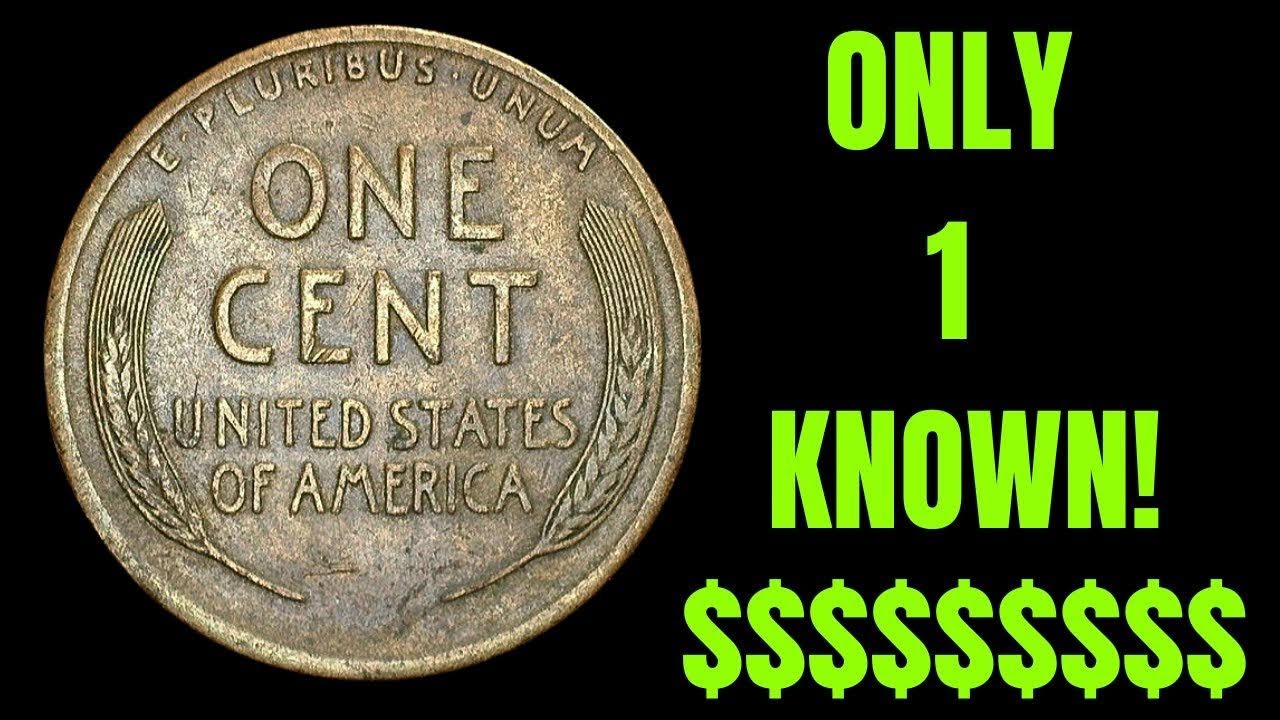
The image presents a dramatic clickbait thumbnail typical of social media and video platforms, designed around the Lincoln Wheat Penny. Against a solid black background, it features a close-up of the reverse side of a Wheat cent with bold green text claiming “ONLY 1 KNOWN! $$$$$$$$$.”
While graphic overlays like this intentionally sensationalize coin values to drive clicks, the underlying world of rare Wheat pennies contains extraordinary history and genuine multi-thousand to million-dollar real-world sales.
The History and Symbolism of the Wheat Penny
Designed by sculptor Victor David Brenner and introduced in 1909 to mark Abraham Lincoln’s 100th birthday, the Lincoln cent made history as the first standard-issue U.S. coin to feature an actual historic figure rather than an abstract depiction of Liberty.
-
The Reverse Design: Features two stylized stalks of durum wheat flanking the denomination “ONE CENT” and “UNITED STATES OF AMERICA,” symbolizing American agricultural abundance and national unity.
-
The Motto: Embedded at the top rim is the Latin phrase E Pluribus Unum (“Out of Many, One”).
-
Production Run: The “Wheat” reverse design was minted from 1909 through 1958 before being replaced by the Lincoln Memorial design in 1959.
Fact vs. Fiction: Is There “Only 1 Known”?
The thumbnail’s claim of “Only 1 Known” refers to one of numismatics’ most famous true error coins: the 1943-D Bronze Cent.
During World War II, the U.S. Mint transitioned from copper to zinc-coated steel for the 1943 cent to preserve copper for wartime military production. However, a stray copper blank (planchet) left over from 1942 was accidentally fed into the coining press at the Denver Mint. Only a single confirmed example exists from the Denver Mint, making it a true “only 1 known” rarity. It holds the record as the most valuable Lincoln cent ever sold, reaching $1.7 million in a 2010 private sale.
Top 5 Valuable Rare Wheat Pennies to Look For
| Variety / Coin | Mint Mark | Why It Is Rare & Valuable | Real Auction Record / Range |
| 1943-D Bronze Cent | D (Denver) | Only 1 known example struck on a bronze planchet during the WWII steel transition. | $1,700,000 |
| 1943-S Bronze Cent | S (San Francisco) | San Francisco copper transition error. Roughly 5 specimens confirmed. | $504,000 |
| 1944-S Steel Cent | S (San Francisco) | The reverse wartime error: struck on a leftover 1943 steel planchet during the return to copper. | $408,000 |
| 1958 Doubled Die Obverse | No Mint Mark (Philly) | Dramatic doubling on “LIBERTY” and “IN GOD WE TRUST.” Extremely rare (3–4 known). | $336,000 |
| 1909-S VDB Cent | S (San Francisco) | First year of issue key date with designer Victor D. Brenner’s initials; low mintage of 484,000. | $168,000 |
How to Check Your Pocket Change for Rare Wheat Pennies
-
Test 1943 Pennies with a Magnet: Standard 1943 pennies are steel and stick directly to a magnet. If you have a brown/copper-colored 1943 penny that does not stick to a magnet, it may be a multi-hundred-thousand-dollar error.
-
Weigh the Coin: Genuine copper/bronze Wheat pennies weigh approximately 3.11 grams, whereas 1943 steel pennies weigh 2.70 grams.
-
Check the Bottom Reverse for “V.D.B.”: On 1909 pennies, look at the bottom rim between the base of the wheat stalks. If it has an “S” mint mark on the front and “V.D.B.” on the back, it is worth hundreds to thousands of dollars even in worn condition.