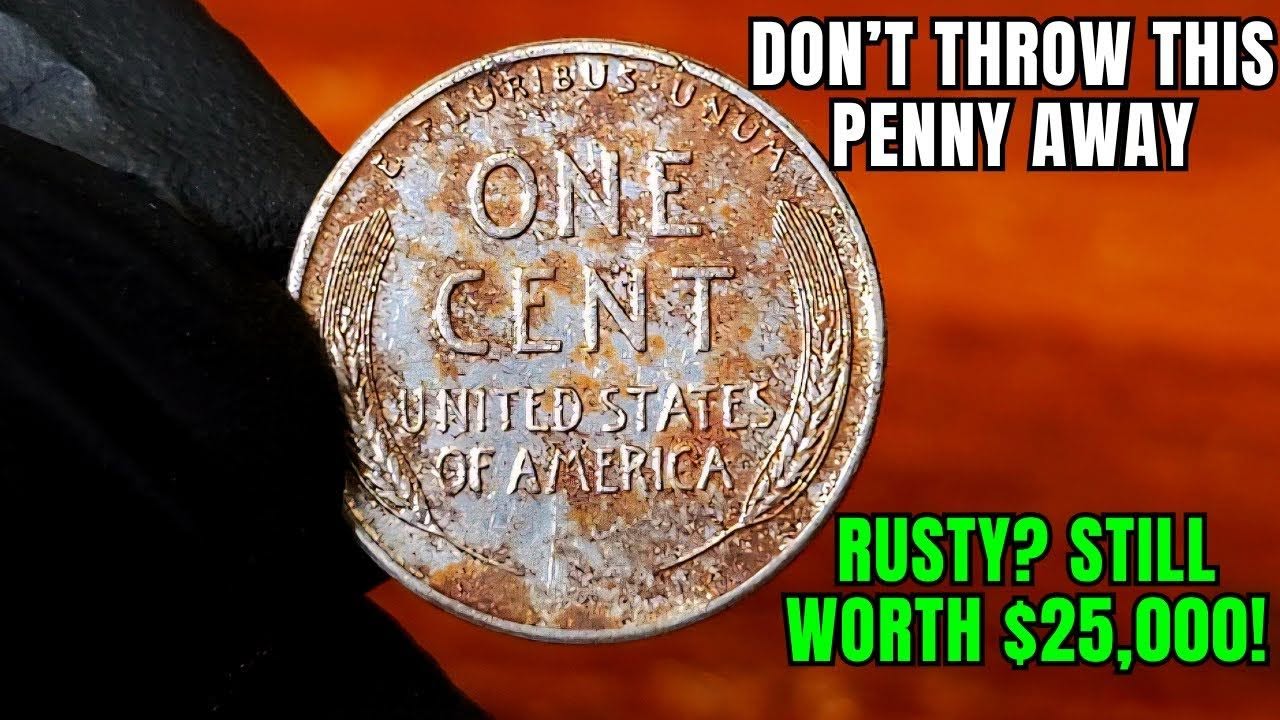
“DON’T THROW THIS PENNY AWAY — RUSTY? STILL WORTH $25,000!”
While rusty 1943 steel pennies found in everyday change are generally worth only 10 to 50 cents, the 1943 issue remains one of the most famous coin series in U.S. history. Under specific circumstances involving rare mint errors and top-tier condition grades, these wartime cents can be worth life-changing money.
Step 1: Why Error Quarters & Rare Cents Can Be Extremely Valuable
Coin value is driven by rarity, demand, and mint errors. During the production process at the U.S. Mint, millions of planchets (metal disc blanks) are struck at high speeds. When mistakes occur in the machinery or metal supply, rare error coins are created:
-
Wartime Composition Errors: During World War II in 1943, the U.S. Mint switched from copper to zinc-coated steel to conserve copper for military ammunition. A few leftover 1942 copper planchets were accidentally struck with 1943 dies. A genuine 1943 copper penny is a holy grail error, selling for anywhere from $100,000 to over $1.7 million at auction.
-
Doubled Die Errors: Caused when a die receives an offset impression during hubbing, resulting in visible double outline text (such as on “LIBERTY” or “IN GOD WE TRUST”).
-
Mule Errors & Wrong Planchets: Coins struck using dies from two different denominations (such as a quarter reverse on a dollar coin obverse) or struck on planchets meant for different denominations (such as a quarter struck on a nickel blank).
Step-by-Step: How to Start Hunting
You do not need an expensive setup to start finding valuable coins in pocket change or bank rolls.
-
Get the Basic Tools: Acquire a 10x jeweler’s loupe or digital microscope, a digital scale measuring in hundredths of a gram (0.01g precision), and a strong neodymium magnet.
-
Obtain Coin Rolls: Visit your local bank and buy face-value rolls of quarters, dimes, or pennies (known as “Coin Roll Hunting”).
-
Perform the Magnet Test on 1943 Pennies:
-
Sticks to Magnet: It is a standard WWII steel penny. (Even if rusted, standard steel pennies are worth $0.10 to $2.00).
-
Does NOT Stick to Magnet: If you have a brown 1943 penny that is non-magnetic, you may have found a multi-hundred-thousand-dollar copper error.
-
-
Weigh the Coin: A standard steel 1943 cent weighs 2.70 grams, whereas a genuine 1943 copper error weighs 3.11 grams.
-
Inspect the Edges and Details: Check quarters and cents for doubled lettering, missing clad layers (showing exposed copper on quarters), or off-center strikes.
Should You Get Your Coin Graded?
Professional coin grading by third-party services like PCGS (Professional Coin Grading Service) or NGC (Numismatic Guaranty Company) authenticates coins, protects them in plastic slabs, and assigns a formal numerical grade (MS60 to MS70).
| Decision Factors | Send for Grading IF… | Skip Grading IF… |
| Market Value | The estimated raw value exceeds $100+. | The coin is a standard circulated item worth under $10–$20. |
| Authentication | You suspect a major error (like a 1943 copper cent or major quarter error). | The coin shows heavy corrosion, severe rust, or surface damage that lowers value. |
| Cost Consideration | You are prepared to pay $30–$70+ per coin in grading and shipping fees. | The grading fees outweigh the total realistic market value of the coin. |
Note: Never attempt to clean a rare coin with chemicals, wire brushes, or polishes. Cleaning drastically reduces a coin’s numismatic value.
Final Thoughts
While social media thumbnails like “$25,000 for a rusty penny” exaggerate everyday finds, the excitement of coin collecting lies in the real possibilities. Genuine mint errors and rare varieties are still sitting in old jars, estate sales, and pocket change waiting to be discovered. By equipping yourself with a magnet, scale, and magnifying glass, you can separate everyday common coins from true numismatic treasures.