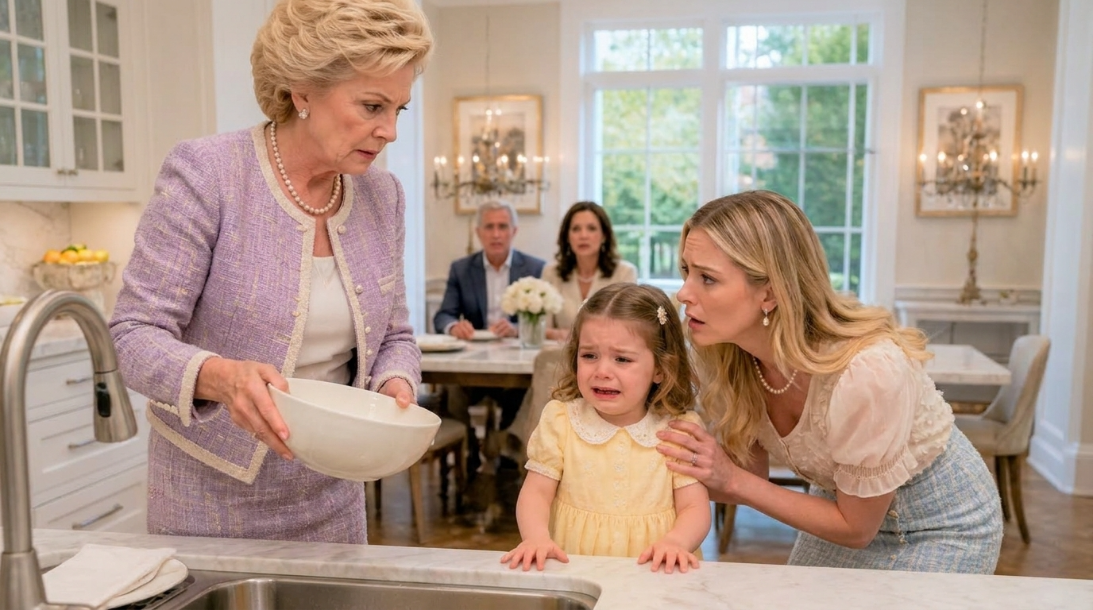
My father said nothing, while my sister smiled, convinced I couldn’t survive without them.
I picked up my little girl, walked out without saying a word, and the next morning, I handed my lawyer a property deed signed by my own parents.
What that document revealed could cost my family their home—and everything they thought they owned.
PART 1

“If you’re thirty-four years old, stop living like a parasite and find somewhere else to die with your daughter.”
My mother said it while holding my two-year-old daughter’s bowl of chicken soup.
Before I could react, she walked over to the stainless steel sink and dumped the entire thing out. The warm broth washed down the drain, noodles stuck around the strainer, and a soft piece of carrot spun beneath the running water.
My daughter, Sophia, stared at her empty plastic bowl. “Grandma… my soup…”
That tiny, confused voice hurt worse than any insult my mother could have hurled at me.
My twenty-nine-year-old sister, Karla, was sitting near the dining window, scrolling through Instagram as if nothing out of the ordinary was happening. “Mom’s right,” she muttered without looking up. “It’s about time you stopped using this place like a free hotel. The rest of us actually work.”
I stared at her. Karla lived in a condo across town, and for nearly four years, I had been quietly covering her monthly mortgage payment out of my own account without anyone in the family ever mentioning it.
Yet I kept my mouth shut.
My father, Arthur, slowly folded his newspaper. For a fraction of a second, I thought he was going to intervene.
He didn’t.
Instead, he stood up, picked up Sophia’s stroller, opened the front door of the apartment, and set it out on the cold concrete landing near the stairs. Then he came right back inside and sat down.
That was it.
Six months earlier, I had gone through a brutal divorce. My ex-husband walked out with another woman, leaving me with Sophia, a modest income as a freelance editor, and just enough savings to start over. My parents had practically begged me to move back into their three-bedroom apartment temporarily.
“This will always be your home,” my mother had promised back then.
At first, I voluntarily paid for groceries, bought the high-speed internet package, covered my father’s heart medication, and spent my weekends deep-cleaning the place. But slowly, my help transformed into an unspokable expectation.
If I bought milk, my mother complained that there were no eggs. If I paid the electric bill, she asked why I hadn’t covered the gas. If I brought home chicken, Karla would stop by, eat half of it, and pack tupperware containers for the rest of the week.
And yet, I was still labeled “the parasite.”
Sophia started to cry quietly.
I didn’t yell. I didn’t cause a scene. I wiped her cheeks, put on her little yellow coat, packed her sippy cup, and lifted her into my arms.
“Thank you for the meal, Mom.”
My mother let out a dry, condescending laugh. “Don’t act high and mighty with me, Laura. When you realize how much it actually costs to survive out there on your own, you’ll be crawling back here begging for forgiveness.”
I walked out the door.
On the stair landing, I strapped Sophia into her stroller. As we navigated down the flight of stairs, she kept asking why Grandma had thrown her soup in the trash. I had no idea how to explain cruelty to a toddler.
We ended up in a modest boarding house near the city center—a single furnished room, a double bed, a shared bathroom, and an elderly landlady named Mrs. Gable who agreed to accept weekly cash payments.
When Sophia finally fell asleep, I pulled out my phone. I opened a private secure note I had kept saved for years. It was titled simply: PLAN B.
I typed a single line beneath it:
Sunday: Activated.
Then I opened my banking app. I navigated to the recurring monthly transfer set to leave my account on the 15th of every month, bound for Karla’s mortgage lender: $850.00.
For years, Karla had boasted to her friends and boyfriend that she was paying off her mortgage entirely on her own.
I hit Cancel Recurring Transfer. I confirmed it twice.
Next, I opened a cloud storage folder containing digital scans of a public deed, bank receipts, pharmaceutical payment records, and property documents that my family had conveniently forgotten existed.
Five years ago, by my parents’ own deliberate choice, the very apartment they had just thrown me out of had been legally gifted and transferred entirely into my name.
They assumed I had forgotten all about it.
As I turned off my phone screen and watched my daughter sleep peacefully, I realized that throwing away that bowl of soup was about to become the most expensive mistake my family ever made.
PART 2
On Tuesday morning at precisely ten o’clock, my mother called.
“Laura, stop throwing your ridiculous temper tantrum and bring the baby back home.”
I sat on the edge of the bed watching Sophia build a tower out of plastic cups. “I’m not coming back, Mom.”
A heavy silence lingered over the line. “What do you mean you’re not coming back?”
“Exactly what I said.”
Her voice instantly hardened. “You have a toddler, Laura! Where are you keeping her? Because if you’re shuffling my granddaughter from one cheap motel to another, I will call Child Protective Services for child endangerment! Don’t think for a second I won’t!”
I felt a cold wave wash over me—not fear, but complete, unadulterated clarity.
“Do whatever you feel is necessary, Mom. Sophia has a pediatrician, her vaccinations are up to date, she’s enrolled in daycare, and everything is fully documented.”
“Is that how you speak to your mother?!”
“You told me to find somewhere else to die. I’m just following your instructions.”
I hung up.
Ten minutes later, a text buzzed from Karla:
Did something go wrong with your bank account? My mortgage payment didn’t process.
I didn’t reply.
Five minutes passed before another text arrived:
Laura, don’t play games with this. My credit score will tank if that payment is late!
I typed back:
Precisely. YOUR credit score. YOUR mortgage.
That afternoon, a colleague from the publishing house connected me with an estate attorney named Adrian Vance.
I met him in his office on Thursday morning and laid a printed copy of the property deed flat on his desk.
Adrian reviewed the document carefully, checking the county registry seals. “Your parents deeded this property to you as an absolute gift five years ago?”
“Yes,” I explained. “My father was involved in a bitter legal dispute with his sister over my grandparents’ estate. They wanted to shield the asset, so they transferred the property directly into my name because they considered me the ‘responsible child.’ They signed it before a public notary. They didn’t even retain a life estate or a formal reservation of usufruct. They’ve just been living there with my permission.”
Adrian set the paper down. “Then you are the sole legal owner of the real estate. However, under state property law, we shouldn’t attempt a self-help lockout while they are occupying it. We’ll issue a formal notice terminating their tenancy and demanding surrender of the premises. If they refuse to vacate, we file an unlawful detainer action in civil court.”
“My mother already changed the deadbolt locks,” I added.
“Even better,” Adrian noted, making a file entry. “If you can document that they locked the legal owner out, it strengthens our position.”
That afternoon, I returned to my parents’ building. My remaining cardboard boxes—clothes, Sophia’s toys, books—were stacked haphazardly in the public hallway near the elevators.
I recorded a video of the scene on my phone, then knocked on the door.
My mother’s voice came through the wood: “Grab your junk and get lost!”
“Did you change the locks, Mom?”
“Of course I did! This is MY house!”
“Alright.” I didn’t argue.
My lack of resistance seemed to unnerve her. She unlatched the top chain and cracked the door open an inch. “What are you up to, Laura?”
I looked her straight in the eye. “Nothing that you didn’t sign your name to five years ago, Mom.”
Her face drained of color as I turned and walked toward the elevator.
The following morning, Adrian obtained a certified copy of the original deed from the county clerk and drafted the formal notice to quit. But an unexpected hurdle arose.
My mother called Adrian’s office, screaming that she was going to sue to revoke the gift, claiming my father “had no idea what he was signing” five years ago due to cognitive decline. Furthermore, the notary who had executed the original deed had recently been hospitalized following a heart attack, making old paper records harder to verify quickly.
“If your father voluntarily signs an affidavit confirming he was fully competent and aware of the transfer,” Adrian told me, “we cut the legs right out from under your mother’s defense. If he refuses or sides with her, this litigation could drag on for months.”
My father. The man who had silently carried his granddaughter’s stroller out into the hallway without saying a word.
On Saturday afternoon, I tracked him down at his friend’s auto repair shop across town.
I placed a manila folder on the workbench between us. On top were five years’ worth of pharmacy receipts—blood pressure medication, insulin supplies, cardiac check-ups. All paid for out of my checking account.
Beneath the receipts lay the copy of his notarized property transfer.
My father slowly flipped through the stacks of medical receipts. “You… you paid for all of these?”
“Yes, Dad.”
“Your mother told me she was paying for my prescriptions out of her pension money.”
“I never mentioned it because I didn’t want you to feel indebted to me,” I said softly.
He lowered his head, staring at the concrete floor. “Why are you showing me this now, Laura?”
I took a deep breath. “Because I don’t want your gratitude, Dad. I just want you to stop being silent for once in your life.”
I pointed to his signature on the deed. “I need you to sign an affidavit confirming that you freely transferred the apartment to me five years ago.”
He didn’t move.
“Dad, last Sunday you watched Mom throw your toddler granddaughter’s food down the drain,” I said, my voice trembling slightly. “You watched them throw us out. You carried her stroller to the stairs yourself.”
His eyes filled with a grief that never quite turned into tears. “Your mother will destroy me if I sign that, Laura.”
“That is between you and her,” I replied firmly. “All I’m asking from you is the truth.”
For thirty seconds, the shop was completely quiet except for the hum of an air compressor.
Then my father stood up, grabbed his jacket, and looked at me. “Where is the notary?”
PART 3
My father executed the formal affidavit that very afternoon before an independent notary public. He officially affirmed under oath that he had knowingly and voluntarily transferred the property to me five years prior, without coercion or misunderstanding.
When he finished signing, he tucked his copy inside his coat.
“Laura…”
“Yes, Dad?”
“Is Sophia doing alright?”
“She’s safe,” I said quietly.
He nodded, looking like he wanted to say more, but he simply turned and walked away.
Three days later, my father packed his personal clothes and moved out of my mother’s apartment, taking up temporary residence at his brother’s house across town.
My mother called me that night, her voice shaking with unbridled fury. “You destroyed this family!”
“No, Mom. You did.”
“Your father walked out on me because of you!”
“Dad left because he finally decided to leave.”
“You brainwashed him with your lies!”
“I showed him official documents bearing his own signature.”
Then she said something I will never forget: “When you finally take this apartment—if you even can—you’re going to sit in those empty rooms all by yourself and realize you gained four walls and lost a mother.”
I looked over at Sophia, who was sleeping peacefully in our small rental room, one sock on and one kicked off under the blanket.
“Mom, the day you threw my daughter’s food in the trash, you decided what kind of mother and grandmother you wanted to be,” I said coldly. “I didn’t make that choice for you.”
I hung up.
The formal legal demand to surrender the premises was delivered by a court process server forty-eight hours later. My mother refused to sign it and refused to leave.
So, Adrian filed the civil unlawful detainer lawsuit.
It was not a swift, cinematic victory. Real legal battles rarely move like the movies. There were formal court filings, process servers, verified answers, motions, hearing dates that got rescheduled, legal fees, and agonizing weeks of waiting.
In the meantime, Sophia and I moved out of the boarding house and rented a small, modest one-bedroom apartment near her daycare. It wasn’t grand, but it was ours.
The very first night we moved in, Sophia ran back and forth across the small living room rug, giggling. “Mommy, nobody else uses our bathroom here!”
I laughed, wiping away a tear. “That’s right, sweetie. Nobody else.”
I took on additional freelance editing work, taking on late-night manuscripts to cover our expenses and my legal bills. For the first time in my adult life, I stopped financial disbursements to everyone in my family—except for continuing to cover my father’s heart medication.
Without my quiet financial subsidy, my family’s artificial lifestyle collapsed like a house of cards.
Karla missed her first mortgage payment. Then her second. By the third month, her lender issued a formal notice of default.
She called me one evening, sobbing into the receiver. “Laura, please! You have to reactivate the monthly transfer!”
“No, Karla.”
“They’re going to foreclose on my condo!”
“Then you need to speak with your loan officer.”
“I can’t afford the payment on my salary!”
“Then look for a second job or sell the place.”
Silence filled the line. “Just like that? You’re just going to let me lose everything?”
“That’s what you said to me when Mom threw Sophia’s soup out,” I reminded her flatly. “’The rest of us actually work.’”
“I was angry!” she cried.
“No, Karla. You were comfortable letting me pay your bills.”
Her boyfriend, who had believed for four years that Karla was paying her own mortgage independently, eventually discovered the truth when he asked why her credit was suddenly plummeting. He broke up with her two weeks later.
Karla showed up at my rented apartment one Saturday afternoon, her eyes red, wearing an oversized sweatshirt.
“Daniel left me,” she whispered.
I stood in the doorway. “I’m sorry to hear that.”
“You sent him those bank statements, didn’t you?”
“He asked me directly if it was true that I had been paying your mortgage for four years,” I stated calmly. “I sent him the itemized bank wire confirmations. Dates, amounts, reference numbers. Nothing more.”
She pushed past me into the small apartment, looking around at the folding table, the cardboard toy boxes, and the drying rack near the window. “You’re actually living like this?”
“Yes.”
“I thought you were just exaggerating to punish Mom.”
That comment brought me more sorrow than anger. “You all really believed I had a hidden fortune somewhere, didn’t you? You couldn’t fathom that I was just working hard and giving my money away to people who despised me.”
My mother tried to weaponize public opinion. She posted frantic messages on social media claiming her “heartless daughter was trying to throw two elderly retirees out on the street,” conveniently omitting that the deed was legally mine, that Dad had moved out voluntarily, and that I had been paying their living expenses for years.
She even called Sophia’s daycare, attempting to make false claims of maternal neglect to trigger a protective investigation. The daycare director, knowing me well, immediately flagged the harassment and notified my attorney.
Every text, every public post, and every documented harassment attempt went straight into Adrian’s legal file.
When our court hearing finally arrived, my mother sat across the aisle in a tailored beige suit she reserved for weddings and funerals. She refused to meet my eye. Her attorney argued that the original property transfer was the result of a “misunderstood family arrangement.”
Then my father took the witness stand.
He didn’t yell. He didn’t insult my mother. He simply looked at the judge and stated: “I signed the deed five years ago. I knew exactly what I was signing. So did my wife.”
When her attorney tried to cross-examine him, asking if I had pressured him into ratifying the transfer, my father replied quietly: “My daughter showed me five years of pharmacy receipts that she paid out of her own pocket while my wife told me our pension was covering it. It helped me realize how many things I had spent years refusing to see.”
The judge issued an order granting full possession of the property to me, entering a judgment of eviction against my mother with a thirty-day voluntary compliance window.
My mother vacated the apartment on the twentieth day.
A neighbor called to inform me she was packing boxes into a moving truck. Karla had come to help her, though they reportedly argued the entire time. My father did not return to help.
On a crisp spring morning, I walked up the stairs to my parents’—now my—apartment to collect the keys.
I met my mother on the landing as she was carrying down her final two suitcases. We stood face-to-face in the narrow hallway. She looked noticeably older, her eyes cold and sharp.
I thought she might scream at me. I thought she might offer a bitter apology.
She did neither. She brushed past me without a word, her heels clicking heavily down the concrete steps until the front lobby door slammed shut. I didn’t ask where she was going.
I unlocked the apartment door and stepped inside.
The rooms smelled stale and hollow. A wall mirror was missing, leaving a faded rectangle on the paint. The place was empty of their presence, but full of memories.
I sat down alone at the kitchen table. For thirty-four years, this place had been “my parents’ house” in my mind. Now it was just four walls that belonged to me on paper. I felt no grand rush of victory—only a profound, quiet stillness.
A week later, Sophia and I moved in.
Sophia ran through the hallway holding her stuffed rabbit. “Mommy, is this where I get my own bedroom?”
“Yes, sweetie. Right here.”
That evening, I made chicken noodle soup for dinner. I didn’t plan it out symbolically; it was just what I had in the pantry.
When I set the warm bowl down in front of Sophia, she looked at it, blew gently on the spoon, and said, “It’s hot, Mommy.”
“Wait a little bit for it to cool down, sweetie,” I smiled, sitting beside her.
I looked over at the stainless steel sink where my mother had dumped her food months ago. I turned on the faucet, let the water run for a second, and turned it off.
My phone chimed on the counter. It was a text from my father:
Laura, I’m sorry to bother you. My blood pressure prescription is due for a refill next week. I can pay you back when my check arrives.
I opened my banking app and transferred the funds for his medication immediately.
Handled, Dad. Take care of yourself.
He replied: Thank you, sweetheart. Can I come by to see Sophia sometime soon?
I looked at my daughter happily eating her soup.
Someday, Dad. Soon. But not just yet.
My mother never apologized. And I stopped waiting for her to.
I learned something that cost me a family home, a broken relationship, and dozens of sleepless nights: forgiving someone doesn’t mean granting them continuous permission to harm you. Helping people doesn’t mean subsidizing adults who hold you in contempt. And setting firm boundaries doesn’t make you a bad person—it makes you a survivor.
Sophia finished her soup and held up her empty bowl with a big smile. “More, please, Mommy!”
I smiled, picked up the bowl, and walked over to the stove to serve her a second portion. This time, there was more than enough to go around.