She had been left alone for two days, hungry, frightened, and with no adult anywhere in sight. When my husband finally came home from his trip, looking perfectly tanned and relaxed, I didn’t confront him. I quietly pulled out the documents, asked the bank to review one of our accounts, and waited. Because the more I uncovered, the more I realized my daughter hadn’t simply been abandoned. She had been left behind as part of a plan—and the real target wasn’t her. It was me.
PART 1

“Let’s toast to Lucy: while other women stay home raising their kids, she prefers putting on a uniform… though at least her paycheck never fails to land.”
My husband, George, said it in front of his entire family the night before I was deployed on a three-month medical assignment to a military hospital in the north.
His mother, Teresa, was the first to laugh. Then came his sister, Fiona. I stood frozen, watching my five-year-old daughter, Chloe, push her spoon into a piece of cake without eating it.
“Mom, I want you to stay,” she whispered softly.
Suddenly, no one was laughing.
I had served eighteen years as a military physician, and this assignment was no whim. There was a critical shortage of anesthesiologists in the northern district, and George had been the one pushing me hardest to accept it.
“Go without worrying,” he kept repeating. “I’ll take care of Chloe. Besides, with the extra stipend, we can finally finish remodeling the house.”
The house. That was the crux of it.
The property wasn’t ours jointly. My Aunt Ellen had willed it to me four years before I ever met George. It was a spacious two-story home with a small courtyard and a separate commercial storefront out front—where Fiona had set up a nail salon without paying a dime in rent because, according to George, “family helps family.”
Before leaving, I handed George a secondary debit card tied strictly to an account for groceries, tuition, medicines, and household utilities.
“The main savings account is not to be touched,” I warned him.
For a fraction of a second, his expression shifted. Then he kissed my forehead.
“Of course, sweetheart. Who do you think I am?”
During the first few weeks, everything seemed normal. Chloe showed me her drawings over video calls and giggled at the lopsided braids her father attempted. But as April wore on, the calls grew shorter.
Then my daughter started repeating a strange phrase: “Everything’s okay, Mommy. Don’t worry about anything.”
No five-year-old speaks like that unprompted.
I asked George directly if she was being left alone. He was instantly offended. “Now you’re surveillance-monitoring me from a thousand miles away? You should trust your family a little more, Lucy.”
We had security cameras installed at the front gate and in the kitchen. Shortly after that call, my phone stopped receiving feed notifications. George claimed Fiona’s contractors had accidentally severed a main line during the salon expansion.
I wanted to believe him.
My assignment was scheduled to end in June, but in early May, my relief physician arrived ahead of schedule. I decided not to call ahead. I wanted to surprise Chloe.
On May 6th, I arrived home around noon.
The house was eerily silent. I unlocked the front door with my key.
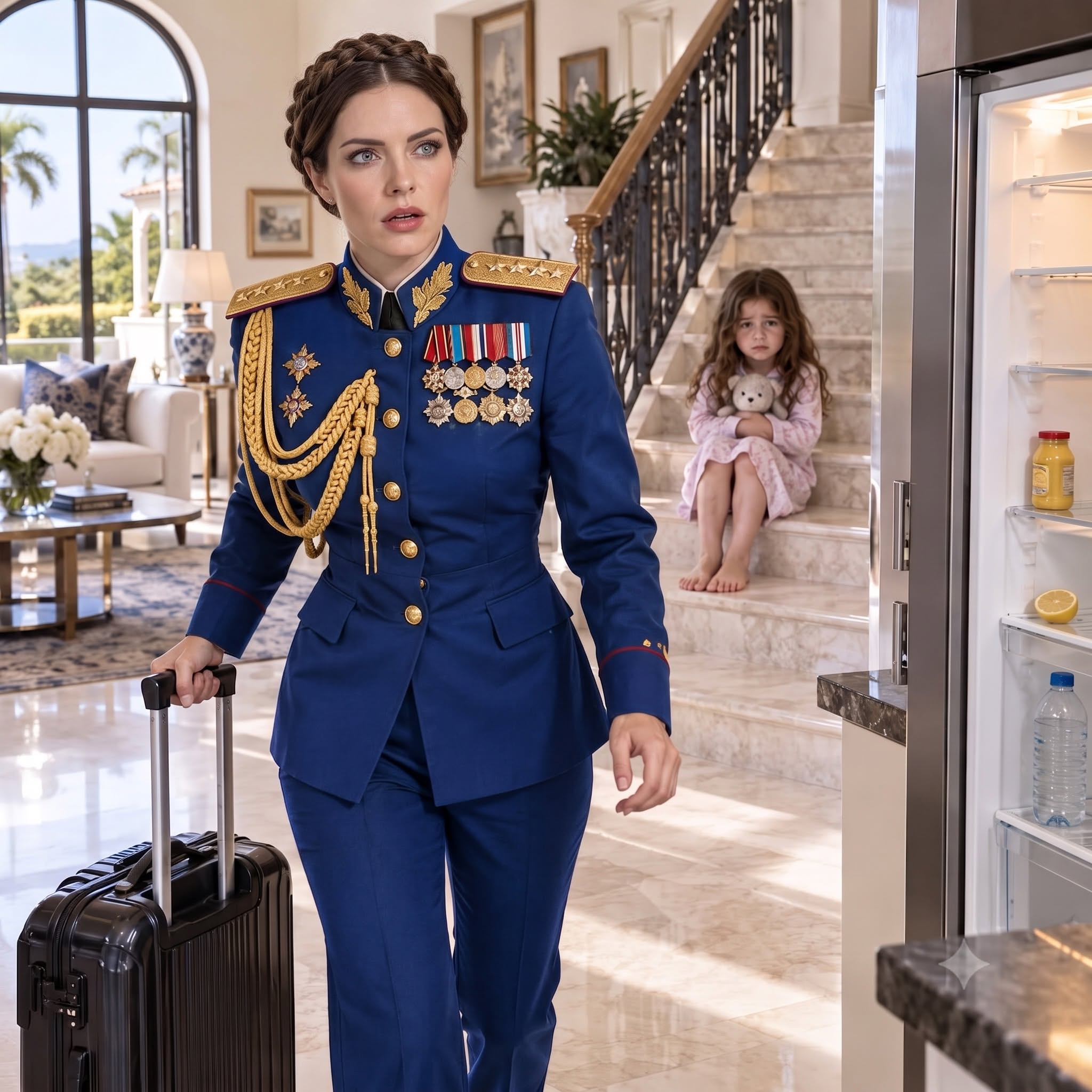
In the foyer lay a small child’s jacket dropped on the floor. In the kitchen, a bowl sat in the sink with dried oatmeal caked to the bottom. I opened the refrigerator.
Mustard. Half a lemon. A single bottle of water. Nothing else.
Then I heard slow, unsteady footsteps upstairs.
Chloe appeared at the top of the staircase wearing an oversized T-shirt, her hair tangled, her lips pale and dry. She stared at me as if she were seeing a ghost.
“Mommy?”
I rushed up the stairs and scooped her into my arms. Her skin was burning hot.
“Where is your father, sweetie?”
Chloe looked down at her bare feet. “He went to the beach.”
“Who is here with you?”
“Nobody.”
My heart stopped beating. “Since when?”
She held up two small fingers. Two days.
My five-year-old daughter had been alone in that house for nearly forty-eight hours. She had eaten a single yogurt, dry cereal, and the heel of a loaf of bread. She had tried to cook pasta on the stove, but she couldn’t figure out how to turn the burner on.
I immediately dialed 911 and called Child Protective Services.
While we waited for the paramedics, Chloe clung to my uniform with a vice grip. “Daddy said I shouldn’t bother grown-ups.”
At the hospital that afternoon, doctors confirmed acute dehydration, low blood sugar, and severe gastric irritation.
George called my phone an hour later. His very first question wasn’t about Chloe.
It was: “Why did you decline my card transfer?”
I sat by my daughter’s bed, watching her sleep with an IV line taped to her small arm. In that quiet, heavy moment, I realized those two days were no simple accident or oversight.
There was something much larger behind it. Something George’s entire family was desperately trying to hide from me—and I had only begun to uncover how far they had gone.
PART 2
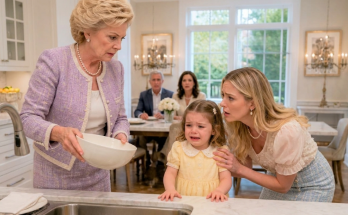
The following morning, George strode into the hospital room flanked by Teresa and Fiona. All three had clearly just driven back from the coast; George’s face was sunburned, Teresa carried a gift shop bag from a luxury beach resort, and Fiona still had an all-inclusive hotel wristband on her arm.
“I’m here to pick up my daughter,” George announced.
“No, you’re not,” I said flatly.
Teresa scoffed. “Don’t be so dramatic, Lucy. I was going to drop by and check on her.”
“When?” I asked.
“Every day!”
“Then explain to me why she’s been alone since Sunday.”
Teresa went quiet.
George shifted tactics, raising his voice so the nurses in the hall could hear: “You’ve been abandoning your family for months to chase your military career, and now you want to play the perfect mother?”
Once, that guilt-trip would have stung. Now, I saw right through him—a man asking about a blocked bank card before checking on his hospitalized child.
When child welfare officers arrived, the trio’s stories scrambled into a mess of pointing fingers. George claimed Teresa was supposed to stay at the house. Teresa claimed Fiona was picking Chloe up. Fiona insisted George told her their mother was already there.
Too many excuses. Too many convenient gaps.
Worse still, George produced screenshots of messages allegedly sent from my messaging account. In one, I supposedly wrote: “Chloe is big enough to stay by herself for a few hours.” In another, I supposedly told Teresa not to bother sleeping over.
The messages used my profile photo, my name, and even my usual phrasing.
A cold chill ran down my spine—not because the texts were real, but because they were remarkably well-crafted fabrications.
Then I remembered: before deploying, I had left my personal laptop in my home office. My messaging session was left logged in, and George knew the administrative password.
While authorities investigated the forged messages, temporary custody of Chloe was granted exclusively to me, with George restricted to supervised visits.
He retaliated by filing an emergency legal claim against me, asserting I was using my military position and contacts to alienate him from his child. He also claimed the house was “marital property” because he had allegedly invested ten years’ worth of improvements into it.
A week later, I received a call from my bank’s senior branch manager asking me to come in personally.
On his desk lay a copy of a notarized power of attorney. Supposedly, I had authorized George to liquidate investments, pull detailed financial statements, and execute property transactions on my behalf.
The document was dated April 10th—a day I was in an operating room over a thousand miles away.
“Did he try to withdraw cash?” I asked.
“He attempted to liquidate a substantial high-yield certificate,” the manager replied. “It failed because he couldn’t answer the secondary security protocols. But he also applied for a commercial line of credit to finance the expansion of your sister-in-law’s salon—using your inherited house as collateral.”
The loan application was for over two hundred thousand dollars. My forged signature sat at the bottom.
Everything connected. The resort trip. The laptop. The card limits. The salon construction. The two days Chloe was left locked inside the house.
On Monday, while my daughter was trying to survive on tap water and dry cereal, George had a scheduled verification call to confirm a commercial loan application. Chloe couldn’t be on camera. She couldn’t be heard in the background asking where her grandmother was. Someone had decided it was simply more convenient to lock her inside.
Now, it had to be proven.
That was when the security technician delivered the piece none of them anticipated.
He inspected the home security system. While the primary power cable to the external router had indeed been cut, the unit possessed an internal battery backup and an offline storage card that automatically synced to a private cloud server once reconnected.
The footage wasn’t lost.
When the video from May 4th loaded onto the screen, George stopped breathing.
On the monitor, George was packing a blue suitcase. Chloe sat at the kitchen counter coloring.
“Daddy, when is Grandma coming?” she asked on the recording.
“Tomorrow morning. There’s yogurt and cereal. Don’t open the front door.”
Then Fiona walked into the frame, followed by Teresa. Standing directly before the lens, oblivious that the secondary sensor was active, the three of them began to speak.
What they said laid bare why my daughter was left alone—and revealed a plot far darker than I had ever imagined to seize my inheritance.
As the investigator paused the frame to export the file as evidence, George bolted to his feet. For the first time since I had known him, I saw absolute terror in his eyes.
PART 3
The security recording played from the beginning.
George packed clothes into his suitcase while Chloe sat coloring.
“When is Grandma coming?”
“Early tomorrow. There’s cereal and yogurt.”
Fiona entered the room. “Did you bring the file from the bank?”
George held up a black folder. “Got it right here.”
Teresa joined them moments later. “I have a spa appointment tomorrow morning. I can drop by after lunch.”
George didn’t even argue. “Fine. Lucy doesn’t get back until June anyway.”
Fiona glanced toward the kitchen. “What about the kid?”
George looked at Chloe. “She’s fine. She’s big enough.”
My daughter was five years old.
At 10:14 AM, all three walked out the front door and locked it. The sensors recorded no further entry until I arrived two days later.
The kitchen camera captured Chloe entering the room repeatedly. The first night, she ate the last yogurt. The next morning, she choked down dry cereal. By afternoon, she opened the refrigerator, stared at the bare shelves for a long time, and quietly closed it.
In another clip, she dragged a wooden chair across the tile toward the gas stove, trying to set a pot on the burner. Unable to light it, she sat down on the floor.
On Monday evening, she cried softly in front of the empty fridge—not throwing a tantrum, but covering her mouth as if terrified that making noise while alone would get her into trouble.
Teresa began weeping in the investigator’s office as the video played. “I thought Fiona was going back!”
Fiona whipped around. “You said you were going!”
George snapped at both of them: “Neither of you checked!”
The three turned on each other right there in the room. I didn’t say a word. The video spoke for itself.
Technical analysis confirmed the footage was unedited. Next came the messaging logs; server records proved the forged texts originated from my desktop in Guadalajara while my military surgical logs placed me in an operating room hundreds of miles away. The login authorization had been confirmed via George’s personal tablet.
His custody defense collapsed instantly.
Desperate, he pivoted to claiming the house. He produced invoices and contracts attempting to prove he had spent years funding major structural renovations on the property.
I hired a seasoned family and asset attorney, Arthur Sterling. His strategy was direct: “Secure Chloe’s permanent custody first. Then dismantle the property claims. Let law enforcement handle the criminal forgery.”
We audited every invoice George submitted. Nearly all the house repairs had been paid directly from my personal accounts. The remaining receipts were tied exclusively to Fiona’s salon.
However, one document posed a problem: a contract showing George had paid for a complete roof replacement prior to our marriage. If he proved he had substantially increased the home’s value with his separate funds, he could demand significant financial compensation.
The contractor’s stamp and signature looked authentic. George even produced a photograph of himself standing on the roof alongside workers from that year.
Arthur tracked down the retired contractor. The man recognized his company’s stamp, but not the signature. More importantly, company records proved his firm wasn’t even operating in the city on the date listed on the contract.
The photograph, however, was real. George had been present during the roof repair—except he hadn’t paid a dime. My Aunt Ellen had hired and paid the crew directly in cash before she passed away.
Lupita, a longtime neighbor, still had the foreman’s contact information. The old builder located his physical job ledgers from that year; there, in faded ink, was my aunt’s name beside the notation: “Ellen Morales. Paid in full, cash.”
George had taken a real event and built a forged paper trail around it. That was his pattern: take a grain of truth and wrap a lie around it.
It was true I traveled for work. It was true he took Chloe to school. It was true he had been affectionate at times. And upon those facts, he tried to construct the ultimate fabrication: that I was an unfit mother who abandoned my child, while he was the noble victim.
The next blow fell on the household card. Account statements revealed that during my deployment, George had drained the account balance—not on groceries or Chloe’s care, but on commercial lighting, seating, and equipment for Fiona’s salon expansion.
When questioned, Fiona claimed, “I thought my brother was giving me a gift.”
“With whose money?” Arthur asked. She had no answer.
The Department of Child Services issued an immediate ruling: Chloe remained in my sole custody, with George restricted to professional, court-supervised visitation.
George responded by staging an outburst outside Chloe’s kindergarten, arriving with Teresa, Fiona, and several onlookers while Fiona recorded on her phone.
“Tell everyone why you vanish for months!” George shouted as I arrived.
Chloe heard the commotion from inside and suffered a panic attack. When she ran out to me, she clung to my neck so tightly I had to support her with both arms. George tried to provoke me, wanting me to scream or push him on camera.
I remained completely silent, handed the responding officers the formal court order restricting his access, and drove away with my daughter. The video Fiona posted online to humiliate me backfired entirely, sparking public outrage against them instead.
In the weeks that followed, Chloe began hoarding food. I found dry crackers in her pockets, bread under her pillow, an apple hidden inside a toy box.
Her child psychologist instructed me not to scold her or throw the food away in front of her. I placed a clear, accessible storage tub on a low shelf in the refrigerator and filled it together with her: yogurts, fruit, cheese sticks, juice boxes.
“This is yours,” I told her. “Nobody will ever take it away.”
For weeks, she woke up in the middle of the night just to open the fridge and check that the tub was still there.
That was what I found hardest to forgive: he hadn’t just stolen money or forged documents—he had turned hunger into a permanent fear inside our daughter.
Months later, the final custody and property hearing convened.
The court psychologist’s report concluded I was fully fit, while noting George exhibited a severe pattern of deflecting responsibility and using a minor child as leverage.
The bank’s legal representative testified that the power of attorney was an absolute forgery; the notary seal belonged to an unrelated corporate document, and the signature had been copied.
The court ruled unequivocally: Chloe remained in my sole custody. George’s property claims were dismissed entirely, as the house was proven to be separate inherited property. Furthermore, the court ordered the immediate seizure of equipment purchased with my funds for Fiona’s salon to satisfy restitution.
When the hearing concluded, George confronted me in the courthouse corridor.
“Are you happy now?” he spat bitterly. “You took a father from your daughter, a house from my family, and a business from my sister.”
I looked at him, with Chloe holding my hand tightly. “I didn’t take anything from you, George. You simply stopped using things that were never yours.”
Weeks later, law enforcement and a court officer arrived to formally execute the eviction and property seizure at the salon. Fiona had set up a promotional event that day, attempting to livestream the encounter.
When asked to surrender the keys, George tossed them into a bush. The court officer noted the obstruction, and a locksmith simply replaced the deadbolts on the spot.
Fiona’s salon equipment was inventoried and removed. Teresa stood on the curb shouting insults, but for the first time in years, I felt zero need to defend myself. It wasn’t my word against theirs anymore. There were cloud recordings, bank ledgers, forensic audits, and court decrees.
And most importantly, a little girl who would never go hungry in her own home again.
That evening, Chloe and I went grocery shopping together. She picked out milk, apples, cheese, yogurts, and fresh bread. When we got home, we put everything away together in the quiet house.
She stood in front of the open refrigerator, looking at every shelf.
“Will the food still be here tomorrow, Mommy?” she asked softly.
I knelt beside her. “Yes, sweetie. Every single day.”
She took out a small roll, tore it in half, and handed one piece to me.
Over the next few months, the fear slowly faded. The day I found her room completely free of hidden food, she walked into the kitchen carrying an old, dry piece of bread she had found under a rug.
“This one’s old, Mom,” she said calmly. “There’s fresh ones in the fridge.”
I smiled. “There always will be.”
I returned to my work at the local hospital, declining overnight shifts to stay home with my daughter. George’s supervised visits remained sparse, as he struggled to maintain the required court fees and professional monitoring. Fiona was forced to rent a single chair in another salon across town, while Teresa and George moved into a small rented apartment together.
One Sunday afternoon, neighbor Lupita sat with me in the courtyard while Chloe drew on the patio with sidewalk chalk. She drew a big house, a tree, flowers, and a massive refrigerator sitting right in the middle of the yard.
Lupita smiled gently. “Why is the fridge outside, Chloe?”
Chloe answered without looking up: “So everyone can see that it’s full.”
Neither of us laughed. The depth of a child’s healing is a quiet thing.
A few minutes later, Chloe ran inside and returned holding a plain white bowl—the very bowl I had found empty in the sink the day I returned home. I had meant to throw it away, but she had asked to keep it.
She set it on the patio table, filled it to the brim with fresh strawberries, sat down, and ate them one by one.
No fear. No hoarding. No wondering if anyone was coming to save her.
I reached into my pocket, feeling the cold metal of my new house key.
Reclaiming a house was never the real victory. The real victory was watching my daughter open the refrigerator, knowing there would always be food—and knowing that no one would ever make her feel abandoned again.