The 1999 Georgia Experimental Planchet Error Quarter
Image Description
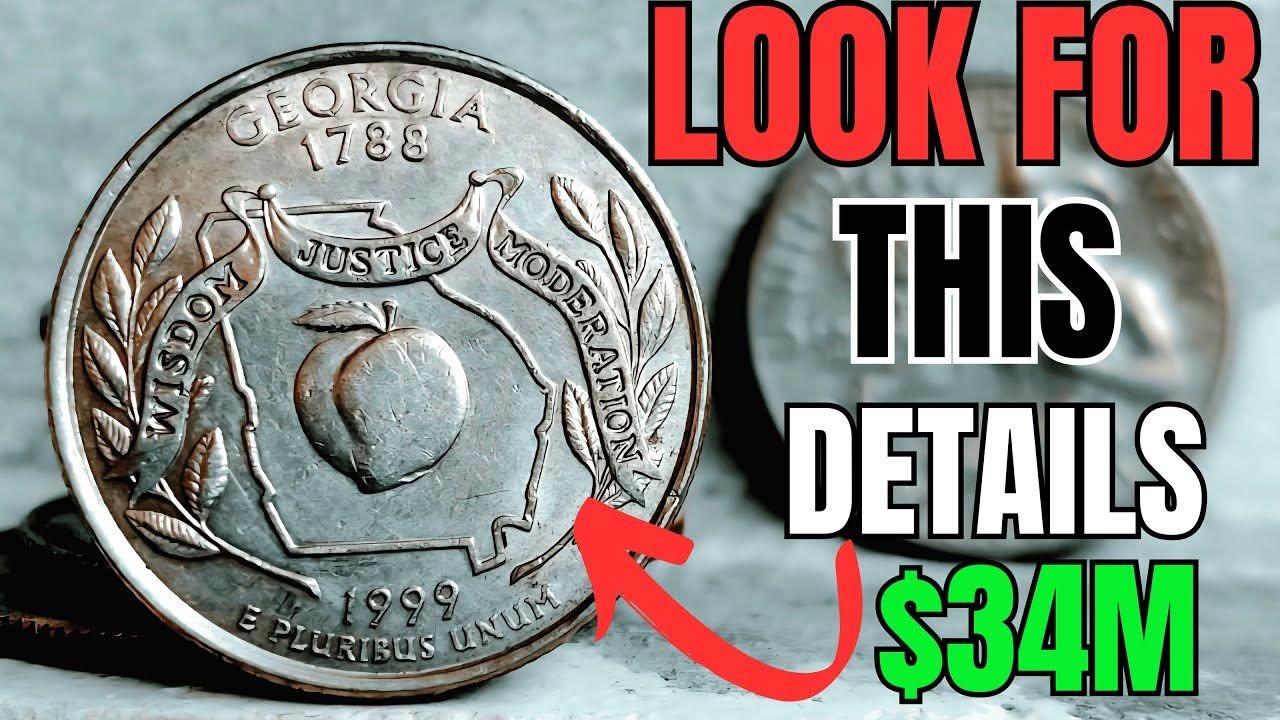
The thumbnail depicts a high-definition macro close-up of a 1999 Georgia State Quarter alongside bold, high-contrast clickbait-style overlay text and graphic pointers.
-
Coin Features: The obverse (or reverse detail) displays the official 1999 Georgia state quarter design featuring the outline of the state of Georgia, a central peach, sprigs of oak surrounding the motto banner ( Wisdom, Justice, Moderation ), and the inscriptions GEORGIA 1788 at the top and 1999 E PLURIBUS UNUM at the bottom.
-
Visual Annotations:
-
A bright red curved arrow points directly to the bottom right rim of the coin near the year inscription.
-
Overlaid text reads LOOK FOR THIS DETAILS in large white letters with black outlines.
-
Green text at the bottom right states $34M, while the background thumbnail features a massive text overlay declaring LOOK FOR THIS in bold red and white.
-
Understanding the Error & Real Market Values
While YouTube clickbait titles frequently claim figures like $310,000+ or $34M, the actual market reality of rare 1999 Georgia quarters is rooted in historical Mint experimentation rather than multi-million dollar payouts.
What Makes This Quarter Special?
In 1999, the United States Mint tested new metal alloys for the upcoming Sacagawea Golden Dollar (introduced in 2000). During alloy testing, a limited number of 1999 State Quarters—including Georgia, Pennsylvania, Delaware, Connecticut, and New Jersey—were accidentally struck on these experimental planchets (blanks).
Physical Characteristics of a Genuine Experimental Quarter
-
Golden/Greenish Tonal Hue: The coin has a distinct manganese-brass golden color similar to a Sacagawea dollar rather than standard silver-clad nickel.
-
No Copper Stripe: Unlike normal clad quarters, the edge lacks the standard split copper layer.
-
Overweight: Standard quarters weigh 5.67 grams. Experimental planchet error quarters typically weigh between 5.9 grams and 6.7 grams.
-
Thicker Profile: The blank is slightly thicker than normal pocket change.
Real-World Valuation Breakdown
What to Do If You Suspect You Have One
-
Weigh the Coin: Use a digital jewelry scale accurate to 0.01 grams. An authentic error must be overweight (5.9+ grams).
-
Examine the Rim: Check if the edge has a silver/copper sandwich look. If it lacks the copper stripe and displays a smooth or unusual edge, it warrants further inspection.
-
Do NOT Clean It: Cleaning a rare coin destroys up to 90% of its numismatic value.
-
Get Professional Authentication: Submit the piece to third-party grading services like PCGS or NGC for verification.