The 1966 Washington Quarter Rarity & Error Guide
Image Breakdown & Visual Analysis
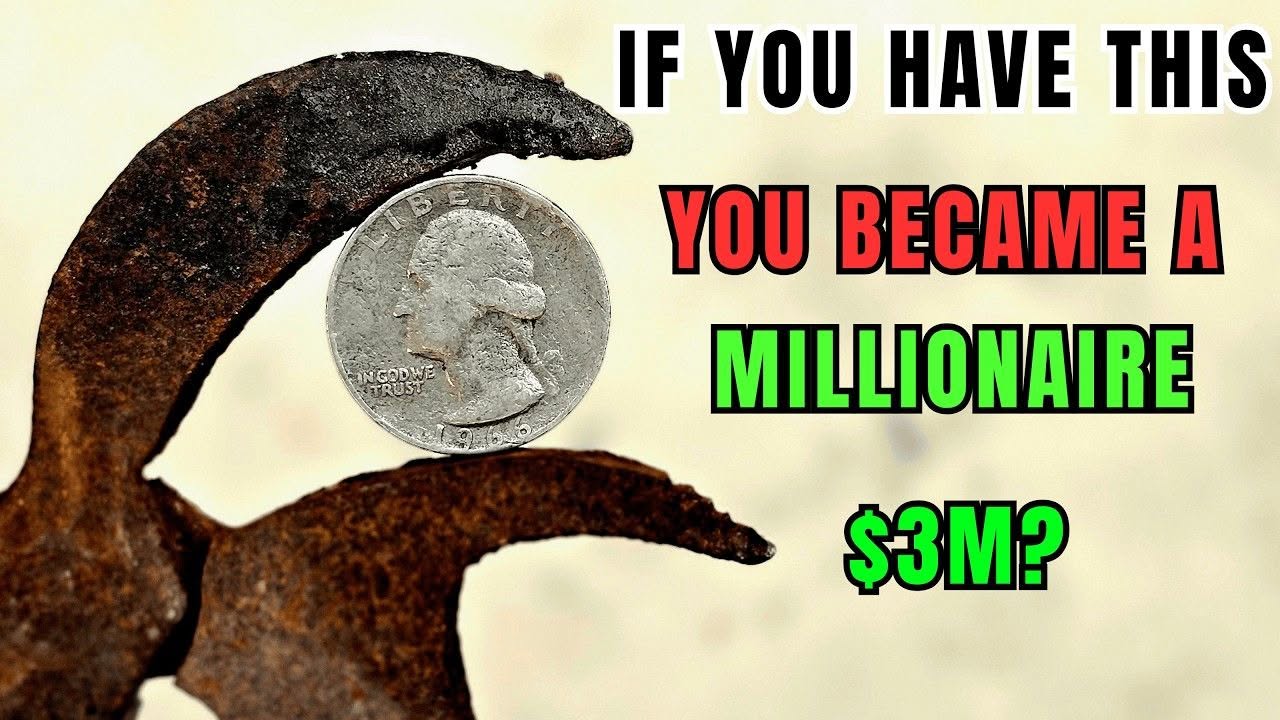
The YouTube thumbnail features a macro close-up of a 1966 Washington quarter held within rusted metal jaws, framed by sensationalist clickbait text designed to attract online viewers:
-
Coin Details: The featured piece is a 1966 Washington quarter displaying noticeable surface wear, circulation marks, and a dull patina. The obverse shows the portrait of George Washington, the motto IN GOD WE TRUST, the word LIBERTY, and the date 1966.
-
Visual Framing: The coin is dramatically pinched between the pitted, corroded tips of a heavy iron tool or rusty vice.
-
Graphic Overlays: Large text reads IF YOU HAVE THIS YOU BECAME A MILLIONAIRE with a glowing green $3M? graphic at the bottom right.
Reality Check: Is a 1966 Quarter Worth Millions?
While clickbait thumbnails claim values like $3 Million, standard 1966 quarters found in everyday pocket change are worth $0.25. The U.S. Mint struck over 821 million circulation quarters in 1966, making it one of the most abundant clad coins in history.
However, select rare conditions and mint errors elevate specific 1966 quarters into major high-value collector items:
1. Condition Rarity (Top Mint State Grades)
The U.S. Mint did not produce traditional proof sets from 1965 to 1967 due to a coin shortage. As a result, finding business-strike quarters in flawless condition is exceptionally rare.
-
MS67 Grade: Typically fetches $250 to $600.
-
MS68 Grade: Can sell for $1,000 to $11,000+.
-
Auction Record: The finest known 1966 quarter (graded PCGS MS68+) set an all-time record when it sold for $21,000 at Heritage Auctions.
2. Special Mint Set (SMS) Cameo Varieties
Special Mint Sets were offered to collectors as an alternative to proof sets.
-
Standard SMS (SP67): Worth about $20 to $35.
-
Deep Cameo (DCAM) SMS: Coins displaying heavy visual contrast between frosted devices and mirror-like fields command huge premiums, reaching $2,500 to $5,900+.
3. Transitional Silver Planchet Error (The Holy Grail)
In 1965, the U.S. Mint switched from 90% silver to a copper-nickel clad composition. A tiny number of 1965 and 1966 quarters were accidentally struck on leftover 90% silver planchets.
-
How to Identify: Standard 1966 clad quarters weigh 5.67 grams. A genuine silver error quarter weighs 6.25 grams and lacks the copper stripe along the outer rim.
-
Real-World Value: Transitional silver errors fetch between $4,000 and $15,000+ at numismatic auctions.
1966 Quarter Error & Variety Value Comparison
| Error / Variety Type | Key Diagnostic Feature | Typical Weight | Auction / Market Value |
| Circulated Business Strike | Common wear, standard edge | 5.67 g | $0.25 (Face Value) |
| Doubled Die Reverse (DDR FS-801) | Split serifs on UNITED and QUARTER DOLLAR | 5.67 g | $200 – $900+ |
| Quarter Struck on Dime Planchet | Off-center, undersized, missing text | ~2.27 g | $300 – $900 |
| SMS Deep Cameo (DCAM) | High frosted contrast on proof-like surfaces | 5.67 g | $1,000 – $5,900 |
| Transitional Silver Planchet Error | Solid silver edge, overweight | 6.25 g | $4,000 – $15,000+ |
| Finest Known Gem (MS68+) | Perfect mint luster, no surface flaws | 5.67 g | $21,000 (Record) |
What to Do If You Find One
-
Check the Rim: Look at the coin’s edge. A standard clad quarter shows a distinct red-orange copper strip along the rim. If the edge is solid silver, weigh it immediately.
-
Weigh on a Precision Scale: Standard clad quarters weigh 5.67 g. Silver planchet errors weigh 6.25 g.
-
Inspect Under Magnification: Use a 10x loupe to check for doubled lettering on the reverse text (E PLURIBUS UNUM, QUARTER DOLLAR).
-
Avoid Cleaning: Never polish or chemical-clean a potentially valuable coin, as doing so destroys its original surfaces and removes up to 90% of its market value.
-
Get Professional Grading: Submit authentic candidate errors to professional services like PCGS or NGC for certification.