
Patrick built the house in 1974 with his own hands and the help of two friends who were compensated in cold beer, weekend dinners, and the specific satisfaction of men who have made something real together. He was thirty-two that year and we had been married for seven years. We had Luke, who was five and who spent that entire summer running around the unfinished frame, pretending the exposed joists were bridges across dangerous rivers. Before that, we had been living in a rental that was adequate but that was not ours, and the not-ours quality of it had been weighing on both of us in different ways.
Patrick’s way of dealing with a burden was to do something practical about it. He had saved every spare dollar for five long years. He had designed the house himself, not formally because he was not an architect, but in the precise way of a man who understands raw materials and who has been imagining a home for so long that the imagination has become concrete. Three bedrooms were drawn into the plans. A kitchen that faced east was essential because I had told him once that morning light in a kitchen was the exact thing that made a house feel like a home.
He also built a porch on the back that looked out at the wide green yard. He built the porch so that two people could sit on it comfortably, which was what we ended up doing for the next forty-eight years. We sat on that porch together through every kind of weather. We watched Luke grow up in that yard, and we watched the yard change through the passing seasons while our lives proceeded from that particular angle, the angle of two people who have made something together and who can see it clearly from where they are sitting.
Patrick died two years ago on a crisp November day. He had a sudden stroke on a Monday morning while standing right in the kitchen where the morning light came through the east window. By the time the ambulance arrived at our driveway, he was already gone in the sudden way that people are sometimes gone before anyone has time to argue with it. He was eighty-one years old. He had spent fifty-four years of those eighty-one years living in this exact house.
He had built it and he had loved it and he had maintained it with the same quiet attention he brought to everything else in his life. He took care of the regular painting, the roof replacements, and the porch boards that he swapped out one at a time as they showed signs of rot. Because of his care, the porch was both original and renewed, a living thing of gradual continuity. After his funeral, which was held on a damp Thursday afternoon, Luke and his wife Brenda arrived on Sunday morning with a massive moving truck parked in front of the garage.
My name is Margaret. I am eighty-one years old and I have lived in this house since I was thirty-three, and I am going to tell you what happened to this place, to me, and to the family that Patrick and I thought we had built over a lifetime.
Luke had been living four hours away in a neighboring town. He had married Brenda eleven years ago, shortly after his first marriage fell apart. Brenda was a woman of very specific qualities, her primary quality being the ability to assess any situation purely in terms of what it offered her and to position herself accordingly. She had assessed our family the exact way a developer assesses a piece of vacant property. She had found us wanting in certain social respects and quite adequate in monetary terms.
Luke had learned, over eleven years of marriage, to see the entire world through Brenda’s cold assessment. He walked into the kitchen on that Sunday morning and set his keys on the counter.
“You shouldn’t be living alone here, Mom,” Luke said as he looked around the room.
“We’re going to stay for a while to help you get settled,” Luke added while opening the refrigerator door.
“It’s simply the right thing to do for family,” Luke insisted when I stared at him in silence.
“You really don’t need to do that,” I replied, setting my teacup down firmly on the saucer.
“We want to do this, Mom, so please don’t argue,” Luke said with a forced smile.
“We’ve already arranged everything with my employer so I can work remotely,” Brenda announced, walking in with two large suitcases.
They moved into my house that very afternoon. By the end of their first week, I was sleeping in the tiny sewing room on an uncomfortable folding army bed. I did not move because they had directly asked me to leave my master bedroom, nor had I volunteered to give it up. I moved because Brenda had begun making the master bedroom hers in the specific incremental way of someone who understands that real possession is established through accumulation. She worked through the gradual replacement of one person’s belongings with another’s until the room no longer recognized its original owner.
She moved my dresses out into the dark hallway closet. She moved her expensive cosmetics and heavy wardrobe into my private space. She did all of this quietly while I was making soup in the kitchen.
“You’ll actually be much more comfortable in the sewing room, Mom,” Luke told me that evening without looking me in the eye. “It stays much warmer in the winter months.”
The sewing room was not warmer at all. But I was eighty-one years old and I had been awake at three in the morning in the quiet way that old people who have lost their lifelong spouses are awake. It was not the wakefulness of simple insomnia, but the heavy wakefulness of someone whose bed has contained the wrong number of people for long enough that sleep has become an impossible transaction. I simply did not have the physical energy to fight them about a bedroom.
Part 2: Whispers in the Dark Kitchen
So I stayed in the sewing room, keeping my small possessions tucked neatly in the corner. By Thanksgiving, Brenda had subtly begun calling the property our house during every conversation. It was never referred to as my house or Margaret’s house anymore, but strictly our house. She said it in small ways that were not openly confrontational but were structurally deliberate, the way ownership language works its way into the vocabulary of a space until it seems like it was always there.
“Our house really needs a brand new furnace filter before December,” Brenda remarked at the dinner table.
“Our house is getting terribly drafty on the west side where the window seals are old,” Brenda said a few days later.
“I’ve been thinking about what structural changes we should make to our kitchen,” Brenda declared as she wiped down the wooden table.
I said absolutely nothing in response to any of those statements. I was learning at eighty-one that some battles were worth choosing while others were not. Choosing your battles was a crucial form of energy management, and the small amount of energy I possessed was finite and had to be saved for the things that truly mattered.
The things that mattered were clarifying very slowly in my mind. In January, Luke began taking three hundred dollars directly from my monthly pension check.
“Everybody needs to pay their fair share of the utilities, Mom,” Luke said as he stood near the kitchen table.
He said it while holding out his open hand toward me without a trace of shame. He said it while his shiny new pickup truck sat outside in my driveway. It was a vehicle that was only seventeen months old and had been purchased with heavy monthly payments that he had complained about several times.
“Here is the money, Luke,” I said quietly, handing him three hundred-dollar bills.
I gave it to him because I was eighty-one and because an open confrontation required a kind of energy that I was carefully reserving. I understood that what was happening in my home was something that needed to be fully observed and comprehended before I made my move. I was watching everything. I have always been a quiet watcher.
Patrick used to smile and tell our friends that Ruth sees everything, but she just doesn’t always speak it right away. He was completely right about me. I was watching every single detail.
In March, I woke up around two in the morning and got out of my narrow folding bed to get a glass of cold water from the kitchen. The hallway was completely dark, but the kitchen light was casting a bright yellow streak across the hardwood floor because Luke was inside speaking on his cell phone. He did not hear my soft slippers on the stairs because Patrick had built those steps with the specific knowledge of where wood creaked and where it remained dead silent. I had been walking those exact stairs for forty-eight long years and I knew every inch of the safe path.
I stood silently in the shadow of the hallway archway.
“She’s eighty-one years old now, man,” Luke said into the phone, his tone cold and detached. “The house is easily worth four hundred thousand in this current market. We can list it the exact day she’s out of here.”
Then Luke laughed. That specific laugh was the thing that cut through me. It was not just the terrible words he spoke, but the awful quality of the laugh itself.
It was the unmistakable laugh of a man who finds something deeply amusing that is not amusing at all, a man who has arrived at a place of comfort with cruelty that requires a chuckle to express it. That laugh was the sound of something terrible that I had been watching accumulate over five long months, suddenly becoming fully visible in the dark.
I turned around without making a sound and went back to the sewing room. I lay down on the thin mattress and stared up at the dark ceiling. Patrick had put up that exact ceiling board by board in the scorching summer of 1974, working tirelessly in the heat of the unfinished wooden frame before the roof was even finished.
I had brought him cold mason jars of ice water back then. He had drunk the water greedily, looked up at what his hands were creating, and smiled down at me.
“This is going to be our house, Margaret,” Patrick had whispered softly to me. “Ours forever.”
When he said ours, he had always secretly meant mine. It was his special word for mine because Patrick was the precise kind of man who understood that what he was building with his sweat was not for his own pride, but for the safety of the woman he loved. By the time the morning sun began to rise over the trees, I knew exactly what I was going to do. I knew it clearly and completely in the clear way that things become obvious when you have been watching a situation long enough for the whole picture to fill in.
Luke and Brenda were strict creatures of comfortable habits. Monday through Friday, Luke left the house for his office at seven in the morning. Brenda always drove over to her sister’s house in a neighboring town on Tuesday mornings, which was the routine they had established as their private day together. Her sister lived forty minutes away, and Brenda’s visits always lasted until mid-afternoon.
The very next Tuesday morning, I waited patiently for the house to empty out. Luke drove away at seven. Brenda left the driveway at nine sharply.
As soon as her car disappeared down the road, I walked into the kitchen and went straight to the old flour tin resting on the pantry shelf. The flour tin was a sturdy tin container I had used for forty-eight years. Brenda had never touched it because she did not cook in this house and had no reason to open a tin of baking flour.
Deep inside the flour tin, buried under the paper sack, was Patrick’s old brown leather folder. The leather folder had been his main document keeper for decades, the place where he stored the papers that mattered. The kind of man he was showed clearly in the neat way he kept that folder.
I pulled out the folder and drew out the original house deed. I also took my personal checkbook from my apron pocket. Then I picked up the kitchen telephone and called Natalie.
Part 3: The Secret Meeting on Elmwood Street
Natalie was my granddaughter. She was Luke’s daughter from his very first marriage, which had ended abruptly when Natalie was only nine years old. That marriage had ended badly, in the painful way of marriages that break apart because one person decides they are completely finished while the other person was never even consulted.
Luke’s first wife had been named Hannah. She was a good, hardworking woman in the quiet way of women who give a great deal of themselves to a marriage until they finally realize that giving more will never produce a different result. She and Luke divorced, and Luke married Brenda two short years later.
Brenda did not want young Natalie around their new life. This was never stated out loud in plain words, but it was communicated clearly through the subtle language of inconvenience, cold looks, and the slow withdrawal of welcome that makes a child understand they are unwanted long before anyone explicitly tells them so. Natalie was a sharp child who grew up into an equally perceptive adult, and she understood the dynamic completely.
Despite the distance forced upon her, she kept sending me sweet handwritten birthday cards every single year. She had even come to Patrick’s funeral two years ago, sitting quietly in the very back row of the chapel because Luke had told her she was not welcome to sit near the main family. That was a sentence I still thought about with deep sorrow, knowing it said far more about the cruelty of the man who spoke it than the young woman who received it.
She had sat alone in the back row at her own grandfather’s funeral service. When I noticed her sitting there, I walked right past Luke and sat beside her in the back row. If Natalie was not considered part of the family, then I had no desire to sit with the rest of them either. Luke had been too busy performing the role of the grieving son to even notice where I was sitting.
When I called Natalie from the kitchen phone that Tuesday morning, she answered the line on the second ring.
“Grandma Margaret?” Natalie asked, her voice light and surprised.
She always called me Grandma Margaret instead of just Grandma, as if she needed the full name to specify which grandmother she was speaking to, even though her mother’s mother had passed away when she was just three years old.
“Natalie, my dear, I need your help today,” I said plainly into the receiver.
“Tell me what’s wrong, Grandma,” Natalie replied instantly, her voice full of concern.
“I need to find someone who is willing to buy a house,” I explained clearly.
There was a brief silence on the other end of the line before she spoke again.
“Grandma, are you doing all right over there?” Natalie asked softly.
“I am completely fine in my mind, but I need to explain a few things to you right now,” I told her.
I explained everything that had happened over the last five months without leaving out a single detail. I told her about the moving truck arriving on Sunday morning right after the funeral. I told her about being pushed into the small sewing room to sleep on a folding cot. I told her about Brenda claiming our house, taking three hundred dollars from my pension check, and Luke’s shiny new truck sitting in the driveway.
Finally, I told her about standing in the dark hallway at two in the morning, listening to Luke’s phone call, and hearing that terrible laugh about listing the house the day I was gone.
Natalie remained completely silent while I spoke.
“How much are they planning to sell it for?” Natalie finally asked.
“I had a trusted lawyer look at the official property value recently, and he confirmed it is worth four hundred thousand dollars,” I said. “I want to sell the house to you today for two hundred thousand dollars.”
“Grandma, that’s…” Natalie gasped, unable to finish her sentence.
“Natalie, I want to sell it directly to you for two hundred thousand,” I repeated firmly. “I know you have been saving your earnings for years. I know you do not waste money on unnecessary things because that is who you are. I know you can manage this.”
“How do you even know how much money I’ve saved up?” she asked softly.
“Because you are the one person in this entire family who sends me birthday cards, and because I have been paying close attention to your life for thirty-two years,” I told her. “I know exactly who you are.”
She did not say anything for a long moment, but across the telephone line, I heard the quiet, muffled sound of someone trying to hold back deep tears.
“Yes,” Natalie sobbed gently. “Yes, Grandma, of course I will.”
“Are you absolutely sure about this decision, Grandma?” she added after taking a breath.
“I have never been more certain of anything in my life since the day I decided to marry your grandfather,” I replied.
“When do we do this?” she asked.
“Today,” I answered without hesitation. “I am going to call a taxi right now. I have the deed and my checkbook ready, and I need you to meet me at a lawyer’s office downtown.”
“Which lawyer’s office should I go to?” she asked, her voice turning practical.
I gave her the exact address on Elmwood Street. The lawyer was a man named Martin Clarke. He had been recommended to me by a trusted woman at my church who handled legal affairs for seniors. Her recommendation was that Martin was honest, efficient, and never treated elderly women as if their age made their mental faculties suspect.
He was a man in his late fifties with the calm demeanor of someone who had seen every possible family dispute and had no interest in being surprised by human greed. When I arrived at his office, he examined the old deed carefully, then looked up at me over his reading glasses.
“You are telling me you want to sell this property at fifty percent of its current market value?” Martin asked, reviewing his notes.
“Yes, that is exactly what I want to do,” I confirmed sitting straight in the chair.
“And you want to sell it directly to your granddaughter here?” Martin clarified, pointing to Natalie.
“Yes, to Natalie,” I said.
“And you are requiring a legal life lease as a non-negotiable condition of this sale?” Martin pressed.
“Yes,” I explained. “I want the legal right to live in my house until the day I die, paying exactly one dollar per year in rent.”
Martin turned his gaze toward Natalie, who was sitting quietly in the chair beside me. She was thirty-two years old and possessed Patrick’s striking blue eyes. It was something I had always found remarkable, that the distinct eyes of a man who was not her biological grandfather had somehow found their way into her face. She also had his natural stillness, the specific stillness of a person who spends their time paying close attention to the world around them.
“Miss Clarke,” Martin said, addressing Natalie directly. “Do you fully understand the legal terms of this agreement?”
“Yes, Mr. Clarke, I understand completely,” Natalie replied without hesitation.
“You are purchasing a valuable property significantly below market value, but it comes with a binding life lease attached to the title,” Martin explained. “When Mrs. Margaret Clarke passes away, the house will belong to you outright with no additional conditions or probate required.”
“I understand,” Natalie nodded.
“You must realize that once these papers are executed and filed with the county, this is not a reversible transaction,” Martin warned her. “This is a massive financial commitment on your part.”
“I know what I am doing, Mr. Clarke,” Natalie said clearly, looking the attorney dead in the eye. “My grandfather built that house with his own hands. My grandmother has lived in it for forty-eight years. I know exactly what I am doing today.”
“Very well,” Martin said, drawing a fresh stack of legal documents toward his desk.
It took nearly two hours to draft and verify all the paperwork. The life lease clause was the most critical part of the entire document. It explicitly stated that Margaret Clarke, as the seller, retained the absolute right of residence in the property located at the home address for the entire duration of her natural life. She could never be removed, evicted, or required to vacate by the new owner under any circumstances, and the property would pass fully and without condition to Natalie only upon my death.
The rent was set at one dollar per year.
When the final pages were prepared, we both signed our names neatly on the dotted lines. As soon as the pen was down, Natalie stood up and wrapped her arms around me, holding me tight for a long time. Martin Clarke stared down at his desk blotter, wearing the expression of a man who had facilitated hundreds of real estate transactions in his career, but rarely one that produced this specific quality of deep human emotion.
When Natalie finally stepped back, there were wet tears running down her cheeks, but she made no effort to wipe them away.
“Grandma, I have to ask you something important,” Natalie whispered.
“Ask me anything, dear,” I said.
“How are you going to manage Dad and Brenda when they finally figure out what we did today?” she asked nervously.
“They are not going to find out a single thing until the exact moment I want them to know,” I told her plainly.
“And when will that moment be?” Natalie inquired.
“When the time is right, they will find out,” I said with a slight smile.
“Is that really enough detail for you to feel safe?” she asked, searching my face.
“That is precisely as much detail as I need to carry out my plan,” I reassured her.
Natalie looked at me for a moment, seeing the determination in my eyes, before giving a firm nod.
“All right then,” she said. “Let me drive you back home.”
Part 4: The Specter of the Realtor
Natalie drove me back to the house and dropped me off at the end of the driveway. When I walked inside, Brenda was sitting in the kitchen scrolling through her phone.
“Where have you been all morning?” Brenda asked without looking up from her screen.
“I was out attending a lovely church luncheon with some friends,” I lied smoothly.
“Well, nobody misses you around here anyway,” Brenda scoffed, returning to her phone.
She had no idea what had just transpired at the lawyer’s office. I walked calmly into the pantry, opened the old flour tin, and tucked my official recorded copy of the new deed safely inside the metal container.
For six long months after that day, I sat back and watched them. I watched Brenda spend her afternoons looking at paint color swatches, choosing colors meant for future buyers.
“Future buyers will definitely want something light and neutral in the hallway,” Brenda would remark aloud to herself while holding up color cards. “I really wonder what potential buyers are going to think about this old hardwood floor.”
I said absolutely nothing to her remarks. I simply sat at the table and drank my hot tea.
A few weeks later, I watched Luke invite a tall, fast-talking man named Chuck into my living room. Chuck was a local real estate agent who carried himself with the supreme confidence of someone who had been promised a lucrative commission. He walked briskly through every single room of my house while Luke walked beside him, acting as a guide.
“Notice how the kitchen faces due east,” Luke pointed out proudly as they stepped into the kitchen. “It gives you incredible morning light coming through the window.”
Luke did not mention who had carefully drawn the floor plans to capture that light. He did not mention who had poured the concrete foundation or built the window frame with his own hands, or why that morning light mattered to our family. He simply treated it as a attractive selling feature.
“Good morning light is always a great selling point,” Chuck agreed, scribbling notes on his clipboard.
I stood near the counter and quietly poured fresh coffee into two mugs, offering them to the men.
“The old lady stays here with the property for the time being, but obviously not for long,” Chuck said in a low voice, chuckling as he took a mug from my hands.
Luke laughed right along with him, a short, dismissive sound.
“Here is your coffee,” I said politely, refilling their cups without a hint of emotion. I said nothing else.
In September, Brenda brought a professional house painter into the living room to estimate the cost of repainting the entire interior.
“We’re thinking about going with something very warm but completely neutral,” Brenda told the painter, gesturing toward the walls. “We want the new buyers to feel like they can immediately put their own personal stamp on the space.”
The painter stepped closer to the wall and ran his hand along the smooth surface. Patrick had painted those exact walls himself. The living room was painted a specific shade of soft, warm yellow that I had chosen back in 1989 from a thick sample book we had spread out across the kitchen table on a sunny Saturday afternoon, spending hours picking the perfect tone together.
“I can certainly paint over this for you,” the painter said, turning to Brenda. “Though I have to say, these walls are in pristine condition.”
“Yes, ma’am, they really are,” the painter added, looking directly at me with respect. “This house has good solid bones.”
“We will be in touch with you next week about the pricing,” Brenda interrupted coldly, cutting the painter off.
I took another sip of my tea and said nothing.
By late October, a glossy colorful brochure for a local senior living facility arrived in the daily mail. I knew immediately that Luke had requested it. The brochure advertised a full-care nursing home located forty minutes outside of town, the exact kind of sterile facility that brochures describe as comfortable and that costs a staggering amount of money every month.
Luke intentionally left the brochure sitting right in the center of the kitchen table one evening after dinner. He did not say a single word about it when I walked into the room. He simply left it there as an unmistakable signal that an uncomfortable conversation was coming very soon.
I picked up the paper, looked at the photographs of the small rooms, and set it back down on the wooden surface. I said nothing.
Then came a dark Friday morning in early November. I walked out of the sewing room and found my large blue suitcase sitting directly beside the front entrance door. Resting right on top of the suitcase was an official intake form for the nursing home, with a specific room and bed number circled in bright red ink.
He had actually circled the bed number. It was the specific, calculated indignity of a red circle on a piece of paper. I stood there in the hallway and looked at it for a long moment.
A few minutes later, Luke walked into the kitchen, pulled out a wooden chair, and slid an official property transfer document across the table toward me, accompanied by a black pen.
“Sign this house over to us today, Mom, and prepare to leave by next Friday,” Luke said, leaning back in his chair.
“Before I do anything, you should probably ask the man who actually owns this house,” I replied softly, keeping my hands folded in my lap.
Luke burst out laughing, shaking his head at me.
“The only man who ever owned this house was buried six feet under two years ago,” Luke sneered, referring to his own father.
Brenda slammed her coffee mug down onto the table so hard that liquid splashed over the rim.
“Patrick is dead and gone, Margaret, and you are just a confused old woman!” Brenda snapped, her face twisting with anger. “Confused old women end up in locked memory units, not comfortable sewing rooms!”
She spoke with the unrestrained cruelty of a person who had been managing her deep contempt for a long time and had finally reached the point where managing it was no longer necessary because she believed the final outcome was guaranteed.
Luke leaned across the table, getting close to my face.
“Next Friday is the absolute deadline, Mom,” Luke said in a stern, commanding voice. “The real estate agent is arriving here at ten o’clock this morning to take official photos, and the moving van arrives at noon. Sign the transfer paper before then so we can keep this whole process friendly.”
I did not flinch or shout. I said nothing at all. I simply picked up my teacup and took a slow sip.
Later that afternoon, as soon as Luke and Brenda went out to run errands, I walked to the kitchen phone and dialed Natalie’s number. She picked up before the first ring even finished.
“It is happening this Friday morning,” I told her clearly.
“Yes, Grandma,” Natalie answered instantly. “Are you truly ready for this?”
“I have been completely ready for this moment since that night in March,” I assured her.
“Oh, Grandma,” she breathed softly.
“I love you very much, Natalie,” I said.
“I love you too, Grandma,” she replied. “What time should I arrive at the house?”
“The real estate agent is coming at ten o’clock,” I said. “Be standing on the front porch at ten o’clock sharp.”
“I will be there at ten sharp,” she promised.
“Natalie,” I added before hanging up.
“Yes, Grandma?”
“Make sure you bring the blue folder with you,” I instructed.
“I have it right here,” she said. “Should I bring the house keys too?”
“Yes,” I told her. “Bring the keys.”
Part 5: The Blue Folder on the Table
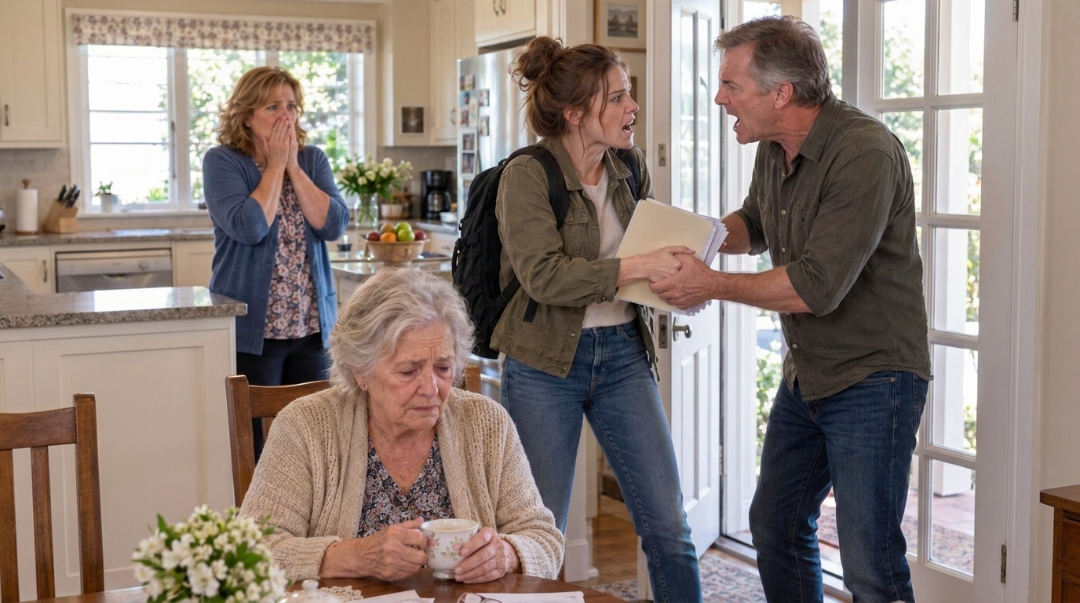
On Friday morning, Luke came downstairs wearing his crispest dress shirt. He had spent twenty minutes ironing it, and he walked into the kitchen with the smug satisfaction of a man who believes he is about to successfully execute a massive financial deal.
Brenda was busy arranging store-bought cookies on a delicate porcelain plate. It was my mother’s floral china plate, a precious family heirloom that had been handed down to me. Brenda had taken it from the cabinet and arranged the cookies on it without ever asking for permission, completely unaware of whose history rested beneath those treats.
The property transfer paper was resting right in the middle of the kitchen table with the black pen lying beside it. My blue suitcase was still sitting by the front entrance, topped with the nursing home form and the red-circled bed number.
At exactly ten o’clock, the front doorbell rang through the house.
Luke smoothed his ironed shirt, adjusted his posture, and walked confidently down the hallway toward the entrance. He grabbed the brass handle and pulled the front door wide open.
Standing on the wooden porch was a young woman holding a thick blue folder in one hand and a shiny ring of house keys in the other.
I stayed seated at the kitchen table, carefully watching Luke’s face through the open doorway. I had been watching my son’s face for fifty-six years, ever since a crisp morning in 1968 when the hospital nurse had first placed him into my arms and he had looked up at me with the unfocused gaze of a person who has just arrived in the world and is trying to decide what to make of it.
Over the decades, I had seen his face in every possible configuration. I had seen him happy, furious, weeping, terrified, bored, distracted, and deeply in love. But in all my eighty-one years, I had never seen his face turn completely ghost-white.
“You…” Luke whispered, his voice cracking as he stumbled backward a step.
“Hello, Dad,” Natalie said calmly, standing tall on the porch.
“You’re nobody here!” Luke stuttered, his voice rising in panic. “She’s nobody, Brenda! She isn’t allowed to step foot inside this house!”
Natalie did not hesitate. She walked right past him through the doorway and stepped firmly into the front hallway.
“That’s a very strange thing to say, Dad,” Natalie remarked coolly. “Especially considering I have the keys to the front door right here.”
She lifted the ring of keys and let them jingle in the air.
Brenda came rushing out of the kitchen, her eyes wide as she stared at Natalie in disbelief.
“Luke, who on earth is this girl?” Brenda demanded, looking between them.
Luke was staring at his daughter with the terrifying expression of a man trying to comprehend a reality that refused to organize itself into a shape he could control. He slowly turned his head and looked down the hallway at me.
I was sitting quietly at the kitchen table with my warm teacup in my hand. I had made my tea that morning the exact same way I had made it every day for decades, using the heavy metal kettle that Patrick had bought for me back in 1991. I took a slow, deliberate sip.
Luke’s eyes dropped down to the thick blue folder clutched in Natalie’s hands. He stepped forward nervously and snatched the folder from her grip. He flipped it open and began reading the legal document inside.
I watched him read every line. I watched his eyes move rapidly across the recorded deed, scanning down the page until his gaze landed squarely on the official owner’s name. He read the name once. He blinked, shook his head, and read it a second time.
“This is completely impossible,” Luke stammered, his hands beginning to shake. “You didn’t have this kind of money! Who paid for this?”
Natalie held out her right hand toward him, her voice remaining steady and calm.
“Read the owner’s name out loud, Dad,” Natalie commanded. “Read it right now so your wife can hear it.”
Luke could not bring himself to speak the name. He simply stared down at the paper as if it were written in a foreign language.
“Luke!” Brenda yelled, stepping up beside him. “Who is she and what does that legal paper say?”
Luke slowly lifted his head. He looked at Brenda’s angry face, then at Natalie’s calm expression, and finally at me sitting at the head of the kitchen table.
I set my teacup down on the saucer with a soft click.
“Her name is Natalie,” I said clearly, my voice echoing through the house. “She is your biological daughter, Luke. And she is the sole owner of this house.”
Brenda gasped, taking a step back. “That’s completely ridiculous! That can’t be!”
“Luke, tell me what is going on!” Brenda demanded, grabbing his arm. “How could she possibly own this house?”
“Because I sold the house directly to her six full months ago,” I answered before Luke could speak.
“You can’t just sell a house like that!” Brenda shouted, her voice shrill. “You need… you need proper authorization!”
She stopped mid-sentence. She was a woman who understood property laws well enough to realize that the argument she was trying to construct was falling apart before she could even finish the thought.
“You need legal assistance to sell real estate at your advanced age!” Brenda tried again, desperate.
“I possess the exact same mental faculties at eighty-one that I possessed when I was thirty-one years old,” I told her sternly. “I hired a respected lawyer. I had the official deed. I had my checkbook. I legally sold my house to my granddaughter six months ago.”
“That is simply not legal!” Brenda insisted, her face flushed red.
“You are welcome to visit Attorney Martin Clarke over on Elmwood Street,” I informed her smoothly. “He will be more than happy to show you the recorded documents. Everything was legally drafted, signed, stamped, and recorded at the county land registry office.”
Brenda turned to Luke, grabbing the blue folder from his shaking hands. Luke stood there numbly, making no effort to stop her.
“Dad,” Natalie said, stepping closer to him.
Luke looked up at her, looking utterly defeated.
“I would like my folder back now,” Natalie said firmly, extending her hand.
When he didn’t move right away, she spoke again. “It belongs to me.”
Slowly, Luke took the folder back from Brenda and handed it over to Natalie. He handed it over the way a man hands over his weapons when he finally realizes that fighting is no longer an option, when the boundary of what is his and what is not has shifted so completely that denial is useless.
Natalie took the folder and held it against her chest.
“There is also an official life lease attached to the title,” Natalie explained to both of them. “Grandma Margaret has the absolute legal right to live in this house until the day she passes away. That condition is recorded right there in the deed.”
Brenda dropped her hands to her sides, her mouth open in shock. “So you’re telling me… this entire house has already been sold out from under us?”
“Six months ago,” Natalie confirmed. “The sale is fully recorded at the county courthouse. The life lease is recorded right alongside it. Every bit of it is completely legal, binding, and finished.”
“The real estate agent is not needed today,” Natalie added coldly. “The nursing home intake form is going straight into the trash. And that property transfer paper sitting on the kitchen table is something my grandmother will never sign.”
Brenda glared at Natalie, her eyes burning with frustration. “We have been living in this house for two whole years!”
“Yes,” Natalie replied without raising her voice. “You have been living here as my grandmother’s guests. Guests who stole her master bedroom, stole her pension money, and had the nerve to call this place ‘our house’.”
She stated the facts quietly, presenting them as indisputable truths.
“Luke! Say something to her!” Brenda shrieked, shoving his shoulder. “Fix this!”
Luke looked at his daughter, his eyes filled with a mixture of confusion and shame.
“When did she call you about this, Natalie?” Luke asked softly.
“Back in March,” Natalie answered directly. “The very morning after you stood in that hallway at two in the morning and told your buddy on the phone that the house was worth four hundred thousand and you’d list it the exact day she was out.”
Luke gasped, turning his head toward me in horror. “How could you possibly know about that phone call?”
“She heard every single word you said, Dad,” Natalie revealed.
“That’s impossible,” Luke stammered. “She was fast asleep in the sewing room!”
“I was not asleep at all, Luke,” I said, looking him straight in the eyes. “I had gotten up to get a glass of cold water. I was standing right there in the dark hallway.”
Luke stared at me in a way he had not looked at me in two long years. He looked at me directly, stripped of the calculated avoidance of a man who spends his time managing around a mother he considers an inconvenience.
“Mom…” Luke whispered, his voice trembling.
“Yes, Luke?” I replied calmly.
“I really didn’t mean…” Luke started to say.
“Luke,” I interrupted, cutting him off before he could fabricate an excuse. “Do not dare tell me what you meant to do. Tell me what you actually did.”
Luke closed his mouth and remained completely silent.
Part 6: The Weight of an East-Facing Window
Brenda slammed her hand down on the kitchen counter, her face contorted with rage. “This absolute nonsense is not over! We are going to hire a high-powered lawyer on Monday morning and fight this whole thing in court!”
Natalie smiled slightly, totally unbothered by the threat. “Yes, please do hire a lawyer, Brenda. I strongly encourage it. Attorney Martin Clarke will be in his office at nine o’clock sharp on Monday. He holds the official recorded deed, the life lease agreement, and all the notarized closing documents.”
“He also has the cleared two-hundred-thousand-dollar check I wrote back in March, fully deposited and processed through the bank, along with the complete tax transfer records,” Natalie added. “So please, go ahead and spend your money on a lawyer.”
Brenda turned back to Luke, her voice panicked. “She can’t get away with doing this! She’s an old woman, she’s…”
Brenda stopped dead in her tracks. She looked directly at my face and saw an expression of absolute resolve that offered zero support for whatever accusation of senility she was about to make.
“Brenda,” I said, breaking the heavy silence.
“What do you want?” Brenda snapped defensive.
“I want both of you to understand something very clearly today,” I told them. “I did not sell this house out of petty anger. I sold this house because it was mine to sell.”
“Patrick built this home for me in 1974,” I continued, my voice steady and strong. “He put my name first on the legal deed, and it remained mine for forty-eight years. It was mine to do with exactly as I saw fit, and I chose to sell it to Natalie.”
“You only gave it to her because she needed the money!” Brenda blurted out.
“No, Brenda, that was not the reason,” I corrected her gently. “I gave it to Natalie because she has been the only person in this family who remembered to call me on my birthday for thirty-two years. I gave it to her because she sat quietly in the back row at her own grandfather’s funeral after you told her she wasn’t welcome near the rest of the family.”
I turned my gaze to Luke, looking deep into his eyes.
“This house was built by a good man who strongly believed that family meant the people who actually show up for you,” I said to my son. “Natalie showed up.”
“Mom, I showed up here too,” Luke pleaded, taking a step toward the table. “I came back to help you.”
“Yes, you showed up, Luke,” I admitted softly. “But you showed up for the house, not for me.”
Luke looked down at the floor, unable to say a word.
“It was the laugh, Luke,” I added quietly.
“What laugh?” he asked, his voice barely a whisper.
“That laugh in the dark kitchen back in March,” I explained. “When you chuckled about listing my home the day I was out. That laugh was the one thing I could never forgive.”
Luke stood frozen in place. Brenda slowly walked over to the kitchen table and sank into a chair. She picked up the unsigned transfer document, looked at the empty signature line for a long moment, and then tossed it back onto the table.
“I want to know what happens with this life lease,” Brenda said, her tone suddenly flat.
“Grandma Ruth lives right here until the day she dies,” Natalie stated firmly. “When that day comes, the entire property passes to me. Neither of you has any legal claim, right, or standing in this house ever again.”
“We’ve been paying money towards the house…” Brenda began.
“Are you asking if my grandmother plans to demand full reimbursement for the three hundred dollars you stole from her pension check every month?” Natalie interjected sharply. “Because we can certainly have Attorney Martin Clarke bring that up in court if you’d like to pursue legal action.”
Brenda looked up at Luke, but Luke remained completely silent.
Luke slowly sat down at the wooden table across from me. He placed his elbows on the surface, covered his face with both hands, and let out a long, shuddering sigh.
“I honestly never thought you would do something like this, Mom,” Luke mumbled into his palms.
“Do what, Luke?” I asked.
“Fight back against us,” Luke confessed, lifting his head slightly. “You’re eighty-one years old.”
“Yes, I am eighty-one,” I replied.
“I just thought…” Luke swallowed hard, struggling to find the words. “I thought you would just accept it and go.”
“Where on earth did you think I was going to go, Luke?” I asked, leaning forward. “I have lived in this house since I was thirty-three years old. Your father built every inch of this structure specifically for me.”
“I sat right on that porch and watched you run across those exposed floor joists the summer it was built, while your father’s heart was in his throat every time you got close to the edge,” I recalled softly. “I have poured forty-eight years of my life into these walls. Where did you honestly expect me to go?”
“I thought… Brenda said the senior facility was the best place for you,” Luke mumbled, shame written across his face.
“Yes, Brenda said so,” I noted. “And you went right along with her.”
“I know,” Luke whispered, tears welling in his eyes. “I know I did. Mom… I am so sorry.”
He spoke with the quiet quality of a genuine apology that has had every performative layer stripped away. It was the raw apology that remains when a person finally realizes the full weight of the harm they have caused and realizes they have no valid defense left.
I looked at my son sitting across from me. I thought back to that hot summer of 1974. I thought about the wooden joists, the sound of his childhood laughter, and his father’s protective heart. I thought about the years before Brenda came into his life, the years when he was a thoughtful young man who called every Sunday evening just to hear my voice.
He was a man who had been deeply changed by the influence of a toxic relationship that had redirected him toward a cruel version of himself I hardly recognized. That change did not excuse his actions, but it explained them.
“I know you are sorry, Luke,” I said quietly. “A real apology is a beginning, but it is only a beginning.”
“What does a beginning look like for us now?” Luke asked, looking up at me.
“You start by packing your things and leaving my house today,” I instructed clearly. “And then you make things right with Natalie.”
Luke turned his head and looked at his daughter. Natalie was still standing near the hallway entrance, holding the blue folder against her chest. Her face showed a complex mix of lingering pain and cautious openness. She was looking at a father who had hurt her deeply, but who was now standing stripped of his arrogance.
“Natalie…” Luke said, his voice breaking. “I stopped calling you years ago.”
“Yes, Dad, you did,” Natalie agreed softly.
“I let Brenda push you out of my life,” Luke admitted, tears spilling over his cheeks. “I was a coward, and I am so terribly sorry.”
“I know you are,” Natalie replied quietly. “I hear you.”
“Can you ever forgive me?” Luke asked, desperate.
“I will think about it,” Natalie answered honestly.
It was not an immediate absolution, but it was not a closed door either. It was a statement that required real time and consistent demonstration before it could carry any true meaning. Luke nodded his head slowly, accepting her terms.
Brenda sat silently at the table, staring down at my mother’s floral china plate. She slowly reached out, picked up a cookie, looked at it for a second, and then placed it right back down. She looked across the table at me, her eyes hollow.
“How long have you known about all of this?” Brenda asked softly.
“Since that night in March when Luke laughed in the dark kitchen,” I told her.
“And you stayed quiet and said absolutely nothing for six whole months?” Brenda asked in disbelief.
“I was watching,” I replied simple.
“Watching what?” she pressed.
“I was watching you pick out paint swatches for buyers who were never going to come,” I explained. “I was watching that real estate agent walk through my living room. I was watching you serve cookies to strangers on my own mother’s china plate.”
“I honestly didn’t know that plate belonged to your mother,” Brenda whispered, looking down.
“No, you didn’t know,” I agreed. “And that is the exact core of the problem.”
“What do you mean?” Brenda asked.
“You didn’t know, and you never bothered to ask, because you had completely stopped viewing me as a real human being who owned things of her own,” I told her plainly.
“Margaret…” Brenda started to say.
“Listen to me very carefully, Brenda,” I interrupted, keeping my voice firm. “This house is going to outlast every single person sitting in this room today. Patrick built it with his hands in 1974, and it will still be standing long after you, Luke, Natalie, and I are all gone from this earth.”
“And the grand truth that will remain about this house when it outlasts us all is that a good man built it out of love for his wife, a devoted granddaughter bought it to keep it safe in the family, and an old woman who everyone assumed was powerless discovered she had all the leverage she ever needed,” I declared.
“All because your name was listed first on the deed,” Brenda said quietly.
“Because Patrick put my name first,” I corrected her. “On the exact day we signed the original papers forty-eight years ago, I asked him why my name was written before his.”
“What did he tell you?” Brenda asked, genuinely curious.
“He smiled at me and said, ‘Because it is your house, Margaret. I’m just the lucky man who gets to build it for you,’” I recalled, a soft smile touching my lips.
Brenda looked down at the wooden table and said nothing more.
Luke slowly stood up from his chair. “We will start packing our bags right now,” he said quietly. “We’ll be out of your way by this afternoon.”
“Thank you, Luke,” I nodded.
“Mom,” Luke added, pausing as he stepped away from the table. “Where are you going to sleep tonight?”
“I am going to sleep right in my own master bedroom,” I answered without hesitation.
Luke gave a small, somber nod. “I will move all of our belongings out of your room first thing.”
He walked quietly up the stairs. Brenda stood up from her chair, paused, and turned to face Natalie.
“I know I have absolutely no right to say anything to you right now,” Brenda said, her defensive edge completely gone.
“Say whatever you need to say,” Natalie replied neutrally.
“Luke is not a malicious man at heart,” Brenda said softly. “He is just a weak man who makes terrible choices when I push him to make them.”
She spoke with the startling, raw honesty of a person who has suddenly come face-to-face with her own flaws and realized that lying any longer was useless.
“Yes, that is true,” Natalie agreed plainly.
“I am truly sorry for how I treated you over the years, Natalie,” Brenda said, looking down.
“I know,” Natalie nodded gently. “I will think about that too.”
It was the exact same condition. Words meant nothing without future actions to prove them. Brenda turned around and slowly walked up the stairs to pack her bags.
The kitchen fell completely quiet. Natalie walked over to the table and sat down in the chair across from me.
“Grandma,” Natalie whispered softly.
“Yes, my dear?” I replied.
“Are you really doing all right after all of this stress?” she asked with deep concern.
“I am doing wonderfully,” I assured her with a bright smile. “I am eighty-one years old, and I am sitting in the sturdy house my husband built for me, knowing I am legally secured to stay here for the rest of my life.”
“I have a wonderful granddaughter who sat in the back row at her grandfather’s funeral because she is the kind of person who shows up for family even when she is told she isn’t welcome,” I added, reaching across the table to squeeze her hand. “Yes, Natalie, I am doing very well.”
“I want to come over and visit you much more often,” Natalie said, her eyes shining with joy.
“I would love nothing more,” I agreed. “How about every Sunday?”
“Every single Sunday,” Natalie promised. “I’ll make sure to bring delicious food over.”
“You certainly will not,” I teased gently. “You will sit right here and eat my homemade cooking.”
“I would love that so much, Grandma,” Natalie laughed softly.
She looked around the bright kitchen, admiring the wooden cabinets and the warm sun shining through the glass.
“Grandma, I want to ask you something about the future,” Natalie said thoughtfully.
“What is on your mind?” I asked.
“When this house eventually becomes mine… what do you want me to do with it?” she inquired.
I turned my head and looked around the warm kitchen. The bright morning light was pouring through the east window, filling every corner with gold, exactly the way it had every single morning for forty-eight years. It was the specific quality of morning light that I had asked Patrick for, and that he had carefully aligned the foundation to catch just for me.
“I want you to sit on the back porch,” I told her simply.
“That’s all you want me to do?” Natalie asked with a gentle smile.
“I want you to sit on that back porch on warm summer evenings, look out at the green yard, and think about the people who sat there before you,” I explained. “And then I want you to invite your own loved ones to sit right there alongside you.”
“I promise I will do that,” Natalie said, tears of happiness filling her eyes.
“And I want you to cook wonderful meals in this kitchen,” I added.
“You know I’m not a very good cook yet, Grandma,” Natalie chuckled nervously.
“Then I will teach you everything I know,” I declared warmly.
“Starting when?” she asked.
“Starting right now,” I said, rising from my chair.
I walked into the pantry, reached up to the shelf, and grabbed the heavy tin of baking flour. I carried it back to the table and opened the lid. The recorded copy of my house deed was still lying tucked inside. I pulled the paper out, set it gently on the wooden surface, and then poured fresh flour into the tin.
“Some important things you put away in a safe place until you need them,” I told her, folding the document neatly. “And once everything is settled, you don’t really need them in the tin anymore.”
I slipped the folded deed safely into my apron pocket. “But you keep them close to your heart anyway.”
Natalie smiled warmly at me, her face full of love. “Yes, Grandma, you keep them anyway.”
“Grandma?” Natalie asked softly after a moment.
“Yes, dear?”
“Grandfather Patrick always knew, didn’t he?” she asked. “He knew you would figure out a way to handle whatever trouble came your way. He knew how strong you were.”
I paused and thought about Patrick. I thought about the day we signed the papers in 1974, and the way he smiled when he put my name first on the deed because it was my house.
“Yes, Natalie,” I whispered, feeling his presence all around us in the warm light. “He always knew.”
“He was a very smart man,” Natalie smiled.
“He certainly was,” I agreed. “He was right about almost everything.”
“Was that ever annoying?” she teased playfully.
“Only occasionally,” I laughed. “The rest of the time, it was absolutely wonderful.”
I pulled out a mixing bowl and began preparing the dough for fresh buttermilk biscuits. Outside in the driveway, I could hear the muffled sounds of Luke and Brenda loading their heavy suitcases into the back of their truck. I didn’t bother to look out the window.
I stayed right where I belonged, standing in the middle of my kitchen, wrapped in the warm morning light coming through the east window, right where Patrick had placed it just for me.