I Hid It Before She Could Notice.
Hours Later, I Opened the Envelope—and found a birth certificate and a tiny key.
What I discovered next made me question whether my son’s death had ever been an accident at all.
PART 1

“If that woman sees this envelope, my mom says something terrible could happen to me, too.”
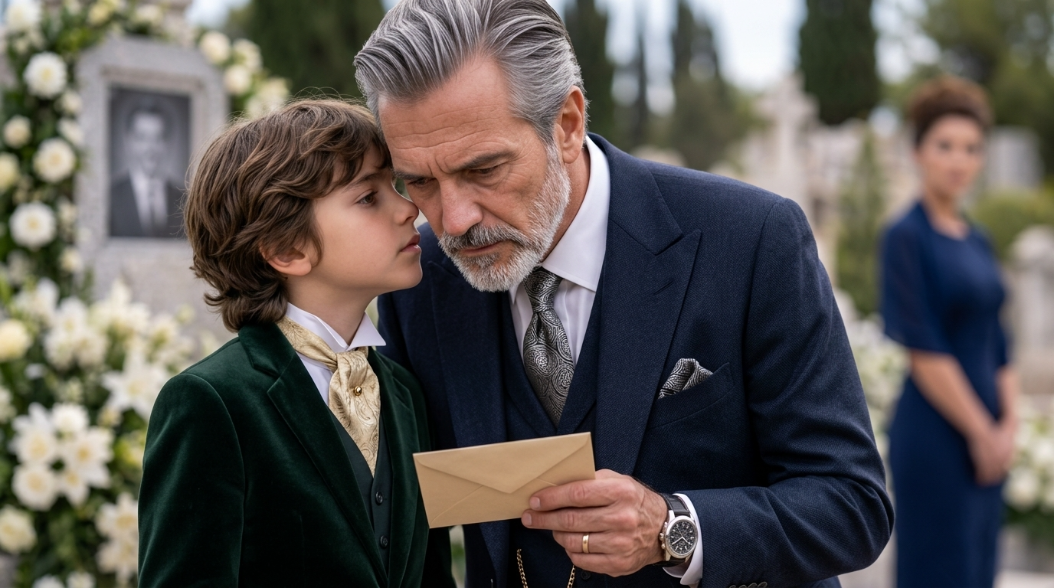
Those were the very first words spoken to me by the young boy who appeared at my elbow during my son’s funeral.
I was standing beside Julian’s grave at a cemetery just outside Chicago, struggling to comprehend how a father is supposed to keep drawing breath while his only son is lowered into the cold earth. Julian was thirty-six years old. Three weeks earlier, his pickup truck had skidded off a slick highway near Milwaukee. The state police talked about heavy rain, excessive speed, and tragic bad luck.
I kept repeating those official words to myself so I wouldn’t lose my mind.
Then I felt a small, urgent tug on the sleeve of my wool coat.
The boy couldn’t have been more than nine years old. Dark hair, an oversized navy jacket, and serious, guarded eyes that didn’t belong on a child. He glanced nervously toward Chloe, Julian’s widow, who was surrounded by weeping relatives and senior executives from Vance Logistics, then pressed a worn manila envelope into my hand.
“What’s your name, son?” I asked softly.
“Lucas.”
“And where is your mother?”
“In the hospital,” Lucas whispered. “Mrs. Gable brought me here. She’s waiting in the car outside. My mom told me I had to find you and give you this without Julian’s wife seeing me.”
A sudden, violent blow seemed to strike my chest.
I slipped the envelope deep inside my coat pocket just as Chloe turned her head toward us. She had been crying through the entire graveside service, but there was something strangely practiced about her grief. I couldn’t put my finger on it. Maybe it was unfair of me; maybe my overwhelming grief was turning me paranoid. Still, when our eyes met across the grass, her gaze darted first to the young boy, then directly to my coat pocket.
That evening, I brought Lucas to my quiet suburban home in Naperville. Mrs. Gable, a neighbor of Lucas’s mother, explained that the boy’s mother, Nora, had been involved in a serious hit-and-run accident two days ago. Before she was wheeled into surgery, she had begged her neighbor to bring Lucas to Julian’s funeral to deliver that envelope to me.
I waited until Lucas was fast asleep in the guest room before I sat at my desk and broke the seal.
Inside was an old photograph of my son Julian, taken nearly ten years ago. Beneath it lay an official state birth certificate. In the space designated for the father’s name, the line was left blank.
And then there was the letter.
Mr. Vance:
You don’t know me. I was in a relationship with Julian nearly ten years ago, before he met Chloe. When we broke up, I discovered I was pregnant. I was young, afraid, and decided to raise our son alone. I made a terrible mistake. Julian died without ever knowing that Lucas was his son.
I had to stop reading. My hands began to shake.
I picked up the photograph. The same quiet smile. The exact same arch of the eyebrows. The same subtle tilt of the head.
I continued reading Nora’s shaky handwriting.
Two weeks ago, a car tried to force me off the road. I don’t believe it was an accident. It all started because of a leather corporate briefcase Julian accidentally left behind after we ran into each other at a hotel in downtown Chicago. Certain people are desperately looking for it. I heard them mention Chloe’s name. The key to the storage locker where I hid the briefcase is enclosed in this envelope.
I reached inside and pulled out a small, metallic key I hadn’t noticed before.
The final line of the letter made the blood drain from my face.
If a DNA test confirms what I already know, protect Lucas. Because if Chloe discovers who he really is, my son will be in grave danger, too.
I looked up from my desk toward the quiet hallway where the boy was sleeping—a child who might be my own grandson.
And I realized the nightmare was only just beginning.
PART 2
First thing the following morning, I called Evelyn, the senior estate attorney who had managed my family’s legal affairs for nearly eighteen years. We ordered a discreet, high-priority DNA test. While we waited for the results, I hired a private investigator—a former federal agent specializing in corporate fraud.
Eleven days later, the report arrived.
“Arthur,” Evelyn said over a secure line, her voice quiet and heavy. “There’s no doubt about it. Lucas is Julian’s biological son.”
I sank into my chair, unable to speak. My son had spent nine years as a father without ever knowing it, and he had died in the dark.
Evelyn wasn’t finished.
Years ago, I had established a binding family trust to protect the ownership of Vance Logistics. Under the trust’s founding charter, if Julian died leaving legally recognized biological descendants, his forty percent voting stock passed directly to his children. That meant the moment a family court judge verified paternity, nine-year-old Lucas would become the sole legal heir to Julian’s massive share of the corporate empire.
“If someone was banking on Julian dying without heirs,” Evelyn added, “Lucas’s existence completely destroys their plans.”
That afternoon, I drove to the hospital to visit Nora. Her arm was in a heavy cast, and yellowing bruises covered her face. She told me she had bumped into Julian by chance at a hotel conference in Chicago a month before his death. They had talked for an hour. She had been on the verge of confessing the truth about Lucas, but lost her nerve.
During their conversation, Julian had accidentally left behind a black leather corporate briefcase containing internal logistics ledgers.
Two days later, two unknown men showed up at her apartment building asking about it. Nora overheard one of them speaking on a cell phone outside her door: “Mrs. Vance wants to know if he left any files behind.”
Chloe.
Nora took the briefcase, hid it in a self-storage facility, and began noticing strange vehicles idling outside her building. Then came the hit-and-run: an unmarked SUV rammed her sedan into a concrete divider on the highway and sped away into the night.
The key in the envelope opened a locker at an old commercial warehouse my firm had leased years ago in Elgin.
That night, my investigator and I drove out to the facility. Julian’s briefcase was still sitting inside the locker. Inside were shipping manifests, route costs, acquisition reports, and handwritten notes in my son’s distinct handwriting. It looked like standard corporate data—until we examined a secondary folder tucked inside the lining.
It contained recent off-the-books cargo logs bearing the official corporate code of Meridiano Consulting.
I felt the air leave my lungs.
Chloe had worked for Meridiano Consulting for three years before she ever met Julian.
My investigator dug into the firm’s background and uncovered massive wire transfers coming from Altiplano Holdings—a predatory investment group that had spent years quietly acquiring struggling logistics companies across the Midwest. Four years ago, precisely two days after it was publicly announced that Julian would be the keynote speaker at a supply-chain summit in Milwaukee, Meridiano had registered Chloe for the exact same event.
She hadn’t met my son by chance. She had been planted in his path.
That evening, looking out my front window, I spotted a dark sedan idling across the street from my driveway. I immediately arranged for Lucas to be taken to a secure property in Michigan under the care of my trusted sister until the judicial paternity filing was completed.
An hour later, Chloe arrived at my front door carrying a covered casserole dish and wearing a tragic, sorrowful smile.
“Arthur,” she said gently, stepping into the foyer. “That little boy who approached you at the funeral… who was he?”
“I have no idea,” I lied, keeping my expression entirely flat. “Probably the child of one of our warehouse workers.”
Chloe offered a tight, polite smile.
That exact same night, someone broke into Nora’s hospital room while she was down in radiology. They didn’t steal her purse, phone, or jewelry. They tore through her personal belongings, ripped open her overnight bag, and searched under her mattress.
They were looking for the storage key.
And Chloe’s sudden visit proved she was actively hunting for the boy.
What none of them realized was that before this war was over, I would uncover the terrifying truth behind why my son was killed.
PART 3
It took my investigator four days to find the first structural crack inside my own corporate office.
Richard, our senior legal VP, had worked alongside me for fifteen years. He had attended my late wife’s memorial, toasted at Julian’s wedding, and stood beside me at my son’s funeral, laying a comforting hand on my shoulder and saying: “Arthur, we’re going to protect what Julian built.”
In reality, he had spent three years selling internal route data and financial assets to offshore entities.
The illicit payments were disguised through shell companies. It wasn’t enough to convict him in court yet, so we laid a trap. Evelyn drafted four distinct versions of a confidential memo detailing a fake buyout of our northern regional assets. Each copy carried an invisible digital watermark, and I handed one to each senior executive.
Richard’s watermarked document was leaked to an external IP address that very night. Forty-eight hours later, a representative tied to Altiplano Holdings made an unsolicited inquiry regarding the exact asset code found only on Richard’s copy.
But the discovery that completely shattered my heart came next.
An independent forensic examination of Julian’s recovered pickup truck concluded that a key component in the primary brake line had been deliberately tampered with. It wasn’t mechanical wear. It wasn’t a manufacturer defect.
Someone had systematically staged my son’s fatal crash.
My investigator pulled security footage from our corporate parking garage recorded six days before the wreck. A sub-contracted fleet mechanic named Oscar had entered the executive parking bay after hours using high-level clearance, spending thirty-two minutes beneath Julian’s truck.
Cell tower logs revealed that during the forty-eight hours leading up to Julian’s death, Oscar had exchanged forty-three text messages with a burner phone pinging continuously near our executive suites.
My investigator laid the file on my desk. “Everything points to Richard as the operational contact inside the firm. But he isn’t the architect.”
“Who is?” I asked, my voice barely a whisper.
He slid a photograph across the desk.
Gustavo Ledesma.
The name dragged me back twenty years. Ledesma and I had been fierce corporate rivals competing for a massive commercial transport corridor in Indiana—a strategic nexus connecting Midwest trade routes. He thought he had the deal locked up, but my legal team discovered a loophole that allowed Vance Logistics to match his bid and take the contract.
At the closing ceremony, Ledesma smiled, shook my hand, and walked away. I assumed he had moved on.
He had spent twenty years plotting his revenge.
He had built shell companies, bought minority stakes in our suppliers, and studied the inner workings of Vance Logistics. Then he hired Meridiano Consulting. Then Chloe appeared in Julian’s life.
“Are you telling me they deliberately positioned Chloe to seduce my son?” I asked, my blood running cold.
“The paper trail confirms it,” my investigator replied. “Her conference registration was processed six days after Julian was announced as the speaker. Before that, an entity tied to Ledesma purchased a complete intelligence dossier on your family, your firm, and your succession plan.”
I stood up and walked to the window, staring out at the city skyline.
I thought of my son falling in love with a woman who had memorized his entire life before ever introducing herself. I thought of family dinners, holiday gatherings, and quiet evenings where Chloe had served coffee in my own living room.
And then I remembered a detail that made me violently ill.
Three weeks before his death, Julian had called me to update his corporate life insurance policy, ensuring Chloe was named as the primary beneficiary. While she was actively feeding his movements to his enemies, my son was making sure she would be financially protected if anything ever happened to him.
“I don’t want revenge,” I told my investigator, turning back around. “I want irrefutable, ironclad evidence.”
So I began to pretend to lose.
I canceled two high-profile board meetings. I let rumors circulate that Julian’s death had broken my spirit. In front of Richard, I muttered that I no longer had the strength to run the firm. I allowed an intermediary from Altiplano Holdings to approach me with a lowball takeover offer.
Chloe began visiting my house far more frequently. One afternoon, she walked into my study and found me staring blankly at financial spreadsheets.
“Arthur, you don’t have to carry this crushing weight alone,” she said softly, laying a comforting hand on my shoulder. “Julian wouldn’t want to see you destroy your health over a company.”
“Maybe you’re right,” I murmured, feigning exhaustion.
I caught a momentary, cold glint of triumph in her eyes.
Then I dropped the bait. “There’s a specialized logistics division I’m thinking of selling off quietly. Project Naranjo. If they give me a fair price, it might be time for me to step down.”
Project Naranjo didn’t exist. It was a completely fabricated operational name.
Forty-eight hours later, Altiplano Holdings submitted a formal inquiry asking to acquire “Project Naranjo.”
Richard had never heard that name. Only Chloe had been in the room when I uttered those words.
We now had both leak channels locked down.
Evelyn and my investigator turned the entire dossier over to federal prosecutors and the State Attorney General: wire transfers, digital footprints, recorded surveillance, and the forensic report on the truck’s tampered brakes. Federal agents verified every piece of evidence and placed the mechanic, Oscar, under 24-hour surveillance.
The trap closed late one evening at the old warehouse in Elgin. We leaked a final piece of false intelligence—claiming that a secondary hard drive containing Julian’s master files was still stored inside locker forty-two.
Oscar arrived at midnight accompanied by two armed men. Federal agents arrested them the moment they unsealed the locker door.
At dawn, federal marshals raided Richard’s home.
By the following afternoon, facing federal conspiracy and murder charges, Richard broke. He turned state’s evidence, handing over encrypted email servers, offshore account ledgers, and meeting logs that directly implicated Ledesma and bound Chloe to the assassination plot.
Before federal agents moved in to arrest Chloe, I asked for one final thing: to see her face-to-face.
I summoned her to the executive boardroom at Vance Logistics under the guise of signing final estate probate forms. She arrived wearing a dark green wool coat, carrying the exact same serene, grief-stricken posture she had maintained since the funeral.
When she walked through the double doors, she found Evelyn, my lead investigator, and two federal marshals standing beside the mahogany conference table.
She stopped dead in her tracks, her eyes darting toward the exits. Then she forced a sweet, innocent smile. “Arthur? What is the meaning of this?”
“Sit down, Chloe,” I said.
I systematically laid the documents onto the table one by one.
The wire payments from Meridiano.
The intelligence dossiers bought on my family.
Her conference registration records.
Her encrypted text logs with Richard.
The inquiry for “Project Naranjo.”
The garage surveillance photos of Oscar under Julian’s truck.
The forensic brake-line report.
And finally, a copy of Julian’s insurance update form.
Chloe stared at the last document longer than any of the others.
“Three weeks before he died,” I said, my voice cutting through the quiet room, “Julian was worried about your future. He raised his policy so you would be taken care of if anything ever happened to him.”
For the very first time, her icy composure shattered. “Arthur…”
“Do not speak my name,” I said coldly. “You aren’t family.”
She lowered her eyes, her breathing growing ragged. “You think you know everything.”
“I know enough,” I replied. “I know you targeted my son because you were paid to do it. I know you fed his daily movements to his killers. I know that after his death, you hunted for his briefcase. I know you sent men to run his former girlfriend off the road. And I know that when you heard a young boy approached me at the funeral, you started hunting for him, too.”
Chloe clenched her fists, her lips trembling. “I never touched his brakes!”
“A federal court will decide your level of murder conspiracy,” I said. “But for four years, you helped pave the road that carried my son to his grave.”
A federal marshal stepped forward, snapping heavy steel handcuffs around her wrists.
Before she was led away, Chloe looked back at Julian’s insurance document one last time. She didn’t scream or fight. She simply closed her eyes, letting out a long, shuddering breath as the sheer, monstrous reality of what she had done settled into her chest.
“He trusted you completely,” I said softly as she reached the door. “He never suspected a thing. You didn’t outsmart my son, Chloe. You just took advantage of a good man who loved you.”
She lowered her head and was led down the hallway into federal custody.
The federal prosecution against Gustavo Ledesma moved swiftly. Richard cooperated fully, Oscar was convicted of murder-for-hire, and federal authorities froze every asset tied to Altiplano Holdings.
None of it brought my son back. Justice doesn’t erase a father’s grief. But that night, for the first time in months, I slept without the suffocating terror that my son’s killers were walking free.
A week later, Evelyn called me into her office. “The family court judge just signed the order, Arthur. Lucas is legally recognized as Julian’s biological son.”
I sat in the leather chair, staring at the legal document in my hands, tears quietly streaming down my face. It wasn’t the DNA report that broke me—it was seeing my grandson’s full legal name officially joined to my son’s.
The family trust was locked tight. Julian’s forty percent voting stock was placed into an irrevocable trust for Lucas, managed by Evelyn and myself until the boy came of age.
That covered the corporate empire. But the human debt remained.
I flew down to Michigan to bring my grandson home.
When Lucas walked through the airport terminal carrying his small backpack and wearing the same navy jacket he had worn to the funeral, his eyes locked onto mine and he quickened his pace. He didn’t run; Lucas wasn’t a child who ran to people. He had learned far too young not to take stability for granted.
He stopped right in front of me. “Is it safe to go home now, Grandpa?”
“Yes, Lucas,” I whispered. “It’s completely safe.”
“Did you find out the truth?”
“We found out everything.”
He looked up at me for a long second, then leaned his forehead gently against my coat. Just for three seconds. I wrapped my arms around him, holding him tight against my chest.
Nora fully recovered from her injuries and relocated to Naperville. Between us, there remains an unspoken conversation regarding nine years of silence. Part of me was still angry that she had kept my grandson hidden from us for so long, but I came to understand that some past mistakes cannot be fixed by punishing a mother who has already suffered enough.
On a quiet morning in early spring, Lucas followed me up to the high ridge behind my property. From there, you could see the rolling hills of the nature preserve stretching out toward the horizon, glowing under the pale morning sun.
We stood in comfortable silence for a long time.
Then Lucas looked up and asked: “Grandpa… if my dad had known about me… do you think he would have loved me?”
It was the hardest question I had ever been asked in my entire life. Harder than reviewing forensic reports. Harder than facing my son’s killers in a federal courtroom.
I dropped to one knee so I was eye-level with him.
“Lucas, I knew your dad from the second he was born,” I told him, my voice thick with emotion. “Julian made mistakes, but he never, ever turned his back on the people he loved. If he had known you existed for even one second, he would have crossed the world to bring you home, no matter where you were.”
Lucas looked out across the sunlit hills. “I wish I could have met him.”
“He would have loved meeting you even more, buddy.”
He went quiet, then slowly reached out and slid his small hand into mine. “At least I get to know you.”
I squeezed his hand, unable to speak through the lump in my throat.
The sun broke fully over the horizon, flooding the valley with golden light—warming the fences, the tall oaks, and the roof of the home where Nora was waking up and where breakfast was being prepared.
Six months ago, an unknown child had pulled on my coat sleeve in a cold cemetery. I had thought that day was only about burying my son. In reality, it was also the day I found my grandson.
I learned that true betrayal rarely kicks down your front door with a weapon. Sometimes it sits at your dinner table, attends your family holidays, and speaks the names of the people you love with a rehearsed, poisonous tenderness.
But evil does not get the final say on what is built from the ashes.
Julian lost the chance to raise his son. Lucas lost nine years with a father who would have adored him. Nora has to live with her past silence, and I have to live with the knowledge that I spent too much time looking at corporate ledgers and not enough time looking at the people inside my home.
None of those tragedies can be undone. We can only choose what we build with the time we have left.
I looked down at Lucas standing beside me, his dark hair catching the spring wind, his hand resting securely in mine.
“Ready for breakfast, champ?” I asked gently.
“Only if you made chocolate chip pancakes.”
“Chocolate chip it is.”
We turned and began walking down the hill toward the house. Halfway down the path, Lucas stopped and looked up at me.
“Grandpa?”
“Yeah, buddy?”
“I think my dad would be really happy that I found you.”
I swallowed hard, pulling him close against my side. “I know he is, Lucas. I know he is.”
And as the morning sun warmed the earth around us, I finally understood that a family doesn’t always begin at birth. Sometimes it begins the moment someone decides to protect a child without asking for anything in return.
Blood can open a door. But staying, protecting, and choosing each other every single day—that is what turns a house into a home.
I had lost my son. Nothing in this world could change that. But I was never going to let go of the grandson he left behind.