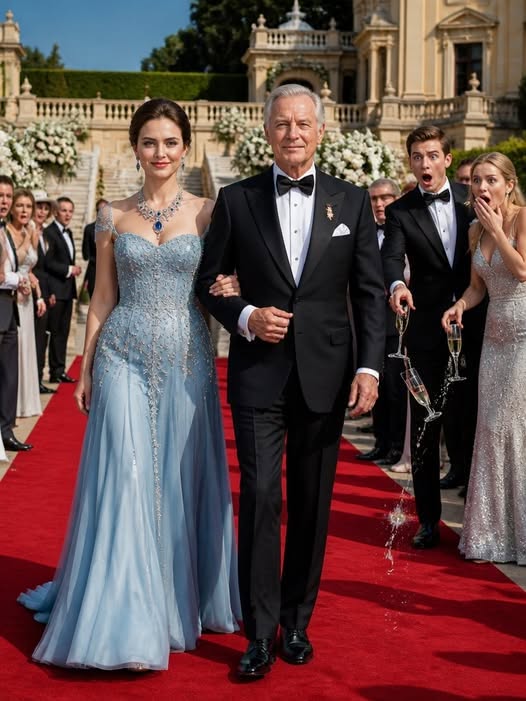
“Take your hands off her. Now.” Richard Kensington’s command cracked through the ballroom like thunder. Julian’s fingers immediately loosened around Elena’s arm, but he did not step away because he seemed incapable of understanding what had just happened. Richard Kensington, a man famous for never showing emotion in public, was staring at Elena as though the dead had suddenly walked into the room.
Elena instinctively touched the silver half-sun at her throat. Richard’s gaze followed her fingers. Then his knees buckled. Several guests gasped as the seventy-two-year-old billionaire dropped to the polished marble floor directly in front of the woman Julian had just ordered to pretend she was catering staff. Eleanor Kensington rushed forward, but Richard raised one trembling hand, silently asking everyone to stay back.
“No,” Richard whispered. “It can’t be.” His face had gone completely pale. “May I see that necklace?” Elena looked at Julian, who stood frozen beside her, then slowly unclasped the chain. Richard accepted it with both hands as though she had placed a living heartbeat into his palms. He turned the pendant over, and a tiny engraving caught the chandelier light.
Eleanor began crying before Elena even understood what they were looking at. On the back of the half-sun were three nearly invisible letters: E.M.K. Elena had seen them thousands of times but had never known what they meant. Mrs. Rosa Bennett had always told her that whatever those letters represented belonged to a life that had disappeared in the fire thirty years ago.
Richard suddenly looked up at Elena’s face. His eyes moved to her cheekbones, her eyes, then the small portion of collarbone visible above her dress. “Do you have a scar?” he asked. Elena’s breath caught. She stepped backward. “A burn scar?” Richard continued, his voice breaking. “Curved. About two inches long. Just below your left collarbone.”
Julian forced a nervous laugh. “Sir, I’m sure this is some misunderstanding.” Nobody laughed with him. Elena slowly pulled the neckline of her dress aside just enough to reveal the pale crescent-shaped scar she had carried since childhood. Eleanor made a sound that was somewhere between a sob and a scream. Richard closed his eyes, and tears rolled down his face.
“My God,” Eleanor whispered. “It’s her.” Elena’s knees weakened. “Who?” she demanded. Eleanor stared at her with thirty years of grief written across her face. “You,” she said. “You’re Elizabeth Mae Kensington.” Richard pressed the silver pendant against his chest. “You are my daughter.” The ballroom erupted in shocked whispers, but Elena heard only the pounding of her own heart.
Julian’s face went blank. “That’s impossible,” he said. Richard ignored him. Elena stared at the billionaire kneeling before her. “My father?” she repeated. She almost laughed because the idea was too enormous to fit inside her mind. “I was abandoned. I was found after a fire. Rosa raised me. I don’t know who my parents were.”
“You weren’t abandoned,” Richard said immediately. “You were stolen from us.” Those words silenced the room again. Richard rose with Eleanor’s help, but his legs were still trembling. “Thirty years ago, my wife Margaret and our three-year-old daughter Elizabeth disappeared during a fire at our family estate outside Dallas. Margaret’s body was recovered. Elizabeth’s was never conclusively identified.”
Eleanor removed something from beneath her own gown. It was a gold chain with a pendant nearly identical to Elena’s, except hers formed the opposite half of the sun. When Eleanor pressed the two pieces together, they created one complete circle. On the front appeared a tiny sunburst surrounding the letter K. Elena covered her mouth as an old memory stirred somewhere beneath thirty years of silence.
A woman singing. Warm arms lifting her from a bed. Smoke. A man shouting downstairs. Glass breaking. Then a woman she would later know as Rosa running through darkness while Elena cried against her chest. The memories were fragmented, little more than flashes, but for the first time they had names. They had a house. They had people who had spent three decades believing she was dead.
Julian finally found his voice. “Mr. Kensington, this has nothing to do with tonight’s event. Elena and I can handle our personal affairs privately.” Richard turned slowly toward him. Whatever grief had been on his face disappeared beneath something colder. “You introduced my daughter as event staff.” Julian swallowed. “I didn’t know who she was.”
“No,” Richard said. “You didn’t know she was wealthy.” A few people lowered their eyes. The distinction cut deeper than shouting ever could. Richard continued, “But you knew she was your wife. You knew she had dignity. You knew she deserved respect. Apparently, that wasn’t enough for you.” Julian’s mouth opened, but nothing came out.
Elena felt the entire ballroom watching her, waiting to see whether she would break down, embrace Richard, slap Julian, or run. Instead, she walked to the nearest table, picked up a glass of water, and drank slowly. Years of being told to speak less, stand farther back, dress differently, and apologize for existing had trained her to disappear during uncomfortable moments.
But she suddenly understood that disappearing was exactly what other people had been doing to her entire life. “I want the truth,” she said. She did not raise her voice, yet everyone heard her. “Not tomorrow. Not after lawyers clean it up. I want to know why Mrs. Bennett found me. I want to know why she never told me who I was.”
Eleanor looked at Richard. Something passed silently between them, something heavier than reunion. Elena noticed it immediately. “There’s more,” she said. Richard’s face tightened. “Yes.” Elena placed her water glass down. “Then say it.” Richard looked around at the executives, politicians, investors, and board members filling the ballroom. “Not here.” Elena shook her head. “You recognized me here. Tell me here.”
Before Richard could respond, an elderly man near the stage suddenly stood. He was Harold Pierce, the corporation’s retired general counsel, invited that evening for a lifetime achievement presentation. His face looked gray. “Richard,” Harold said carefully, “if that necklace is genuine, you cannot treat this simply as a family matter.” Richard’s expression sharpened. “I know.”
Julian glanced between them. “What does that mean?” Harold looked directly at him. “It means your promotion ceremony is not happening tonight.” Julian blinked. The ballroom had been prepared partly to announce him as executive vice president of corporate acquisitions, a position carrying enormous power. “Why?” he demanded. Harold’s answer made several board members immediately reach for their phones.
“Because Elizabeth Kensington’s legal status affects the controlling trust of this corporation.” Julian laughed again, but this time panic cracked through it. Harold continued, “Thirty-one years ago, Richard established an irrevocable family trust. His children were the primary beneficiaries. After the fire, Elizabeth was declared presumed deceased, and a contingent voting block passed into another branch of the company.”
Elena slowly turned toward Julian. “Which branch?” Harold’s silence answered before his words did. “The Whitmore branch.” Julian’s face emptied of color. Richard’s company had been built decades earlier through a merger between Kensington Communications and Whitmore Infrastructure. The Whitmore family retained major voting privileges. Julian had spent his entire career boasting that business leadership was “in his blood.”
Richard stepped toward him. “Your grandfather received control of shares that were meant to be held for my daughter until her thirty-fifth birthday.” Elena stared at Julian. She was thirty-three. Harold added quietly, “If Elizabeth is alive, the transfer that created the Whitmore family’s controlling position may have been legally defective from the beginning.”
Julian’s breathing became shallow. “My grandfather is dead. I had nothing to do with any of that.” Elena almost believed his confusion until she saw his eyes move toward his father, Victor Whitmore, standing across the ballroom. Victor had arrived earlier without greeting Elena. He was seventy, silver-haired, elegant, and currently clutching the back of a chair so tightly his knuckles were white.
Richard saw him too. “Victor.” Every head turned. Victor forced himself forward. “This is insane,” he said. “A necklace and scar prove nothing. Richard, grief can make people see what they desperately want to see.” Eleanor’s expression hardened. “Her face proves more than you think. She has Margaret’s eyes.”
Victor smiled thinly. “Then do a DNA test.” Richard nodded. “We will.” Victor seemed relieved for half a second. Then Richard added, “And while we wait, I’m reopening the investigation into the fire.” Victor’s smile disappeared. “There was an investigation.” “There was,” Richard replied. “And somehow you were the one executive who benefited most from its conclusion.”
Julian stepped between them. “Dad, tell them.” Victor’s jaw tightened. “There’s nothing to tell.” Elena noticed Richard watching Victor with something beyond suspicion. It looked like recognition. “Thirty years,” Richard said quietly. “I have wondered why Margaret called me twenty minutes before she died and said she had discovered someone stealing from the family trust.”
Victor’s head snapped up. Eleanor closed her eyes. Richard continued, “She said she had proof, but the line disconnected before she could name the person.” Harold Pierce looked shaken. “Richard, you never told the board that.” “Because the police told me I was imagining connections,” Richard answered. “And Victor was the man comforting me while I buried my wife.”
Victor’s voice rose. “Enough.” Elena stepped toward him. “Did you know Rosa Bennett?” The question came from instinct, but its effect was immediate. Victor’s face changed. Barely. A tightening around the eyes. A half-second hesitation. Yet Elena saw it. So did Richard. “Who is Rosa Bennett?” Victor asked too quickly.
Elena touched her necklace. “The woman who saved me.” Victor shrugged. “Never heard of her.” Eleanor whispered, “You’re lying.” Victor turned sharply. “Don’t be absurd.” But Elena suddenly remembered something Mrs. Bennett had said during her final days, something Elena had always assumed was feverish confusion. Rosa had grabbed her wrist and whispered, “Never trust the man with the white horse pin.”
Elena looked at Victor’s tuxedo lapel. A tiny platinum pin gleamed there. A rearing white horse. She had seen it on him at holidays, corporate events, and even her wedding. Her stomach twisted. “That pin,” Elena said. Victor looked down. The entire ballroom seemed to lean toward him. “Where did you get it?”
Victor’s hand instinctively covered the pin. “Family crest.” Elena whispered, “Rosa knew it.” Julian turned toward his father. “What?” Elena repeated louder, “Before she died, Rosa warned me about a man with a white horse pin.” Victor’s face hardened. “A sick old woman said something strange. That proves nothing.” But Richard was already pulling out his phone.
“Security,” Richard said. Four guards stepped closer. “Nobody leaves this ballroom.” Several guests protested, but Richard’s authority ended the discussion. “Harold, call federal counsel. Eleanor, contact Detective Ramirez. Tell him I want the sealed Kensington fire archive reopened immediately.” Victor laughed angrily. “You can’t imprison people at a party because your long-lost daughter appeared.”
Richard stared at him. “I am not imprisoning anyone. Those doors are public exits. You are free to leave. But the second you do, my security team will document it, and every director here will know you walked away the moment a thirty-year-old fraud was mentioned.” Victor stopped moving. Richard had trapped him without touching him.
Julian turned to Elena, desperation replacing arrogance. “Elena, sweetheart, this is overwhelming. We need to go home and discuss this privately.” She looked at the same man who had told her twenty minutes earlier to pretend she cleaned tables. “Home?” she repeated. “You mean the house where I’m not allowed to invite my old friends because they might embarrass you?”
“That isn’t fair.” Julian lowered his voice. “You know how corporate life works.” Elena’s expression barely changed. “Apparently not. You always told me I understood nothing about your world.” Julian reached toward her. Richard stepped forward, but Elena lifted one hand. “No. Let him talk. I want to hear what a man says when the wife he hid suddenly becomes useful.”
Julian flinched. “I love you.” Elena stared at him for several seconds. “Then why did you erase me?” He shook his head. “I was under pressure.” “You told strangers I worked for the event.” “I made a mistake.” “You told me my voice embarrassed you.” Julian glanced at the watching executives. “Not here.”
Elena almost smiled. “You loved saying things to me when nobody important was listening. Now people are listening, and suddenly you want privacy.” A few employees looked down, visibly uncomfortable. Some had witnessed Julian belittling Elena at previous functions. None had intervened. She realized shame had shifted across the room. It no longer belonged to her.
Less than an hour later, two detectives entered Arlington Manor. One was retired Detective Samuel Ramirez, now seventy-six, the original junior investigator on the Kensington fire. Richard had kept in contact with him for years. When Ramirez saw Elena, he stopped so abruptly that the younger detective behind him nearly collided with his back.
“You look like Margaret,” Ramirez whispered. Richard introduced Elena. Ramirez’s hands trembled. “There was always something wrong with that case.” Victor cursed under his breath. Ramirez heard him. “You were interviewed,” he said. “Victor Whitmore. You claimed you were in Houston the night of the fire.” Victor nodded. “Because I was.”
Ramirez opened a weathered leather folder. “Your hotel receipt said Houston. Your assistant confirmed Houston. A company driver confirmed Houston. Three witnesses.” Victor spread his hands. “Exactly.” Ramirez looked at Harold Pierce. “Do you remember Paul Davies?” Harold frowned. “Victor’s old driver?” Ramirez nodded. “He died eleven years ago. Before he died, he contacted me.”
Victor went perfectly still. Ramirez continued, “He admitted he lied about driving Victor to Houston. Victor paid him twenty thousand dollars and threatened his family.” Julian stared at his father. “Why wasn’t this investigated?” Ramirez’s expression darkened. “Because Davies refused to sign a statement. He was terrified. And by then the statute on several related offenses had become complicated.”
“Related offenses?” Elena asked. Ramirez opened the folder wider. “Two months before the Kensington fire, someone created shell companies that purchased substantial life-insurance positions and debt instruments connected to Kensington Communications. After Margaret’s death and Elizabeth’s presumed death, those positions became extremely profitable.” Richard looked at Victor. “Your companies?”
Victor shook his head. “No.” Harold moved closer to the documents. His eyes widened. “Greyhaven Holdings.” Richard recognized the name. “That company disappeared in 1998.” Harold whispered, “It was registered through a Nevada agent used by Whitmore family offices.” Julian backed away from his father.
Victor’s composure finally cracked. “You are building a fantasy from scraps.” Elena watched him carefully. “Then why did Rosa know your pin?” Victor snapped, “Maybe she worked somewhere I visited.” Ramirez looked up sharply. “Rosa Bennett?” Elena nodded. “She raised me.” Ramirez whispered something under his breath.
“What?” Richard demanded. Ramirez seemed suddenly older. “Rosa Bennett was a temporary housekeeper at the Kensington estate.” The revelation hit Elena harder than learning Richard might be her father. “She worked there?” Ramirez nodded. “Three days a week. She disappeared the night of the fire. Police believed she had died or fled because she was undocumented in employment records.”
Elena’s eyes filled with tears. Rosa had never told her. Not once. Ramirez continued, “We found one witness who thought he saw a woman carrying a child near the service road, but the sighting was dismissed. The road was dark. Heavy smoke. No identification.” Richard whispered, “Rosa took Elizabeth.”
“Saved her,” Elena corrected automatically. Nobody argued. A memory returned with sudden painful clarity: Rosa whispering, “Quiet, mi niña. Quiet. He will hear us.” Elena had always believed it was a nightmare. Now she could smell smoke again. She remembered Rosa’s heartbeat hammering beneath her cheek as they hid inside something metallic.
“A truck,” Elena said. Everyone turned. “She hid us in a truck. Under blankets or sacks. I remember metal beneath me.” Ramirez opened another document. “A bakery delivery truck was reported stolen six miles from the estate that night. It was recovered the next morning in South Dallas.” Elena began trembling.
Richard moved toward her, then stopped, uncertain whether he had the right to comfort a daughter who had only known him for an hour. Elena noticed. After a moment, she reached for his hand. He took it carefully. For thirty years, Richard Kensington had controlled companies spanning continents, yet his fingers shook around hers like those of a frightened old man.
Eleanor wiped tears from her cheeks. “Rosa didn’t steal you,” she said. “She escaped with you.” Ramirez nodded. “If she believed someone involved in the fire was still looking for the child, staying hidden would make sense.” Elena thought about Rosa moving apartments repeatedly during Elena’s childhood, refusing photographs, insisting Elena never tell strangers where she lived.
“She was afraid,” Elena whispered. “All those years, she was afraid.” Victor scoffed. “Convenient story.” Elena turned toward him. “When I was twelve, someone broke into our apartment. They didn’t steal money. They searched drawers. Rosa moved us the next morning.” Victor’s expression remained blank, but Julian was staring at him differently now.
Then Harold’s phone rang. He answered, listened, and slowly sat down. “Richard,” he said. “We have a problem.” Richard’s eyes narrowed. Harold looked at Elena. “Actually, we have proof.” He explained that after Rosa Bennett’s death six years earlier, her possessions had been stored by the nonprofit clinic where Elena once worked.
Elena frowned. “I donated most of her things.” Harold nodded. “Apparently not everything. A locked metal box was listed under your name, but the clinic couldn’t reach you after you changed addresses. It has remained in storage.” Elena remembered moving into Julian’s house soon after their engagement. Julian had insisted she stop using her old neighborhood mailing address.
Richard ordered one of his attorneys to contact the clinic immediately. The gala had now become something stranger than any corporate event Dallas had ever seen. Guests remained clustered throughout the ballroom, unwilling to leave. Phones buzzed constantly. Rumors were already spreading outside. Julian’s promotion banner still glowed absurdly on a screen behind the stage.
Forty minutes later, a clinic administrator arrived carrying a dented green metal box. Elena recognized it instantly. Rosa had kept it beneath her bed for years. Whenever Elena asked about it, Rosa said it contained “old pain.” After her death, Elena had been too overwhelmed to sort everything. She thought the box held bills and immigration papers.
The lock had rusted. With Elena’s permission, security cut it open. Inside were photographs, letters, a child’s yellow sweater, newspaper clippings about the Kensington fire, and a sealed envelope with one sentence written in Rosa’s handwriting: FOR ELENA, WHEN THE WHITE HORSE CAN NO LONGER HURT YOU.
Nobody breathed. Elena opened the envelope. Her hands shook so badly Eleanor helped unfold the pages. Rosa’s letter began with an apology. She wrote that Elena’s real name was Elizabeth Mae Kensington, daughter of Richard and Margaret Kensington. She confessed that she had spent three decades waiting for the right moment to tell the truth but fear had repeatedly defeated her.
Rosa described the night of the fire. Margaret Kensington had been preparing to expose financial theft inside the corporation. She had discovered documents showing millions diverted through Greyhaven Holdings. Margaret confronted someone in Richard’s study while Richard was away. Rosa heard shouting. Then she saw Victor Whitmore leaving the study carrying a leather portfolio.
Victor shouted, “That is a lie!” Richard’s security guards immediately moved closer. Rosa’s letter continued. Minutes after Victor left, Rosa smelled gasoline near the service hallway. Margaret screamed for her daughter. Flames spread unnaturally fast. Rosa ran upstairs, found three-year-old Elizabeth beneath her bed, wrapped her in a blanket, and carried her toward the rear staircase.
At the bottom of the staircase stood a man wearing a white horse pin. Rosa could not see his face through the smoke, but she recognized Victor’s voice when he shouted, “Where is the girl?” Rosa fled through a laundry exit. She saw another man outside near a dark sedan. Believing both Margaret and Elizabeth were targets, Rosa ran toward the service road.
Elena’s vision blurred as she read Rosa’s final paragraphs. Rosa had intended to go to police, but the next morning two men came to the apartment of her cousin where she was hiding. They asked questions about “a child from the Kensington fire.” Rosa realized someone had traced her. She fled again and eventually raised Elena under a different surname.
Then came the sentence that changed everything: “I kept one thing besides your necklace because your mother pushed it into my apron before I took you upstairs. She told me, ‘If anything happens, give this to Richard.’ I was too afraid. Forgive me.” Beneath the letter lay a small cassette tape wrapped in plastic.
Harold stared at it. “Do we have anything that can play that?” One of the hotel technicians produced an old portable player from the audiovisual department. The tape was fragile, but intact. Richard pressed play. Static filled the ballroom. Then a woman’s voice emerged from thirty years ago.
“Richard, if you’re hearing this, I was right.” Richard covered his mouth. “Margaret,” he whispered. The recording continued. Margaret said she had discovered that Victor Whitmore and two accountants were secretly diverting money from the corporation. More importantly, Victor had altered documents relating to Elizabeth’s family trust.
Margaret’s voice became more urgent. “Victor believes if something happens to Elizabeth before she reaches thirty-five, the voting shares revert to the Whitmore line. Harold needs to review Amendment Seven. It isn’t authentic. Your signature was copied.” Harold Pierce staggered backward. “Amendment Seven,” he whispered. “That amendment created the entire Whitmore voting block.”
Julian stared at his father. “Dad?” Victor’s face had transformed into something Elena had never seen: not fear exactly, but calculation. He was measuring exits, allies, consequences. “A thirty-year-old tape can be fabricated,” he said. Harold shook his head slowly. “Not the amendment. I still have the original archival comparison records.”
Richard turned toward Harold. Harold looked devastated. “I questioned the signature years ago. Victor produced a notarized duplicate. I accepted it.” Richard’s voice became lethal. “You accepted it?” Harold closed his eyes. “I believed you had signed it privately after Elizabeth’s death. I was wrong. God help me, I was wrong.”
Julian grabbed his father’s sleeve. “Tell me this is fake.” Victor pulled away. “Control yourself.” “Tell me!” Julian shouted. The polished executive mask shattered. Dozens of his coworkers watched him unravel beneath the giant digital announcement reading JULIAN WHITMORE — THE FUTURE OF LEADERSHIP.
Victor lowered his voice. “Everything I did was for this family.” The sentence was so quiet that for several seconds nobody reacted. Then Richard said, “What did you just say?” Victor realized his mistake. “I said—” Julian interrupted him. “No. You said everything you did.”
Victor looked at his son with contempt. “You have enjoyed everything I built. The schools. The houses. The connections. The Whitmore name opened every door you ever walked through. Don’t stand there pretending your hands are clean because you were too spoiled to ask where the keys came from.”
Julian recoiled as though struck. “I didn’t know.” Victor laughed bitterly. “Of course you didn’t. You never wanted to know anything that made your life less comfortable.” Elena felt an eerie chill. The words sounded almost identical to Julian’s treatment of her. Different generation. Same instinct: ignore whatever truth threatened status.
Richard stepped toward Victor. “Did you kill Margaret?” Victor’s face tightened. “No.” “Did you start the fire?” Silence. “Answer me.” Victor stared at Richard for a long moment. “I paid someone to frighten her. To recover the documents. The fire was not supposed to spread.”
Eleanor screamed at him. “She died!” Victor’s composure snapped. “It was an accident!” The younger detective immediately stepped forward. “Victor Whitmore, do not say another word without counsel.” But Victor had spent thirty years imagining himself untouchable, and arrogance overcame caution.
“She wasn’t supposed to be home that long,” Victor said. “Margaret was supposed to leave after the alarm triggered. The contractor used too much accelerant.” Richard lunged forward, but Elena grabbed his arm. Security surrounded Victor. Eleanor was sobbing openly. Julian stood motionless, looking at his father as though meeting him for the first time.
The detective placed Victor under temporary detention pending questioning. As officers escorted him away, Victor turned to Julian. “Call Bennett & Price. Tell them to activate the family defense agreement.” Julian did not move. Victor shouted his name. Julian finally whispered, “Did you know Elena was Elizabeth?”
Victor stopped. That question changed the air again. He slowly looked at Elena. She felt every muscle in her body tighten. “Did you know?” Julian repeated. Victor said nothing. Richard stepped forward. “Answer him.”
Victor’s silence lasted too long. Elena suddenly understood why he had always been strangely cold toward her. At her wedding, he had stared at her necklace for several seconds before telling Julian privately that the marriage was “a mistake.” Julian had later said Victor disliked Elena’s background. But perhaps Victor had recognized more than poverty.
“You knew,” Elena whispered. Victor looked at her scar. That tiny movement was enough. Julian saw it too. “Oh my God,” he said. “You knew.” Victor finally spoke. “I suspected.” Julian’s face twisted. “Since when?” Victor’s answer destroyed what remained of his son’s career before the police even reached the doors.
“Your wedding.” Julian stumbled backward. “You knew at our wedding?” Victor nodded once. “The necklace. The resemblance. I wasn’t certain.” Elena’s stomach turned. “Then why didn’t you say anything?” Victor smiled without warmth. “Because my son had accidentally married the one person who could take everything from us.”
The room exploded in disbelief. Julian looked physically sick. Victor continued before police pulled him away. “I told you to divorce her. You refused because you liked having someone obedient at home. Then I realized marriage could protect us. If Elizabeth regained her trust, her husband could potentially influence her assets.”
Elena turned toward Julian. He looked horrified. “I didn’t know that.” Victor laughed. “Not at first.” The words struck harder than anything else that night. Elena’s eyes narrowed. “Not at first?” Victor’s grin widened. “Ask him about the file in his office.”
Julian whispered, “Dad, shut up.” Elena felt something inside her break cleanly in two. Richard ordered security to block Julian from leaving. Julian raised both hands. “Elena, listen to me. Whatever he is implying—” She interrupted him. “What file?”
Julian looked around the ballroom. His colleagues, board members, and investors were now watching the man who had spent years manufacturing an image of perfect discipline. “It was nothing,” he said. Elena repeated, “What file?” Richard’s chief security officer stepped forward. “Mr. Kensington, Julian’s office is on the eighteenth floor of headquarters. We can secure it immediately.”
Julian panicked. “You cannot search my private office.” Harold answered, “Corporate offices and devices are company property.” Julian’s phone was already being preserved by legal staff under emergency board authority. “This is insane,” Julian shouted. “Elena, tell them to stop!”
She stared at him. “Tonight you told me to stand by the restrooms because I embarrassed you. Now you want me to save you in front of the same people.” Julian’s eyes filled with desperation. “I’m your husband.” Elena’s voice remained calm. “Then you should have remembered that before Mr. Kensington recognized my jewelry.”
Within minutes, the board voted to suspend Julian pending investigation. It was unanimous except for Julian himself, who had no voting authority on the matter. The promotion announcement vanished from the screen behind him. His company access was disabled. His executive credentials stopped working before he had finished protesting.
But the worst discovery came from his corporate email archive. Legal investigators found a folder Julian had attempted to delete eighteen months earlier. The title was simply E.V. Inside were scanned articles about the Kensington fire, photographs of young Margaret Kensington, trust summaries, and a private investigative report comparing Elena’s childhood scar and necklace with evidence from the missing-child case.
Elena read the date. Eighteen months earlier. Nearly two years after their wedding. Julian had known. Not suspected. Known. Her hands became cold. Richard looked ready to destroy him with his bare hands. Elena only asked, “When did you become certain?”
Julian began crying. Whether from guilt or fear, Elena could not tell. “My father showed me documents,” he said. “He said there was a possibility.” “The report says ninety-eight percent probability before DNA.” Julian stared at the floor. “He told me revealing it would cause chaos.”
Elena’s voice cracked for the first time. “So you stayed married to me because of the trust?” “No!” Julian moved toward her. Security blocked him. “I did love you. I loved you when we met.” Elena shook her head. “But after you found out?” Julian had no answer.
Harold opened another recovered email. It was from Julian to Victor, dated fourteen months earlier. He read it silently, then handed it to Elena. The message contained one sentence: IF SHE NEVER LEARNS WHO SHE IS, WE KEEP CONTROL. IF SHE DOES, AS HER HUSBAND I CAN MANAGE HER.
Elena read it twice. Julian whispered, “I was angry when I wrote that.” She looked up. “Angry at whom?” He could not answer. “At me?” Elena asked. “Because I existed?” Julian sank into a chair. For years he had told Elena she was lucky he had chosen a poor orphan from Oak Cliff. Now everyone knew he had been living beside a woman whose identity terrified his entire family.
Richard looked at Elena. “The company is yours if the trust holds.” She shook her head immediately. “No.” Harold clarified, “Not exactly. But the disputed voting block would return to your trust. Combined with Richard’s current holdings, your family would control nearly seventy percent of the company.”
Julian stared at Elena with an expression she would never forget. Not love. Not apology. Calculation. Even now, after everything, his eyes flicked toward the numbers. She saw him thinking about reconciliation, marital property, leverage. Elena suddenly understood that the most dangerous thing about Julian was not cruelty. It was his inability to see people without translating them into value.
She removed her wedding ring. Julian stood. “Elena, don’t.” She placed it beside his untouched champagne glass. “You asked me not to introduce myself as your wife tonight.” Julian’s face crumpled. Elena continued, “For once, I’m going to respect your wishes.”
A quiet sound moved through the ballroom, not applause exactly but something close. Elena turned toward Richard. “I’m not making decisions about companies tonight.” He nodded. “You shouldn’t.” “And I’m not calling you Dad yet.” Pain flashed across his face, but he nodded again. “You shouldn’t have to.”
Elena looked at Eleanor. “I need time.” Eleanor stepped forward carefully. “Take all of it.” Elena’s eyes filled with tears. “Rosa was my mother in every way that mattered.” Richard answered softly, “Then I owe Rosa Bennett a debt I can never repay.” Elena looked at the battered green box. “We all do.”
Three days later, DNA results confirmed what the necklace, scar, photographs, and Rosa’s testimony had already made undeniable. Elena Vance was Elizabeth Mae Kensington, Richard Kensington’s biological daughter. News spread internationally. But the public revelation was only the beginning.
Federal investigators reopened the Kensington fire case, financial fraud inquiries, insurance fraud questions, trust manipulation allegations, obstruction claims, and conspiracy charges. Victor Whitmore’s old business records were subpoenaed. Two surviving accountants agreed to cooperate. One admitted Victor had paid them to fabricate documents after the fire.
Then investigators found something nobody expected. Victor had not acted alone. A second signature appeared repeatedly throughout Greyhaven Holdings records. The name belonged to Marcus Whitmore—Julian’s grandfather, the man whose portrait hung in the corporation’s executive lobby beneath the words INTEGRITY BUILDS LEGACY.
The Whitmore fortune had not merely benefited from tragedy. It had been reconstructed through it. Victor had protected his father’s theft, expanded it, and used the forged trust amendment to build decades of influence. Richard immediately ordered Marcus Whitmore’s portrait removed from headquarters.
Julian’s career collapsed within a week. The board terminated him for undisclosed conflicts of interest, destruction of corporate records, participation in concealment, and conduct damaging to the corporation. His name disappeared from leadership pages. Business partners stopped returning calls. Two companies withdrew job offers before he could even apply.
Yet Julian still believed Elena might rescue him. He appeared outside Richard’s estate one rainy evening carrying flowers and wearing the same navy tie Elena had once given him for their anniversary. Security called her before allowing him past the front gate.
Elena agreed to speak with him on the covered terrace. Julian looked exhausted, stripped of the polished arrogance she had lived beneath for years. “I’ve lost everything,” he said. Elena noticed how quickly the conversation began with his suffering. “Your father may spend the rest of his life dealing with what he did,” she said. “My mother died. Rosa lived afraid. Richard lost thirty years with his child.”
Julian lowered his head. “I know.” Elena shook hers. “No. You know the facts. That isn’t the same thing.” He stepped closer. “I made terrible choices. But my father manipulated me.” Elena looked at him calmly. “Did he choose my dress tonight?” Julian froze.
“Did your father tell you to make me stand near the kitchen?” she continued. “Did he force you to correct my accent? Did he order you to hide photographs of Rosa when your colleagues visited? Did he make you introduce me as staff?” Julian began crying. Elena felt sadness, but not confusion.
“I became obsessed with proving I belonged,” he whispered. “Around people like Kensington, I always felt like I was one mistake away from losing everything.” Elena almost laughed at the terrible irony. “So you made me feel small enough that you could feel tall.”
Julian reached for her hand. She stepped back. “I loved you,” he said. “Maybe,” Elena replied. “But love that requires another person to shrink isn’t something I want anymore.” She handed him a folder. Divorce papers waited inside.
Julian stared at them. “If we divorce now, people will say you abandoned me when I lost my career.” Elena smiled sadly. “And six days ago, you were afraid people would know I was your wife because of my dress. We’ve both worried too much about what strangers think.”
He left without the flowers. Elena watched his car disappear beyond the gates, then returned inside. Richard was waiting in the library but pretended to be reading because he did not want to intrude. Elena sat across from him.
“Tell me about my mother,” she said. Richard put the book down. For the next four hours, he told her everything. Margaret loved old jazz, hated expensive jewelry, burned pancakes every Sunday, collected ridiculous coffee mugs, and once drove across Texas in the middle of the night because Eleanor had called crying after a breakup.
Elena laughed through tears. Then Richard showed her a photograph of Margaret wearing a plain navy-blue dress at a charity dinner. Elena stared. The dress looked startlingly similar to the one Julian had mocked. “She hated designer labels,” Richard said. “Said clothing should never become a résumé.”
Elena touched the photograph. “Rosa used to say that.” Richard smiled through tears. “Rosa and Margaret were friends. Not employer and employee the way the old reports described it. Margaret helped Rosa after Rosa’s husband died. Rosa taught Margaret how to make tamales.”
Something inside Elena finally settled. Two women she had believed belonged to separate lives had known each other. Loved each other. The mother she lost and the mother who saved her were connected before Elena could remember either of them.
Several weeks later, Richard took Elena to the ruins of the old Kensington estate. Most of the structure had been demolished decades earlier, but a stone garden wall remained. Near it stood a memorial to Margaret and the child everyone thought had died.
Elena stared at her own name carved into stone: ELIZABETH MAE KENSINGTON, BELOVED DAUGHTER, 1993–1996. She ran her fingers across the dates. “I spent thirty years alive beneath my own tombstone,” she whispered.
Richard stood beside her. “I’m sorry I stopped looking.” Elena turned. “Did you?” He looked ashamed. “After fifteen years, yes. People convinced me hope had become unhealthy. I funded missing-child organizations because I couldn’t save mine.” Elena reached for his hand. “You didn’t stop loving her. You stopped expecting to find her.”
Richard nodded. “I suppose.” Elena looked again at the stone. “Then we should change this.” Months later, the memorial was replaced. Margaret’s name remained, but Elena’s became a different inscription: ELIZABETH MAE KENSINGTON — FOUND, LOVED, AND RETURNED.
The corporate consequences were equally dramatic. Courts froze the disputed Whitmore voting shares. After forensic review, Amendment Seven was declared fraudulent. Elena’s trust regained control of the shares stolen three decades earlier, making her one of the most powerful shareholders in the telecommunications industry overnight.
Reporters expected her to become a glamorous heiress. Fashion houses sent dresses. Jewelry brands offered sponsorships. Society magazines begged for interviews. Elena declined nearly all of it. At her first board meeting, she wore the same repaired navy dress from the gala.
Nobody mistook her for catering staff.
She sat at the head of the long table beside Richard and placed Rosa’s half-sun necklace in front of her. “Before we discuss acquisitions,” Elena said, “I want to discuss the lowest-paid workers in this company.” Several executives shifted uncomfortably.
She proposed wage increases for custodial staff, stronger healthcare benefits, education grants, whistleblower protection, and an independent ethics office. “Companies don’t become corrupt because nobody sees warning signs,” she said. “They become corrupt because the people with the least power are afraid to speak, and the people with the most power are rewarded for not listening.”
The proposal passed.
The strongest opposition came from directors who had benefited from the old Whitmore system. Within months, several resigned. Elena never shouted at them. She simply asked questions until their excuses collapsed under their own weight.
Meanwhile, prosecutors offered Victor Whitmore a plea agreement in exchange for complete testimony. He refused until investigators showed him Rosa’s cassette, Margaret’s financial records, the accountants’ confessions, and recovered payments to the men sent searching for Elena after the fire.
Victor finally admitted almost everything. He had intended to scare Margaret, recover documents, and ensure the child could not later challenge the forged trust. He claimed he never ordered anyone to kill Elena. But when asked why men had searched South Dallas for a little girl after the fire, he remained silent.
That silence became one of the most haunting moments of the trial.
Julian testified against his father in exchange for consideration regarding his own obstruction charges. On the witness stand, he admitted discovering Elena’s likely identity eighteen months before the gala and hiding it because he feared losing his family’s influence.
The prosecutor asked, “Did your wife know you had investigated her identity?” Julian whispered, “No.”
“Did you encourage her to search for her biological family?”
“No.”
“Did you tell her she might be connected to the Kensington family?”
“No.”
“Instead, what did you tell her?”
Julian closed his eyes. “That she should stop obsessing about where she came from.”
Elena sat behind the prosecutor and felt the final fragment of their marriage disappear. She remembered those exact conversations. She had once told Julian she dreamed of discovering whether her mother had loved her. Julian had kissed her forehead and said, “Some doors are better left closed.”
He had already known what was behind the door.
Victor was ultimately convicted on multiple financial and conspiracy counts, while prosecutors continued litigating charges connected to Margaret’s death. Julian avoided prison on the most serious allegations because evidence showed he had not participated in the original crimes, but his professional reputation never recovered.
He moved away from Dallas.
Elena heard through mutual acquaintances that he began working quietly for a small consulting firm in another state. For the first time in his adult life, the Whitmore name opened no doors.
One year after the gala, Arlington Manor hosted another corporate event. This time, Elena helped organize it. There were no velvet ropes separating executives from staff. Catering employees ate from the same kitchen menu as executives. Rosa Bennett’s photograph stood beside Margaret Kensington’s near the entrance.
Beneath Rosa’s photograph was a simple plaque: ROSA BENNETT — COURAGE DOES NOT REQUIRE WEALTH, TITLE, OR PERMISSION.
Elena wore a cream-colored dress that cost eighty dollars.
Richard noticed the price tag accidentally when Elena showed Eleanor the pocket sewn inside. He smiled. “You’re going to give the fashion magazines a nervous breakdown.”
Elena laughed. “Good.”
Later that evening, a young server approached Elena hesitantly. She apologized because a tray had slipped earlier and stained part of the ballroom carpet. “I’m so sorry, Ms. Kensington. I thought I’d be fired.”
Elena looked at the terrified young woman and remembered standing by the dessert table one year earlier, trying to occupy as little space as possible.
“What’s your name?” Elena asked.
“Marisol.”
“Well, Marisol, carpets can be cleaned.” Elena handed her a napkin. “People should not be humiliated over accidents.”
The girl’s shoulders relaxed.
Across the ballroom, Richard watched them. Elena noticed him smiling.
“What?” she asked when he approached.
“You remind me of your mother.”
Elena touched the half-sun necklace. “Which one?”
Richard’s eyes filled.
“Both.”
Near midnight, after most guests had left, Elena stood beneath the chandeliers where Richard had first recognized her. She thought about how quickly the world had changed because one arrogant man believed the value of a woman could be measured by the label inside her dress.
Julian had wanted her hidden because he believed poverty was contagious and status was fragile. He had spent years trying to erase every part of Elena that reminded him she came from somewhere he considered beneath him.
But the truth was that the woman he hid carried the missing key to his family’s stolen empire around her neck every single day.
The cheap dress had never been the embarrassment.
The patched hem had never been the embarrassment.
Rosa’s food cart had never been the embarrassment.
Elena’s accent, childhood, neighborhood, job, and lack of designer labels had never been the embarrassment.
The embarrassment had been a family so terrified of losing power that they burned truth, forged history, buried a child beneath a false grave, and then accidentally welcomed that same child back into their bloodline through marriage.
And the cruelest irony belonged to Julian.
Had he simply loved Elena without shame, had he encouraged her to discover her past when he learned the truth, had he chosen honesty over inheritance, Elena might have stood beside him when the Whitmore empire collapsed.
She might even have defended him.
Instead, the night he believed he was protecting his career by hiding his wife became the night his career ended.
Not because Richard Kensington saw a cheap dress.
Because Richard Kensington saw the necklace Julian had spent years calling junk.
The half-sun Rosa Bennett had protected through poverty, fear, and three decades of silence.
The half-sun Margaret Kensington had fastened around her daughter’s neck before someone tried to erase them both.
The half-sun Elena had clutched whenever Julian made her feel small.
For thirty years, everyone powerful had searched for documents, witnesses, money, and control.
But the truth had been walking beside Julian all along.
Wearing a simple navy dress.
Standing quietly in the corner.
Waiting for someone to finally look at her.
They Sent the Widow to the Filthiest Kitchen on the Bell Yoke Ranch. Two Months Later, Four Trail Bosses Were Begging for a Seat at Her Table.
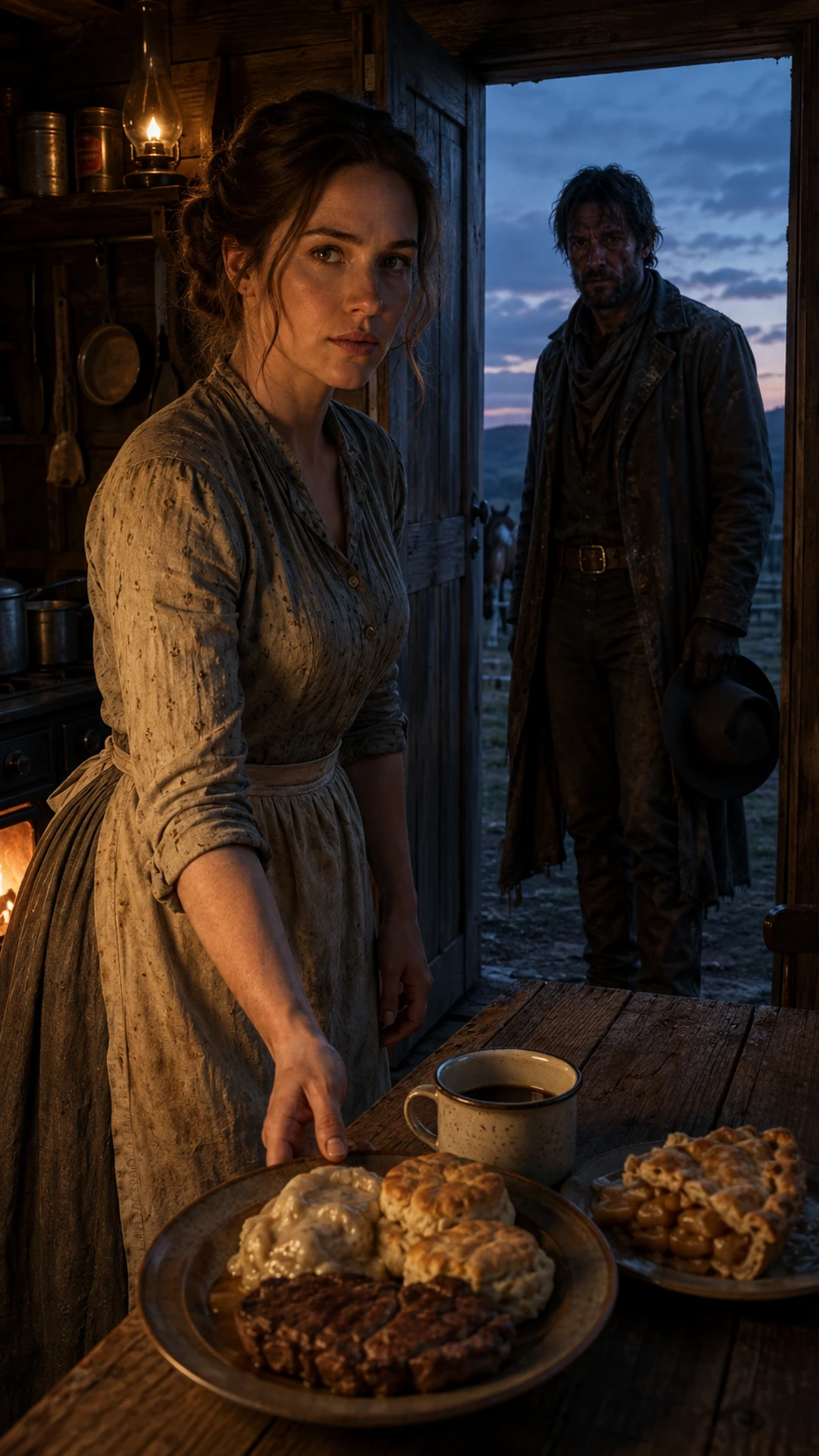
The first man Serilda Wayross fed after her husband died would eventually force her to discover who had really put her husband in the ground.
At the time, she knew none of that.
She only saw a starving stranger standing outside the back door of the Bell Yoke Ranch kitchen with cracked lips, dust ground into his beard, and eyes that carried the hollow look of someone who had ridden farther than his body could endure.
His name was Tob Chesser.
He had arrived near sunset, leading a lathered bay gelding that looked almost as exhausted as he did.
“Ma’am,” he said quietly, keeping his hat in both hands. “I don’t suppose there’s anything left that a man could buy.”
Serilda looked over her shoulder.
Beyond the kitchen doorway, the long dining room remained empty.
Sophronia Bogardis had gone upstairs.
The pantry door was locked, as always.
And Serilda had already been warned twice that month.
No ranch provisions were to be given to passing trail men.
Not even coffee.
Not even yesterday’s biscuits.
Bell Yoke fed Bell Yoke, Sophronia said.
Everyone else could continue riding.
Serilda stared at Tob’s trembling hands.
Then she remembered Orrin.
Her husband had been dead eight months, yet sometimes his voice returned so clearly that she could almost feel his breath against her ear.
He had spent most of his life cooking beside cattle trails, wagon camps, branding fires, and freezing river crossings.
Orrin Wayross had never been wealthy.
He had never owned more than two good shirts at once.
But he possessed rules that he treated as if God Himself had carved them into stone.
The most important had been simple.
A cook feeds whoever is in front of him.
Serilda turned toward the stove.
“Tie your horse in the shade,” she told Tob.
His expression changed.
“Ma’am?”
“You heard me.”
“But I’ve got money.”
“Keep it.”
She carved a thick steak from the roast intended for the ranch owner’s supper.
She reheated gravy.
She split three biscuits.
She poured coffee strong enough to wake a dead cowboy and set down the final slice of apple pie.
Tob stared at the plate.
For a strange instant, he did not look grateful.
He looked startled.
Almost frightened.
Then the expression vanished.
“You’re Wayross’s widow,” he said.
The knife stopped in Serilda’s hand.
She slowly looked up.
“You knew my husband?”
Tob lowered his eyes.
“Most trail men did.”
Before she could ask anything else, he sat and began eating.
He ate slowly at first.
Then hunger conquered manners.
Serilda watched him scrape gravy from the plate with the final piece of biscuit.
When he finished, he touched two fingers to the brim of his hat.
“That was better than I deserved.”
“Nobody deserves hunger.”
A faint smile crossed his mouth.
“Your husband used to say something close to that.”
He walked toward the door.
Then he paused.
His gaze dropped briefly to the black Dutch oven sitting beside Serilda’s worktable.
It had belonged to Orrin.
Serilda noticed.
Tob looked away quickly.
“Thank you, Mrs. Wayross.”
Then he disappeared into the evening.
By breakfast the next morning, Sophronia knew everything.
She summoned Serilda to the pantry and stood beside shelves lined with flour, sugar, dried apples, salt pork, canned peaches, and coffee.
Sophronia Bogardis was a narrow woman in her late forties whose severe black dresses seemed cut from the same material as funeral curtains.
She kept her gray-streaked hair pinned so tightly that Serilda sometimes wondered how the woman managed to blink.
“You fed a stranger.”
“Yes.”
“With Bell Yoke beef.”
“Yes.”
“Three biscuits.”
“Yes.”
“Gravy.”
“Yes.”
“Coffee.”
“Yes.”
“And Mr. Bell’s final piece of pie.”
Serilda almost smiled.
“Yes.”
Sophronia’s nostrils flared.
“You find this amusing?”
“No.”
“You were specifically warned.”
“I was.”
“Yet you deliberately ignored me.”
Serilda folded her hands over her apron.
“He was hungry.”
“Hungry men exist from Texas to Montana.”
“Then I hope someone feeds them.”
Something flickered in Sophronia’s eyes.
Not anger.
Fear.
It disappeared so quickly Serilda wondered whether she had imagined it.
Sophronia stepped closer.
“You will move to the bunkhouse kitchen before dinner.”
Serilda’s stomach dropped.
Everyone at Bell Yoke knew about the bunkhouse kitchen.
No permanent cook had lasted there longer than three weeks.
The stove was cracked.
The chimney smoked.
Mice lived inside the cupboards.
Grease had hardened on the walls until the boards looked varnished black.
Rotten beans littered the floor.
A flour sack covered the broken window.
And the ten-foot dining table had disappeared beneath forty years of dirt.
Sophronia waited for Serilda to protest.
The humiliation hurt.
Serilda had worked hard in the main house.
She had kept quiet through grief, loneliness, condescension, and rules that would have made Orrin laugh.
Now she was being sent where failed hands, drifters, and unwanted workers were sent.
But underneath the humiliation came another feeling.
Unexpected.
Dangerous.
Freedom.
No locked pantry.
No woman counting biscuits.
No one measuring coffee grounds.
No one asking whether a tired rider deserved a meal.
Serilda lifted her chin.
“When do you want me gone?”
Sophronia seemed surprised.
“I told you. Before dinner.”
“Then I’d better start packing.”
Serilda carried three things to the bunkhouse that afternoon.
Her trunk.
Orrin’s black Dutch oven.
And the faded green book he had taken across thousands of miles of cattle country.
Trail cooks had filled it with recipes over nearly twenty years.
Orrin rarely accepted money from another cook.
Instead, he asked them to write down something worth remembering.
Chili.
Biscuits.
Sourdough starter.
Coffee tricks.
Ways to soften tough beef.
Remedies for fever.
Instructions for finding water along dry stretches of trail.
The book smelled faintly of smoke and grease.
Serilda kept it because Orrin’s handwriting lived between the pages.
The bunkhouse kitchen was worse than rumor suggested.
She stood in the doorway for nearly a minute.
A mouse crossed the counter without hurry.
A cracked pot lay upside down beneath the stove.
One chair had only three legs.
Wind pushed the flour sack inward through the broken window.
Serilda set down her trunk.
Then she laughed.
She laughed until tears came.
Maybe because if she had not laughed, she would have cried.
“All right, Orrin,” she whispered. “Here we are.”
She rolled up her sleeves.
It took two days of lye water and brick to uncover the table.
Beneath the grime appeared honey-colored pine.
On the third day, Hiram Tully, the ranch’s oldest wrangler, wandered in and found Serilda kneeling beside the stove with soot across her cheek.
Hiram was seventy if he was a day, bow-legged from decades in a saddle, and so thin that his belt seemed to be holding his bones together.
“You planning on cleaning the dirt off the whole ranch?” he asked.
“Eventually.”
He glanced around.
“You know three cooks quit because of this room.”
“They lacked imagination.”
“Fourth one claimed the stove tried to kill him.”
“The stove and I have reached an understanding.”
Hiram scratched his beard.
“What understanding?”
“If it kills me, I’ll haunt it.”
Hiram laughed so hard he had to lean against the wall.
The next afternoon, someone repaired the broken window.
Serilda never learned who.
That evening, a new stovepipe appeared outside the door.
The following morning, two sacks of potatoes sat beside the pantry.
No note.
No explanation.
Serilda understood anyway.
The bunkhouse men had decided to help.
On the fourth evening, nine ranch hands entered with muddy boots, hats on, and tin plates already in their hands.
Serilda had made beef stew, cornbread, beans with onion, and peach cobbler from fruit she had bought with three dollars of her own money.
The men shuffled toward the stove.
Serilda stepped in front of them.
“Hats off.”
The foreman stopped.
His name was Gant Rusk.
He was broad-shouldered, dark-haired, and carried the permanent expression of a man who expected rooms to become quieter when he entered them.
“This is a bunkhouse,” Rusk said.
“Yes.”
“We aren’t company.”
“No.”
He looked at the empty chairs.
“We eat when we’re hungry.”
“Not standing.”
Rusk’s eyes narrowed.
Serilda did not move.
“Hungry men are not hogs at a trough.”
Silence.
One second.
Two.
Five.
Then Hiram Tully removed his hat.
He placed it carefully on the peg beside the door.
Another wrangler followed.
Then another.
Finally all eyes turned toward Rusk.
His jaw tightened.
Slowly, he removed his hat.
Serilda stepped aside.
“Sit.”
That night, for the first time anyone could remember, every Bell Yoke bunkhouse hand ate together at a clean table.
They talked.
They laughed.
One man asked for more beans.
Another complimented the cornbread and immediately pretended he had not.
Hiram ate two bowls of cobbler.
Rusk said nothing.
But when he left, Serilda noticed he carried his tin plate to the wash basin instead of leaving it on the table.
That was how it began.
Not with a miracle.
Not with revenge.
With a clean table and nine hats hanging by the door.
Within ten days, the bunkhouse changed.
Men repaired chairs.
Someone whitewashed the walls.
Hiram built shelves.
A wrangler named Cole Mercer traded a Saturday afternoon in town for six yards of curtain cloth because he claimed the window looked “naked.”
Serilda started rising before dawn.
Coffee first.
Then biscuits.
Then bacon or beans depending on supplies.
She wrote everything down.
Every pound of beef.
Every cup of flour.
Every spoonful of sugar.
If a passing rider ate, she recorded what he consumed and what he left in return.
Sometimes it was money.
Sometimes coffee.
Sometimes salt.
Sometimes news.
And sometimes, following Orrin’s old tradition, a recipe went into the green book.
The first stranger after Tob arrived eleven days later.
A Mexican vaquero named Mateo Vela stopped with two riders.
He smelled Serilda’s chili from fifty yards away.
“You selling supper?” he asked.
“I’m feeding it.”
Mateo grinned.
“Difference?”
“Depends whether you’re polite.”
He laughed.
They ate.
Before leaving, Mateo placed two silver dollars on the table.
Serilda pushed them back.
“Write me something.”
“What?”
“A recipe.”
Mateo studied her face.
Then his gaze shifted to the green book lying near her elbow.
His smile vanished.
“Where did you get that?”
“It was my husband’s.”
“Wayross?”
Serilda’s pulse quickened.
“You knew Orrin?”
Mateo did not answer immediately.
Instead, he removed his hat.
“Yes.”
“What did you know about him?”
“That he made terrible coffee.”
She almost laughed.
Mateo’s expression softened.
“And that half the trail outfits between San Antonio and Cheyenne trusted him more than they trusted bankers.”
Serilda stared at him.
“He was a cook.”
Mateo looked at the book.
“So he told you.”
Before Serilda could question him, the vaquero opened to a blank page and wrote a recipe for campfire chocolate thickened with cornmeal.
Underneath, he drew a tiny symbol.
A circle crossed by two short lines.
Serilda had seen the symbol before.
Hundreds of times.
In margins.
Beside recipes.
Sometimes hidden inside Orrin’s notes.
“What does that mean?” she asked.
Mateo shut the book.
“Ask me again when you have three more men sitting at this table.”
“Which men?”
But Mateo was already walking toward the door.
He stopped beside the hat pegs.
“Mrs. Wayross?”
“Yes?”
“Lock that book at night.”
Then he left.
Serilda slept badly.
The next morning she examined every page.
The symbols were everywhere.
Triangles.
Crosses.
Half-moons.
Letters inside circles.
Tiny drawings resembling cattle brands.
She had always assumed they were trail marks.
Orrin doodled constantly.
Or so she had thought.
At breakfast, she asked Hiram.
The old wrangler studied one page.
His easy expression hardened.
“Where’d you get this?”
“You know where.”
“Keep it put away.”
“Why does everyone say that instead of answering me?”
Hiram closed the book.
“Because answers get expensive.”
“What does that mean?”
“It means cattle country remembers things longer than people do.”
He stood.
Serilda grabbed his sleeve.
“Hiram.”
The old man looked down at her hand.
“My husband died eight months ago.”
His face changed.
“I know.”
“They said his wagon rolled in Cimarron Pass.”
Hiram said nothing.
“Orrin had crossed worse country half his life. He could drive a cook wagon over ground that would frighten a mountain goat.”
Still silence.
Serilda felt cold.
“Hiram.”
He looked toward the door.
Then back at her.
“Some wagons roll because the road is bad.”
His voice became nearly inaudible.
“Some roll because somebody cuts the brake line.”
Serilda let go of him.
The room seemed suddenly too small.
“Who?”
“I don’t know.”
“You know something.”
“I know your husband asked questions during his last year that sensible men didn’t ask.”
“What questions?”
“Missing cattle.”
Serilda stared.
Hiram continued.
“Three herds came north light. Brands changed. Tallies didn’t match. Men blamed rivers, stampedes, rustlers, bookkeeping.”
“And Orrin?”
“Orrin blamed arithmetic.”
That sounded exactly like him.
“He said cattle don’t disappear because men are unlucky. They disappear because somebody makes money.”
Serilda looked at the green book.
Her mouth went dry.
“What does this have to do with recipes?”
Hiram’s eyes settled on the pages.
“I don’t know.”
She knew he was lying.
But before she could push harder, boots sounded outside.
Gant Rusk entered.
Hiram stepped away from the table so quickly that Serilda noticed.
Rusk noticed too.
“What are you two whispering about?”
“Biscuits,” Serilda said.
Rusk glanced at the book.
“Those must be dangerous biscuits.”
Serilda closed it.
“Breakfast?”
He stared at her for another moment.
Then sat.
That afternoon, Serilda bought a small lockbox.
She kept the green book inside.
Three nights later, someone tried to open it.
The scratches around the lock were fresh.
Nothing was stolen.
Because nothing else had been touched.
Serilda carried the box under her bed after that.
The bunkhouse table, meanwhile, became famous.
Cowboys talked.
Freighters talked.
Drovers talked.
A man heading north told another man heading south.
Within a month, riders began asking at Bell Yoke’s gate:
“Is this where the Wayross widow cooks?”
Serilda hated the phrase at first.
The Wayross widow.
As if widowhood were her occupation.
But hungry men arrived.
And she fed them.
They brought flour.
Coffee.
Molasses.
Salt.
Venison.
Dried fruit.
One passing camp cook left twenty pounds of beans and a recipe for sourdough pancakes.
Another repaired her oven door.
A third gave her six jars of plum preserves.
The pantry Sophronia had guarded so fiercely became almost unnecessary.
Serilda’s shelves filled through barter.
Then something unexpected happened.
Bell Yoke’s ranch hands began working better.
Not harder because someone threatened them.
Better because they were fed.
Men stopped riding into town every night seeking meals.
Fewer horses went unsaddled.
Repairs happened before equipment broke.
Sick hands recovered faster.
Arguments decreased.
Even Gant Rusk seemed unable to deny it.
One morning he entered before sunrise and found Serilda pulling biscuits from the oven.
“You’ve got twelve strangers sleeping outside.”
“Eleven.”
“I counted twelve horses.”
“One man owns two.”
Rusk stared at her.
“You enjoying making me look foolish?”
“I don’t need to help you with that.”
His eyebrows rose.
Serilda froze.
Then Hiram choked on coffee behind him.
Rusk turned.
Hiram suddenly became fascinated by his cup.
For one terrible second, Serilda thought the foreman would explode.
Instead his mouth twitched.
He took a biscuit.
“You’re getting brave.”
“No.”
Serilda looked him directly in the eye.
“I’m getting less afraid.”
Something dark passed through Rusk’s expression.
“Those are not always different things.”
He walked away.
Sophronia arrived that afternoon.
She had not entered the bunkhouse kitchen since banishing Serilda.
She stopped in the doorway.
Her gaze moved over the clean walls.
The repaired stove.
Curtains.
Shelves.
Long table.
Fresh bread cooling near the window.
Eleven hats hung by the door.
Serilda waited.
Sophronia looked almost offended by the transformation.
“You used Bell Yoke money?”
“Not one cent beyond my wages.”
“Food?”
“Recorded.”
Serilda placed her ledger on the table.
“Anything eaten by outsiders has been replaced at greater value.”
Sophronia flipped through the pages.
Her face became unreadable.
“You keep records.”
“My husband taught me.”
At the word husband, Sophronia’s hand stopped.
Serilda noticed.
“Did you know Orrin well?”
“No.”
The answer came too quickly.
“You knew of him.”
“Everyone knew of him.”
“Did you know he was investigating missing cattle?”
Sophronia slowly closed the ledger.
“Who told you that?”
“Hiram.”
A flash of fury crossed her face.
“Old men should learn when silence is useful.”
“Did someone cut Orrin’s brake line?”
Sophronia went pale.
That was answer enough.
Serilda’s knees almost weakened.
“You knew.”
Sophronia looked toward the men outside.
Then she grabbed Serilda’s wrist.
“Not here.”
She pulled her into the pantry.
“Listen carefully.”
Serilda ripped her arm free.
“You knew my husband may have been murdered, and you said nothing?”
“Lower your voice.”
“No.”
“Serilda.”
“No!”
Sophronia slapped both palms onto the counter.
“Because the man who killed him may still be eating at your table.”
Serilda stopped breathing.
The words seemed to remain suspended between them.
“What?”
Sophronia’s face was gray.
“Orrin came to me three weeks before he died.”
“Why you?”
“Because I kept Bell Yoke’s books.”
“You count flour.”
“I count everything.”
Sophronia’s laugh contained no humor.
“Cattle. Payroll. hides. freight. feed. contracts. losses.”
Serilda had never known.
“Your husband found discrepancies. Hundreds of cattle over several years.”
“Stolen?”
“Maybe.”
“By Bell Yoke?”
“I don’t know.”
“You expect me to believe that?”
“I expect you to survive long enough to discover the truth.”
Serilda stepped back.
“Why send me here?”
For the first time in all the months Serilda had known Sophronia, the older woman looked ashamed.
“Because after you fed Tob Chesser, I knew word would travel.”
“What does Tob have to do with this?”
Sophronia did not answer.
“Sophronia.”
“I couldn’t keep you in the main house.”
“Why?”
“Because the main house has empty rooms.”
Serilda frowned.
“The bunkhouse has nine men.”
Understanding arrived slowly.
Sophronia continued.
“If someone frightened you here, nine men would hear it. If someone entered your kitchen at midnight, someone would wake.”
Serilda stared at her.
“You sent me here to protect me?”
“I sent you here because I didn’t know what else to do without telling the wrong person I was afraid.”
Serilda almost laughed from disbelief.
“You humiliated me.”
“Yes.”
“You could have told me.”
“No.”
“Why?”
Sophronia looked toward the dining room.
“Because your husband trusted someone he should not have trusted.”
“Who?”
“I don’t know.”
Serilda suddenly thought of Rusk.
Sophronia saw it.
“Do not guess. Guessing gets people buried.”
“Was it Rusk?”
“I said stop guessing.”
“What about Tob Chesser?”
Sophronia’s eyes changed again.
There.
Fear.
“He knew Orrin.”
“Many men knew Orrin.”
“Not like Tob.”
“What does that mean?”
Before Sophronia could answer, a shadow passed the window.
Someone outside.
Sophronia immediately straightened.
Her old cold expression returned.
“You are wasting flour,” she said loudly.
Serilda understood.
“Then dock my wages.”
Sophronia opened the pantry door.
Gant Rusk stood ten feet away.
He smiled.
“Everything all right?”
Sophronia brushed imaginary dust from her sleeve.
“Mrs. Wayross remains unable to understand economy.”
Rusk looked at Serilda.
“Some habits are hard to break.”
Then he walked away.
That night Serilda locked the door.
She moved Orrin’s Dutch oven beneath her bed.
The green book went inside it.
She slept with a carving knife beside her pillow.
Three days later, Mateo Vela returned.
This time he did not come alone.
Beside him rode a lean red-haired trail boss named Jory Quade.
Two days after that came Elam Cross, whose outfit moved more cattle through Kansas than some rail companies.
And on the final evening of August, with thunder rolling across the western horizon, the fourth man appeared.
Tob Chesser.
Serilda stood in the bunkhouse doorway.
Four trail bosses dismounted together.
Mateo Vela.
Jory Quade.
Elam Cross.
Tob Chesser.
Behind them waited nearly forty riders.
Every bunkhouse hand had stopped working.
Even Gant Rusk stared.
Tob removed his hat.
“We need your table, Mrs. Wayross.”
Serilda folded her arms.
“You rode forty men here for supper?”
“Not supper.”
“Then what?”
Tob looked past her toward the long pine table.
“Judgment.”
Thunder shook the windows.
Serilda’s skin prickled.
She let them inside.
Only the four trail bosses sat.
Hiram stood by the stove.
Rusk remained near the door.
Sophronia arrived from the main house ten minutes later and went white when she saw Tob.
Serilda noticed.
Tob noticed her noticing.
“Been a while, Miss Bogardis.”
“Sophronia.”
His smile sharpened.
“Of course.”
Serilda put coffee on the table.
Nobody touched it.
Mateo looked toward her.
“The green book.”
Serilda’s hand tightened around the pot.
“What about it?”
“We need it.”
“No.”
Elam Cross leaned forward.
“Mrs. Wayross, your husband was keeping records for us.”
“Recipes?”
Jory Quade laughed softly.
“Some.”
Mateo removed a folded sheet of paper.
He placed it beside Serilda’s cup.
On it were cattle brands.
Numbers.
Dates.
River crossings.
Then he opened the green book.
“Show her.”
Elam turned to a recipe titled Brazos Pepper Stew.
The ingredient list looked ordinary.
Three pounds beef.
Two onions.
Four peppers.
One spoon salt.
Twenty-two beans.
Serilda frowned.
“Twenty-two beans?”
Mateo tapped the number.
“Two-two.”
He pointed to a brand symbol in the margin.
“Twenty-two head missing from my herd at Double Creek.”
He turned another page.
A sourdough recipe.
Forty-seven spoonfuls of starter.
“Nobody uses forty-seven spoonfuls.”
Serilda’s heartbeat accelerated.
“Elam lost forty-seven cattle that week.”
Another page.
Another impossible number.
Another brand.
Another disappearance.
The recipes were real.
But the mistakes were not mistakes.
Orrin had hidden cattle theft records inside them.
Serilda sat slowly.
“My husband was keeping evidence.”
“Yes.”
“Against whom?”
No one answered.
Sophronia stood near the wall, rigid.
Serilda looked at her.
“You knew.”
“I knew part.”
Tob leaned back.
“We think Bell Yoke has been washing stolen cattle.”
Gant Rusk stepped forward.
“That’s a lie.”
Tob did not even look at him.
“Interesting that you answered before anyone accused you.”
Rusk’s hand moved near his belt.
Hiram shifted beside the stove.
Serilda saw it.
So did Mateo.
“This table is neutral,” Mateo said quietly.
Rusk sneered.
“This is my bunkhouse.”
Serilda looked at him.
“No.”
The room became still.
Rusk’s eyes narrowed.
“What?”
“It is my kitchen.”
Hiram removed his hat.
The Bell Yoke hands followed.
Rusk looked around.
Something passed across his face.
For the first time, Serilda saw fear.
Tob opened the book again.
“Your husband wrote his last coded entry five days before he died.”
Serilda leaned closer.
The recipe was called Chesser’s Black Coffee.
Her stomach twisted.
“Tob?”
He smiled faintly.
“Orrin named recipes after people all the time.”
Serilda read.
Six cups water.
Three scoops coffee.
One pinch salt.
Boil once.
Never boil twice.
Underneath, in Orrin’s handwriting:
If bitterness remains after the second pour, change the pot.
Serilda frowned.
“What does it mean?”
Tob shrugged.
“Probably nothing.”
Mateo studied him.
“You rode two hundred miles because it meant nothing?”
Tob’s smile disappeared.
Lightning flashed.
Rain struck the roof.
Elam Cross turned several pages.
“We believed Rusk was moving the cattle.”
Rusk cursed.
“And who told you that?”
Elam looked at Tob.
Serilda followed his gaze.
Tob’s face did not change.
Something cold began crawling through her stomach.
Sophronia whispered, “Serilda.”
But before she could say more, the lamps went out.
Someone had thrown open the back door.
Wind exploded through the room.
Men shouted.
A chair crashed.
Serilda heard a struggle near the stove.
Then came the smell.
Kerosene.
“Fire!”
Flames climbed the rear wall.
Chaos erupted.
The ranch hands attacked the blaze with blankets and buckets.
Serilda grabbed the green book.
A hand seized her shoulder.
She turned.
Gant Rusk.
“Give me that.”
“No!”
He pulled harder.
Hiram struck him from behind with a chair.
Rusk staggered.
Mateo and Elam tackled him.
Serilda ran outside with the book pressed to her chest.
Rain hammered the yard.
Behind her, men fought the fire.
Then a voice came through the darkness.
“Mrs. Wayross.”
Tob.
He stood beside the corral.
Alone.
His horse was saddled.
“Come here.”
Serilda stopped.
“Why?”
“We need to get that book away from Rusk.”
Something about his tone frightened her.
“You go.”
His face hardened.
“We don’t have time.”
“Yes, we do.”
“Serilda.”
She had never told him he could use her first name.
Rain streamed down his face.
“Give me the book.”
Behind them, the bunkhouse roof smoked.
Serilda backed away.
Tob moved forward.
Then Sophronia appeared from the darkness holding a revolver.
“Stop.”
Tob laughed.
“There she is.”
Serilda looked between them.
Sophronia’s arm trembled.
“Tob Chesser, you stay exactly where you are.”
He smiled.
“Still pretending?”
“Pretending what?”
“That you weren’t part of it.”
Serilda stared at Sophronia.
Tob continued.
“Ask her who signed the Bell Yoke tallies.”
Sophronia said nothing.
“Ask her who had access to every brand record.”
Serilda’s chest tightened.
“Sophronia?”
“I kept the books.”
Tob spread his hands.
“There you have it.”
Sophronia’s voice cracked.
“He is lying.”
Tob took another step.
“You lied to her for eight months.”
“I was trying to keep her alive.”
“That sounds noble.”
Serilda looked at the green book.
Then at Tob.
Then at Sophronia.
Inside the bunkhouse, someone shouted that the fire was under control.
Tob’s urgency increased.
“Serilda, your husband trusted me. Give me the book.”
Those words struck something inside her.
Your husband trusted me.
Hiram had said nearly the same thing.
Your husband trusted someone he should not have trusted.
Serilda suddenly remembered the first night Tob had arrived.
His cracked lips.
His shaking hands.
His hunger.
And then—
The way he had looked at Orrin’s Dutch oven.
Not like a stranger recognizing cookware.
Like a man recognizing an object he had seen before.
Serilda whispered, “Where did you last see my husband?”
Tob froze.
“Cimarron.”
“Where?”
“Near the pass.”
“My husband died in the pass.”
“I know.”
“How?”
“The wagon rolled.”
Serilda’s fingers went numb.
“Nobody told you that.”
Tob’s face changed.
Only slightly.
But enough.
Serilda heard Sophronia inhale.
Tob glanced toward her horse.
Then back.
“Everyone knew.”
“No.”
Serilda shook her head.
“The ranch told outsiders he died on the north road. Only Hiram, Sophronia, and the sheriff knew the wagon was found inside Cimarron Pass.”
Tob’s jaw tightened.
“You’re confused.”
“No.”
Rain ran into Serilda’s eyes.
“You knew where he died.”
He stepped forward.
Sophronia cocked the revolver.
“Stay back.”
Tob stopped.
Then he laughed.
Slowly.
“You always were sharper than Orrin said.”
The words turned Serilda’s blood to ice.
“What did you do?”
His smile vanished.
“What I had to.”
Sophronia whispered, “God help us.”
Serilda could barely speak.
“You killed him.”
Tob looked toward the burning bunkhouse.
“Rusk cut the brake.”
From behind them came a broken voice.
“No.”
Gant Rusk stood in the doorway, blood on his forehead, Mateo holding one arm.
Rusk looked at Tob.
“You cut it.”
Everything stopped.
Tob’s face went blank.
Rusk spat into the mud.
“You told me to change the tally sheets. I did. You told me which cattle to move. I did. But I never touched Orrin’s wagon.”
Mateo tightened his grip.
Rusk shouted toward Serilda.
“He did it! Chesser rode out that night. Came back without his coat and paid me fifty dollars to say I’d seen Wayross drinking.”
Tob reached for his gun.
Sophronia fired.
The shot struck the mud beside his boot.
“Next one won’t.”
Three trail hands surrounded him.
Tob slowly lifted his hands.
Serilda stood motionless.
Her grief, which had been dull and heavy for eight months, suddenly became something alive.
Something with teeth.
“You ate at my table.”
Tob looked at her.
She could hardly breathe.
“You stood starving at my door.”
He said nothing.
“I fed you.”
A strange expression crossed his face.
Almost regret.
“That was your mistake.”
Serilda wiped rain from her cheek.
“No.”
Her voice steadied.
“That was yours.”
She opened the green book.
Chesser’s Black Coffee.
Six cups.
Three scoops.
One pinch.
Boil once.
Never twice.
Then she saw something she had never noticed.
The first letter of each instruction.
S.
T.
O.
P.
T.
O.
B.
Her pulse thundered.
STOP TOB.
Below it, Orrin had written:
If bitterness remains after the second pour, change the pot.
The pot.
Serilda looked toward the bunkhouse.
Her Dutch oven.
She ran.
“Serilda!” Sophronia shouted.
The fire had blackened one wall, but the kitchen still stood.
Serilda dropped to her knees beside her bed and dragged out Orrin’s Dutch oven.
The iron pot was heavy.
Old.
Black from twenty years of fires.
She turned it over.
Nothing.
She ran her fingers around the base.
Then Hiram entered.
“Handle.”
“What?”
“Orrin replaced that handle before his last trip.”
Serilda examined the iron bail.
One side was wrapped with old leather.
She cut the leather away.
Beneath it was a thin metal tube.
Inside the tube was a rolled piece of paper.
Serilda’s hands shook so violently that Sophronia had to help her open it.
Orrin’s handwriting filled both sides.
Serilda began reading.
Seri,
If you are reading this, I failed to come home.
Her vision blurred.
She kept going.
Do not believe the first man who tells you Bell Yoke stole the cattle.
Serilda looked toward Tob.
His face went pale.
She read aloud.
The thefts belong to Tob Chesser.
Mateo cursed.
Jory Quade stared at Tob.
Orrin’s letter continued.
Chesser has been shaving cattle from every drive he supervises, changing brands through smaller ranches, and blaming the losses on river crossings and independent rustlers.
Rusk helped him alter tallies.
Gant Rusk lowered his head.
Bell Yoke was used because its books are large enough to hide small changes.
Sophronia closed her eyes.
Then came the sentence that broke Serilda.
I trusted Tob.
She pressed one hand to her mouth.
That was my mistake.
He knows I found the pattern.
If he comes looking for the green book, do not run.
Feed him.
Serilda stopped.
Everyone stared.
She read it again.
Feed him.
The words blurred beneath tears.
Feed him because a hungry man watches food before he watches hands.
Feed him because kindness makes guilty men believe you are weak.
Feed him because you will remember my rule, and he will remember only my death.
Tob’s face twisted.
“Enough.”
Mateo shoved him against the wall.
Serilda continued.
The green book contains the numbers, but the four men whose marks appear most often can prove them.
Vela.
Quade.
Cross.
And Chesser.
Jory stared.
“Four.”
Orrin had known exactly who would come.
Serilda’s knees weakened.
The letter continued.
Three are witnesses.
One is the thief.
You will know which one because only the thief will ask you to surrender the book before he asks what happened to me.
Every face turned toward Tob.
From the moment he had arrived at Bell Yoke, Tob had asked about nothing except the book.
Never Orrin’s grave.
Never his final days.
Never Serilda.
The truth settled over the room with horrifying simplicity.
The starving stranger Serilda had fed on her first night of rebellion was the man who had murdered her husband.
Tob lunged.
Not for a gun.
For the stove.
He grabbed a burning piece of wood and hurled it toward the table.
Mateo knocked him sideways.
Hiram kicked the brand away.
Rusk, perhaps understanding that his only chance at mercy lay in choosing a side, tackled Tob from behind.
The two men crashed into the floor.
Tob fought like a cornered wolf.
He struck Rusk.
Kicked Mateo.
Reached for the knife inside his boot.
Serilda saw the blade.
So did Hiram.
The old wrangler swung Orrin’s Dutch oven with both hands.
Iron struck Tob’s wrist.
The knife fell.
For one astonished second, everybody stared at Hiram.
He looked at the pot.
“Always hated that thing.”
Despite everything, Serilda laughed.
It came out half sob.
Half broken joy.
Tob Chesser was tied before the sheriff arrived.
Gant Rusk confessed before sunrise.
The stolen cattle scheme stretched across six years.
Tob had diverted small numbers from dozens of herds.
Never enough to cause immediate suspicion.
Five here.
Twelve there.
Thirty after a storm.
Twenty-two after a river crossing.
He used Bell Yoke’s legitimate sales to hide altered brands and false tallies.
Rusk changed records for money.
Orrin discovered the pattern because trail cooks talked.
They knew how many mouths they fed.
How much beef a herd yielded.
How many riders left camp.
How many cattle crossed rivers.
Men ignored cooks.
That had been Tob’s mistake.
Orrin had listened to the invisible men of cattle country.
Sophronia had helped him compare the information against Bell Yoke’s accounts.
When Orrin gathered enough evidence, he planned to confront the sheriff.
Tob learned about it first.
He loosened the wagon brake and followed Orrin into Cimarron Pass.
Orrin survived the crash long enough to return secretly to a line shack.
There, bleeding and badly injured, he wrote the letter and concealed it inside the Dutch oven handle.
Hiram found him the following morning.
Orrin made him promise not to expose the evidence until all four trail bosses could be gathered.
“Why?” Serilda asked Hiram through tears.
The old man looked at her.
“Because Tob owned a sheriff, two deputies, and half a county judge back then.”
The local sheriff had changed since.
The judge was dead.
Tob’s influence had weakened.
But Orrin had not known how long it would take.
“So you let me think it was an accident.”
Hiram’s eyes filled.
“I promised him.”
Serilda slapped him.
The sound echoed through the kitchen.
Hiram did not move.
Then Serilda collapsed against his chest and sobbed.
“I’m sorry,” he whispered.
“No.”
She struck his shoulder again.
“You should be.”
“I know.”
She cried until she had nothing left.
Morning came gray and washed clean by rain.
The bunkhouse smelled of smoke.
One wall was charred.
The curtains were ruined.
Half the plates were broken.
But the table remained.
Serilda stood beside it as deputies took Tob away.
He stopped at the doorway.
For the first time since she had met him, he looked small.
“You think Orrin won?” he asked.
Serilda looked at the men repairing the room.
Mateo replacing a broken chair.
Jory sweeping ash.
Elam carrying water.
Hiram fitting the Dutch oven handle back together.
Sophronia helping wash cups with her sleeves rolled up.
“Yes.”
Tob smiled bitterly.
“He died.”
Serilda’s throat tightened.
“Yes.”
“You’re still a widow.”
“Yes.”
“You’re still a cook.”
Serilda looked at him.
Then at the long table.
“And you still came hungry.”
Tob had no answer.
The sheriff led him away.
For several minutes no one spoke.
Then Mateo Vela cleared his throat.
“Mrs. Wayross.”
Serilda turned.
He looked embarrassed.
That frightened her more than gunfire.
“What?”
Mateo glanced at Jory and Elam.
“We need to discuss the table.”
Serilda groaned.
“If you’re about to complain about breakfast, leave.”
“No.”
Elam laughed.
“Nothing wrong with breakfast.”
Jory reached into his coat.
“We came here because Orrin’s letter told us to.”
Serilda frowned.
“What letter?”
All three men produced envelopes.
Her heart stopped.
Each carried Orrin’s handwriting.
Mateo opened his.
“He mailed these before his final trip.”
Serilda sat.
“What do they say?”
Mateo passed it to her.
If I die before finishing this business, go to Serilda.
Do not bring money.
Bring what her table needs.
And when she understands what the green book is, ask whether she will keep the table open.
Serilda stared.
“What does that mean?”
The men looked at one another.
Finally Elam spoke.
“Your husband was trying to build something.”
“A restaurant?”
Jory laughed.
“No.”
“A kitchen?”
“Bigger.”
Mateo leaned forward.
“Trail crews lose men every year because food runs short, water goes bad, horses fail, storms trap outfits, or some boss is too proud to ask another outfit for help.”
“Orrin believed camps needed neutral places.”
“Neutral?”
“Tables.”
Elam pointed toward the bunkhouse.
“A man could arrive hungry. Nobody asked his outfit. Nobody asked his brand. Nobody asked whether his boss hated the man sitting beside him.”
Mateo smiled.
“Orrin called them open tables.”
Serilda remembered the recipes.
The strange notes.
The marks.
The names.
“He was building a network.”
“Yes.”
“How many?”
“Three.”
Jory held up three fingers.
“Santa Fe. Red Bluff. Fort Laramie.”
Elam looked around.
“Bell Yoke would be four.”
Serilda laughed from pure disbelief.
“You want me to run some kind of trail station?”
“We want you to run this one.”
“I work for Bell Yoke.”
Sophronia spoke from behind them.
“No, you don’t.”
Serilda turned.
Sophronia stood near the pantry with a folded document.
“What now?”
The older woman approached.
“When my father bought Bell Yoke, the bunkhouse parcel was legally separated from the main ranch because of an old water-right dispute.”
Serilda stared blankly.
Sophronia placed the paper on the table.
“Six acres. Kitchen. Bunkhouse. Well. Small pasture.”
“What about them?”
“My father deeded them to Orrin Wayross seven years ago.”
Silence.
Serilda laughed because nothing else made sense.
“No.”
Sophronia nodded.
“No.”
“He never told me.”
“He refused to record the deed while Tob’s theft ring remained active. He feared Chesser would use legal pressure to seize it.”
Serilda opened the document.
There was Orrin’s signature.
There was Sophronia’s father’s signature.
There was a county seal.
And at the bottom:
Upon the death of Orrin Wayross, all rights transfer to his lawful wife, Serilda Wayross.
Serilda sat down hard.
The room tilted.
“This kitchen is mine?”
Sophronia’s mouth twitched.
“You were correct when you told Rusk.”
Hiram started laughing.
Then Mateo.
Then Jory.
Soon the entire room erupted.
Serilda covered her face.
For eight weeks she had scrubbed floors she owned.
Repaired windows she owned.
Cooked over a stove she owned.
Taken orders on land that belonged to her.
Sophronia sat beside her.
“There is one more thing.”
Serilda lowered her hands.
“I don’t want another thing.”
“You do.”
“No.”
“You truly do.”
Sophronia pulled out another envelope.
Serilda recognized Orrin’s handwriting.
She almost refused to touch it.
Then she opened it.
Inside was a single page.
Seri,
If you ever end up at the Bell Yoke bunkhouse, do not curse me too much.
A laugh escaped her.
Tears followed.
The place looks hopeless.
It isn’t.
The stove draws badly.
The west window leaks.
Hiram pretends he cannot repair chairs, but he can.
Hiram looked offended.
Serilda kept reading.
And the table is beautiful beneath the dirt.
She looked at the honey-colored pine.
Her tears fell onto the page.
You always thought I loved the trail because I loved traveling.
Truth is, I loved tables.
Tables are where men stop pretending they do not need one another.
If I ever leave you anything worth having, I hope it is not money.
I hope it is a place where nobody has to eat alone.
Serilda could no longer see the words.
Sophronia finished for her.
“A cook feeds whoever is in front of him.”
For the first time since Orrin died, Serilda heard the rule without pain.
She heard it as an inheritance.
Not of money.
Not of land.
Of purpose.
Two months after Sophronia Bogardis had sent Serilda to the filthiest kitchen on Bell Yoke Ranch as supposed punishment, four trail bosses had indeed stood at her door begging for her table.
One turned out to be a murderer.
Three became her first partners.
By October, a painted sign hung over the bunkhouse door.
THE OPEN TABLE
WAYROSS STATION
HATS OFF. SIT DOWN. EAT.
Trail outfits began leaving supplies there for one another.
A northbound crew deposited coffee.
A southbound crew left beans.
A freight wagon brought flour.
Cowboys passing through repaired fences, chopped wood, replaced hinges, and wrote recipes in Serilda’s green book.
The coded cattle records were removed and placed into evidence.
The recipes remained.
Serilda added her own.
On the first page she wrote:
Honey Table Biscuits
Four cups flour.
Two spoons baking powder.
Salt.
Lard.
Milk.
Bake hot.
Serve hotter.
Underneath she added:
Best eaten beside someone who believes he does not belong.
Hiram complained that this was not a proper measurement.
Serilda told him to write his own book.
Sophronia visited every Sunday.
At first she still criticized the coffee.
Then one morning Serilda caught her adding sugar.
“Don’t tell anyone,” Sophronia warned.
“Your reputation?”
“Exactly.”
Gant Rusk served seven years for conspiracy, fraud, and cattle theft after testifying against Tob.
Serilda never forgave him completely.
She did, however, send him one letter.
It contained no words.
Only Orrin’s biscuit recipe.
Years later, Rusk sent back a note.
Made them.
Burned the first batch.
Second was better.
Serilda kept the note.
She never answered.
Tob Chesser was convicted of Orrin’s murder.
At his trial, the prosecutor held up the green book before the jury.
“A dead cook recorded what powerful men believed nobody noticed.”
Serilda sat in the front row.
Tob never looked at her.
Not once.
Until the verdict.
Guilty.
Then his eyes found hers.
Serilda expected triumph.
She felt none.
Only sadness.
For Orrin.
For herself.
Even for the hungry man she had fed before she knew what he was.
Outside the courthouse, a reporter asked the question everyone seemed desperate to ask.
“If you had known who Chesser was that first night, would you still have fed him?”
Sophronia looked horrified.
Mateo muttered something in Spanish.
Hiram said, “Don’t answer foolish questions.”
But Serilda thought about it.
Really thought.
Then she said:
“Yes.”
Everyone went silent.
The reporter blinked.
“Why?”
Serilda looked toward the road beyond town.
A rider was approaching through the dust.
Someone traveling.
Someone possibly hungry.
“Because starving him would not have brought Orrin back.”
She touched the wedding band on her finger.
“And because I refuse to let the worst thing a man has done decide what kind of woman I become.”
The reporter wrote that down.
Years later, the quote appeared beneath a painting of Serilda inside the largest Open Table station in Kansas.
Because Bell Yoke had only been the beginning.
Mateo established one beside the Cimarron crossing.
Jory built another near Dodge City.
Elam funded three along northern cattle routes.
Railroad workers opened tables.
Freight companies copied the idea.
Churches joined.
Widows ran some.
Former cowboys ran others.
One was run entirely by men who had once slept beneath Serilda’s bunkhouse roof.
Within twelve years, twenty-seven Open Tables existed across cattle country.
No uniforms.
No membership cards.
No questions.
Only one rule.
If there was food, and someone stood hungry in front of you, you fed them.
Serilda never became rich in the way newspapers understood wealth.
She owned land.
She had savings.
Eventually she built a small house beside the station.
But she continued cooking most mornings.
Gray entered her hair.
Lines appeared around her eyes.
Hiram grew older and meaner, which nobody had believed possible.
Sophronia retired from Bell Yoke and moved into a cottage close enough to complain about Serilda’s coffee twice a week.
The green book became thick with additional pages.
Children wrote recipes.
Cowboys wrote jokes.
Trail cooks added corrections.
Someone drew a mule.
Someone else wrote:
Do not trust Jenkins with gravy.
Nobody remembered who Jenkins was.
And that was fine.
One winter evening, nearly fifteen years after Tob first stood starving at her door, Serilda was closing the kitchen when a young man arrived.
He was perhaps nineteen.
Thin.
Exhausted.
Snow covered his coat.
He held his hat in shaking hands.
“Ma’am?”
Serilda looked up.
“Yes?”
“I heard a man could get food here.”
“A man can.”
“I don’t have money.”
“Good. Saves us arguing about price.”
She set stew on the stove.
The young man remained by the door.
“Sit.”
He hesitated.
“What?”
Serilda pointed toward the pegs.
“Hats off.”
He removed it.
“Nobody eats standing at my table.”
He sat.
Serilda placed bread beside him.
The young man began eating.
After several minutes, he noticed the green book.
“What’s that?”
“Recipes.”
“People pay with them?”
“Sometimes.”
He smiled.
“My mother had a soup recipe.”
“Write it down.”
“She died.”
“So did my husband.”
The young man looked embarrassed.
“Sorry.”
“Don’t be.”
Serilda placed a pencil beside him.
“Write what you remember.”
He did.
Potatoes.
Onions.
Carrots.
Bones if available.
Pepper.
Salt.
Then he stopped.
“My mother always said there was something else.”
“What?”
“I don’t remember.”
Serilda smiled.
“Then write that.”
The young man frowned.
“Write what?”
“Something else.”
He laughed.
Then he wrote:
Add something else.
Serilda stared at the sentence.
Orrin would have loved it.
She looked toward the shelf where his black Dutch oven rested.
Its handle had been replaced years ago.
The secret tube remained inside Serilda’s desk.
She had never thrown it away.
The young man finished eating.
“Thank you.”
Serilda nodded.
Outside, the storm deepened.
“You can sleep in the bunkhouse.”
“I don’t want to trouble anybody.”
“Hiram!”
From the next room came an elderly shout.
“What?”
“Got another one.”
“Does he snore?”
The young man looked alarmed.
Serilda called back.
“Probably!”
“Put him by Mateo’s room!”
Mateo, now fifty and far less lean, yelled from upstairs.
“No!”
The bunkhouse erupted in laughter.
The young man smiled uncertainly.
Serilda suddenly saw the room as it had been on the first day.
Grease-blackened walls.
Broken stove.
Rotten beans.
Flour sack window.
A punishment.
That was what Sophronia had intended everyone to believe.
That was what Serilda herself had believed.
Yet the worst room on Bell Yoke Ranch had become the safest place for hundreds of strangers.
The table that no one wanted had become famous.
The widow people had pitied had built something powerful men could not purchase.
And Orrin, in his strange, stubborn way, had known exactly what he was leaving behind.
Not the six acres.
Not the building.
Not even the green book.
He had left Serilda a question.
What will you do when someone hungry stands in front of you?
For years, she had answered it with biscuits.
Stew.
Coffee.
A chair.
Sometimes forgiveness.
Sometimes justice.
Sometimes simply a place to rest.
That night, after everyone slept, Serilda stepped outside.
Snow covered Bell Yoke beneath moonlight.
She could see the main ranch house in the distance.
The bunkhouse windows glowed behind her.
For a moment, she imagined Orrin beside her.
Hat crooked.
Coffee cup in hand.
That ridiculous smile.
“You knew,” she whispered.
Wind moved through the grass beneath the snow.
She laughed softly.
“You impossible man.”
Then she went back inside.
On the table, the young traveler’s recipe remained open.
At the bottom, beneath Add something else, he had written one final line.
Serilda leaned closer.
My mother said hungry people remember the door that opened.
Serilda stood perfectly still.
Then she smiled.
She closed the green book.
Turned down the lamps.
And before going upstairs, she placed one fresh log into the stove.
Because somewhere beyond the dark horizon, another rider was coming.
Another stranger.
Another story.
And at the Open Table, the door would never again be locked against hunger