Six months later, I walked into court carrying our healthy daughter, and a detective walked behind me with the kitchen footage they thought had been destroyed.
PART 1

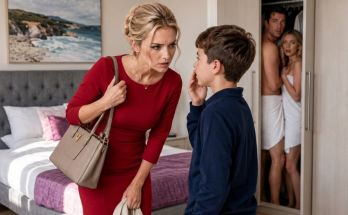
The first thing I remember was the scream of boiling broth and Luca’s hand between my shoulder blades. The second was his mother saying, very calmly, “Maybe now she’ll learn who this house belongs to.”
I was eight months pregnant.
Ten minutes earlier, I had been standing in our kitchen with a pen in front of me and my late father’s deed beside it.
“Sign it,” Luca said.
He had already filled in the property transfer documents. My father’s small brick house—the one he had renovated with his own hands, the one he had left to me alone—would become jointly owned by Luca and me.
I pushed the papers back across the marble island. “No.”
His jaw tightened. “You’re my wife.”
“And it’s my inheritance.”
His mother, Wendy, sat at the breakfast table sipping coffee like she had purchased a front-row ticket to watch me surrender. “You live under my son’s protection, Jessi,” she said coldly. “Stop acting like some rich widow. Your father left you one house, not an empire.”
I looked at Luca. “Why are you so desperate for it?”
That was the mistake.
He moved fast. One second I was beside the stove; the next, his palm struck my upper back with violent force.
I crashed against the enormous stockpot Wendy had insisted on using for Sunday soup. My left arm plunged into the boiling liquid before my hip hit the rim. Pain detonated through my body. I screamed and twisted away, collapsing onto the tile, clutching my stomach.
Luca froze. Wendy didn’t.
“Get the papers,” she snapped, pointing at the island.
I stared at them through tears—not at the severe burns blossoming across my skin, not at my shaking hands, but at the deed. Luca snatched the packet from the counter.
Then he noticed the small black lens above the pantry door. His face changed. “Mom.”
Wendy followed his gaze.
Luca ripped the camera from the wall and crushed it beneath his heel, stomping until the plastic casing shattered into pieces. He crouched beside me, his voice suddenly soft, performative. “You slipped, Jessi. You lost your balance.”
I heard sirens twenty minutes later only because our neighbor, Mrs. Patel, had heard me screaming through the open kitchen window.
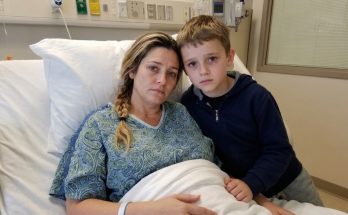
At the hospital, doctors treated second-degree burns along my arm and side. Thankfully, our daughter’s heartbeat stayed strong. Luca told the police it was a tragic domestic accident. Wendy confirmed it.
I said almost nothing to the officers. Because my father had taught me a vital lesson long ago: Never show a thief which lock still works.
When Luca appeared beside my hospital bed later that night, he carried fresh flowers and an icy expression. “Tell them you lost your balance, Jessi,” he whispered, leaning in. “We can still be a family.”
I touched my stomach and felt my daughter kick against my palm. Then I looked at the man who had almost killed us both.
“I remember,” I said.
His smile vanished. But I did not tell him what else I remembered.
PART 2
I came home from the hospital three days later because my doctor wanted me resting somewhere quiet and familiar. Luca assumed my silence meant I had surrendered.
He became almost tender. He changed my bandages. He cooked dinner. He told our friends I was “emotionally confused” after the traumatic accident. Wendy came over every afternoon and reminded me how lucky I was that Luca hadn’t been arrested over “a silly misunderstanding.”
Then the pressure returned.
“We need to refinance,” Luca said one evening, setting a fresh stack of documents on the table. “Your father’s place is sitting there doing nothing.”
I kept my voice completely flat. “I’m not signing.”
His eyes hardened, but this time, he didn’t touch me. He thought fear had made me obedient enough to manipulate.
What he didn’t know was that the destroyed kitchen camera had never stored its footage locally.
My father had installed the security system two years earlier after someone broke into his workshop. When I inherited the house, I moved his equipment into ours and linked it to the same encrypted cloud server. Luca knew there were cameras in the house, but he didn’t know how they were configured.
My father had set up the system. And he had taught me how to use it.
The night after the attack, while Luca slept at home believing the evidence was pulverized beneath his shoe, I gave my attorney, Rachel Vance, the recovery key from memory.
The footage was there. Every single second.
Luca demanding the deed. Wendy mocking me. His violent shove. My scream. Wendy ordering him to grab the papers before helping me. Luca destroying the physical camera.
And, worst of all, the conversation captured after I collapsed on the floor.
“Once the house is ours, sell it fast,” Wendy had said on the audio feed.
“She’ll sign after this,” Luca had answered.
That sentence changed everything.
Rachel called Detective Marcus Reed. Detective Reed didn’t rush to make an immediate arrest. Neither did I. He told me reckless people often expose themselves further when they believe they have escaped consequences.
So we let Luca talk.
I wore no wire; we didn’t need one. I simply stopped arguing. Within weeks, he sent dozens of text messages instructing me on how we would transfer the property. Wendy sent messages warning that if I “made trouble,” Luca would seek sole custody and tell the family court I was mentally unstable.
I saved every single message.
.
Then our daughter, Chloe, was born healthy. Luca cried in the delivery room. For one dangerous second, I almost confused his tears with genuine remorse.
Then, two days later, he brought the property transfer papers straight to my hospital room. “A fresh start for our family,” he said, pressing a pen into my hand.
I looked at our sleeping daughter in her bassinet, then up at him. “Of course,” I whispered softly. “Just give me time to recover.”
He kissed my forehead, completely satisfied.
Then Rachel found the final piece that explained his utter desperation: Luca had signed a private debt agreement months earlier, promising a predatory lender that my father’s property would secure repayment once the title was transferred. He had gambled away nearly ninety thousand dollars through a failed restaurant investment.
My father’s house was not his dream; it was his escape route.
He thought he had won. Instead, he had handed my lawyer undeniable proof that my inheritance mattered more to him than the woman he had burned and the child he had endangered.
PART 3
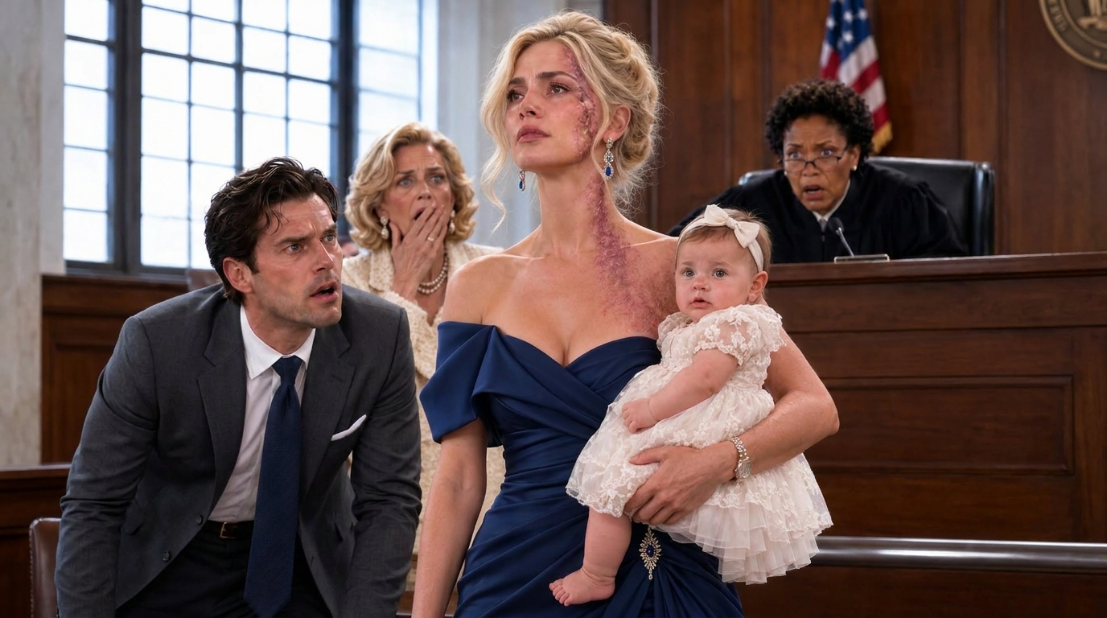
Six months after I hit the kitchen floor, I walked into the county courtroom carrying Chloe against my chest.
The room fell dead silent.
Luca sat beside his defense counsel in a tailored charcoal suit—clean-shaven, polished, looking almost offended to be there. Wendy sat directly behind him wearing a string of pearls.
When Luca saw Chloe in my arms, his mouth parted in shock.
Then Detective Reed entered the courtroom behind me, carrying the official evidence briefcase. Wendy’s face completely drained of color.
Their attorney had argued for months that the camera had been destroyed, that my burns proved nothing more than a tragic accident, and that my memory had been distorted by trauma and pain medication.
Then the prosecutor pressed play on the media console.
The kitchen appeared on the courtroom monitors in crystal-clear high definition.
My voice echoed through the speakers: “I’m not signing.”
Luca’s voice: “You’re my wife.”
The shove. My scream. Wendy’s sharp command: “Get the papers.”
Nobody in the courtroom moved.
The video played on.
“Once the house is ours, sell it fast,” Wendy’s recorded voice said.
“She’ll sign after this,” Luca answered.
In the courtroom, Luca stared blankly at the defense table. The prosecutor froze the image on his face right as his hand made contact with my back.
“That,” the prosecutor told the jury, “is not an accident.”
Luca’s attorney desperately asked for a recess. The judge denied it instantly.
Next came the text messages—Wendy’s custody threats, Luca’s relentless demands for the deed. Finally, Rachel testified regarding the secret debt agreement Luca had signed behind my back.
He had motive. He had intent. He had lied under oath. And he had destroyed physical evidence believing the recording itself was gone forever.
When I took the witness stand, Luca finally looked at me. His expression was no longer arrogant or angry; it was pleading.
“Did you slip?” the prosecutor asked me.
“No.”
“Did your husband intentionally push you into that boiling pot?”
“Yes.”
“Why didn’t you tell him immediately that you had recovered the cloud footage?”
I looked directly into Luca’s eyes. “Because the first time I underestimated him, my daughter and I nearly died. I wasn’t going to give him a second chance to destroy what could protect us.”
Wendy began to weep softly in the gallery. I felt nothing.
The jury deliberated for less than two hours before convicting Luca of aggravated domestic assault, evidence tampering, and attempted coercion. Wendy, prosecuted separately for her role, later pleaded guilty to conspiracy and witness intimidation.
Luca was sentenced to eight years in a state facility. Wendy received eighteen months followed by mandatory probation.
The family court judge granted me an immediate divorce and sole legal and physical custody of Chloe. Luca received zero interest in my inheritance, and a civil judgment was levied against his assets to cover my medical bills and legal fees.
My father’s house remained exclusively mine.
For the first time since that morning in the kitchen, I slept through the night without waking up to phantom screams.
EPILOGUE
Eighteen months after the trial concluded, the autumn sun washed over the front porch of my father’s brick house.
Chloe was two years old now, her dark curls bouncing as she chased a butterfly across the grass in the front yard. Her laughter was bright, clear, and utterly unburdened.
I sat on the porch swing with a warm mug of tea, watching her.
With Rachel’s guidance and a small portion of the civil settlement, I had converted my father’s old woodworking shop in the backyard into a community legal-aid clinic. We offered free consultation services and digital security resources for women navigating financial abuse and domestic coercion.
Above my desk in the workshop hung the original black USB drive my father had handed me years ago, labeled in his precise handwriting: KEEP COPIES.
I used to think he meant tax documents and property receipts. Now I understood he meant choices, evidence, exit strategies, and the pieces of yourself that no one else should ever be allowed to control.
Luca had wanted my father’s house because he believed ownership equaled power. He was wrong.
Real power was walking out of that courtroom with my daughter safe, my name clean, and the front-door key warm in my hand at last.