PART 1: THREE MINUTES BEFORE THE CEREMONY

Three minutes before I was supposed to marry the woman I thought I loved, I found my nine-year-old daughter sitting behind a locked laundry-room door with her flower basket resting on the cold tile beside her.
My name is Colonel Christopher Caldwell. I was thirty-six years old, served in the United States Army, and had spent nearly eighteen years learning to stay calm when plans fell apart.
Nothing in my military career prepared me for what my daughter said that afternoon.
My first wife, Rebecca, died five years earlier after a sudden illness changed our lives completely within a few devastating months. Since then, my daughter Hannah and I had become a small family structured around school calendars, Army schedules, rushed breakfasts, and the constant possibility that duty might interrupt our plans.
Hannah was observant enough to know when a late-night call meant something serious. She recognized my exhaustion after field exercises and understood when certain questions could wait until I removed my uniform and became her father again.
She rarely complained about the instability surrounding my career.
When Pamela Gable entered my life two years earlier, she seemed to understand everything our family required. She accepted interrupted dinners, changed plans, weekend obligations, and the reality that Rebecca’s memory would always remain part of our home.
More importantly, Pamela appeared affectionate toward Hannah.
She helped with science projects, attended a school concert when I was delayed, and remembered that Hannah disliked frosting but loved strawberry filling. During difficult moments, she repeatedly assured me she never expected to replace Rebecca.
“I only want Hannah to understand that loving me does not mean loving her mother any less,” Pamela told me one evening while we washed dishes together.
That sentence helped convince me to propose.
We planned a small wedding at Pine Crest Manor outside Colorado Springs, where a garden terrace overlooked pine-covered hills near Fort Carson. White chairs lined the lawn, soft lights hung between wooden beams, and wildflowers decorated an arbor facing the mountains.
Hannah spent weeks choosing her pale-blue junior bridesmaid dress. She practiced walking slowly with her flower basket because she worried excitement would make her scatter everything before reaching the aisle.
“Do you think I will walk too fast, Dad?” she asked me the night before the wedding.
“You are going to do wonderfully, sweetheart,” I replied while smoothing her hair.
On the wedding morning, Pamela complimented her dress and kissed the top of her head.
“You look like a little princess today, Hannah,” Pamela said softly.
At least, that was what I saw.
Shortly before the ceremony, my sister Samantha entered the preparation room and asked whether Hannah had joined the wedding party outside.
“Is Hannah with you, Christopher?” Samantha asked while looking around the empty room.
I assumed she was helping the photographer, but her assigned chair was empty.
“I thought she was outside taking pictures with the bridesmaids,” I answered.
I checked the garden, kitchen, guest rooms, and upstairs hallway. Nobody remembered seeing her leave.
Then I heard faint movement behind the laundry-room door near the lodge’s service corridor. The handle would not turn when I rattled it.
“Hannah, are you inside that room?” I called out while tapping on the wood.
After a moment of silence, her frightened voice answered from the other side.
“Dad, I am here, but she told me not to come out,” she whispered.
I found the key above the doorframe, unlocked the bolt, and opened the door.
Hannah sat beside a washing machine with her knees pulled tightly to her chest. Her flower basket rested on the floor, and several crushed petals clung to her light blue skirt.
I knelt immediately on the tile floor.
“Why are you sitting in here, and who told you to remain inside?” I asked while taking her hand.
She twisted the satin ribbon around her waist until her fingers turned pale.
“Pamela said I had to stay hidden until the ceremony ended,” Hannah replied softly.
Every sound inside the building seemed to disappear instantly.
“Why would Pamela tell you something like that?” I asked, keeping my voice steady.
Hannah glanced toward the doorway as though expecting Pamela to appear at any second.
“She said today needed to belong to your new family,” Hannah whispered. “She told me people would feel uncomfortable if Mom’s daughter stood beside you.”
My pulse settled into the controlled rhythm I had learned before difficult military decisions.
“Did she say anything else to you, Hannah?” I asked.
Hannah nodded without meeting my eyes.
“She said everything would change after you married her,” she said. “She told me I needed to stop acting like I was the most important girl in your life.”
Then she asked the question that ended whatever future remained between Pamela and me.
“Am I doing something bad by reminding you about Mom?” Hannah asked.
I took both of her cold hands in mine.
“You have done absolutely nothing wrong,” I said firmly. “Nobody will ever punish you for being Rebecca’s daughter.”
Her lower lip trembled as she looked up at me.
“Pamela said you would agree with her after the wedding because husbands are supposed to choose their wives,” she whispered.
I stood up immediately and picked up her flower basket from the floor.
“You are coming outside with me right now,” I told her. “Nobody is going to hide you from your own family.”
PART 2: THE WORDS SHE COULD NOT TAKE BACK
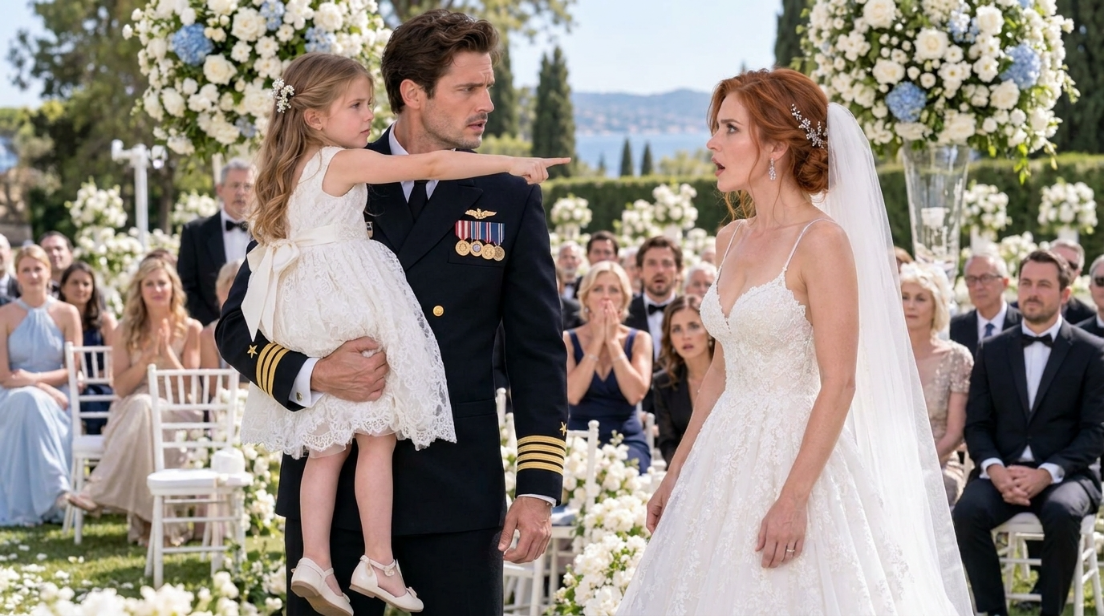
Pamela stood near the garden entrance while the photographer adjusted her silk veil. She wore an ivory gown, held white roses, and smiled toward the guests who were taking their seats.
Her smile vanished completely when she saw Hannah holding my hand.
“Christopher, why did you bring her out here?” Pamela asked, stepping forward with a frown.
That single question revealed more than any lengthy explanation ever could.
I stopped several feet away from her.
“Why was my daughter locked inside the laundry room?” I asked directly.
Pamela glanced toward the photographer and two bridesmaids before lowering her voice.
“She was not locked inside because I only asked her to remain somewhere quiet until we finished,” Pamela said nervously.
“You instructed a nine-year-old child to hide during her father’s wedding,” I said.
“Please stop making it sound so cruel when I was only trying to prevent unnecessary emotional confusion,” Pamela replied.
Hannah moved closer to my side and squeezed my fingers.
“What emotional confusion could her presence possibly create?” I asked.
Pamela looked toward the guests sitting in the garden.
“Everybody knows she represents your first marriage,” Pamela whispered aggressively. “Constantly placing her beside us makes it appear that Rebecca remains part of this relationship.”
I stared at the woman I had intended to marry within minutes.
“Rebecca will always remain part of Hannah’s life,” I stated plainly. “That means her memory will never be erased from mine either.”
Pamela’s expression tightened instantly.
“That is exactly the problem, Christopher,” she hissed. “You keep treating the past as though it deserves equal space with our future.”
“Hannah is not the past,” I said.
“I did not say she was,” Pamela countered. “However, she constantly brings Rebecca into everything we do.”
Samantha had quietly approached us and now stood several steps behind Hannah.
Pamela folded her arms around her rose bouquet.
“She mentions her mother during holidays, keeps photographs everywhere, and becomes upset whenever we discuss changing the house,” Pamela said. “I have tried to be patient, but our marriage needs clear boundaries.”
“Those photographs belong inside Hannah’s home because Rebecca was her mother,” I told her.
Pamela shook her head in frustration.
“Once we have children together, I will not raise them inside a shrine to the woman you married first,” Pamela declared.
The photographer lowered his camera completely. Several nearby guests went dead silent.
Pamela noticed the audience and softened her tone slightly.
“We can discuss this privately after the ceremony,” Pamela murmured. “However, Hannah needs to understand that your wife cannot spend her life competing with a dead woman’s daughter.”
Hannah flinched at the harsh words.
I stepped directly between Pamela and my daughter.
“My daughter is not competing with anybody,” I said coldly.
“She competes every day whether you recognize it or not,” Pamela snapped. “She watches every decision you make and makes you feel guilty whenever you prioritize me.”
“She is nine years old, Pamela,” I reminded her.
“Nine is old enough to understand that families change,” Pamela argued.
I looked Pamela in the eyes and asked whether she had ever told Hannah to hide photographs, stop mentioning Rebecca, or stay away during conversations about our future children.
Her total silence answered my question immediately.
Hannah spoke up quietly from behind me.
“She put Mom’s picture inside a kitchen drawer last month,” Hannah revealed. “She told me not to bother you about it because you were busy.”
A specific memory returned to me instantly. I had noticed Hannah’s favorite photograph missing from the refrigerator, and Pamela had claimed it probably fell behind the counter.
“What else did she ask you not to tell me, Hannah?” I asked softly.
Hannah’s eyes filled with tears.
“She said my bedroom would become the nursery because it has better windows,” Hannah cried softly. “She said I could sleep in the smaller guest room after you got married.”
Pamela’s face reddened with anger and embarrassment.
“Those were preliminary possibilities,” Pamela insisted loudly. “She simply misunderstood an adult conversation.”
“You discussed removing my daughter from her bedroom without speaking to me first,” I said.
“I was planning for our future,” Pamela defended herself. “Somebody inside this family needs to start thinking ahead.”
I finally understood the whole truth in that moment. Pamela’s affection for my daughter had never been real. It had always been completely conditional.
She had accepted Hannah only while believing our marriage would eventually give her the authority to make my daughter less important.
PART 3: THE CEREMONY THAT NEVER BEGAN
The processional music began playing because the coordinator had not seen our confrontation near the trees. Guests turned toward the aisle while Pamela tried desperately to regain control of the situation.
She reached out to grab my hand.
“We are both emotional right now,” Pamela pleaded softly. “Let us complete the ceremony first and handle this afterward like adults.”
I stepped back out of her reach.
“There will be no ceremony today,” I said clearly.
Her face emptied of all color.
“You cannot cancel our wedding because Hannah misunderstood one conversation,” she gasped.
“I am canceling this wedding because you deliberately isolated my daughter,” I replied. “You treated her as an obstacle and planned to restructure her home the moment you got my commitment.”
Pamela looked around in panic toward my commanding officer, our relatives, our friends, and members of her own family.
“Do not humiliate me publicly over something we can easily repair in private,” she begged.
For a brief second, her request almost sounded reasonable. My professional career had always rewarded discretion, self-control, and solving complex problems without creating a public scene.
However, protecting Pamela from public embarrassment would mean allowing Hannah to believe that the shame belonged to her.
I walked with my daughter directly toward the microphone near the wooden arbor. The wedding music stopped abruptly when the coordinator finally realized that the plan had changed.
“Thank you all for coming today,” I spoke into the microphone. “However, this wedding will not take place.”
A confused murmur moved through the rows of wooden chairs.
Pamela rushed up to the arbor behind us.
“Christopher, please do not announce private accusations without explaining the proper context,” she demanded angrily.
I turned to face the gathering of guests.
“Several minutes ago, I found Hannah sitting on the floor of a locked service room,” I stated clearly. “Pamela instructed her to remain hidden until after the ceremony because my daughter supposedly interfered with the family we were trying to create.”
Pamela stepped right up to the microphone.
“That is a completely distorted description of a very complicated family matter,” Pamela told the crowd.
I looked at Pamela in front of everyone.
“Did you tell Hannah she could not participate in this wedding?” I asked her directly.
Pamela avoided looking at me or the guests.
“I told her that emotions were high today and everyone needed some space,” Pamela stammered.
“Did you tell her she would no longer remain the most important girl in my life?” I asked.
Pamela glared at me with sharp eyes.
“You cannot expect your wife to accept second place forever, Christopher,” she blurted out.
Several guests lowered their eyes in disbelief while others gasped softly.
I pulled the wedding band intended for Pamela out of my jacket pocket and placed it quietly on the table beside the microphone.
“I will not marry anybody who views my daughter as a rival requiring removal,” I said firmly.
Pamela stared down at the golden ring resting on the wood.
“You are throwing away our entire future because of one brief conversation with a child,” she said bitterly.
Hannah tightened her grip around my fingers.
“I am protecting my future,” I replied quietly. “That child finally told me the truth today.”
Pamela’s mother approached the arbor quickly and urged everyone to pause before making irreversible choices. She described Pamela as completely overwhelmed by wedding stress and suggested that blended families always experienced difficult transitions.
“Wedding stress does not place a frightened child behind a locked door,” Samantha replied firmly as she stepped up beside us.
Pamela accused my sister of trying to undermine our relationship from the very beginning, but the argument no longer mattered to me.
The wedding coordinator began releasing the catering staff from their ceremonial duties while guests started leaving the lawn quietly. Some friends approached Hannah gently to offer support, though Samantha made sure nobody overwhelmed her with questions.
Pamela followed me inside the lodge corridor as I gathered our belongings.
“If you walk away right now, I will never forgive you for this,” Pamela threatened with tears in her eyes.
“Your forgiveness is not my primary concern today,” I replied calmly.
“I changed my entire life for you,” Pamela shouted. “I accepted every military interruption, every photograph of Rebecca, and every mood your daughter brought into our home.”
That specific word, accepted, clarified everything for me once and for all.
Hannah and I had never been people she loved completely. We were merely heavy burdens she had tolerated while waiting to gain total authority over our lives.
“You never truly accepted my daughter,” I told her plainly. “You merely postponed rejecting her until you thought I was locked in.”
Pamela unclasped her engagement ring and slammed it hard onto the reception table.
“Someday Hannah will grow up and leave your house,” Pamela said venomously. “You will realize you sacrificed your happiness for somebody who was never meant to stay the center of your life forever.”
“A child does not need to stay forever to deserve protection today,” I said quietly.
I left both expensive rings resting on the table and walked out of the building with my daughter.
PART 4: WHAT MY DAUGHTER HAD BEEN HIDING
When we returned home later that afternoon, Hannah immediately changed out of her blue bridesmaid dress and put on comfortable sweatpants and one of my old Army T-shirts.
Samantha stayed at our house while I made the necessary phone calls to the venue manager, the coordinator, and my attorney regarding contract cancellations and retrieving our financial deposits.
Handling the practical work delayed my emotional collapse until Hannah finally fell asleep on the living-room sofa.
Samantha handed me a fresh cup of black coffee and sat down across from me.
“How long do you think Pamela was treating Hannah like that when you were not around?” Samantha asked quietly.
The full, painful answer emerged over the course of the following week.
Pamela had actually begun removing Rebecca’s photographs from the common living areas about six months earlier. She had told Hannah that talking about her late mother made me terribly sad, suggesting that keeping silent was the ultimate form of kindness toward me.
She had repeatedly described my military deployments and training obligations as deliberate personal choices, claiming those choices proved adult relationships mattered far more than children.
Whenever Hannah questioned any of our upcoming wedding plans, Pamela accused her of being selfish and demanding constant attention.
Most painfully of all, Pamela had warned Hannah that telling me about these conversations would cause me to cancel the wedding and spend the rest of my life lonely and miserable.
My sweet daughter had genuinely believed that protecting my long-term happiness required her to endure emotional mistreatment in silence.
That realization forced me to confront my own terrible blindness over the past two years.
I had foolishly interpreted Pamela’s willingness to help with homework and attend school functions as absolute proof of lasting affection. I had completely overlooked how quiet Hannah became whenever Pamela walked into the kitchen. I had dismissed my daughter’s deep resistance to household changes, assuming that simple wedding anxiety explained her frequent stomachaches.
During our first family counseling session a week later, Hannah finally described the entire laundry-room conversation in detail.
“Pamela told me that you needed a normal family now,” Hannah said softly to the therapist. “She said I was making everything harder for everyone because Mom died.”
My hands clenched into tight fists in my lap, but the counselor caught my eye and gently reminded me that showing intense anger might make Hannah believe she had started another major crisis.
I took a deep breath and looked directly at my daughter.
“Your mother’s death was never your fault or your responsibility,” I told her gently. “You are not an obstacle preventing me from having a loving family.”
Hannah looked down at her hands.
“What if you want to marry somebody else later on?” she asked quietly.
“Then that person must understand that loving me means respecting you, respecting your mother, and honoring the life we had before we met her,” I promised.
Hannah thought about my words for a moment.
“Would you really cancel another wedding for me, Dad?” she asked timidly.
“I hope I become observant enough that neither of us ever reaches another wedding before discovering the truth,” I replied with a reassuring smile.
Her faint smile carried far more emotional relief than amusement.
Over the next month, Pamela tried contacting me repeatedly through text messages, mutual friends, and letters from her relatives. Her explanations constantly shifted from total denial to elaborate self-justification.
First, she claimed that Hannah had grossly exaggerated the entire interaction. Then, she insisted her request for Hannah to stay in the room had been purely temporary. Finally, Pamela argued that every healthy marriage required a wife to become her husband’s absolute primary priority above all else.
I responded only once through my family lawyer.
“No real adult partnership requires humiliating a young child or erasing the memory of her deceased parent,” the letter stated.
After that formal notice was delivered, all direct communication from her stopped completely.
PART 5: THE UNIFORM COULD NOT MAKE THE DECISION FOR ME
Several of my fellow officers at Fort Carson eventually learned about the canceled wedding, though nobody asked intrusive personal questions while I was wearing my uniform.
The Army had trained me thoroughly to gather intelligence, assess tactical risks, and protect those under my command at all costs. Yet at home, I had trusted mere appearances simply because I desperately wanted the peaceful domestic comfort they promised us.
That painful contradiction was extremely difficult for me to accept as a leader and a father.
My commanding officer, General Thomas Bradley, invited me into his office one afternoon after hearing a distorted version of the event from another guest.
“You do not owe me any personal details, Colonel Caldwell,” General Bradley said from behind his desk. “However, I need to know whether your daughter is safe and whether this situation will impact your official duties.”
“Hannah is completely safe sir,” I replied while standing at attention. “Though I deeply regret failing to recognize an emotional threat developing inside my own home.”
General Bradley considered my response for a moment before gesturing for me to sit down.
“Command responsibility includes taking immediate action to correct conditions once reliable intelligence appears,” he told me calmly. “It does not require you to pretend you possessed information that was deliberately hidden from you.”
That distinction helped lighten my guilt slightly, though the ultimate responsibility still rested on my shoulders.
I temporarily reduced my official travel schedule and arranged more consistent childcare help with Samantha during upcoming field training periods.
Hannah continued her weekly counseling sessions and gradually stopped apologizing whenever she mentioned Rebecca’s name in conversation. Together, we brought her mother’s framed photographs back into the living room where they belonged.
We also built a custom memory cabinet together in the hallway. It held personal letters, photo albums, Rebecca’s favorite cooking recipes, and special keepsake items that Hannah wanted accessible without feeling like the entire house was a somber memorial.
Our goal was never to remain trapped in endless grief. We simply needed to carry our shared history forward without allowing anyone else to erase it.
One evening while we were cooking dinner together, Hannah asked if I still loved Pamela.
“Part of me still loves the person I believed she was,” I answered honestly while chopping vegetables. “However, that imagined person cannot be separated from the choices she made.”
“Does loving somebody mean you have to forgive them for everything they do?” Hannah asked.
“Loving someone does not mean you throw away your boundaries,” I explained to her. “Forgiveness never requires you to give an unsafe person another chance to hurt you.”
Hannah nodded thoughtfully and returned to her schoolwork at the table. Her growing willingness to ask tough, direct questions showed me that her deep fear was finally losing its grip on her heart.
PART 6: THE AISLE WE WALKED TOGETHER
Three months after the canceled ceremony, the manager at Pine Crest Manor called to return several personal items that our family had left behind in the chaotic rush.
Among those items was Hannah’s blue flower basket.
We drove out to the lodge together on a clear, warm Saturday morning. The garden terrace was completely empty today, devoid of white chairs, dangling lights, or elaborate wedding decorations. Tall pine trees moved gently in the breeze beyond the arbor, and bright sunlight spilled over the mountains.
Hannah carried her basket toward the edge of the stone patio.
“I practiced this walk for weeks,” she murmured while looking down the empty stone path. “I never actually got to finish it.”
“Would you like to finish it right now?” I asked her.
She hesitated for a second before reaching into the basket and pulling out a handful of silk rose petals that had remained tucked inside.
We linked arms and walked slowly together toward the wooden arbor while she scattered the colorful petals onto the path.
No wedding guests watched us. No music dictated our steps.
When we reached the arbor, Hannah looked up at me with clear eyes.
“What happens after we reach this part, Dad?” she asked.
“Now we get to decide where we want to walk next,” I told her.
That simple moment became the start of a meaningful new tradition for our small family.
Every year on Rebecca’s birthday, Hannah and I would choose a new place that neither of us had ever visited before. Sometimes we visited an art museum, sometimes we hiked a scenic mountain trail, and other years we simply tried a brand-new restaurant in town where we ordered dessert first.
It allowed Rebecca’s memory to remain a living part of our ongoing journey rather than just a source of silent sorrow.
Eventually, Pamela sent Hannah a handwritten letter through my attorney’s office. In the note, she admitted that her deep internal jealousy regarding Rebecca’s memory had turned into unfair resentment toward a child who could not defend herself.
Our family counselor reviewed the letter first before letting Hannah decide whether she wanted to read it.
Hannah held the sealed envelope in her hands for a moment and then placed it unopened inside her desk drawer.
“Maybe I will read it when I am much older,” Hannah said calmly. “I do not need her explanations right now.”
I respected her mature decision completely. The power over our family’s story now belonged to the child who had once been forced into silence.
PART 7: THE FAMILY THAT WAS ALREADY COMPLETE
One year after the canceled wedding, Hannah participated in a special school presentation about family history and heritage.
On her display board, she placed a photograph of Rebecca, a photo of me in my Army dress uniform, and a third picture showing herself sitting between Samantha and me during a summer picnic in the park.
During the question segment, a classmate asked whether she ever wished she had a more normal, traditional family structure.
Hannah looked at her poster and then answered before looking over at me standing in the back of the classroom.
“My family is completely normal,” Hannah said confidently to her class. “Because people die, plans change, and the people who stay still have to choose each other every day.”
Her clear answer reminded me instantly of the terrified little girl who had sat behind a locked laundry room door, twisting a dress ribbon while wondering if her existence was something shameful.
After the school presentations ended, we drove home together and cooked Rebecca’s special baked chicken recipe using the recipe card from our memory cabinet.
Hannah playfully criticized my seasoning techniques while I reminded her that Army colonels were not generally trained for high-end culinary precision.
“Well, maybe the military needs to reconsider its training priorities,” she teased back with a giggle.
Our house no longer waited for an outsider to arrive and transform it into a legitimate family unit. It was already filled with school homework, framed photographs, occasional arguments over chores, late-night Army phone calls, and more than enough daily affection to remain complete on its own.
I had once mistakenly believed that marrying Pamela would give Hannah long-term stability and help both of us build a brand-new future beyond our grief. That deep desire had caused me to overlook the danger that someone could fake tenderness while viewing my young daughter as temporary competition.
Canceling our wedding had not felt grand or heroic at the time. It had felt deeply humiliating, financially costly, completely confusing, and thoroughly painful.
Yet it was absolute necessary.
Real protection rarely resembles the dramatic certainty that people imagine in movies. Sometimes protecting the people you love simply means believing a frightened child, even when doing so shatters the future you spent years planning.
Three minutes before the ceremony was set to begin, I genuinely believed my sole responsibility was to walk down the aisle toward Pamela and make a lifelong vow. Instead, I found my daughter hiding behind a locked door and remembered the solemn vow that already mattered most.
Five years earlier, right after Rebecca died, I had held my crying daughter and promised her that she would never have to face this world alone as long as I was alive. At Pine Crest Manor, I nearly broke that vital promise by putting my trust in the wrong person.
Then Hannah summoned the courage to tell me the absolute truth, and I made sure to listen before three minutes could turn into an entire ruined childhood.
There was no wedding on the terrace that afternoon.
Nevertheless, a real family walked away together.