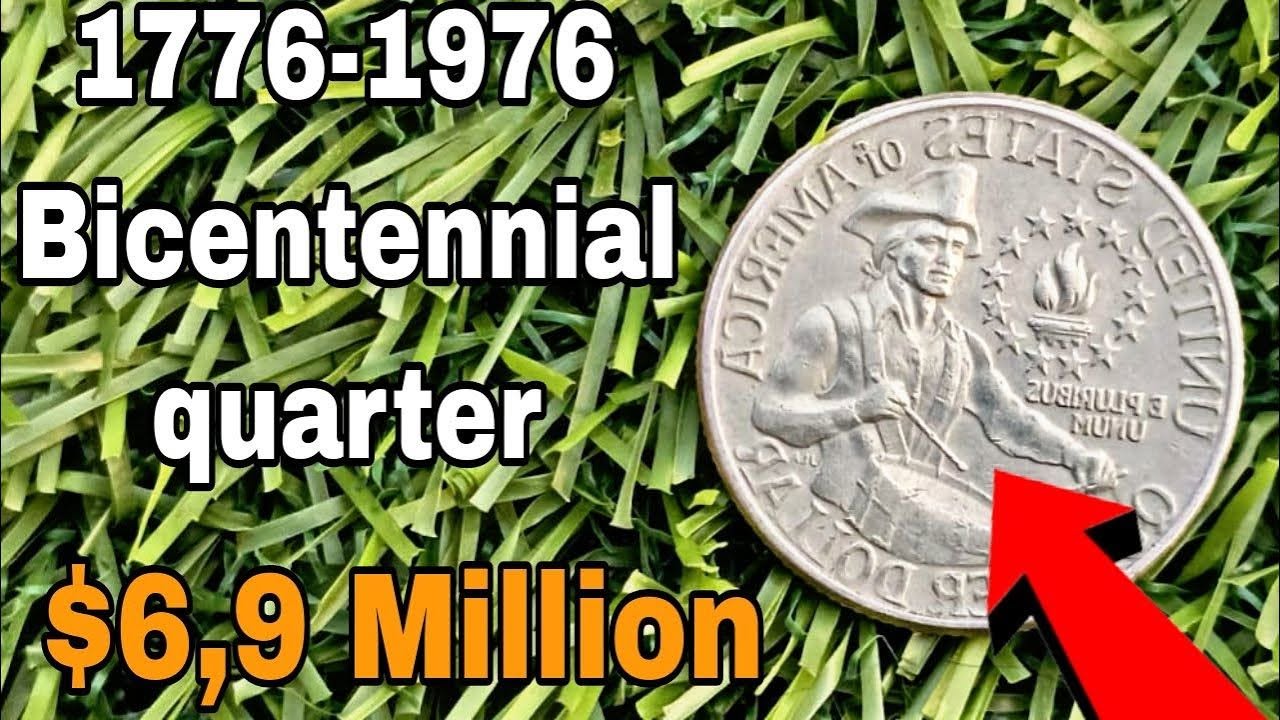
1776–1976 Bicentennial Quarter over a faux-grass background with bold text claiming a value of “$6.9 Million.”
While over 1.6 billion Bicentennial Quarters were minted—making most pocket-change examples worth face value (25 cents)—certain rare silver varieties, top-tier certified grades, and major mint errors can sell for thousands of dollars.
1776–1976 Bicentennial Quarter: History and Design
To celebrate the 200th anniversary of the Declaration of Independence, the U.S. Mint produced dual-dated quarters throughout 1975 and 1976.
-
The Obverse: Retains George Washington’s portrait, modified with the dual dates 1776–1976.
-
The Reverse: Designed by Jack L. Ahr, replacing the traditional eagle with a Colonial military drummer standing next to a victory torch surrounded by 13 stars.
-
Mintage Output: More than 1.6 billion circulating clad quarters were produced across Philadelphia and Denver, making them extremely common in pocket change.
What Makes Certain Bicentennial Quarters Valuable?
The multi-million dollar claims in social media graphics exaggerate the real market. However, specific features drive significant value among numismatists:
-
40% Silver Composition (1976-S): The U.S. Mint produced special collector uncirculated and proof coins at the San Francisco Mint containing 40% silver rather than standard copper-nickel.
-
Flawless Mint State Grades (MS68+): Because billions were struck and handled roughly, coins preserved in perfect uncirculated condition without scratches or spots command premiums.
-
Major Mint Errors: Double strikes, off-center strikes, and wrong-planchet errors carry high collector demand.
Realistic Auction Values for Bicentennial Quarters
How to Check Your Change
-
Check the Edge: Look at the coin’s edge. A solid silver-colored stripe (without a copper line) indicates a potential 40% silver specimen.
-
Check for Mint Marks: Look for an “S” mint mark under the right side of Washington’s ribbon on the front.
-
Look for Double Die Details: Use a magnifying loupe to inspect the lettering “LIBERTY” and “IN GOD WE TRUST” for faint doubling or extra outlines.