PART 2: THE LIE BEHIND THE ROSES
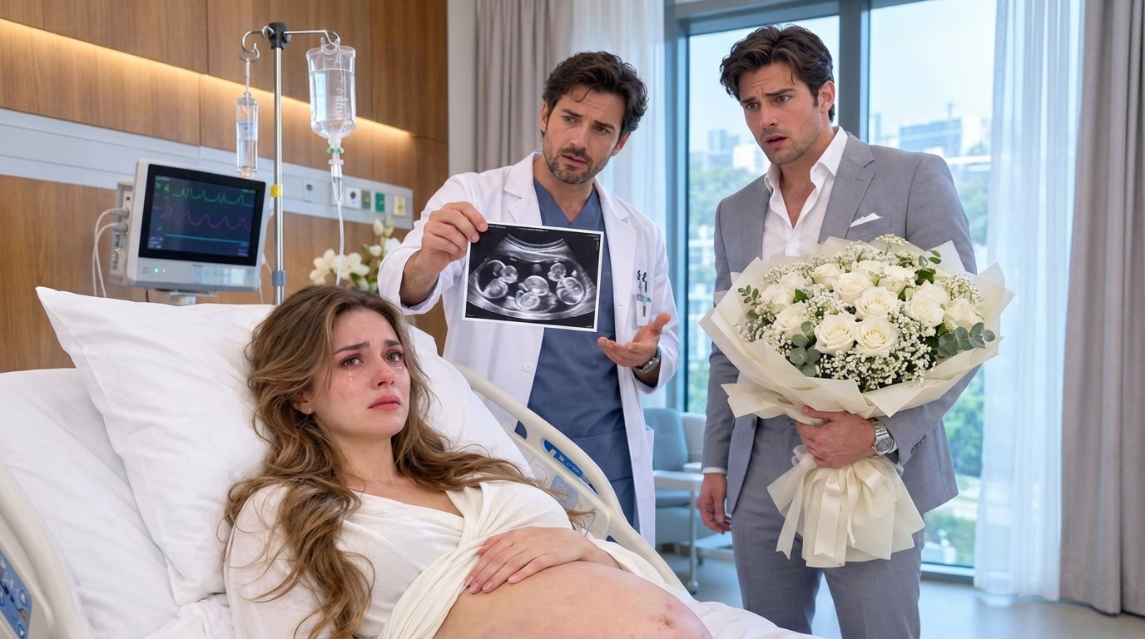
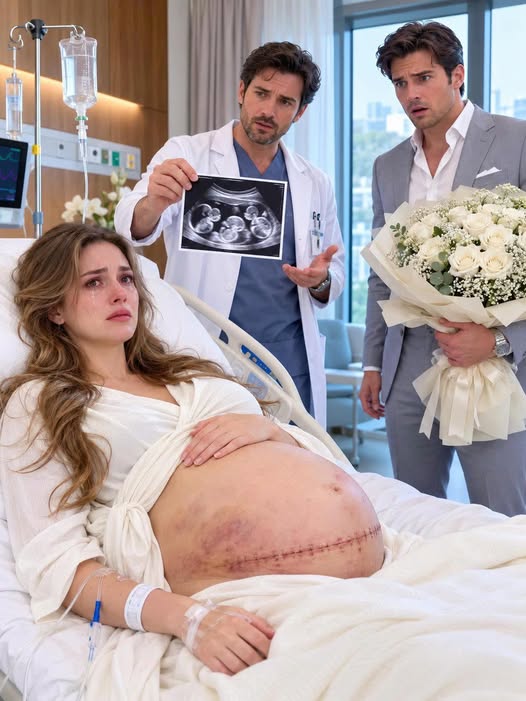
Flynn went ghost-white. For several seconds, he stood beside my hospital bed without moving, his lips parted as if his body had forgotten how to breathe. Then he looked down at the ultrasound photograph again. Two tiny shapes. Two children who had existed quietly inside me while their father raised a knife. I watched realization crush him, but there was something strangely unsatisfying about seeing him finally understand what he had destroyed.
“Mabel,” he whispered. “Please. I didn’t know.”
I stared at him without answering. Three days earlier, I would have begged this man to believe me. I would have explained where I had been, shown him my phone records, called witnesses, opened every application on my phone just to prove I had never touched Selina. Now I felt no need to prove anything. Flynn’s trust had been tested once, and he had answered that test by driving a knife into my body.
Dr. Reed quietly moved the ultrasound back into my chart. His expression remained professionally controlled, but the disgust in his eyes was impossible to miss. “Mr. Vance, your wife needs rest. You have been instructed not to upset her.” Flynn barely seemed to hear him. His attention stayed fixed on me. “I can fix this,” he said desperately. “Whatever it takes. Therapy. Counseling. Anything. Just don’t end us like this.”
“You already ended us,” I said.
A knock came at the door before he could respond. Two uniformed officers entered first. Behind them came a woman in a charcoal suit carrying a leather folder. She introduced herself as Detective Nora Patel of the Chicago Police Department. Flynn’s expression immediately changed. The grieving husband vanished. The CEO returned. His shoulders straightened. His voice lowered. “My attorneys are already handling this.” Detective Patel looked at him calmly. “That doesn’t change why I’m here.”
Flynn glanced at me as though I had betrayed him by surviving long enough to speak to the police. That look told me everything I needed to know. He had expected remorse to erase consequence. He had expected flowers, tears, and the Vance name to transform attempted murder into an unfortunate marital disagreement. When Detective Patel asked him to step into the hallway, he refused. Then one officer quietly told him he could walk voluntarily or in handcuffs.
He walked.
The moment the door closed, I finally exhaled. My entire abdomen burned. Every breath pulled painfully against the stitches. Detective Patel returned alone ten minutes later and sat beside my bed. Her voice softened. “Mrs. Vance, I understand you recently regained consciousness. We can wait if you’re not ready.” I looked toward the closed door. “I’ve spent three years waiting for people to be ready to hear the truth. I’m ready now.”
So I told her everything.
I told her Selina had arrived crying. I told her about the scratch. I told her Flynn had been cutting an apple before Selina came. I described the knife, his questions, my denial, the first stab, the second stab, and Selina smiling while I bled. I told her Flynn had not checked whether I was breathing. He had not pressed a towel against my wounds. He had wrapped his jacket around Selina instead.
Detective Patel wrote quietly for nearly twenty minutes. Then she asked a question I had not expected. “Who called 911?” I frowned. “Flynn, I assume.” Patel stopped writing. She looked at me. “No.” My heartbeat quickened. She opened her folder. “The emergency call came from your housekeeper, Maria Santos, approximately eleven minutes after the stabbing. She had returned because she forgot her medication in the staff kitchen.”
I stared at her.
Eleven minutes.
For eleven minutes, Flynn had known I was bleeding on the floor.
“What did Flynn do?” I asked.
“We’re still establishing that.”
“What did Selina do?”
Patel hesitated.
Then she answered.
“She left.”
I turned my face toward the window. Chicago stretched beyond the hospital glass, glittering beneath a cold gray sky. Somewhere inside me, something changed permanently. Selina had watched me collapse. Flynn had watched me collapse. Neither had called for help. Maria had returned by accident. Five more minutes, Dr. Reed had said. Five minutes separated my life from death. Maria forgetting medication had been the reason I still existed.
Detective Patel continued carefully. “Mrs. Vance, there’s another problem. The security system at your residence was manually disabled seventeen minutes before Ms. Cole arrived.” I slowly looked back at her. “Disabled by whom?” Patel studied my face before answering. “According to the security company, the command was entered from your husband’s phone.” For the first time since waking, genuine fear crawled through me. Flynn hadn’t simply reacted badly. He had prepared for privacy.
“He turned off the cameras?”
“Yes.”
“Why?”
“That’s what we intend to find out.”
I thought about Selina standing at our front door with that tiny scratch. I thought about Flynn holding the apple. I thought about how quickly anger had appeared in his eyes. Too quickly. Almost as if he had entered the conversation already expecting me to be guilty. “Detective,” I said quietly, “I want you to examine every message between Flynn and Selina. Not the last week. Not the last month. Everything.”
Patel nodded. “We already obtained preservation orders.”
“Good.”
She closed her notebook, but I stopped her before she stood. “And Detective?”
“Yes?”
“I want Maria protected.”
Patel’s expression changed slightly.
That was enough for me to understand.
“You already think she’s in danger.”
“We think she may know more than she realizes.”
Maria came to see me the following morning.
She was sixty-three, barely five feet tall, and had worked for the Vance family longer than I had known Flynn. The moment she entered my room, she started crying. She kissed my forehead and repeated, “I’m sorry,” until I finally caught her hand. “Maria, you saved my life.” Her face twisted. “I should have been there earlier.” The words made me pause. “Earlier?”
Maria looked toward the door before answering.
“Mrs. Vance sent me home.”
I knew immediately she did not mean me.
Flynn’s mother, Celeste Vance.
“When?”
“Thirty minutes before Miss Cole came.”
The room seemed suddenly colder.
Maria explained that Celeste had arrived unexpectedly that afternoon. She had walked through the house as if she still owned it, although Flynn and I had purchased the property after our wedding. She told Maria there would be a private family conversation and instructed every employee to leave early. Maria obeyed. She only returned because her blood-pressure medication remained in the kitchen.
“Was Celeste there when Selina arrived?”
“No, ma’am. She left about ten minutes before.”
My mind began arranging details.
Celeste clears the house.
Flynn disables the cameras.
Selina arrives crying.
Flynn attacks me.
Selina leaves.
Nobody calls an ambulance.
That was no longer a spontaneous argument.
It was a sequence.
I called the only person I trusted enough to handle what came next.
Her name was Evelyn Shaw.
Before marrying Flynn, I had worked beside Evelyn at Archer Rowe Capital. She was ten years older than me, terrifying in negotiation, unimpressed by billionaires, and incapable of pretending stupidity was sophistication. She had begged me not to abandon my career after the wedding. I had insisted I wanted time to build a family. Evelyn never criticized that choice, but she had made me promise one thing.
“Keep your own money. Keep your own lawyer. Keep your own name somewhere nobody can take it.”
I had listened.
Evelyn entered my room carrying no flowers. She brought a laptop, three legal pads, two phones, and the expression of someone preparing for war. She hugged me once, gently enough not to hurt my stitches, then sat down. “Tell me what outcome you want.” I expected myself to say revenge. Instead, the answer came immediately. “I want the truth documented so completely that nobody can buy a different version.”
Evelyn nodded.
“That I can do.”
Within forty-eight hours, Flynn was formally charged with aggravated battery with a deadly weapon and attempted murder while prosecutors reviewed additional charges. His attorneys argued that he had experienced an emotional break after believing Selina was in immediate danger. The argument was ridiculous. Selina had arrived with a superficial scratch from an incident she claimed had already happened. There had been no threat in the room except the knife in Flynn’s hand.
His bail hearing became national news.
Vance Global shares dropped nine percent before noon.
Reporters crowded outside the hospital. Television networks replayed old photographs from our wedding, transforming smiling images into evidence of tragedy. Commentators debated whether Flynn had always been violent. Former employees anonymously described his temper. Others defended him as disciplined and generous. Everyone wanted to explain a marriage they had never lived inside. I turned off the television and concentrated on breathing without tearing my stitches.
Then Selina gave an interview.
She wore pale blue and no makeup. Her arm had been wrapped in an absurdly large bandage, despite medical records later showing the scratch required no stitches. She claimed she had been “terrified for months” because I had supposedly become increasingly jealous of her friendship with Flynn. She said she never intended for Flynn to hurt me. Then, with tears gathering perfectly in her eyes, she called the stabbing “a tragic misunderstanding.”
A tragic misunderstanding.
I replayed that phrase twice.
Then I laughed.
It hurt so badly I had to hold a pillow against my abdomen, but I could not stop. Evelyn rushed toward me, thinking something was wrong. I pointed at the television. “She thinks she can talk her way out of this.” Evelyn took the remote and switched off the screen. “People like Selina usually can.” She looked at me. “Until they meet paperwork.”
That afternoon, paperwork arrived.
Evelyn’s forensic accounting team had started examining publicly available Vance Global disclosures, my marital financial records, and entities associated with Selina. One company caught their attention: Cole Strategic Advisory LLC. It had no visible employees, no physical office beyond a mail service, and no meaningful consulting history. Yet over the previous eighteen months, three Vance Global subsidiaries had paid it a combined $4.8 million.
“For what?” I asked.
“That’s the interesting part,” Evelyn said. “The invoices are meaningless. Market positioning. Strategic introductions. Brand relationship development.”
“Flynn approved them?”
“Some.”
“Who approved the others?”
Evelyn rotated the laptop toward me.
The authorization signature belonged to Damian Cross.
Vance Global’s chief financial officer.
Damian was Flynn’s closest professional ally. He had stood beside him at our wedding. He attended Christmas at Celeste’s lake house. When Flynn traveled internationally, Damian often joined him. I had always assumed their relationship was purely corporate. Evelyn opened another document. Cole Strategic Advisory had been formed using an attorney in Delaware. That attorney had also formed a private investment vehicle called Northwater Holdings.
“Who owns Northwater?”
“We don’t know yet.”
“But you suspect Damian.”
“I suspect people rarely hide boring things behind three layers of shell companies.”
The police discovered something more useful.
Selina’s scratch had not happened where she claimed.
She told detectives I had confronted her outside a boutique on Oak Street shortly before she arrived at my home. There were cameras outside the boutique, cameras inside the neighboring jewelry store, cameras at the parking garage, and traffic cameras along the route. Detectives collected everything. Selina appeared in several recordings.
I appeared in none.
At 1:42 p.m., Selina exited the boutique laughing on the phone.
No scratch was visible.
At 1:51, she entered her car.
At 2:03, a traffic camera captured her vehicle three blocks from my house.
At 2:11, she walked toward our front gate.
Her left sleeve was pulled down.
The alleged assault had never happened.
But that still did not explain the scratch.
The answer came from something embarrassingly ordinary.
A gas station.
Selina had stopped six minutes from my house. The station’s outdoor camera showed her parking beside an empty pump, opening the driver-side door, and sitting there for almost three minutes. The footage was distant, but investigators enhanced it enough to see her bending over her left arm repeatedly. When she emerged, she wrapped a tissue around her forearm and drove directly to my house.
She had injured herself.
The prosecutor informed Evelyn before the information became public.
I felt no surprise.
The smile Selina had given me while I lay bleeding had already told me the wound was fake.
What shocked me was what happened next.
Flynn requested permission through his attorney to speak with me.
I refused.
He sent a handwritten letter.
I returned it unopened.
He sent another.
I returned that one too.
The third letter arrived through Evelyn because Flynn’s attorney claimed it contained information relevant to my safety. I allowed Evelyn to read it first. Halfway through, her expression changed. “You need to see this.” She placed the paper in front of me.
Flynn claimed Selina had manipulated him.
According to the letter, she had called him that morning and said I had been following her. She told him I had threatened to “make her disappear.” She said she was afraid to contact police because my former private-equity connections were powerful enough to destroy her reputation. Flynn admitted that she asked him to disable the house cameras because she did not want any recording leaked.
I finished reading and handed the letter back.
“He wants to be the victim now.”
“Essentially.”
“Did he explain why he stabbed me twice?”
“No.”
“Did he explain the eleven minutes?”
Evelyn shook her head.
I looked toward the window.
“Then he explained nothing.”
Four days later, I was transferred from intensive care to a private recovery floor. That morning, Detective Patel visited with a sealed evidence envelope. Beside her stood Assistant State’s Attorney Lauren Bishop. They closed the door and asked Evelyn to remain. Bishop placed a printed text-message exchange on my bedside table.
“These were recovered from Mr. Vance’s phone.”
I read the first message.
SELINA: Can you turn the cameras off before I arrive?
FLYNN: Why?
SELINA: I need to tell you something about Mabel. I don’t want anyone recording it.
FLYNN: Done.
That part matched Flynn’s letter.
Then Bishop slid another page forward.
It contained messages from three weeks earlier.
My hands went cold.
SELINA: So it’s true? She’s pregnant?
Several minutes later, Flynn had replied.
FLYNN: I saw the test in her handbag.
I stopped breathing.
Evelyn whispered my name.
I kept reading.
SELINA: You told me nothing would change.
FLYNN: Nothing changes.
SELINA: Twins would change everything.
Flynn’s next answer contained only four words.
FLYNN: Let me handle Mabel.
The hospital room disappeared around me.
The flowers.
The tears.
The trembling voice.
If I had known.
He had known.
He had known before the knife entered my body.
I read the exchange again because part of me desperately wanted the words to rearrange themselves. They did not. Flynn had seen my pregnancy test. He knew I was pregnant before I had even found the courage to tell him. Worse, Selina somehow knew I might be carrying twins. At that point I had not yet undergone the ultrasound that confirmed two embryos.
“How did she know about twins?” I asked.
Bishop looked at Detective Patel.
“That’s one of the questions we’re investigating.”
My first ultrasound had been scheduled but not completed. Only my reproductive endocrinologist knew that the hormone levels suggested the possibility of multiples. The information existed in exactly one place outside the clinic.
My patient portal.
Someone had accessed it.
The login came from an IP address registered to Vance Global’s executive network.
I stared at Bishop.
“Flynn?”
“We’re still identifying the device.”
Something inside me hardened.
Flynn had not arrived at the hospital ignorant of my pregnancy.
He had arrived hoping I remained ignorant of what he knew.
That changed everything.
The prosecution changed its theory too.
The stabbing was no longer simply a violent response to Selina’s accusation. Flynn’s knowledge of my pregnancy transformed the meaning of where he had struck me. Both wounds were in my lower abdomen. His attorneys called that coincidence. Prosecutors called it evidence of intent. I refused to predict what a jury might eventually believe, but one fact became impossible to deny.
My husband had looked at a pregnancy test before he looked at me holding my stomach on the floor.
And he had still chosen Selina.
Vance Global placed Flynn on indefinite leave.
Celeste Vance issued a statement describing the incident as a “deeply private family tragedy” and asking the public not to rush to judgment. She did not mention me by name. She did not mention the twins. She did not condemn her son’s actions. Instead, she emphasized Flynn’s “years of leadership, philanthropy, and service.”
Evelyn read the statement aloud.
Then she smiled.
It was not a pleasant smile.
“She just made a mistake.”
“What mistake?”
“She reminded shareholders that this is also a governance problem.”
Before marrying Flynn, I had spent six years restructuring distressed companies. I understood something the Vance family had forgotten because they had inherited power rather than fought for it: ownership and control were not always the same thing. The Vances dominated Vance Global publicly, but years of acquisitions had required debt, preferred shares, institutional financing, and complex voting arrangements.
And three years earlier, one of those institutional investors had been me.
Not personally.
Through a fund.
When I left Archer Rowe, my carried interest and family assets had remained inside several investment vehicles managed independently by trustees. One of those vehicles held preferred securities convertible into Vance Global voting shares if specific governance triggers occurred.
Attempted murder charges against the CEO qualified.
Evelyn had remembered.
Celeste had not.
“How much?” I asked.
“If converted today, approximately eleven-point-eight percent.”
“That’s not control.”
“No.”
She tapped another document.
“But combined with three pension funds already demanding Flynn’s removal, it becomes enough to call a special shareholder vote.”
I leaned back against the pillows.
For three years, Celeste had treated me as a decorative woman who had surrendered her career to marry into her family.
She had never once asked what I owned.
I had never volunteered the information.
We converted the securities.
The announcement hit the financial press at 8:30 the following morning.
By nine, Vance Global stock had halted temporarily because of volatility.
By ten, Celeste called Evelyn twelve times.
Evelyn answered the thirteenth.
I listened from my hospital bed.
“This is Celeste Vance,” she snapped without greeting. “I need to speak with Mabel.”
Evelyn looked at me.
I shook my head.
“My client is recovering.”
“This is a family matter.”
“No, Mrs. Vance. Your son made it a criminal matter. Your board made it a corporate matter. Your statement made it a shareholder matter.”
There was silence.
Then Celeste said something that made Evelyn sit straighter.
“You have no idea what Mabel is doing.”
Evelyn smiled faintly.
“I assure you, Mabel knows exactly what she is doing.”
Celeste lowered her voice.
“If she attacks this company, thousands of people could lose their livelihoods.”
I finally gestured for the phone.
Evelyn put it on speaker.
“Celeste.”
Her breathing changed when she heard me.
“Mabel. Thank God. We need to stop these lawyers from turning grief into destruction.”
I almost admired the sentence.
“Did you send Maria home?”
Silence.
I repeated the question.
“Did you send Maria home before Selina arrived?”
“I stopped by the house.”
“That wasn’t my question.”
“Mabel, you are heavily medicated.”
“I haven’t taken pain medication in six hours. Answer me.”
Celeste sighed.
“Yes. I told the staff they could leave early.”
“Why?”
“Flynn said he needed privacy.”
That was interesting.
Maria had said Celeste ordered everyone out before Flynn disabled the cameras.
“Flynn asked you?”
“Yes.”
“When?”
Another pause.
“I don’t remember.”
“You remember enough to issue a press release about his philanthropy.”
Her voice sharpened. “Be careful.”
I smiled despite the pain.
“You should have given that advice to your son.”
I ended the call.
Detective Patel obtained Celeste’s phone records that afternoon.
Celeste had lied.
Flynn had not called her before she dismissed the staff.
Selina had.
The call lasted seven minutes and forty-two seconds.
When confronted, Celeste claimed Selina had merely told her that she planned to speak privately with Flynn. She said she wanted to spare employees from witnessing an uncomfortable conversation. It sounded almost reasonable until investigators recovered deleted messages from Celeste’s cloud backup.
One message had been sent to Selina forty minutes before I was stabbed.
Make sure Flynn sees enough to believe you.
Selina replied:
He will. He always does.
Celeste answered:
This ends today.
I read those messages in silence.
Evelyn stopped pacing.
Even Detective Patel seemed disturbed.
“What exactly was supposed to end?” I asked.
Nobody knew yet.
The answer arrived from the last person I expected.
Damian Cross.
Vance Global’s CFO requested a meeting with federal investigators forty-eight hours after police searched Selina’s apartment. His attorney contacted prosecutors and offered information concerning financial crimes, obstruction, and what he described as “a longstanding internal arrangement involving members of the Vance family.”
In exchange, Damian wanted immunity consideration.
The investigation expanded overnight.
What began inside my living room was suddenly reaching into bank accounts in Delaware, Luxembourg, and the Cayman Islands.
Then Detective Patel asked me a question that sounded unrelated.
“Did your prenuptial agreement contain provisions concerning children?”
I nodded.
Flynn’s grandfather had created the Vance Family Voting Trust decades earlier. Flynn controlled a substantial block while he remained CEO, but when he had biological children, portions of future voting rights would eventually transfer into protected trusts for them. Celeste had complained bitterly about that clause before our wedding because it reduced the older generation’s influence.
“If you had twins,” Patel asked, “what would happen?”
I thought back to the documents.
Then I understood.
“Two separate descendant trusts would be created.”
“And when would the trust become irrevocable?”
“After a live birth.”
Patel nodded.
My skin prickled.
Celeste had not wanted me dead because she hated me.
She wanted my children never to exist.
I almost rejected the thought immediately. It sounded monstrous even by the standards of everything already uncovered. Then Evelyn opened the trust documents and traced the voting percentages. Two children would eventually receive enough combined voting power to permanently weaken Celeste’s branch of the family trust.
But that still did not explain Selina.
Until Damian did.
According to his cooperation statement, Celeste had spent years trying to restore Flynn’s relationship with Selina. She believed Selina was easier to control than I was. Selina had no independent fortune, no institutional connections, and no experience analyzing corporate structures. If Flynn divorced me and married Selina, Celeste believed she could preserve influence over both of them.
Selina understood the arrangement differently.
She believed she would become Mrs. Flynn Vance.
She believed that meant money.
A great deal of money.
So she had played along.
But secretly, she and Damian had created Cole Strategic Advisory to siphon millions from Vance Global.
They had also been sleeping together for almost two years.
When Evelyn told me, I simply stared at her.
“Damian?”
“Yes.”
“Flynn’s best friend?”
“Yes.”
“Selina was sleeping with Flynn’s best friend while telling Flynn she still loved him?”
Evelyn nodded.
I started laughing again.
This time I did not stop because of the pain.
For three years, Flynn had treated Selina as some tragic lost love, an untouchable woman whose emotions deserved more protection than his wife’s dignity. He had destroyed our marriage defending her. He had destroyed our children defending her.
And Selina had been using him as camouflage while sleeping with Damian.
The cruelty of it was almost mathematically perfect.
But Damian’s betrayal went further.
He provided investigators with audio recordings.
Apparently, he had begun recording Selina months earlier because he feared she would blame him if their financial scheme was discovered. One recording was made in a hotel room six weeks before the stabbing.
Selina’s voice was unmistakable.
“Flynn is easy,” she said.
Damian laughed.
“How easy?”
“He still thinks I’m the twenty-year-old girl who cried when he left for graduate school. I could walk into his office bleeding ketchup and tell him Mabel shot me, and he’d probably call a hitman before checking whether I had a wound.”
My hands started shaking.
Damian answered, “That’s not funny.”
Selina laughed.
“It’s a little funny.”
The recording continued.
Then Damian asked whether she actually wanted Flynn back.
Selina’s answer destroyed the mythology Flynn had built around her for years.
“God, no. I want access. There’s a difference.”
I asked Evelyn to play that sentence again.
She did.
I imagined Flynn hearing it.
For the first time since the stabbing, I wondered what punishment could possibly be more precise than reality.
He had sacrificed everything for a woman who considered him a door.
Two weeks after I entered the hospital, I was discharged under police protection.
I did not return to the house.
I never wanted to sleep beneath that roof again.
Evelyn arranged a furnished apartment overlooking Lake Michigan while my attorneys prepared the divorce petition and preservation orders prevented Flynn or Celeste from removing marital assets. The first night there, I stood beneath the shower for almost an hour, staring at the healing wounds across my abdomen.
I cried for my children.
Not for Flynn.
Not for my marriage.
For them.
I had started thinking of names before I even knew there were two. If one was a girl, I liked Nora. If one was a boy, I liked Samuel after my father. They had never heard my voice outside my body. They had never opened their eyes. Yet grief did not care how long someone had lived. It cared only how much future had disappeared with them.
That night I promised them something.
I would never let anyone describe their deaths as collateral damage.
Not Flynn.
Not Celeste.
Not Selina.
Nobody.
Three days later, Flynn violated the spirit of my no-contact request without technically violating the court order.
He appeared on television.
His attorneys had arranged an interview with a respected journalist. Flynn wore a dark suit and no tie. He looked exhausted. He admitted stabbing me. He called it “the worst act of my life.” He said he had been manipulated by lies and had reacted during a moment of extreme emotional distress.
Then he cried while speaking about the twins.
“I did not know my wife was carrying our children.”
I watched from my apartment.
Evelyn sat beside me.
Neither of us spoke.
The interviewer asked, “There are reports that text messages may contradict that.”
Flynn’s face changed.
“My attorneys have advised me not to discuss evidence taken out of context.”
That was when I knew.
He was going to lie until lying became impossible.
So I made it impossible.
The following morning, my attorneys filed a motion in the divorce proceedings attaching authenticated excerpts from Flynn’s recovered messages. News organizations obtained the filing within minutes.
I saw the test in her handbag.
Those seven words appeared on every major network by lunchtime.
Vance Global’s board convened an emergency meeting.
Flynn was terminated as CEO before dinner.
Celeste was removed as chairwoman of the family governance committee the following morning.
And Selina disappeared.
Police arrived at her apartment with a warrant and found closets half-empty, drawers open, and two suitcases missing. Her phone had been abandoned in a trash bin behind a hotel near O’Hare. Airport authorities confirmed she had not boarded a commercial flight under her own name.
For forty-eight hours, nobody knew where she was.
Then Damian received a message.
You did this. Fix it.
Investigators traced the signal to a lake house in Wisconsin.
The property belonged to Celeste Vance.
Selina was arrested there.
So was Celeste.
The photographs of them being escorted separately into police vehicles became more damaging to the Vance reputation than anything I could have engineered. Celeste wore sunglasses despite the rain. Selina hid her face beneath a blanket. Reporters shouted questions about the stabbing, the missing money, and the deleted messages.
I watched only thirty seconds.
Then I turned off the television.
I had spent enough of my life watching those people perform.
The indictment arrived six weeks later.
Selina faced charges involving conspiracy, obstruction, evidence fabrication, financial fraud, and making false statements. Celeste faced obstruction and conspiracy charges related to the staged accusation and attempts to conceal communications. Damian faced financial charges too, although prosecutors acknowledged his cooperation.
Flynn’s attempted-murder case remained separate.
His attorneys tried desperately to isolate him from everyone else.
Their argument was simple.
Selina and Celeste planned manipulation.
Flynn did not.
Flynn was merely the weapon they unintentionally triggered.
I found the description insulting to weapons.
Knives did not choose where to move.
Flynn had.
Then prosecutors found the missing eleven minutes.
A neighboring property had a security camera angled toward part of our driveway. It could not see inside the house, but it recorded sound whenever motion activated it. At first investigators considered the footage useless.
Then a technician enhanced the audio.
At 2:19 p.m., shortly after I was stabbed, Selina’s voice could be heard near the open front door.
“What are you doing?”
Flynn answered.
“I’m thinking.”
“You need to call someone.”
A long silence followed.
Then Flynn said something that ended every remaining possibility of accidental neglect.
“If she dies, none of this comes out.”
I listened to the recording once.
Only once.
I never needed to hear it again.
Selina responded sharply.
“Are you insane?”
Flynn said, “You wanted this handled.”
“I wanted her out of the marriage!”
“She’s pregnant.”
Silence.
Then Selina said, “You told me you weren’t sure.”
Flynn answered.
“I was sure.”
My vision blurred.
Evelyn stopped the recording.
But I already understood.
Flynn had not merely known about the pregnancy.
He had confirmed it.
And after stabbing me, he had considered allowing me to die because death might protect him from consequence.
Selina, of all people, had apparently been the one telling him to call someone.
Not because she cared about me.
Because she understood murder was harder to explain than manipulation.
The audio transformed the case.
Prosecutors added charges.
Flynn’s bail was revoked.
He was taken into custody.
The next time I saw my husband was through reinforced courtroom glass.
He looked smaller.
Not physically.
The arrogance had drained out of him.
For years, Flynn had entered rooms expecting everyone to adjust around his presence. Assistants stood when he approached. Executives stopped speaking. Restaurant managers appeared personally. Drivers opened doors. His surname functioned like a passport through inconvenience.
In jail-issued clothing, none of it mattered.
He looked at me across the courtroom.
I looked through him.
The divorce was finalized before the criminal trial began.
Flynn contested almost nothing.
Perhaps his attorneys advised him not to.
Perhaps he finally understood that forcing me through a public divorce battle would only expose more evidence.
I kept my own assets.
He kept what remained of his personal holdings after freezes and litigation reserves.
I asked for no spousal support.
I wanted nothing from him except distance.
But there was one provision I insisted upon.
The family home would be sold.
I did not care about the money.
I simply refused to let Flynn eventually return to the room where my blood had dried while he comforted another woman.
The new owners never knew why the flooring in the living room had been completely replaced.
Vance Global changed too.
The shareholder vote succeeded.
A temporary independent chairwoman replaced Celeste’s allies.
Damian was removed.
Three directors resigned.
An outside forensic review uncovered more than $31 million in questionable payments spread across seven years.
Some had nothing to do with Selina.
The culture of entitlement had existed long before she arrived.
She had merely discovered how easy it was to exploit people who believed their surname made them untouchable.
Evelyn asked whether I wanted a board seat.
I surprised her by saying yes.
Not because I wanted Flynn’s chair.
I did not.
I wanted one vote.
One voice.
One seat at a table where Celeste had spent years assuming women like me should appear only in family photographs.
At my first board meeting, nobody mentioned Flynn until the final hour.
Then the interim chairwoman asked whether I wished to recuse myself from discussions regarding cooperation with prosecutors.
“No,” I said.
“Are you certain?”
“Yes.”
“Given your personal history, some may question objectivity.”
I looked around the table.
“My personal history is exactly why I understand what happens when institutions protect powerful people from consequences.”
Nobody asked again.
Selina accepted a plea agreement first.
She agreed to testify about the staged accusation, the financial scheme, Celeste’s involvement, and her communications with Flynn. In exchange, prosecutors recommended reduced sentencing on several counts.
Flynn’s attorneys called her a liar.
For once, they were correct.
But liars sometimes possessed receipts.
Selina possessed thousands.
Texts.
Emails.
Bank transfers.
Recordings.
Photographs.
She had documented nearly every relationship in her life because she trusted nobody.
Ironically, that paranoia became the strongest evidence against all of them.
Her testimony began on a Monday morning.
I sat behind prosecutors.
Selina entered wearing a plain gray suit.
She looked nothing like the glamorous woman Flynn had protected for years.
She avoided my eyes until she took the witness stand.
Then she looked directly at me.
For half a second, I saw the old smile.
The one she had given me from behind Flynn’s shoulder.
But it vanished quickly.
The prosecutor began gently.
“Ms. Cole, did Mabel Vance attack you on the afternoon of March fourteenth?”
“No.”
“Did she push you?”
“No.”
“Did she scratch you?”
“No.”
“Then how were you injured?”
Selina swallowed.
“I scratched myself.”
A murmur moved through the courtroom.
Flynn stared at her.
The prosecutor continued.
“Why?”
“To make Flynn believe Mabel had attacked me.”
“Why did you want him to believe that?”
Selina hesitated.
“Because Celeste wanted Flynn to confront Mabel.”
“What was the intended result?”
“A divorce.”
“And why did Celeste want a divorce?”
Selina looked down.
“Because of the pregnancy.”
Flynn’s mother closed her eyes in the gallery.
The prosecutor asked the question everyone had been waiting for.
“How did Celeste know Mrs. Vance was pregnant?”
Selina answered.
“Flynn told her.”
My fingers tightened around the edge of the bench.
Another lie died.
Flynn had not privately discovered my test and kept it to himself.
He had told his mother.
Selina continued.
“Celeste was furious because Flynn hadn’t told her sooner. She said if Mabel had children, the voting trust would eventually shift. She said Mabel already had too much influence because of her investment connections.”
“Did Celeste tell you to harm Mrs. Vance?”
“No.”
“Did she tell Flynn to?”
“No.”
“What did she tell you?”
Selina took a breath.
“She told me to create enough evidence of instability that Flynn could divorce Mabel quickly and challenge any future custody or trust arrangements.”
There it was.
The original plan.
They wanted me labeled jealous.
Violent.
Unstable.
They wanted a manufactured incident that could be used in divorce proceedings before my pregnancy became public.
The scratch was supposed to begin a paper trail.
Flynn transformed the scheme into blood.
The prosecutor walked closer.
“Did you expect Flynn to use a knife?”
“No.”
“Did you know he was holding one?”
“Not until I arrived.”
“Why didn’t you stop him?”
Selina’s eyes flicked toward me.
“Everything happened fast.”
That was another lie.
The prosecutor knew it.
“So fast,” she said, “that after the first stabbing you had no opportunity to say stop?”
Selina remained silent.
“After the second?”
Silence.
“While Mrs. Vance was lying on the floor?”
Selina’s voice became smaller.
“I panicked.”
The prosecutor displayed a still image from recovered neighboring-camera footage.
Selina stood near our front door.
She was holding Flynn’s jacket around her shoulders.
I was dying several feet behind them.
“You left,” the prosecutor said.
“Yes.”
“You did not call 911.”
“No.”
“You did not ask a neighbor for help.”
“No.”
“You did not remain until emergency services arrived.”
“No.”
“Why?”
Selina’s answer barely carried through the courtroom.
“Because I was afraid I would be blamed.”
I almost smiled.
At last, something truthful.
During cross-examination, Flynn’s attorney attacked Selina relentlessly.
He exposed her affair with Damian.
Her fraud.
Her lies.
Her manipulation.
Then he asked the question Flynn had probably dreamed of hearing.
“Ms. Cole, you deliberately exploited my client’s feelings for you, correct?”
“Yes.”
“You knew he loved you?”
“Yes.”
“You used that love to influence his judgment?”
“Yes.”
The attorney turned toward the jury.
“And without your fabricated accusation, none of this would have happened.”
Selina stared at him.
Then she said something nobody expected.
“That’s not true.”
Flynn’s attorney stopped.
“Excuse me?”
Selina looked toward Flynn.
“I lied about Mabel attacking me. But Flynn had been talking about getting rid of her before that day.”
The entire courtroom went silent.
Flynn’s lawyer objected.
The judge allowed prosecutors to explore the answer during redirect.
They did.
Selina described conversations beginning shortly after Flynn discovered my pregnancy test. According to her, Flynn became terrified that children would permanently bind him to a marriage he had already emotionally abandoned.
He told Selina that divorce would become “messy.”
He complained about custody.
He complained about the trust.
He complained that I would become impossible to remove from the Vance family structure once the twins were born.
Then the prosecutor played another recording.
Damian had not made this one.
Selina had.
Flynn’s voice filled the courtroom.
“What am I supposed to do? Wait until she has them?”
Selina answered.
“You could tell her the truth.”
“What truth?”
“That you don’t love her.”
Flynn laughed bitterly.
“You think Mabel walks away quietly?”
“She might.”
“You don’t know her.”
Then Flynn said the sentence that finally broke whatever tiny piece of me still remembered him as my husband.
“If something happened before anybody knew she was pregnant, everything stays simpler.”
The recording ended.
Nobody moved.
I did not cry.
Flynn looked at me.
For the first time, I looked back.
His face seemed to plead for some distinction between speaking and doing, between imagining and acting, between terrible words and a knife entering flesh.
I gave him nothing.
The trial lasted four weeks.
Forensic specialists testified.
Doctors testified.
Maria testified.
Detective Patel testified.
Dr. Reed described my injuries and the loss of both pregnancies.
The defense objected repeatedly to emotional language.
Dr. Reed needed none.
He spoke clinically.
Blood loss.
Penetrating trauma.
Emergency surgery.
Fetal cardiac activity absent following maternal shock.
His restraint made the testimony worse.
Then Maria took the stand.
She described returning to the house.
She described finding the front door partially open.
She described hearing Flynn and Selina arguing near the entryway.
And she described seeing me.
“I thought she was dead,” Maria whispered.
The prosecutor asked what Flynn had been doing.
Maria looked directly at him.
“He was washing his hands.”
Flynn’s attorneys objected.
The judge overruled.
Maria continued.
“There was blood on his shirt and his hands. Miss Cole was crying. Mrs. Mabel was on the floor. Mr. Flynn looked at me and said, ‘Call somebody.’”
“Did he call himself?”
“No.”
“Did he approach his wife?”
“No.”
“Did he attempt first aid?”
“No.”
“What did you do?”
“I called 911 and pressed towels on Mrs. Mabel.”
Maria started crying.
“So much blood,” she whispered.
I lowered my eyes.
That little woman had knelt where my husband would not.
The prosecution rested two days later.
Flynn made the worst decision of his life.
He testified.
His attorneys clearly believed jurors needed to see regret.
For the first hour, it almost worked.
Flynn cried.
He admitted emotional infidelity.
He admitted trusting Selina over me.
He admitted disabling the security system.
He admitted seeing the pregnancy test.
He claimed his message, Let me handle Mabel, referred only to discussing boundaries.
He claimed the remark about something happening before my pregnancy became known referred to divorce.
He denied intending to kill me.
Then the prosecutor stood.
Lauren Bishop approached slowly.
“Mr. Vance, you loved Selina Cole?”
“Yes.”
“More than your wife?”
Flynn hesitated.
“At the time, emotionally, I was confused.”
“That wasn’t my question.”
His jaw tightened.
“Yes.”
“You believed Ms. Cole when she accused your wife?”
“Yes.”
“Without checking?”
“Yes.”
“You stabbed your wife?”
“Yes.”
“Twice?”
“Yes.”
“In the abdomen?”
“Yes.”
“You knew she was pregnant?”
His voice dropped.
“Yes.”
The courtroom seemed to contract around that single word.
Bishop stepped closer.
“You knew.”
“Yes.”
“But you went to her hospital room three days later and told her you did not.”
Flynn said nothing.
“You told her, ‘If I had known.’ Correct?”
“I was in shock.”
“Was that statement true?”
“No.”
“Then you lied.”
“Yes.”
“You lied while standing beside the bed of the woman you stabbed.”
“Yes.”
“You lied immediately after learning the twins had died.”
Flynn closed his eyes.
“Yes.”
Bishop returned to her table.
Then turned suddenly.
“One more question.”
Flynn looked up.
“Why?”
His attorney objected.
The judge overruled.
Bishop repeated it.
“Why did you lie?”
Flynn looked at me.
His answer came so quietly the microphone barely caught it.
“Because I knew if she realized I had known about the babies, she would never forgive me.”
For several seconds, nobody spoke.
Then Bishop said, “You believed stabbing her twice might be forgivable?”
Flynn’s face collapsed.
The prosecutor sat down.
The jury deliberated eleven hours.
I spent those hours with Evelyn in a private courthouse room. I did not speculate. I did not pray for a particular number of years. I had learned that justice and healing were different things. A guilty verdict would not restore my children. An acquittal would not erase my scars. Whatever twelve strangers decided, I still had to wake up the following morning and build a life from what remained.
At 8:17 p.m., the jury returned.
Guilty.
Attempted murder.
Aggravated battery.
Additional counts associated with the attack.
Flynn did not react immediately.
Then his shoulders sagged.
Celeste began crying behind him.
I felt neither triumph nor pity.
Only finality.
At sentencing, Flynn asked permission to address me.
My attorneys advised against responding.
I allowed him to speak.
He stood in a dark suit between his lawyers, thinner than he had been months earlier.
“Mabel,” he began, “there is nothing I can say.”
That was true.
“I loved someone who was lying to me.”
I almost laughed.
Even now, Selina appeared in the first sentence.
Flynn continued.
“But the court has taught me that being manipulated does not remove responsibility. I chose what I did. I chose not to believe you. I chose anger. I chose the knife. I chose not to call quickly enough. And afterward, I chose to lie.”
His voice broke.
“I killed our children.”
Celeste covered her mouth.
Flynn looked at me.
“And I nearly killed you.”
I said nothing.
“I know forgiveness is impossible.”
Still nothing.
“I just need you to know I will regret it every day.”
The judge imposed a lengthy prison sentence.
When deputies approached Flynn, he looked back once.
I was already walking away.
Selina was sentenced months later.
Celeste avoided the most serious conspiracy theory prosecutors initially considered, because evidence showed she planned a fabricated confrontation and reputational attack, not the stabbing itself. But obstruction, evidence tampering, false statements, and related offenses were enough to destroy the carefully maintained public identity she had protected for decades.
The Vance family lost control of several committees.
Their name remained on the company.
Their unquestioned power did not.
Damian received a reduced sentence because of cooperation, although he lost his career, reputation, and most of the assets investigators could trace.
Cole Strategic Advisory disappeared.
Northwater Holdings was dissolved.
Millions were recovered.
But the strangest development happened almost a year after the stabbing.
I received a package from the prosecutor’s evidence unit.
The criminal cases were closing, and several personal items seized during searches were being returned to rightful owners.
Inside the package was my pregnancy test.
The one I had hidden in my handbag.
Flynn had apparently taken a photograph of it but left the test itself behind. Investigators found it months later in a locked drawer inside Celeste’s lake house.
I stared at the plastic stick.
Then I looked at Evelyn.
“Why was this at Celeste’s house?”
She frowned.
“It shouldn’t have been.”
We contacted Detective Patel.
She was no longer assigned to the closed case, but the question bothered her enough to review property logs.
Two days later, she called.
“I think there’s something everyone missed.”
Celeste had possessed the original pregnancy test before the stabbing.
Not after.
Before.
Investigators had assumed Flynn photographed it inside my handbag.
He had not.
The metadata on the original photograph showed it had been taken at Celeste’s lake house.
That meant somebody had removed the test from my bag, brought it to Celeste, photographed it, and later returned to the house.
But who?
Maria had never touched my handbag.
Neither had the staff.
Then I remembered something.
One month before the stabbing, Celeste had visited while I was upstairs showering.
Selina had been with her.
The two women had remained in the living room.
My handbag had been sitting beside the stairs.
The final missing piece clicked into place.
Selina had found the test.
Celeste had taken it.
Flynn had not discovered my pregnancy accidentally.
They had shown him.
The conspiracy had started almost a month earlier.
Patel contacted prosecutors.
Because the principal cases were already adjudicated, the discovery did not magically reopen everything, but it explained the chronology.
And then a technician found one final file inside Celeste’s old cloud archive.
A voice memo.
Only forty-three seconds long.
Celeste was speaking.
Selina answered.
The date was four weeks before the stabbing.
Celeste said, “If those children are born, Mabel becomes permanent.”
Selina replied, “Flynn can divorce her.”
“You don’t understand the trust.”
“So explain it.”
“I don’t need to explain it. I need Flynn to understand that she is dangerous to everything his grandfather built.”
Selina laughed.
“She’s pregnant, Celeste. Not invading Poland.”
Celeste’s reply was ice.
“Then give him a reason to fear her.”
The recording ended.
I sat in silence after hearing it.
That was the origin.
Not jealousy.
Not romance.
Not a scratch.
Power.
Celeste feared children who had not even developed fingers because someday they might possess votes.
Selina wanted Flynn’s money.
Damian wanted access to company accounts.
Flynn wanted Selina.
Everyone wanted something.
And because they believed I was the least important person in the equation, they never imagined I might be the one left standing when all of them fell.
I kept the pregnancy test.
Not as evidence.
Not as a reminder of Flynn.
I placed it in a small wooden box beside the ultrasound photograph Dr. Reed had shown him.
On the lid, I had two names engraved.
Nora.
Samuel.
I knew I could never be completely certain who they would have been.
Maybe two girls.
Maybe two boys.
Maybe names I had never considered.
But grief sometimes needed language.
Those names became mine.
Two years after the attack, I returned to private equity full-time.
Not Archer Rowe.
I started my own firm.
Evelyn became general counsel.
Maria refused the enormous retirement check I offered her, so I convinced her to accept a house instead. She complained for three weeks, then invited me to dinner and cried when I arrived.
Dr. Reed joined the advisory board of a foundation I created.
The foundation funded emergency legal assistance and medical support for victims of domestic violence whose abusers controlled substantial financial resources.
We named it the N&S Initiative.
Most people assumed the letters stood for something corporate.
I never corrected them.
Vance Global eventually stabilized.
I served on its board for three years.
At the end of my third year, I resigned voluntarily.
The interim chairwoman asked why.
“Because I don’t want the rest of my life measured against what Flynn lost.”
She smiled.
“What do you want it measured against?”
I looked out through the boardroom windows at Chicago.
“What I built after.”
I never visited Flynn in prison.
He wrote occasionally during the first year.
Then less often.
Eventually, the letters stopped.
The last one contained only a single page.
He wrote that prison had given him endless time to examine the moment when everything changed.
For months, he believed the moment was when he picked up the knife.
Then he realized he was wrong.
The marriage had ended earlier.
It ended the instant Selina accused me and he decided her word required no evidence while mine deserved no hearing.
He wrote:
The knife was only the final proof of a decision I had already made about whose humanity mattered more.
I read that sentence twice.
Then I placed the letter in a drawer.
I did not answer.
Some apologies are important because the person finally understands.
That does not mean the person they harmed owes them absolution.
Years passed.
The scars faded from angry red to pale silver.
I stopped covering them.
One summer evening, I attended a fundraiser at a hotel overlooking the river. Halfway through dinner, a young woman approached me.
She looked nervous.
“Ms. Vance?”
I had returned to my maiden name professionally, but some people still recognized the old one.
“Yes?”
She introduced herself as Hannah.
Three years earlier, she had been trapped in a marriage to a wealthy man whose attorneys threatened to take her children if she reported his violence. The N&S Initiative had funded her lawyer, relocation expenses, and emergency medical care.
She had custody now.
She had a job.
Her children were safe.
“I just wanted to thank you,” she said.
I thought of Nora.
Samuel.
The hospital.
Maria’s hands covered in my blood.
Dr. Reed standing between Flynn and my bed.
Detective Patel placing those messages in front of me.
The boardroom.
The courtroom.
The final letter.
Then I looked at Hannah.
“Build something good with the life you fought to keep,” I told her.
She hugged me.
After she left, I stepped onto the hotel terrace alone.
Chicago glowed beneath me.
For years, I believed the worst thing Flynn had taken was my marriage.
Then I believed it was my children.
Eventually, I understood grief did not require me to rank my losses.
I could mourn all of them.
The woman I had been.
The children I never held.
The future I once imagined.
But mourning was not surrender.
I had survived the moment everyone around me treated my life like an obstacle to something they wanted.
Selina wanted access.
Celeste wanted control.
Damian wanted money.
Flynn wanted a fantasy.
They all looked at me and saw something removable.
They were wrong.
My phone vibrated.
A message from Evelyn appeared.
Turn around.
I frowned and looked through the glass doors.
Evelyn stood inside holding two glasses of champagne.
Beside her was Dr. Reed, Maria, and several members of the foundation team.
A small cake sat on the table.
I walked inside.
“What is this?”
Evelyn handed me an envelope.
Inside was the annual report for the N&S Initiative.
At the bottom of the first page was a number.
1,002 families assisted.
I stared at it.
More than one thousand.
Maria touched my shoulder.
“Your babies changed the world, Mrs. Mabel.”
My throat tightened.
Nobody had ever said it that way before.
For years, the twins existed in public records only as evidence.
Medical records.
Police files.
Trial exhibits.
Sentencing arguments.
Two heartbeats lost during emergency surgery.
But Maria was right.
Their story had become something larger than the violence that ended them.
I looked around the room.
Then I raised my glass.
“To Nora and Samuel.”
Everyone repeated their names.
And for the first time, hearing them spoken aloud did not break me.
It filled something.
Not the emptiness.
Nothing could do that.
But the silence around it.
Later that night, after everyone left, I remained alone beside the river.
I remembered Flynn walking into my hospital room with white roses.
I remembered them falling from his hand when Dr. Reed revealed the twins.
At the time, I thought that was the moment Flynn’s world ended.
I was wrong.
His world had ended long before that.
It ended when he confused love with obsession.
When he confused wealth with immunity.
When he confused my patience with weakness.
When he believed the woman standing silently beside him would always remain silent.
I had remained silent in that hospital room because there was nothing worth saying to him.
But silence had never meant surrender.
While Flynn begged for forgiveness, evidence was already speaking.
The security logs spoke.
The messages spoke.
Maria spoke.
The cameras spoke.
The bank records spoke.
Selina spoke.
Damian spoke.
Even Celeste’s deleted voice memo eventually spoke.
And finally, Flynn himself spoke.
Every lie they constructed required another lie to protect it.
Eventually, the structure became so heavy that it collapsed under its own weight.
I never needed to destroy them.
I simply stopped protecting them from the truth.
That was the lesson Flynn never understood until it was too late.
He had believed power meant being the loudest person in the room.
Celeste believed power meant controlling the room.
Selina believed power meant controlling the person with the most money.
I learned something different.
Real power was being able to walk away from people who once convinced you that surviving without them was impossible.
Real power was having evidence when they had excuses.
Real power was refusing to trade truth for peace.
And real power was building a life so complete that revenge eventually became irrelevant.
Before leaving the terrace, I opened the small photograph I carried inside my wallet.
The ultrasound image had faded slightly at the edges.
Two tiny shapes.
Two beginnings.
I touched the photograph gently.
“I’m okay,” I whispered.
For once, I meant it.
Then I slipped the image back into my wallet and walked toward the elevator.
The doors opened.
My reflection appeared in the mirrored wall.
I saw the woman Flynn had once assumed he could silence.
She was older.
Scarred.
Different.
But she was standing.
The elevator doors closed behind me.
And somewhere far away, inside a prison cell built from his own choices, Flynn Vance was living with the one punishment I could never have designed better myself.
He remembered everything.
He remembered accusing me.
He remembered me saying no.
He remembered the knife.
He remembered choosing Selina.
He remembered the blood.
He remembered the eleven minutes.
He remembered the pregnancy test he pretended he had never seen.
He remembered two heartbeats that would never return.
And most of all, he remembered the woman he thought would always forgive him walking out of the courtroom without looking back.
I never needed him to suffer forever.
I only needed him never to rewrite what happened.
Because I finally understood the difference between revenge and justice.
Revenge asks whether the person who hurt you is miserable.
Justice asks whether the truth survived them.
Mine did.
So did I.
“My captain had just told 187 people we were going to die when I unbuckled my seat belt and stood up. “The aircraft is uncontrollable. Brace for impact,” his trembling voice echoed through the cabin, but what no one aboard that plane knew was that I had survived this exact nightmare before, and thirty-two years earlier, the Air Force had called me Phoenix.