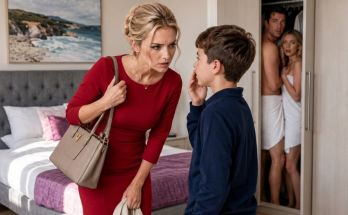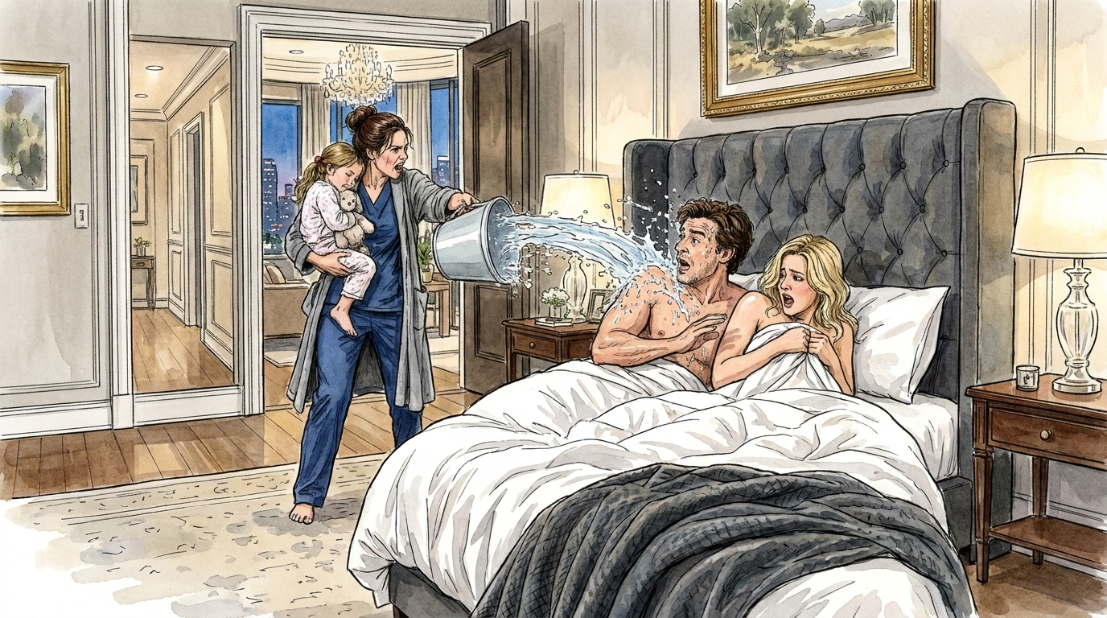
“Stop being dramatic,” he scoffed. “Kids wander around at night.” But my daughter grabbed my hand and whispered, “Daddy told me to stay in the dark… and promised me a puppy if I obeyed.” I left without waking either of them. By sunrise, I discovered the guest room held more than their affair. One hidden detail made me realize they had been deceiving me for far longer than I ever imagined…
PART 1

“Jessi? Are you completely insane? You just take off with our daughter without leaving a note?”
Luca’s voice barked through the car’s Bluetooth speaker. He didn’t even bother to ask if our five-year-old girl was okay.
“Why was she sleeping on the freezing kitchen floor, Luca?” I asked. After a decade of working in hospital trauma wards, I’ve learned that panic kills, but calculated, icy precision saves lives.
“She must’ve wandered out of bed! You’re overreacting because you’re exhausted from your shift. Bring her home right now and stop playing the martyr!”
Right then, little Fiona stirred in the back seat. Still shivering in her thin t-shirt, she looked up with large, anxious eyes and whispered, “Is Daddy mad, Mommy? Did I lose the prize?”
I pulled the car over to the shoulder, my heart shattering into a thousand pieces. “What prize, sweetheart?”
“Daddy said we were playing ‘Operation Silent Soldier,’” Fiona whispered, her voice trembling. “He said I had to guard the kitchen in the dark, and if I made a sound or came upstairs, I would lose the game and we wouldn’t get a puppy. He even locked my bedroom door so I wouldn’t forget the rules.”
The air completely evaporated from my lungs. My husband hadn’t just neglected our child. He had psychologically manipulated a five-year-old girl into enduring sub-zero temperatures on a hard ceramic floor, locking her out of her own bed… just so he could be with my younger sister, Chloe, in the guest suite undisturbed.
I unmuted the phone. Luca was still rambling, aggressively gaslighting me about my “hysteria.”
“I know Chloe is in there with you, Luca,” I interrupted. My voice dropped an octave, settling into a register of total, lethal calm.
The line went dead silent. I could hear his breath literally hitch in his throat.
“And you should know one more thing…” I whispered, staring dead ahead into the pre-dawn fog. “I took the master safe key. I know about the offshore account.”
PART 2
“How many times has she been there while I was at work, Luca?” I asked through the speaker.
Chloe took the phone from him. Her voice didn’t sound guilty—it sounded smug. She refused to give me a straight answer. Instead, she simply said, “This wasn’t the first time, Jessi.”
I turned back toward Fiona, who was now fully awake and clutching her stuffed elephant tightly to her chest. Two adults had established a secret routine during the night hours I was away working trauma shifts, and somehow my five-year-old daughter had been expected to quietly fit around it.
Then Chloe told me one final thing: Luca had already asked her to come back that evening because he knew I was scheduled for another night shift at the hospital.
This wasn’t a single careless morning they regretted being caught in. It had been happening repeatedly, calculated around my roster.
And my absence had been an active part of their plan.
What neither of them knew was that when I walked into the guest room at 6:15 A.M., I hadn’t just found my sister’s clothes on the floor. On the bedside table sat a legal folder containing property transfer drafts for the house my grandfather, Arthur, had left to me, along with fake guardianship documents naming Chloe as a secondary caregiver for Fiona, and her older sisters, Hazel and Kelly.
My brother, Ivan, had warned me six months ago that Luca’s financial firm was failing, but I had defended my husband. Ivan had urged me to audit our joint assets, but I had trusted Luca blindly.
I looked at Fiona in the rearview mirror, my hands gripping the steering wheel until my knuckles turned white.
“Mommy?” Fiona asked softly. “Are we going to see Uncle Ivan?”
“Yes, baby,” I said, pulling back onto the highway as the sun began to break over the horizon. “We’re going to Uncle Ivan’s house. And then we’re going to make sure Daddy and Aunt Chloe never play games in our house again.”
PART 3
By 8:00 A.M., Ivan was sitting across from me at his kitchen table, reviewing the digital photos I had taken of the guest room documents before leaving the house.
As a senior corporate investigator, Ivan didn’t waste time with emotional shock. He pulled up Luca’s business registry, cross-referencing the offshore bank account routing numbers I had retrieved from the master safe.
“Luca didn’t just cheat on you, Jessi,” Ivan said, setting his coffee cup down with a sharp click. “He’s been siphoning money from your inheritance accounts into Chloe’s name for eleven months. He was preparing to file for full custody by arguing your hospital shifts made you an unfit, absent mother—using Chloe’s presence as proof of a stable female caregiver in the home.”
I stared at the screen. The sheer scale of their calculation was terrifying.
“And locking Fiona in the kitchen?” I whispered.
“Fiona was starting to talk,” Ivan explained, pointing to a series of saved text messages between Luca and Chloe recovered from the shared family iPad sync. “She told her sisters, Hazel and Kelly, last week that Aunt Chloe sleeps over when Mommy works. Luca realized the kids were going to ruin the narrative before the legal paperwork was ready.”
I stood up from the table, my fear instantly turning into an absolute, unshakeable rage.
At 10:00 A.M., accompanied by Ivan and an emergency family court officer, we returned to the house.
Luca and Chloe were in the kitchen, casually sipping coffee, completely convinced I was at Ivan’s house crying and waiting for an apology.
When the court officer stepped through the door and handed Luca an emergency ex-parte protective order alongside a temporary custody decree for Fiona, Hazel, and Kelly, Luca’s smug composure completely shattered.
“Jessi, wait!” Luca shouted, rushing toward the foyer. “You’re taking this out of context! Chloe was just helping me with the girls!”
Ivan stepped directly into Luca’s path, towering over him. “Touch her or step past this frame, Luca, and the officers waiting at the curb will arrest you for child endangerment, unlawful restraint of a minor, and grand financial fraud.”
Chloe backed up against the kitchen counter, her face draining of color as she recognized the official state seal on the financial audit notice Ivan held.
“Jessi, please,” Chloe stammered, her voice shaking. “We’re sisters…”
I looked at the woman I had shared a childhood with, then looked down at the cold ceramic kitchen floor where my five-year-old daughter had shivered in the dark just hours earlier.
“I have two daughters named Hazel and Kelly, and a five-year-old named Fiona who spent the night freezing on this tile because of you,” I said, my voice deadpan and razor-sharp. “I don’t have a sister.”
EPILOGUE: THE ARCHITECTURE OF LIGHT
Eighteen months after the freezing November morning when I picked up my shivering five-year-old daughter from a dark kitchen floor, the autumn sun washed over the wide back porch of our new craftsman home in Oregon. The crisp Pacific Northwest air smelled of pine needles, wet cedar, and fresh-baked cinnamon rolls.
I sat on the wooden porch swing, a warm mug of black coffee resting in my hands, watching the morning mist rise off the valley floor.
A few yards away on the damp lawn, six-year-old Fiona was racing in wild, giggling circles with Barnaby, the golden retriever puppy we had brought home six months after the trial. Her older sisters, fourteen-year-old Hazel and twelve-year-old Kelly, sat on the porch steps nearby—Hazel sketching in a charcoal pad while Kelly patiently tied Fiona’s stray shoe laces whenever the little girl zoomed past.
Fiona’s laughter—bright, ringing, and entirely unburdened—echoed off the tall Douglas firs bordering our property.
Her cheeks were flushed a healthy, vibrant pink. Her dark curls bounced in the breeze, and her large green eyes held no trace of the quiet, haunted terror that had filled them on the morning she asked me if she had lost her prize for failing to stay silent in the dark.
Looking at my three daughters now, it was almost impossible to reconcile this sunlit reality with the nightmare Luca Vance and my sister Chloe had so meticulously constructed around us.
A quiet step sounded on the wooden floorboards behind me.
My brother, Ivan, stepped out through the French doors, wearing a thick flannel jacket, holding a tablet and a fresh pot of coffee. He refilled my mug without asking, then leaned against the porch railing, watching the girls play on the lawn.
“The county clerk’s office uploaded the final deed recording this morning, Jessi,” Ivan said quietly, turning the tablet toward me. “The sale of the old house in Seattle is completely finalized. The proceeds have been routed directly into the girls’ educational trust accounts.”
I let out a slow, long breath—a breath I felt like I had been holding in my lungs for a year and a half.
“It’s really over,” I murmured, leaning my head back against the porch swing.
“It’s over,” Ivan confirmed, offering a rare, warm smile. “The property is out of your name, the old joint accounts are closed, and the court protective orders have been renewed for another five years. There are no loose threads left for either of them to pull.”
I looked down at the tablet screen. Seeing the legal address of our old house brought a sudden, vivid memory of the guest room: the discarded clothes, the cold coffee cups on the nightstand, and the sinister folder containing property transfer drafts and fake guardianship papers.
Luca and Chloe had operated under the delusion that my grueling twelve-hour trauma shifts at the hospital made me weak, isolated, and easily manipulated. They had assumed that a mother exhausted by saving lives in emergency rooms would be too tired to notice the subtle signs of betrayal happening under her own roof.
They had failed to realize that a trauma nurse does not panic when blood is spilled; she stops the bleeding, assesses the damage, and cuts away the dead tissue before the infection spreads.
The legal and financial destruction of Luca Vance and Chloe Sterling had been absolute, executed with the cold, methodical precision Ivan and I had promised on that first morning.
Faced with the mountain of digital evidence Ivan had compiled—the iPad sync logs detailing their secret meetings, the forensic paper trail of the offshore bank accounts, and the physical evidence of the locked door frame in Fiona’s bedroom—Luca’s high-priced defense team had collapsed before the preliminary hearing even began.
Luca pled guilty to felony child endangerment, unlawful restraint of a minor, and grand domestic fraud. The family court judge, visibly disgusted by the evidence showing a father manipulating his five-year-old daughter into enduring sub-zero temperatures to facilitate an affair, issued a devastating ruling.
I was granted sole legal and physical custody of Fiona, Hazel, and Kelly, with zero visitation rights granted to Luca. The judge made it explicitly clear that any attempt by Luca to contact the girls, directly or through third parties, would constitute an immediate felony violation of his parole terms.
Furthermore, the state banking commission and federal fraud investigators moved in on Luca’s commercial financial firm. The forensic audit revealed he had been systematically embezzling client funds and diverting inheritance money meant for my daughters into offshore accounts registered under Chloe’s name.
His firm went into forced liquidation within ninety days. Luca was stripped of his financial licenses, ordered to pay over $400,000 in civil restitution, and sentenced to forty-eight months in a state correctional facility. Today, the man who used to boast about his tailored suits and corporate influence was serving his sentence in a medium-security unit in eastern Washington, his career permanently ruined, his wealth evaporated, and his name disgraced.
Chloe’s downfall had been equally definitive.
While she managed to avoid severe prison time by turning over state’s evidence against Luca during the financial fraud investigation, her social and professional standing was completely destroyed.
The news of what she had done to her own sister and five-year-old niece circulated rapidly through our extended family and the local community. My parents, horrified by the revelation that Chloe had actively participated in locking Fiona in a freezing kitchen while preparing to strip my children of their legal rights, formally disowned her.
Deprived of Luca’s stolen money and facing a heavy civil judgment that garnished her future wages, Chloe was forced to sell her car and move into a small, dingy apartment in a neighboring state, working an entry-level retail job. She was entirely isolated, cut off from every family gathering, every holiday, and every milestone in her nieces’ lives.
“Have either of their lawyers tried to reach out recently?” I asked Ivan, taking a slow sip of my coffee.
“Luca’s court-appointed public defender sent a letter three weeks ago,” Ivan replied, his voice dropping into a hard tone. “Claiming Luca was undergoing ‘intensive institutional counseling’ and wanted to write a letter to Hazel and Kelly for their birthdays.”
My jaw tightened slightly. “What did Rachel do?”
Rachel, my lead family law attorney, had handled every administrative boundary with ruthless efficiency.
“Rachel filed an immediate motion with the supervising magistrate,” Ivan said. “The judge issued a stern reprimand to Luca’s attorney, reminding him that any further third-party requests regarding the children would result in an immediate contempt charge. You don’t have to worry about it, Jessi. The wall around your family is unbreakable.”
I looked out across the lawn. I didn’t feel hatred for Luca or Chloe anymore. Hate was an active emotion that required energy, and I refused to expend another drop of my life’s energy on two people who had proven themselves so utterly hollow. What I felt for them now was simply a vast, cold distance—the kind of feeling you reserve for strangers who chose to burn down their own homes out of sheer greed.
“Mommy! Look!”
Fiona’s high-pitched voice shattered my thoughts as she came bounding up the wooden porch steps, Barnaby trotting eagerly at her heels. In her small hands, she held a slightly crumpled, brightly colored drawing she had worked on during her weekend art class.
“Show Uncle Ivan and me, sweetie,” I smiled, sweeping her into my lap and wrapping my arms warm around her waist.
Fiona proudly held up the paper. Painted in bright, bold wax crayons were four figures holding hands in front of a big yellow house with a red roof: me, Hazel, Kelly, and Fiona, with a large, golden-yellow dog standing beside them under a giant sun.
At the top of the page, written in Fiona’s unsteady, six-year-old handwriting, were the words: OUR REAL HOME.
Ivan leaned down, examining the drawing with grand, serious admiration. “Fiona, this is a masterwork. Where are we going to display this?”
“On the refrigerator!” Fiona declared authoritatively, her green eyes sparkling with absolute joy. “Right at the top so everyone who comes into the kitchen sees it first!”
“I think that’s the only acceptable location,” Ivan chuckled, gently ruffling her hair. He stood up, tapping my shoulder softly. “I’m going to head into town to pick up the groceries for dinner. Do you need anything from the hardware store?”
“Just some extra hooks for the hallway coat rack,” I smiled. “Thank you, Ivan. For everything.”
“Always, Jessi,” he said, walking down the steps toward his truck.
After Ivan drove down the gravel driveway, Hazel and Kelly packed up their homework and drawing supplies, heading inside to set the kitchen table. Fiona stayed on my lap, her small head resting comfortably against my chest, watching the golden autumn leaves drift down from the trees onto the lawn.
Inside the house, I could hear the soft, comforting sounds of everyday life: Kelly playing a classical song on the piano in the living room, Hazel laughing as she talked on the phone with a school friend, and the hum of the oven warming up for dinner.
In the beginning of our recovery, those ordinary household sounds had been hard-won battles.
During the first six months after we moved to Oregon, the psychological scars left by Luca’s manipulation had run deep. For a long time, Fiona couldn’t sleep if her bedroom door was fully closed. If the hallway lights were turned off, she would wake up sobbing, gasping for air, convinced she was trapped back in the dark, cold kitchen, guarding a door that led to nowhere.
I remembered one terrible night three months after the trial. A sudden windstorm had knocked out a local transformer, plunging our home into total darkness. Fiona had awakened screaming, clutching her stuffed elephant, hyperventilating on her bedroom floor in a full panic attack.
I had dropped to my knees beside her, wrapped her in a heavy wool blanket, held her tight against my heart, and rocked her in the dark for two straight hours. I whispered into her hair, over and over, until her chest stopped heaving, until her small hands unclasped from my sweater, until she looked up at me in the moonlight and remembered where she was.
“You are in Oregon, Fiona,” I had whispered that night, tears streaming down my own face. “You are in your bedroom. The door is unlocked. The sun is coming up soon. Mommy is right here, and no one is ever going to make you stay in the dark again.”
Gradually, month by month, under the care of a brilliant pediatric trauma specialist and the unshakeable love of her sisters, the shadows had retreated.
The dark rooms stopped terrifying her. The nightmares faded into distant, forgotten memories. She learned that a locked door in our home was just a way to keep the chilly night wind out, not a barrier to keep her trapped inside. She learned that games were meant for laughter and parks, not for psychological isolation.
Most importantly, she had learned that she was loved—unconditionally, fiercely, and forever.
“Mommy?” Fiona’s soft voice broke through the afternoon quiet.
She had turned around on my lap, her large green eyes looking up into mine with quiet curiosity.
“Yes, my sweet girl?” I asked, pushing a stray dark curl behind her ear.
“Do you remember when I was little and we lived in that other house?” she asked softly.
My heart took a slight, quiet dip, but I kept my posture warm and steady. We didn’t avoid talking about the past when she brought it up; her therapist had taught me that giving her questions honest, gentle answers removed the memory’s lingering power.
“I remember, Fiona,” I said gently, holding her small hand in mine.
“I used to think…” she hesitated, looking down at her shoes. “I used to think I was a bad girl because I couldn’t stay quiet long enough to get the puppy. I thought I ruined everything.”
I felt a lump form in my throat, but I looked straight into her eyes with an unshakeable, fierce devotion.
“You were never a bad girl, Fiona,” I said, my voice thick with emotion. “You were a brave, perfect, beautiful little girl who did nothing wrong. The people who told you those things were lying to you. And finding you… picking you up off that floor and bringing you away with me… was the best thing I have ever done in my entire life.”
Fiona looked at me for a long beat. Then, a bright, radiant smile spread across her face—a smile that reached all the way to her eyes, lighting up her entire face.
“I’m glad you came home early from the hospital that morning, Mommy,” she whispered, wrapping her small arms tightly around my neck.
“Me too, baby,” I choked out, burying my face in her soft hair, pressing a long, deep kiss against her temple. “Me too.”
She squeezed me tight, resting her cheek against my shoulder, listening to the steady beat of my heart.
Later that evening, after a dinner of roasted chicken and fresh cinnamon rolls, the sun sank below the mountain ridge, painting the Oregon sky in breathtaking shades of violet, gold, and deep crimson.
The house was filled with light. Every room was bright, warm, and overflowing with life.
I stood in the doorway of the girls’ bedroom, watching Hazel and Kelly read a bedtime story to Fiona. Barnaby lay curled at the foot of Fiona’s bed, his tail thumping softly against the rug as the girls giggled over a funny picture in the book.
Fiona pulled her blanket up to her chin, yawned deeply, and looked over at me standing in the doorway.
“Goodnight, Mommy,” she called out softly.
“Goodnight, my sweet girl,” I smiled, walking over to press a kiss on her forehead, then kissing Hazel and Kelly in turn. “I love you all so much.”
“We love you too, Mom,” Hazel said warmly.
I stepped out into the hallway, leaving their bedroom door resting wide open, letting the warm yellow light from the hall spill across their floor.
For ten years, I had worked in hospital trauma rooms, believing that my purpose in life was simply to repair the broken bodies that arrived on my shift. I had believed in protocol, in staying quiet, in enduring hardship without complaint, and in keeping the peace even when my own marriage felt cold and hollow.
That freezing morning in Seattle had shattered that illusion forever.
It had taught me that peace isn’t the absence of conflict—peace is the courage to stand up in the dark, tear down the lies, and fight relentlessly for the people who belong to you. It had taught me that a mother’s love isn’t a passive emotion; it is an unyielding shield, a burning light, and a force capable of crushing any monster that dares to threaten her children.
I walked out onto the back porch one last time before bed, looking up at the vast, clear night sky above the valley. The stars were brilliant and sharp, glittering like diamonds across the dark velvet expanse.
Behind me, inside our bright, warm home, my three daughters were sleeping peacefully—safe, whole, and completely free.
The dark kitchen floor was gone. The lies had been exposed. The monsters were banished forever.
Here, in the quiet strength of our new life, the air was clean, the doors were unlocked, and the future belonged entirely to us.
I took a deep, clear breath of the cool mountain air, smiled into the quiet night, and stepped back inside, closing the door softly behind me on a world that was finally, beautifully, and unconditionally filled with light.