PART 1

Four little boys walked into a restaurant bathroom only hours before I was supposed to announce my engagement. Five minutes later, I was staring at four identical versions of myself and realizing someone had buried a secret powerful enough to destroy the life planned for me.
That afternoon, everything had been arranged down to the finest detail.
My black suit was tailored by the finest clothiers in San Francisco. My grandfather’s cuff links gleamed beneath crisp white sleeves, reflecting the soft lighting of the private suite. In my coat pocket sat an engagement ring chosen with the strict approval of my mother, my attorneys, and nearly everyone except me.
By seven o’clock, I was expected to propose to Genevieve Ashford at my family’s estate overlooking the bay in San Diego.
It was not love by any stretch of the imagination.
It was purely business wearing a diamond, structured to unite two massive corporate empires before the fiscal quarter ended.
Then I entered the men’s room to adjust my tie.
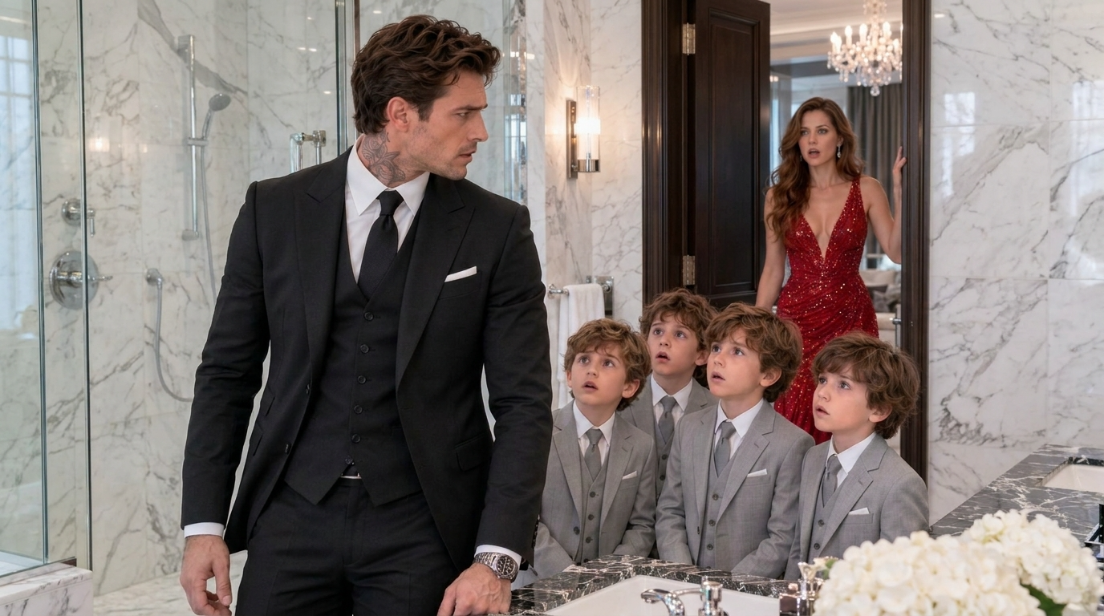
Four little boys in matching dark navy uniforms stood at the long row of marble sinks, looking barely old enough to be in primary school.
At first, I barely noticed them as I reached for a paper towel.
Then one pushed his wet hair back with a quick, nervous motion.
The other three copied him in exact synchronization.
My heart stopped as I watched their mirrored movements.
Fingers sweeping from forehead to crown, followed by a slight shake of the head and then the left hand touching the back of the neck.
I had done that exact sequence my entire life whenever pressure mounted.
My late father used to laugh and say that was how you knew a Farrington man was nervous.
One boy caught me staring through the mirror and tilted his head.
“Mister, why are you copying us like that?” he asked.
“I am not copying you,” I replied, my voice catching slightly in my throat.
All five of us turned to face the glass together.
We shared the same striking steel-blue eyes.
We shared the same sharp chin and defined jawline.
We shared the identical faint dimple in the left cheek.
“I have always done that gesture,” I whispered, feeling the air leave my lungs.
They grinned in unison, revealing small gaps in their teeth.
“So have we,” they said together.
The boldest boy stepped forward and held out a small hand.
“I am Cormac,” he said proudly. “That is Callan, Connor, and Cillian, and we are quadruplets.”
My mouth went dry as I shook his tiny hand.
“Where is your mother right now?” I managed to ask.
“She works here in the dining room,” Cormac explained quietly. “But right now she is arguing with the assistant manager because we need somewhere safe to sleep tonight.”
I immediately followed them out of the bathroom and into the main corridor of the establishment.
Then I saw her standing near the service doors.
Kelsey stood in a black server apron while a supervisor spoke to her with visible coldness.
“Employees cannot keep children in the storage room after hours,” the supervisor said strictly.
“My boys only need somewhere warm until tomorrow morning when my paycheck clears,” she pleaded, holding her hands together.
“That is simply not my problem, Kelsey,” the manager replied, waving a hand dismissively.
Then Kelsey looked up and caught my eye across the floor.
Time stopped completely as six years vanished in a single breath.
I saw the tiny scar just above her left eyebrow.
I saw those deep hazel eyes that had haunted my dreams for half a decade.
She was the woman I had loved more than anyone else in my entire life.
She was the woman my mother claimed had abandoned me without a word six years earlier.
“Kelsey,” I breathed out, taking a step forward.
Her face instantly filled with absolute panic.
“Boys, gather your things and come with me right now,” she said quickly, grabbing her coat.
Outside, the freezing winter wind cut through the street, blowing light snow across the pavement. Two worn duffel bags sat on the curb beside the four young children.
I stepped up to her and offered the electronic key card to my penthouse apartment in downtown Miami.
“No questions tonight,” I said firmly, pressing the card into her trembling hand. “Just take them somewhere warm and safe right now.”
She began to shake her head in refusal until Cormac tugged her coat sleeve.
“Mom, I am so tired,” he whispered, shivering against the cold air.
Finally, she let out a long breath and accepted the card.
Before entering my waiting black vehicle, Kelsey turned her head toward me with a sharp look.
“You do not get to disappear for six years and then suddenly decide you are their father,” she said bitterly.
The words hit harder than any physical blow ever could.
I looked at the four boys waiting quietly inside the back seat.
“I am not deciding anything yet,” I said quietly. “I am just trying to understand why they have my face.”
At four eighteen that afternoon, I pulled out my phone and called my chief assistant.
“Cancel everything tonight,” I ordered without preamble.
“Are you referring to your engagement announcement with Miss Ashford?” she asked in utter shock.
“Yes, cancel the entire event immediately,” I said.
“Your mother is already welcoming the first guests at the estate,” she warned me.
“I do not care about the guests or the estate right now,” I replied firmly.
I ended the call before she could protest any further.
I did not yet know with certainty whether those four boys were truly mine.
I only knew I would not place a ring on another woman’s finger until I discovered why Kelsey vanished and who had convinced me she chose to leave me.
PART 2
At four twenty-one that afternoon, three minutes after I cancelled my engagement announcement, my mother called my personal line.
I watched her full name glow brightly across the screen of my device.
BEATRICE FARRINGTON.
I let the call ring out until it transferred to voicemail.
Then I turned the phone facedown on the soft leather seat beside me and stared through the dark tinted window of the moving vehicle.
The urban landscape moved past in a blurred rush of wet concrete, dark coats, taxicabs, and dirty snow piled high along the granite gutters. Ordinary people hurried beneath broad umbrellas as if this were just another standard late winter afternoon.
It felt absurd that the world kept spinning as if four six-year-old boys had not just walked out of a restaurant washroom wearing my exact features.
It felt absurd that the world kept spinning as if the woman I had spent six long years trying to forget had not stared at me with equal measures of fear and absolute disbelief.
It felt absurd that I was supposed to be placing an expensive diamond ring on another woman’s hand in front of two hundred prominent guests in less than three hours.
My phone began vibrating against the leather seat once more.
This time the screen displayed the name of Genevieve.
I closed my eyes tightly and rubbed the bridge of my nose.
“Take me home immediately,” I instructed my driver.
“Are we heading directly to the coastal estate, sir?” he inquired from the front seat.
“No, take me to the downtown penthouse in Miami,” I corrected him clearly.
There was a brief, hesitant pause before he responded.
“To your private residence, Mr. Farrington?”
“Yes, that is correct,” I said.
I almost let out a dry, humorless laugh at the sheer absurdity of the situation.
Technically speaking, I had just handed the access keys of that exact residence to the woman who might have raised my four biological sons completely without my knowledge or support.
Nothing in my structured existence felt technically true or reliable anymore.
By the time the vehicle pulled up to the residential tower downtown, the sky had turned a deep indigo hue.
I remained seated in the back of the car for nearly a full minute before opening the door to step out into the chill.
The senior building attendant straightened his posture the moment he recognized my face.
“Good evening to you, Mr. Farrington,” he greeted politely.
“Did a woman come through the main lobby earlier accompanied by four young boys?” I asked, stopping near the entrance.
His formal expression softened noticeably as he answered.
“Yes, sir, they arrived approximately twenty minutes ago,” he confirmed.
“Did they appear to be all right?” I pressed, searching his face.
“They looked exceptionally tired, sir,” he noted gently.
That simple observation hit me far deeper than any dramatic report could have.
They were not acting frightened or visibly upset.
They were simply exhausted.
Young children ought to be allowed to just be tired without worrying about where they would sleep.
It was such a fundamental, basic requirement of childhood.
I gave him a brief nod of appreciation and walked toward the private elevators.
“Thank you, Henry,” I said softly.
When the elevator doors smoothly parted on the top floor, I stood in the quiet hallway staring directly at my own front door.
I had owned and lived in that property for nearly eleven years.
I knew every precise angle of the architecture.
I knew every piece of minimalist art hanging on the walls.
I knew every item of custom furniture selected by high-end interior decorators who had asked what environment I wished to create, only to look bewildered when I told them I had no preference whatsoever.
Yet standing there on the polished floor, I felt entirely like an uninvited visitor.
I knocked twice on the heavy wooden panel.
I heard brief, soft movement inside the foyer.
Then complete silence followed.
I knocked a second time, raising my voice slightly.
“Kelsey, it is me,” I called out.
The door slowly swung open a mere three inches, held firmly by the interior security latch.
Kelsey peered through the narrow opening with heavy caution.
“You explicitly said there would be no questions asked tonight,” she reminded me sternly.
“I am aware of what I promised,” I replied quietly.
Her hazel eyes narrowed with deep suspicion.
“I am not asking a single question,” I added quickly.
“Then why exactly are you standing outside your own apartment right now?” she inquired.
I lifted two heavy brown paper bags into her line of sight.
“I brought warm food,” I explained simply.
For the briefest second, her guarded demeanor cracked slightly.
It was not a major shift, but it was just enough for me to catch a glimpse of the spirited woman she had been six years ago.
“You brought actual food for us?” she asked softly.
“I honestly had no clear idea what six-year-old boys prefer to eat,” I admitted freely.
“They eat practically everything in sight,” she said, her voice dropping its edge.
“That is not particularly helpful information for future reference,” I noted dryly.
The corner of her mouth twitched upward slightly before she forced her expression back to seriousness.
“What did you end up purchasing?” she asked.
“I bought pasta, hot soup, roasted chicken, fresh bread, sliced fruit, ice cream, and something labeled as dinosaur nuggets,” I detailed carefully.
That specific item earned me a genuine, unforced smile.
It faded quickly back into caution, but I definitely saw it.
“You can come inside,” she said, unlatching the door and stepping back.
The interior of the apartment looked vastly different almost immediately.
Four small dark coats had been neatly draped across the high backs of my pristine dining chairs.
Tiny pairs of worn sneakers were lined up in an orderly row along the marble foyer.
One young boy was kneeling directly on my cream-colored imported rug, carefully arranging several wooden coasters into an elaborate geometric design.
A second boy had discovered the motorized window controls and was raising and lowering the shades with quiet, focused fascination.
A third stood motionless in front of the floor-to-ceiling glass, gazing out at the bright city lights below.
The fourth sat quietly on the deep sofa, holding one of my minimalist decorative pillows tightly against his chest.
Cormac was the first to spot me walking inside.
“Look, it is the bathroom guy,” he announced aloud to the room.
Kelsey closed her eyes briefly in mild embarrassment.
“Cormac, please,” she murmured softly.
“What did I say wrong?” he asked defensively. “He really is the guy from the bathroom.”
I carefully placed the heavy food bags onto the dark kitchen counter.
“I have certainly been called far worse things in my life,” I remarked easily.
Cormac walked over to the kitchen island with curious steps.
“Do you actually live in this huge place?” he asked, looking around.
“Yes, I do,” I answered, meeting his gaze.
He glanced around the high ceilings and vacant spaces.
“Do you live here all by yourself?” he continued pressing.
“Yes, just by myself,” I confirmed.
“Why do you do that?” he asked with complete childhood frankness.
I opened my mouth to provide a standard adult response, then paused as I realized I had no good answer.
Kelsey stepped in to rescue the conversation.
“Because some adults prefer to have very quiet homes, Cormac,” she explained gently.
Cormac turned his gaze back toward me, studying my face carefully.
“Do you actually like it being quiet?” he asked innocently.
I looked around the sprawling, immaculately clean living area.
I looked at the cold stone surfaces, the absurdly expensive artwork, and the vast, empty rooms that had served as my sanctuary for years.
“I thought I liked it,” I said honestly, looking back down at him. “Now I am not so certain.”
That answer appeared to satisfy his immediate curiosity, and he nodded once before returning to his brothers.
Dinner was a remarkably surreal experience for everyone involved.
Kelsey firmly refused to sit down at the counter initially.
She moved with practiced, efficient motions as she prepared plates for the four children, poured glasses of fresh water, cut up the chicken portions, handed out napkins, and quickly wiped a small drop of spilled soup before it could touch the floor.
I stood back and watched her every move.
I was not evaluating her parenting or judging her circumstances.
I simply could not stop witnessing the vast, complex life that had unfolded entirely in my absence.
“Kelsey, please,” I said softly.
She paused and looked up at me.
“Please sit down and eat something,” I requested gently.
“I am completely fine,” she insisted, waving a hand.
“You have not eaten a single bite since I brought the food,” I pointed out.
“I ate earlier during my shift at the restaurant,” she claimed.
One of the boys, whom I believed was Callan, looked up from his plate.
“No, you did not eat at work, Mom,” he corrected her instantly.
Kelsey let out a soft sigh of defeat.
“Thank you for that update, Callan,” she said with a tired smile.
“You explicitly told us never to tell fibs,” Cormac chimed in from across the counter.
“That is entirely correct,” Connor agreed solemnly.
“I am rapidly understanding how the rules of this household function,” I observed with a faint smile.
Callan nodded with profound seriousness.
“Mom loses every single argument against us,” he declared.
“I do not lose arguments,” Kelsey protested playfully.
“You definitely lose them when it is four against one,” Connor noted.
Kelsey finally surrendered and took a seat on one of the barstools.
For twenty full minutes, not a single person mentioned the massive elephant in the room.
No one brought up the topic of missing fathers.
No one questioned the lost six years that stretched between us.
The four boys enthusiastically shared the name of their primary school teacher, argued over which one of them despised green peas, revealed who maintained a collection of city bus maps, and explained at length why Connor believed urban pigeons possessed higher intelligence than human beings.
I began to distinguish their unique traits slowly as the meal progressed.
Cormac was remarkably bold and outspoken.
Callan preferred to observe every detail before uttering a word.
Connor asked highly practical, logical questions about how things functioned.
Cillian remained almost entirely silent until he had something genuinely meaningful to contribute.
Their physical features were practically indistinguishable from one another.
Their inner personalities, however, were strikingly distinct.
With every small detail I uncovered, something tight and painful constricted further inside my chest.
After finishing their main meal, they each enjoyed small portions of vanilla ice cream.
Kelsey had initially tried to decline the dessert for them, but I handed her a bowl as well.
“I distinctly remember you always preferred plain vanilla,” I mentioned quietly.
She froze mid-movement, her spoon hovering in the air.
“So you actually remember that small detail,” she said, her tone complex.
“I remember absolutely everything about us,” I replied, the words coming out far lower and heavier than I had intended.
The four boys were fully engaged in a lively debate over whether dark chocolate syrup improved or ruined good ice cream.
Kelsey kept her gaze fixed on her bowl.
“Selective memory can be a very convenient tool,” she murmured softly.
“My memory was never selective,” I stated directly.
Her hazel eyes lifted to meet mine directly.
“Neither was mine,” she countered smoothly.
We remained locked in that quiet look for several seconds, six unaddressed years hanging heavy between us over the kitchen counter.
Then Cillian let out a long, sleepy yawn that broke the tension.
Kelsey immediately turned her attention toward the dark hallway.
“They desperately need to get some sleep,” she noted.
“There are three fully furnished guest bedrooms down that hall,” I offered immediately.
“We can easily manage in just one room,” she countered reservedly.
“I am more than happy to leave the apartment entirely,” I said.
She studied my face with a thoughtful look.
“You do not have to leave,” she said quietly.
That statement took me entirely by surprise.
She appeared somewhat taken aback by her own words as well.
“What I mean to say is,” she clarified in a lower tone, “you should not feel forced to abandon your own home on our account.”
“I own a secondary residential property downtown,” I explained simply.
“Of course you own multiple properties,” she remarked, a faint trace of dry humor returning to her voice.
“I fully deserved that comment,” I acknowledged with a small nod.
A faint shadow of the former Kelsey resurfaced for a brief second.
She was the same woman who had once teased me endlessly for wearing cuff links that cost more than her entire college tuition.
She was the same woman who had burst into laughter the first time I attempted to cook a basic meal in her tiny kitchen and managed to burn the pan.
I missed that vibrant version of our shared past so suddenly and acutely that it physically hurt.
“I will head out now,” I said, standing up from the counter. “Before I step out, may I ask just one single question?”
Her posture immediately shifted back to a guarded state.
“You may ask exactly one question,” she granted carefully.
“Are those four boys biologically mine?” I asked directly.
Kelsey turned her head slowly toward the living room where the children were gathering their things.
Cormac was diligently assisting Connor with collecting the empty ice cream bowls.
Callan stood near the window, quietly studying the glowing city landscape once more.
Cillian had curled himself into a small ball on the far corner of the plush sofa.
When she finally turned her eyes back to meet mine, they were brimming with unshed tears.
“I do not know how to answer that question without opening up every single painful detail,” she admitted softly.
“Please just try,” I requested quietly.
She took a long, steadying breath.
“Yes,” she said clearly.
The ambient noise in the apartment seemed to drop to absolute zero inside my mind.
There was no sudden crash of reality, no theatrical surge of emotion.
There was simply that one single, definitive word.
Yes.
I placed both hands flat against the polished marble counter to steady myself.
“Are all four of them mine?” I asked, needing to hear it plainly.
Kelsey gave a faint, almost bewildered half-smile at the sheer absurdity of my question.
“They are quadruplets, Lawson,” she pointed out gently.
“I am aware of that fact,” I stammered, rubbing a hand across my face. “I just needed to hear you say it.”
Six long years.
Four young boys.
My biological sons.
Somewhere on the opposite side of the city, wealthy guests were likely still mingling at the coastal estate.
Expensive champagne would be resting on ice.
Elaborate floral arrangements would line the grand hall.
Genevieve’s influential parents would be demanding urgent answers regarding my mysterious disappearance.
Yet here I stood in my own kitchen, processing the monumental revelation that I was the father of four six-year-old children.
“Do they have any idea who I am?” I asked softly.
“No, they do not,” she replied plainly.
I looked at her intensity.
“They do not know they have a father at all?” I pressed.
“They are fully aware that they have a father somewhere,” she clarified.
“That is not what I am asking you, Kelsey,” I pushed gently.
“No,” she said softly but firmly. “They do not know that you are their father.”
“Why did you never tell them?” I asked.
Her soft expression instantly hardened into steel.
“Not tonight,” she stated firmly.
“Kelsey, please,” I urged.
“You gave me your word,” she reminded me sternly. “No questions tonight.”
I caught myself and stopped immediately.
She was entirely right to call me out.
I had given my word, and I had already pushed past the boundary once.
I offered a respectful nod.
“Fair enough,” I conceded quietly. “All right.”
She seemed genuinely surprised that I yielded the point so quickly without further argument.
I retrieved my dark coat from the rack.
As I reached the front doorway, Cormac materialized at my side.
“Are you leaving us now, bathroom guy?” he inquired, looking up.
“Yes, I am leaving for the night,” I told him.
He scowled slightly in confusion.
“You did not even eat any ice cream with us,” he pointed out.
“I was not particularly hungry tonight,” I explained gently.
“That makes absolutely no sense at all,” he declared plainly.
“I am quickly learning that you ask very challenging questions, Cormac,” I noted with a faint smile.
He offered a broad, childish grin in response.
Then he performed the gesture again.
Without any wet hair present, his small fingers swept across his forehead, brushed smoothly backward over his crown, and his left hand came to rest against the back of his neck.
I stared at him in complete silence, my chest tightening.
“What is wrong?” he asked, tilting his head.
“Nothing at all,” I managed to say.
I crouched down on the floor so that we were at eye level with one another.
“I will see you again tomorrow,” I told him clearly.
He gave a slight, casual shrug of his shoulders.
“We will probably be leaving here tomorrow,” he noted casually.
I glanced over his shoulder toward Kelsey, who was watching from the hallway.
“Not if I have any say in the matter,” I stated firmly.
Kelsey’s expression immediately signaled a warning for me not to make grand promises I could not keep to young children.
I stood back up to my full height.
“Goodnight, Cormac,” I said softly.
Cillian lifted a tiny hand from his cozy spot on the couch.
“Goodnight, bathroom guy,” he called out quietly.
For the very first time on that chaotic day, a genuine, warm laugh escaped my chest.
I stepped out into the hallway, took the elevator down, and walked six full city blocks through the biting winter night air simply because I desperately needed space to think.
My mother managed to intercept me before I could even reach my private office building downtown.
Of course she did.
Beatrice Farrington had spent her entire adult life ensuring that virtually nothing occurred within the city’s social or financial circles without her immediate knowledge and oversight.
She stepped out from the rear of a sleek black luxury sedan parked directly at the curb.
Even in the harsh, biting winter wind, her appearance was impeccably composed.
She wore an elegant dark tailored coat, understated pearl jewelry, and her platinum hair was styled in an effortless, perfect twist.
“Lawson,” she called out sternly as I approached.
I deliberately maintained my pace, attempting to walk right past her.
She matched my steps with practiced ease.
“You utterly humiliated Genevieve in front of everyone tonight,” she stated coldly.
“I simply cancelled an engagement announcement,” I corrected her plainly.
“You vanished without a trace three hours before you were scheduled to propose,” she pointed out sharply.
“I was never going to go through with that proposal,” I revealed firmly.
“You explicitly agreed to this arrangement weeks ago,” she countered.
“That agreement was my very first major mistake,” I said, stopping in my tracks.
She stepped directly into my path, forcing me to halt completely.
“Whatever personal crisis you are experiencing right now, you will resolve it tomorrow morning,” she ordered firmly.
I stopped and looked down at her.
For a long, lingering second, I simply observed the woman who had guided my life for thirty-five years.
Then I spoke clearly. “I saw Kelsey today.”
Something shifted subtle in her demeanor.
It was barely perceptible to an untrained observer, but I knew my mother intimately.
Her squared shoulders went completely rigid for a fraction of a second.
Her sharp eyes lost their focus for half a heartbeat.
Then her impenetrable mask returned smoothly to its place.
“Kelsey?” she repeated neutrally.
“Kelsey Vance,” I specified clearly.
“I am fully aware of which Kelsey you are referring to, Lawson,” she said coolly.
“Are you truly aware?” I challenged.
Her jawline tightened visibly.
“What on earth is she doing back in this city?” she demanded to know.
“That is a remarkably fascinating question,” I replied with heavy irony.
“Lawson, answer me properly,” she commanded.
“She has four young children with her,” I revealed steadily.
My mother remained completely silent, her face unreadable.
“Four young boys,” I emphasized clearly.
Continued silence met my words.
“They are six years old,” I added, stepping closer.
Still, she offered not a single word of surprise.
“They possess my exact facial features,” I stated, watching her reaction intensely.
Her gaze drifted past my shoulder, fixing on a distant point down the street.
That was the exact moment I realized the truth.
She did not display shock because she did not feel any.
“You already knew,” I said, the realization settling heavily in my gut.
She brought her eyes back to meet mine.
“I was aware that she was pregnant six years ago,” she confessed smoothly.
The surrounding world seemed to shrink down to just the two of us on that cold sidewalk.
Traffic continued to move past us.
A distant vehicle horn sounded through the winter air.
An anonymous pedestrian brushed past my coat.
Yet all I could hear was that single, devastating admission echoing in my head.
You were aware that she was pregnant.
“Yes,” she repeated plainly.
“How on earth did you know that?” I demanded, my voice dropping dangerously.
“She came directly to the family estate to see me,” she revealed.
“When exactly did this occur?” I pressed.
“Shortly after you departed for your business meetings in London,” she detailed.
“I was only away in London for five days,” I pointed out quickly.
“It was six days,” she corrected precisely.
“Why on earth did she not simply call my personal line?” I asked, frustration rising.
“She claimed that she had attempted to reach you,” my mother explained calmly.
I stared at her in utter disbelief.
“What do you mean she claimed?” I questioned loudly. “I never received a single phone call or message from her.”
“You were occupied in high-level executive meetings around the clock,” she noted smoothly.
“I personally checked every single incoming message every evening,” I stated fiercely.
“Lawson, please understand—”
“I checked every single message,” I repeated, cutting her off entirely.
My mother appeared unusually tired for a brief second.
Not remorseful or guilty.
Simply old.
My mother had never looked old or vulnerable to me in my entire existence.
“She arrived at the estate in an extremely emotional and frightened state,” Beatrice explained carefully.
“She was carrying my children,” I reminded her sharply.
“I had no way of knowing at the time that she was carrying quadruplets,” she defended coldly.
I took a full step backward, creating physical distance between us.
“What precise words did you speak to her when she stood in our home?” I demanded to know.
She hesitated for several long seconds.
That brief hesitation revealed far more than any calculated verbal response ever could.
“What did you say to her?” I repeated firmly.
“I informed her that you had made a definitive decision regarding your long-term future,” she admitted.
A cold, sickening feeling spread rapidly through my stomach.
“What decision are you referring to?” I asked, my voice barely above a whisper.
“That you were planning to relocate to the London office permanently,” she revealed plainly.
“I never once stated that I intended to move to London permanently,” I refuted fiercely.
“You were actively considering the offer at the time,” she argued smoothly.
“I was evaluating the European expansion project for the firm,” I clarified sharply.
“It was a multi-year executive assignment,” she noted.
“It was a temporary one-year posting,” I corrected her firmly. “At that point in my life, I was weighing my options.”
“At that point in your life, you were completely uncertain about what you wanted,” she asserted.
“I knew with absolute certainty that I wanted a future with Kelsey,” I stated with complete conviction.
My mother closed her eyes for a brief moment before responding.
“You were only twenty-nine years old at the time,” she pointed out coldly.
“I was an adult, not a helpless child,” I fired back.
“No, you were not a child,” she conceded smoothly.
“Then why did you take it upon yourself to make life-altering decisions on my behalf?” I demanded.
“I did not make decisions for you,” she claimed smoothly.
I let out a harsh, bitter laugh that held zero amusement.
“You explicitly told the woman carrying my unborn children that I was abandoning her to move overseas,” I summarized accurately.
“I communicated what I genuinely believed was the most probable outcome for your career,” she defended smoothly.
“And what precise story did you concoct for me when I returned?” I asked, my tone icy.
Her silence returned immediately.
I remembered that return trip with painful clarity.
Arriving back from London with plans to see Kelsey.
Dialing her phone number fourteen consecutive times only to reach a disconnected line.
Driving directly to her small apartment building, only to find the unit completely cleared out.
Sitting in my mother’s grand study that very evening as she gently explained that Kelsey had come by to say goodbye.
My mother had claimed Kelsey was overwhelmed, that she wanted a completely different lifestyle, and that she had explicitly asked us not to pursue or contact her ever again.
I had accepted that narrative as painful reality because Kelsey’s phone was permanently turned off.
Because her apartment lease had been abruptly terminated.
Because her former college roommate claimed she had moved far away without leaving a forwarding address.
Because every available path leading back to her had been meticulously closed off.
“You deliberately convinced me that she chose to abandon me,” I stated coldly.
My mother looked down at the concrete pavement.
“She did, in fact, choose to leave the city,” she noted quietly.
“Only after you systematically lied to her face,” I pointed out fiercely.
“Yes,” she acknowledged softly.
“What else occurred during that meeting?” I demanded to know.
“I have shared everything I know,” she claimed smoothly.
I stared at her with deep disappointment.
For the first time in my memory, Beatrice Farrington could not maintain direct eye contact with her own son.
“You are actively withholding information from me right now,” I accused firmly.
“I am doing no such thing,” she refuted instantly.
“You consistently touch your right hand when you are actively lying,” I revealed coldly.
Her hand instantly dropped away from the custom ring resting on her finger.
My late father had taught me that exact observation years ago.
It was one of the very few insights he had ever shared regarding her guarded nature.
Your mother can negotiate multi-million-dollar mergers with absolute composure, Lawson, but pay close attention to her hands. The absolute truth always manifests in her fingers first.
My father had been deceased for three years now.
Standing on that icy street, I felt an intense, unexpected wave of grief for his absence.
“What else happened?” I asked one final time.
My mother remained silent for a long moment before offering a response.
“You ought to speak directly with Kelsey regarding those details,” she advised quietly.
“I fully intend to do precisely that,” I stated clearly.
“And Lawson,” she added as I turned away.
I paused and waited without turning around.
“I am truly sorry that your evening was ruined in this manner,” she said softly.
I turned back, staring at her in absolute disbelief.
“My evening?” I repeated, my voice laced with venom.
“I did not mean to minimize—”
“I just uncovered the fact that I have four six-year-old sons who have grown up without me, and you are offering condolences for my cancelled evening?” I stated with sheer disgust.
Her face visibly fell, the composure cracking further.
For the very first time in my entire life, I turned my back on my mother while she was actively speaking to me and walked away.
Genevieve was patiently waiting inside my private executive office downtown when I arrived.
She was sitting directly behind my heavy mahogany desk, having removed her designer heels to tuck her feet beneath her.
That uncharacteristic, comfortable posture felt so unexpectedly human that I froze in the open doorway for a moment.
Her formal engagement gown was a muted blue silk, elegant and incredibly costly.
She had changed nothing about her appearance since the event was cancelled.
Her hair remained styled, her diamond earrings caught the soft lamp light, and her makeup was entirely flawless except for a faint, dried smudge near her left eye.
“You could have at least placed a direct phone call to me,” she said softly as I stepped inside.
“I should have handled that properly,” I acknowledged honestly.
“Yes, you certainly should have,” she agreed plainly.
I gently closed the heavy office door behind me, shutting out the rest of the building.
“I am deeply sorry, Genevieve,” I offered sincerely.
“I know you are,” she replied softly.
“No, I mean it sincerely,” I pushed gently. “I managed the entire situation today disastrously.”
She studied my face with sharp, intelligent eyes.
“Did you ever genuinely intend to marry me, Lawson?” she asked directly.
I could have easily crafted a politically polite, diplomatic response.
She deserved absolute honesty from me after everything that had transpired.
“I genuinely believed that I could make it work,” I confessed quietly.
“Believing you can make something work is entirely different from wanting it,” she noted shrewdly.
“You are correct,” I admitted.
She nodded slowly, processing my words.
To my immense surprise, she displayed no inclination toward tears or anger.
She carefully slipped one high heel back onto her foot, followed by the other.
“My father is currently convinced that this cancellation represents an absolute catastrophe for our business merger,” she shared calmly.
“I am certain he holds that view,” I noted dryly.
“My mother is convinced that you are undergoing a complete mental breakdown,” she added smoothly.
“That assessment might actually hold some truth,” I offered with a dry smile.
That small joke earned me a soft, genuine chuckle from her.
Then her expression shifted back to a serious, inquiring state.
“What actually occurred today, Lawson?” she asked quietly.
I hesitated briefly, weighing how much to disclose.
“You do not owe me a complete personal confession,” she clarified gently.
“I owe you the fundamental truth at the very least,” I insisted.
So I explained the situation to her cleanly.
I omitted the complex historical details involving my mother’s deliberate deception.
I left out the deep, lingering trauma of our past separation.
I simply delivered the plain, unvarnished facts as I now understood them.
I had unexpectedly reencountered the woman I had once loved more than life itself.
She was currently raising four six-year-old boys.
Those four boys were indisputably my biological children.
Genevieve listened attentively without interrupting a single time.
When I finally concluded my brief summary, she leaned back into the leather executive chair.
“Four children?” she repeated, raising an eyebrow.
“Yes, four,” I confirmed.
“Actual quadruplets?” she clarified.
“Yes, quadruplets,” I repeated.
“You simply could not ease gently into the concept of fatherhood, could you?” she remarked with dry humor.
Despite the immense weight resting on my shoulders, a small smile touched my face.
“Apparently, moderation was not an option,” I noted.
She remained silent for a long moment, pondering the reality of the situation.
“You need to go figure out your family dynamics immediately,” she advised quietly.
“I do not even know if I truly have a family to return to,” I confessed honestly.
“You possess four biological sons, Lawson,” she stated with absolute, unshakeable certainty. “That constitutes a family.”
The sheer clarity in her tone stopped me cold.
“I barely know their names or personalities,” I pointed out softly.
“Then that is precisely where you must begin,” she stated simply.
I looked at her with genuine appreciation.
“You are handling this absolute mess far better than I have any right to expect,” I noted.
“Oh, make no mistake, I am absolutely furious with you,” she corrected smoothly.
“That is entirely fair,” I conceded.
“However, my anger is not stems from the fact that you cancelled tonight,” she clarified.
“Why are you angry then?” I inquired.
“Because we came dangerously close to actually going through with a hollow marriage,” she revealed softly.
That statement landed with profound force in the quiet room.
She neatly folded her hands in her lap, looking down at them.
“I think deep down, I always recognized that you did not love me,” she admitted quietly.
“Genevieve—”
“No, please do not apologize,” she interrupted gently. “It is entirely fine. The truth of the matter is that I did not love you either.”
I blinked in mild surprise at her frank admission.
A faint, knowing smile touched her lips.
“We enjoyed each other’s company,” she explained smoothly. “Our respective families were captivated by the economic alignment. The media loved publishing photographs of us together. Somewhere along the way, everyone simply decided that mutual convenience was sufficient for a life together.”
“I should have possessed the courage to halt the momentum much sooner,” I said remorsefully.
“So should I,” she admitted freely.
She stood up gracefully from behind the desk, smoothing down her gown.
“Perhaps this cancellation represents the very first sound decision either of us has made regarding our future,” she offered quietly.
“We never truly had a real relationship to begin with,” I noted thoughtfully.
“Precisely,” she agreed softly.
As she reached the heavy exit door, she paused and turned back toward me.
“How do you plan to explain this situation to the broader public and press?” she asked.
“I will provide the exact truth,” I answered plainly.
“Which specific portion of the truth?” she pressed gently.
“That you and I mutually came to the conclusion that we should not proceed with an engagement,” I stated clearly.
She raised one styled eyebrow in surprise.
“That is a remarkably generous narrative to offer the public,” she remarked softly.
“I have zero desire to allow you to be painted as the villain in a story that was never authentic to begin with,” I assured her firmly.
Her guarded expression softened noticeably.
“Thank you, Lawson,” she said quietly.
Then she opened the door and walked out, leaving me entirely alone in the quiet office.
I remained standing near the window for a very long time, watching the city below.
By nine o’clock the following morning, I had firmly grasped three fundamental realities.
First, four energetic six-year-old boys possessed the terrifying ability to utterly chaoticize an executive kitchen faster than a crew of professional demolition workers.
Second, my sleek, luxury penthouse apartment contained virtually zero items that a child actually required for daily existence.
Third, Kelsey still consumed her morning coffee with an absurdly high proportion of sweet cream.
I returned to the penthouse carrying several bags of fresh breakfast items, only to discover all four boys seated comfortably on the hardwood floor, eating dry cereal out of ridiculously expensive imported porcelain bowls.
Kelsey looked immensely embarrassed the moment I stepped into the room.
“I searched every cabinet and could not locate a single plastic or child-friendly bowl,” she explained apologetically.
“I do not own any plastic kitchenware,” I informed her plainly.
“Yes, I have quickly come to realize that fact,” she noted wryly.
Cormac immediately pointed a finger toward the kitchen counter.
“One of those fancy bowls broke into pieces earlier,” he announced cheerfully.
Kelsey closed her eyes briefly in mild frustration.
“Cormac, you were explicitly instructed not to mention that immediately,” she murmured.
“I thought we established a strict rule against telling fibs,” he argued defensively.
“We certainly did,” she conceded.
“Navigating the ethics of this household seems wonderfully complex,” I remarked, setting down the food bags.
“I will fully reimburse you for the broken porcelain,” Kelsey stated firmly.
“No, you most certainly will not,” I dismissed instantly.
“It looked extraordinarily expensive, Lawson,” she insisted.
“So are most of the completely useless decorative objects occupying this apartment,” I countered smoothly.
Callan looked up from his cereal, gazing around the minimalist space.
“Do you own any actual toys in this place?” he asked curiously.
“No, I do not,” I answered honestly.
“Do you have any board games?” he pressed.
“No,” I replied.
“What about simple colored pencils?” he continued investigating.
“No, I do not own those either,” I confessed.
He pondered my answers for several seconds with a look of profound pity.
“What on earth do you actually do when you are in this apartment?” he asked bluntly.
I looked over at Kelsey, who was actively biting her lower lip to suppress a sudden burst of laughter.
“I work,” I answered the boy plainly.
Callan appeared deeply disappointed by my complete lack of entertainment options.
Following breakfast, Kelsey directed the four boys into the private media room, equipping them with stacks of plain white printer paper and several executive pens I managed to locate in my desk drawer.
Then she took a seat directly across from me at the formal dining table.
For the very first time since this chaotic sequence began, we were truly alone to speak freely.
“You had a direct conversation with your mother last night,” she stated plainly.
“Yes, I did,” I confirmed quietly.
Kelsey’s slender fingers tightened visibly around her warm coffee cup.
“What precise details did she share with you?” she asked, her voice guarded.
“She confirmed that you came directly to the estate after I departed for London,” I revealed smoothly.
“I did go there,” she acknowledged softly.
“She admitted that you informed her of your pregnancy,” I added.
“That is the absolute truth,” she confirmed quietly.
“What exactly transpired after that moment?” I asked gently.
Kelsey kept her gaze fixed on the faint steam rising from her coffee.
“When you initially boarded the flight for London, I had not formed any plan to inform anyone until you returned to the city,” she explained softly.
“Why on earth did you choose to wait?” I pressed gently.
“Because you were dealing with an immense amount of corporate pressure at that exact moment,” she recalled softly.
“I would have dropped everything to know that truth, Kelsey,” I stated with absolute conviction.
“Kelsey,” I repeated when she remained silent.
She let out a long, heavy sigh.
“I was utterly terrified, Lawson,” she admitted, her voice trembling slightly.
That vulnerable admission instantly softened the remaining edge of my frustration.
“I was only twenty-eight years old at the time,” she recalled, looking back into the past. “I had just received confirmation that I was pregnant. We had been dating for less than two full years. You were being actively courted for high-level international positions in cities I had never even visited, and your family consistently made me feel like an insignificant, temporary distraction that everyone fully expected you to eventually outgrow.”
“My father always genuinely liked you,” I pointed out softly.
“Your father was consistently kind and polite to me,” she clarified carefully.
“And my mother?” I asked, already knowing the answer.
Kelsey’s eyes lifted to lock onto mine directly.
“Your mother barely tolerated my presence,” she stated plainly.
I could not offer a single word of defense against that accurate characterization.
“I attempted to reach your personal line multiple times while you were in London,” she revealed softly.
“I swear to you that I never received a single message or notification,” I stated fiercely.
“I left three distinct voicemail messages,” she detailed.
“I completely believe your word,” I assured her instantly.
That immediate trust appeared to take her somewhat by surprise.
“My mother explicitly confessed last night that you mentioned leaving those messages,” I revealed smoothly.
Kelsey gave a slow, somber nod of understanding.
“The very day after I confirmed the pregnancy, I took a taxi directly to the family estate,” she continued recounting. “I genuinely believed Beatrice could assist me in establishing a direct line of communication to your hotel in London.”
“What specific words did she offer you?” I asked, bracing myself.
“She informed me that you had officially accepted the permanent executive posting in London,” she revealed quietly.
My chair suddenly felt far too rigid beneath me.
“She explicitly claimed that to your face?” I confirmed, anger rising.
“Yes, she did,” Kelsey affirmed.
“What else did she claim?” I pressed.
“She claimed that you were deeply embarrassed by the prospect that I might create a public scene or complicate your career trajectory,” she shared softly.
The surrounding room felt entirely void of air for a second.
“She actually uttered those exact words to you?” I asked, my voice deadly quiet.
“Yes, she did,” she confirmed softly.
“Did she offer any further statements?” I asked, needing every detail.
Kelsey hesitated for several long seconds, looking toward the hallway.
Then she stood up from the table.
“I need to physically show you something,” she said quietly.
She walked over to one of the worn duffel bags resting in the entryway and returned holding a small cloth pouch.
From inside the pouch, she carefully extracted a faded paper envelope.
The high-quality paper had softened significantly over the course of six years.
My full name was distinctly written across the front surface.
It was written in my unmistakable handwriting.
I stared down at the object in absolute shock.
“Where on earth did you acquire this item?” I asked, my voice barely audible.
“Your mother personally handed it to me six years ago,” she revealed softly.
I carefully accepted the envelope from her hands.
The paper flap had been sliced open years ago.
Inside rested a single folded sheet of cream-colored executive stationery, bearing my official embossed initials at the top corner.
L.F.
I unfolded the paper and read the neat text written across the surface:
Kelsey, My time in London has provided absolute clarity regarding my long-term future. I must make calculated decisions that fully align with the heavy responsibilities I hold toward my family and the firm. What we shared was meaningful, but continuing our relationship would ultimately make both of our lives far too difficult. I trust you will understand the necessity of this choice. Lawson
I read through the short paragraph twice.
Then I read it a third time, analyzing every stroke of the pen.
“I never wrote a single word of this letter,” I stated with absolute, unshakeable certainty.
“I am fully aware of that fact now,” she replied softly.
My head snapped upward to meet her gaze.
“You are aware of that now?” I repeated.
“I was not aware back then,” she clarified gently.
“What occurred to change your perspective?” I demanded to know.
“Several years later, I accidentally discovered the old postcards,” she revealed.
“What postcards are you referring to?” I asked, bewildered.
She pointed a finger toward the media room where the boys were quietly playing.
“They are currently stored away in a lockbox,” she explained.
“Kelsey, please,” I urged.
“I did not bring every single item with us when we traveled here,” she noted defensively.
“Where is this lockbox located?” I pressed firmly.
“In a secure storage unit in Queens,” she answered softly.
“I can immediately dispatch a private courier to retrieve—”
“No, absolutely not,” she interrupted firmly.
The absolute authority in her voice stopped me cold.
“This is precisely how your family consistently operates, Lawson,” she pointed out softly.
“What do you mean by that?” I asked quietly.
“An issue arises, and someone immediately dispatches an assistant, makes a swift phone call, or pays money to ensure the problem vanishes behind closed doors,” she explained gently.
She softened her posture slightly before continuing.
“I desperately need to share this entire story with you at a slow, manageable pace,” she requested softly.
I offered a quiet nod of compliance.
“All right, I am listening,” I agreed softly.
“That forged letter completely convinced me that you had made a conscious choice to prioritize your family’s wishes over our relationship,” she recounted softly.
“I would have never made that choice, Kelsey,” I stated fiercely.
“I recognize that truth today,” she assured me gently.
“How exactly did you arrive at that realization?” I inquired.
“Because three years ago, when your father unexpectedly passed away, I happened to come across his published obituary online,” she revealed softly.
I remained entirely silent, listening intently.
“I do not fully understand why, but I decided to search your full name in news archives that evening,” she continued. “There were numerous press photographs, executive interviews, and old business articles. One specific piece explicitly noted that you had formally declined the permanent London appointment six full years earlier.”
My skin prickled with a cold sensation.
“I officially declined that position before I even boarded the flight back home,” I revealed clearly.
“Precisely,” she noted softly, tapping the forged letter on the table. “Yet this document explicitly stated that you were actively building your permanent future overseas.”
“You realized the letter was a complete fabrication,” I synthesized cleanly.
“I realized that the entire narrative presented to me contained massive contradictions,” she corrected softly.
“Why on earth did you not attempt to contact me the moment you realized that truth?” I asked, pain lacing my words.
She cast another gentle look toward the media room.
“Because by that point in time, the four boys had established a complete, stable life,” she explained softly.
“So had I,” I noted quietly, feeling the weight of missed years.
“Yes, you had,” she acknowledged gently, offering zero judgment.
There was a complete absence of bitterness in her tone, which somehow made the reality far harder to absorb.
“You were frequently photographed alongside Genevieve by that time,” she noted neutrally.
“Genevieve and I were not romantically involved during that period,” I clarified quickly.
“I had no way of knowing the private details of your personal life,” she pointed out reasonably.
“You could have simply reached out and asked me directly,” I suggested softly.
“Yes, I suppose I could have,” she conceded quietly.
Her quiet, unfiltered honesty completely disarmed any lingering defensiveness I held.
“I made my fair share of critical errors as well,” she confessed softly. “I readily accepted what I was told six years ago largely because a vulnerable part of me already feared that you would eventually leave me.”
I looked down at the forged document resting between us.
“My mother personally handed this physical letter to you?” I verified.
“Yes, she handed it to me directly,” she confirmed.
“And you preserved it through all these years?” I asked, moved.
“I preserved absolutely everything,” she revealed softly.
Something in her quiet delivery prompted me to look up at her face.
“Everything?” I repeated gently.
Kelsey offered a faint, somber nod.
“The forged letter, every birthday card you ever gave me, all of our old photographs, and even the train stub from that rainy weekend we traveled to Boston and missed the final return departure,” she detailed softly.
Despite the heavy atmosphere, a small, genuine smile touched my lips.
“You placed the entirety of the blame on my shoulders for missing that train,” I recalled warmly.
“It was entirely your fault,” she countered with a faint smile.
“You explicitly insisted on exploring that obscure bookstore for two hours,” I defended playfully.
“You spent forty-five full minutes reading in the architecture section,” she countered instantly.
“And you spent an hour lingering in the poetry aisle,” I reminded her softly.
A sudden burst of cheerful laughter echoed from the media room, breaking our quiet memory.
We both fell silent, listening to the joyful sound.
It was a remarkably strange sensation; the children’s presence grounded the space, making our painful shared history feel less like an insurmountable ghost and more like a bridge.
“What precise steps did you take after reading that forged letter six years ago?” I asked gently.
“I packed my belongings and left the city entirely,” she answered plainly.
“Why did you choose to leave so abruptly?” I pressed.
“My elderly aunt resided in a rural town in Vermont,” she explained. “She offered me a safe place to stay for as long as I needed.”
“And when did you learn about the boys?” I asked softly.
“I had no inkling that I was carrying quadruplets until the formal ultrasound procedure,” she recalled with a gentle smile.
I could not prevent myself from asking, “What was your immediate reaction when the physician delivered that news?”
Kelsey let out a soft, warm laugh at the memory.
“I politely asked the doctor to perform the scan a second time to ensure the equipment was functioning correctly,” she shared sweetly.
I mentally pictured her sitting alone in some small, unfamiliar medical clinic, receiving that monumental news without my hand to hold.
The sharp pain of my absence in that moment cut deep, but she had requested a gentle recounting, and I was rapidly beginning to understand the necessity of her pace.
“Were all four of them born healthy?” I inquired softly.
“Yes, they were quite small at birth, but perfectly healthy,” she confirmed warmly.
“Who assisted you through that process?” I asked gently.
“My aunt provided immense support, along with a few close neighbors and a remarkably patient local pediatrician,” she detailed.
“And what about your own parents?” I inquired quietly, searching my memory.
“My father passed away while I was attending university, as you recall,” she noted softly. “And my mother and I had been completely estranged for many years.”
I recalled those details slowly; pieces of her personal background were resurfacing, facts I should have held closer to my heart.
“You successfully raised four boys entirely on your own,” I remarked with immense respect.
“I had wonderful help along the way,” she deflected modestly.
“Even so, it is an extraordinary achievement,” I insisted softly.
She gave a modest shrug of her shoulders.
“You simply manage whatever requirements the day places in front of you,” she said plainly.
That statement was quintessentially Kelsey: pragmatic, unadorned, and grounded in absolute reality.
“What eventually happened to your aunt?” I asked gently.
“She passed away peacefully late last year,” she shared softly.
“I am so deeply sorry for your loss, Kelsey,” I offered sincerely.
“Thank you, Lawson,” she acknowledged gently.
“Is her passing the primary reason you decided to return to the city?” I asked thoughtfully.
“It was certainly a contributing factor,” she admitted.
“What was the remaining reason?” I pressed gently.
Her hazel eyes drifted to the forged document sitting between us.
“I desperately wanted definitive answers,” she confessed softly.
For the very first time since reencountering her in the restaurant, I realized that Kelsey had not returned to the city with the expectation of tracking me down.
She had returned simply because she was finally strong enough to uncover the full truth of what had destroyed her life six years ago.
“Did you make any attempt to contact my mother upon arriving?” I asked cleanly.
“Yes, I did,” she confirmed.
My pulse quickened slightly. “When exactly?”
“Approximately three weeks ago,” she revealed.
“What was her response to your outreach?” I pressed.
“She offered no verbal response at all,” she shared softly.
“What do you mean by that?” I asked, confused.
“She formally agreed to meet with me in person,” she detailed.
“And what happened at the meeting?” I inquired.
“She simply failed to show up,” she revealed plainly.
“Where was this meeting supposed to occur?” I asked.
“At a quiet tea room situated near Bryant Park,” she specified.
I stood up slowly from my chair, processing the timeline.
“So she was fully aware of your presence in the city three weeks ago,” I synthesized cleanly.
“Yes, she was,” Kelsey confirmed.
“She was aware that you had returned,” I repeated, walking toward the large windows.
“However, she was not aware of the children,” Kelsey added quickly.
I turned back to face her sharply. “Are you entirely certain of that?”
“I never once disclosed to her that I had given birth to four children,” she stated firmly.
I gazed out at the sprawling cityscape below, my mind racing through the complex chain of events.
My mother was fully aware that Kelsey had returned to the area.
My mother was fully aware six years ago that Kelsey was pregnant with my child.
My mother had somehow possessed a forged letter written on my personal stationery.
Yet despite these established facts, there remained far too many critical gaps in the narrative.
Who had actually authored the physical text of that letter?
For what specific purpose was it created?
Had my mother personally forged my signature and handwriting?
Or had an unknown third party handed the document to her?
My thoughts unexpectedly drifted to my late father.
I was not suspecting him of duplicity, but for the very first time, I genuinely pondered what specific details he might have uncovered before his death.
“Your mother was not the final individual I attempted to reach out to,” Kelsey revealed softly.
I turned my attention back to her immediately. “Who else did you attempt to contact?”
She reached into the small cloth pouch a second time and extracted a weathered business card.
The heavy paper card was creaked at one corner from years of storage.
FARRINGTON FINANCIAL LEGAL GROUP DANIEL SLOANE SENIOR GENERAL COUNSEL
I recognized the prestigious name instantly.
Virtually every member of my extended family knew Daniel Sloane.
He had served as my grandfather’s primary legal advisor for decades before fulfilling the exact same role for my late father.
He had meticulously managed complex family trusts, estate distributions, charitable foundations, prenuptial agreements, property acquisitions, and every delicate internal matter that wealthy families preferred to resolve far away from public scrutiny.
He was currently eighty-two years old and lived a largely retired lifestyle at his private estate in Connecticut.
“Why on earth did you attempt to contact Daniel Sloane?” I asked, bewildered.
“Because his official initials were clearly stamped on the envelope,” she revealed plainly.
I looked at her with sharp intensity. “What are you talking about?”
She pointed a delicate finger toward the faded paper sitting on the dining table.
I picked up the envelope and flipped it over to examine the reverse side carefully.
Tucked almost invisibly beneath the gummed paper flap was a tiny, embossed monogram.
D.S.
I had completely overlooked that minute detail.
My thoughts raced to analyze the discovery.
Daniel Sloane had routinely utilized personalized stationery for his legal correspondence for over forty years.
However, the main letter inside was written on my personal stationery, not his.
“Where did this envelope originate?” I asked cleanly.
“Your mother handed it directly to me with that letter inside,” she reminded me softly.
“And Daniel’s monogram was already embossed on the flap?” I pressed.
“Yes, it was already there,” she confirmed.
“Did you inquire about that detail when you reached out to him?” I asked.
Kelsey reached into the cloth pouch one final time and carefully extracted a folded note.
My hands felt completely cold as I accepted the paper and unfolded it.
The handwriting across the page was somewhat shaky due to advanced age, but the elegant script was undeniably Daniel Sloane’s:
Ms. Vance, I possess a clear recollection of the overall circumstances you reference in your letter, though my personal memory of those events diverges substantially from the specific narrative you have outlined. I am firmly convinced that there exist critical facts that neither you nor Lawson were made aware of at that time. I am fundamentally uncomfortable articulating these sensitive matters in written correspondence. Should you ever return to the city, I urge you to contact my private office immediately. D. Sloane
I read through the short letter twice before looking up at her.
“You have held this written response for two full years?” I asked, stunned.
“Yes, I have,” she confirmed softly.
“Why did you not pick up the phone and call him immediately upon receiving it?” I asked gently.
“I did place a call to his office,” she revealed.
“When exactly?” I pressed.
“The day after I arrived back in the city,” she shared softly.
“And what was his response?” I inquired.
“He readily agreed to meet with me in person,” she revealed.
“When is this meeting scheduled to take place?” I asked cleanly.
“Tomorrow morning,” she stated plainly.
I stared at her in absolute astonishment. “Tomorrow morning?”
“At eleven o’clock sharp,” she specified.
“And you were planning on attending this meeting without informing me?” I asked, hurt.
“As of yesterday afternoon, I was genuinely uncertain whether I wanted you involved in this painful process,” she confessed honestly.
“And how do you feel about my involvement today?” I asked softly.
Kelsey turned her head slowly toward the media room, where four energetic young voices were currently engaged in a passionate debate over building blocks.
Then she brought her hazel eyes back to meet mine directly.
“Today, I firmly believe that this narrative belongs to both of us,” she answered softly.
At exactly ten fifty-seven the following morning, Kelsey and I were seated together in the formal receiving room of Daniel Sloane’s elegant Upper East Side apartment.
The four boys were entirely safe, remaining at the penthouse under the care of a trusted woman Kelsey had known for years from her restaurant work, supplied with an abundance of breakfast items, coloring supplies, and board games to keep them thoroughly occupied.
Daniel Sloane had long since ceased the active practice of law.
His sprawling residence resembled a prestigious historical library far more than a private home.
Floor-to-ceiling wooden bookshelves lined every wall, interspersed with framed historical photographs depicting major milestones.
There were images of my late grandfather shaking hands with former presidents, photographs of my father attending high-society charity galas, formal portraits of my parents on their wedding day, and a single photograph of myself.
I was twenty-two years old in the image, standing directly beside Daniel Sloane on the steps of Columbia University following my graduation ceremony.
That specific photograph unsettled me deeply.
I had entirely forgotten that he had personally attended my graduation event.
At eleven o’clock sharp, the heavy mahogany study door slowly opened.
Daniel Sloane emerged, leaning lightly on a dark wooden walking cane.
He had aged considerably since I had last seen him three years prior at my father’s memorial service.
However, his sharp eyes remained strikingly clear and alert.
His gaze moved first to examine Kelsey’s face, then shifted cleanly to rest on mine.
“Well now,” he stated quietly, his voice raspy with age. “I genuinely wondered whether both of you would arrive together today.”
Kelsey stood up politely from her chair. “Were you actively expecting Lawson to accompany me?”
“I certainly held out hope that he would,” the old attorney confessed softly.
Daniel looked at me intently for several seconds. “You bear a striking resemblance to your father, Lawson.”
“I have been told that my entire life,” I noted neutrally.
He gestured with his cane toward the open study door. “Please step inside.”
We took seats around a massive, polished walnut executive desk.
For several lingering moments, Daniel remained entirely silent, studying us both.
Then he slowly retrieved a thin manila file folder from a desk drawer.
There was zero dramatic volume to the file.
No overflowing stack of classified legal documents.
Simply a thin, well-worn folder that had clearly seen handle over the years.
“Before we begin discussing the details,” he began softly, “I owe both of you a sincere and long-overdue apology.”
Kelsey’s hands instinctively clasped tightly together in her lap. “An apology for what, Mr. Sloane?”
“For allowing misplaced professional loyalty to a prominent family to serve as an excuse for my own prolonged silence,” he stated solemnly.
I leaned forward in my chair, cutting straight to the core issue. “Did you personally draft the forged breakup letter that Kelsey received six years ago?”
“No, I did not,” he answered firmly.
“Did my mother draft it?” I pressed directly.
Daniel met my gaze calmly. “I do not know the physical identity of the author.”
That unexpected answer took me entirely aback. “Then why on earth do your official monogram initials appear on the envelope?”
“Because that item passed directly through my legal office,” he revealed plainly.
My heart rate accelerated noticeably. “Dispatched by whom?”
Daniel carefully opened the thin file folder on the desk.
Inside rested three photocopied pages.
He picked up the top page and placed it directly in front of me.
It was an official legal memorandum dated precisely six years prior.
The top heading read: SUBJECT: LAWSON FARRINGTON / KELSEY VANCE
The official author line was completely blank.
Daniel tapped a frail finger against the top of the paper. “This specific document was personally delivered to my desk by your late father.”
I looked up at him in absolute shock. “My father?”
“Yes, Charles Farrington himself,” he confirmed smoothly.
“What specific details was my father aware of at that time?” I demanded.
“Far less than you currently fear, my boy,” Daniel assured me gently.
“Then please explain everything cleanly,” I requested, my voice tight.
Daniel settled back into his high-backed leather chair. “Your father arrived at my office approximately two days after Kelsey had her initial conversation with your mother at the estate.”
I glanced sideways at Kelsey, whose face was pale.
“He was fully aware that I was pregnant?” she asked softly.
Daniel offered her a gentle, somber nod. “Yes, he was aware.”
Kelsey closed her eyes briefly, processing that single fact; it clearly impacted her deeply.
“My father was aware of the pregnancy,” I whispered, the words heavy in my mouth.
“Yes, he was,” Daniel confirmed softly.
“Then why on earth did he not place a direct call to my personal line in London?” I asked, pain lacing my tone.
“He made multiple attempts to reach you,” Daniel revealed plainly.
I stared at him in utter disbelief as he opened the folder once more.
This time, he extracted a printed email document.
FROM: CHARLES FARRINGTON TO: LAWSON FARRINGTON SUBJECT: URGENT – CALL MY DIRECT LINE
The date stamped at the top matched the exact window of my London trip six years ago.
I knew that specific date intimately.
I had been sitting in the main terminal of Heathrow Airport waiting for my return flight.
The body of the email contained only two brief sentences:
Lawson, You must place a direct call to my personal line before you finalize any decisions regarding the London executive assignment. This matter is of critical importance and directly concerns Kelsey. Dad
I had never once seen that email notification in my inbox.
“Where on earth did you locate this printout?” I asked, my mind reeling.
“From your father’s archived private account records following his passing,” Daniel explained smoothly.
“I swear to you that I never received this email transmission,” I stated firmly.
“I am fully aware that you did not receive it,” Daniel noted calmly.
“How can you possibly be certain of that fact?” I pressed.
“Because your father sat in that exact chair and asked me that identical question six years ago,” Daniel revealed softly.
I sat completely motionless in my chair, absorbing the revelation.
Daniel continued his explanation in a steady tone. “Charles firmly believed that an unknown entity was actively intercepting and blocking private communications between you and Kelsey.”
“Who did he suspect was responsible for such an action?” I demanded to know.
Daniel chose his words with extreme legal precision. “It is no secret that your parents held vastly different views regarding how your future should be structured.”
“That does not answer my direct question, Daniel,” I countered sharply. “Did he suspect my mother was responsible?”
“Yes, he did suspect her,” Daniel admitted softly.
That confirmation hurt in an entirely different manner than the previous revelations.
It meant that my father had recognized that something was deeply wrong six years ago, yet somehow, six long years had still slipped past without resolution.
“What constructive actions did my father take upon reaching that conclusion?” I asked quietly.
“He directly confronted Beatrice that very night,” Daniel revealed.
Kelsey spoke up for the first time in several minutes. “When exactly did this confrontation occur?”
“The evening immediately preceding Lawson’s scheduled return flight from London,” Daniel specified.
“What transpired during that confrontation?” I pressed.
“I was not present for the conversation,” Daniel noted, tapping the second document in the file. “However, your father arrived at my office early the following morning and left this handwritten memo.”
The sheet contained my father’s distinct, elegant handwriting:
Beatrice insists that Kelsey has chosen to leave the city voluntarily. I find her explanation entirely unconvincing. I must locate the girl personally before Lawson returns tomorrow.
Kelsey read the short note twice.
Her eyes brimmed with tears, though she maintained her composure. “He actively attempted to track me down?”
“Yes, he did,” Daniel affirmed gently. “He immediately hired a private investigator to trace your whereabouts.”
“Then why on earth was he unable to locate me in Vermont?” Kelsey asked, bewildered.
“Because you had already relocated to your aunt’s home, and the investigator provided your father with incomplete and inaccurate intelligence,” Daniel explained smoothly.
“Inaccurate intelligence provided by whom?” I demanded sharply.
Daniel hesitated briefly before answering. “I do not know the precise source.”
I stood up abruptly from my chair and paced across the wide room toward the heavy bookshelves.
“It appears that every single person associated with this family has suddenly developed a profound fondness for the phrase ‘I do not know,’” I remarked bitterly.
“Lawson, please,” Kelsey said gently, her tone a soft reminder.
I stopped my pacing and looked at her.
She was entirely right.
Daniel Sloane was an eighty-two-year-old man who had voluntarily invited us into his private home to share classified information.
Renting my frustration on him would not rewrite six lost years.
I walked back to the walnut desk and resumed my seat. “I apologize for the outburst, Daniel.”
Daniel offered a slow, understanding nod. “You possess every right to feel immense anger, Lawson.”
“What ultimately became of the private investigator my father hired?” I asked cleanly.
“He generated a formal investigation summary approximately three weeks later,” Daniel explained, handing me the final photocopied document.
I scanned the brief summary text:
Kelsey Vance is confirmed to have voluntarily vacated her residence without coercion. No forwarding address established. No evidence of distress or external pressure.
I immediately looked at the bottom of the page where the investigator’s signature should have appeared.
The signature block had been completely blacked out with heavy dark ink.
“Why is the investigator’s identity redacted on this copy?” I asked, pointing to the mark.
“I did not redact that information,” Daniel stated plainly.
“Who redacted it then?” I pressed.
Daniel reached into the manila folder one final time and extracted the physical original document.
The investigator’s full name was clearly legible on the original page.
Thomas Vale.
I recognized that name instantly.
It was not a distant or unfamiliar name to me.
Thomas Vale had served as the chief of corporate security for Farrington Enterprises for nearly twenty years.
He had formally retired from his position the exact same year my father passed away.
“Thomas Vale worked directly for our family firm,” I noted, my mind connecting the pieces.
“Yes, he was on the corporate payroll,” Daniel confirmed.
“He was not an independent, objective investigator,” I pointed out sharply.
“No, he was internal personnel,” Daniel agreed.
“Then why on earth did my father entrust him with such a delicate personal assignment?” I asked.
“Because Charles trusted Thomas implicitly with sensitive matters for decades,” Daniel explained.
I reflected on my younger years.
Thomas Vale had been a constant, quiet presence throughout my childhood.
He was present at my grandfather’s estate, attended major corporate functions, and accompanied our family on private travels.
He was remarkably quiet, highly efficient, and expert at remaining invisible until needed.
“Can we arrange a meeting to speak with Thomas Vale directly?” I asked firmly.
Daniel slowly shook his head side to side. “That is impossible, Lawson.”
“Why is that impossible?” I pressed.
“Thomas Vale passed away late last winter,” Daniel revealed softly.
A heavy silence descended upon the study once more.
It was not a sinister silence, but rather the quiet disappointment of reaching another dead end in our search for definitive answers.
Another individual who might have provided key information was permanently gone.
Kelsey looked deeply disappointed, though she maintained her steady composure.
Daniel leaned forward over his desk, his posture taking on a serious weight. “There is one additional detail I must share with both of you.”
I focused my full attention on him. “What detail?”
“Your father explicitly requested that I preserve these original file documents in my private safe,” Daniel revealed.
“For what purpose?” I asked.
“He stated that he intended to directly confront a specific individual once he had gathered indisputable proof,” Daniel explained.
“Did he ever reveal the identity of that individual to you?” I pressed.
“No, he never disclosed a name,” Daniel stated plainly.
“When exactly did he make that request to you?” I asked.
“Approximately five years ago,” Daniel specified.
I stared at him in surprise. “That was a full year after Kelsey had left the city.”
“Yes, that is correct,” Daniel affirmed.
“So my father was actively continuing his private investigation long after the initial search failed,” I realized cleanly.
“He never truly ceased searching for the absolute truth,” Daniel confirmed softly.
Kelsey’s expression shifted, a profound question dawning on her face. “What specific discovery prompted him to continue investigating a year later?”
Daniel met her gaze directly. “The children.”
My breath caught sharply in my throat. “He was aware of the children?”
“He was not aware that there were quadruplets,” Daniel clarified gently, his eyes moving between us. “However, he became firmly convinced that Lawson had fathered a child.”
“How on earth did he arrive at that conclusion?” I demanded.
“A physical photograph,” Daniel revealed quietly.
Kelsey frowned in complete confusion. “What photograph are you talking about?”
“A photograph depicting you, Kelsey,” Daniel explained gently.
“Depicting me where?” she asked, bewildered.
“Sitting on a park bench alongside a small young boy,” Daniel detailed.
Kelsey’s face went completely pale. “That is utterly impossible, Mr. Sloane.”
“Why do you say that so definitively?” Daniel asked.
“Because I have never once dispatched a photograph of my sons to any member of the Farrington family or firm,” she stated with absolute conviction.
Daniel stared at her in genuine shock. “Are you entirely certain of that fact?”
“I am one hundred percent certain,” she affirmed fiercely.
Daniel turned and opened another desk drawer, searching through the contents.
He checked a secondary drawer, then a third, his brow furrowing deeper with each passing second.
Finally, he sat back in his chair, looking deeply troubled.
The photograph was missing from his files.
Kelsey turned her head to look at me, the exact same unuttered question forming in her mind.
It was not panic or fear, but rather a quiet, chilling realization.
Who had possessed sufficient knowledge of her private life in Vermont to track her down and photograph one of our sons years ago without her knowledge?
Daniel appeared visibly shaken by the discovery. “I personally verified the presence of that photograph in this file shortly after Charles passed away.”
“You kept the physical photo stored inside this office?” I asked cleanly.
“Yes, inside this very desk,” he confirmed.
“Who maintains authorized physical access to this study, Daniel?” I inquired firmly.
“My private housekeeper, my adult daughter, and on occasion, my former legal secretary,” he listed carefully.
“Has any member of my family visited this residence recently?” I pressed directly.
He hesitated briefly before answering truthfully. “Your mother visited my residence last month.”
Kelsey and I exchanged a sharp, knowing look.
Daniel appeared to process the troubling timing of that visit as he uttered the words.
“She arrived to consult regarding routine estate archive records,” he added quickly, attempting to offer a neutral context.
“Did her visit occur prior to or following Kelsey’s initial phone call to your office?” I asked directly.
Daniel paused to calculate the timeline. “It occurred shortly after Ms. Vance reached out to my secretary.”
I leaned back slowly into my leather chair, processing the heavy implications.
Nothing had been conclusively proven yet.
That distinction was critically important to maintain.
There remained multiple plausible, innocent explanations for the missing photograph.
My mother could have learned of the photo’s existence without personally removing it from the desk.
An authorized house staff member could have accidentally misplaced the document during routine cleaning.
Daniel himself could have filed it in an alternate location due to his advanced age.
Six long years built upon flawed assumptions had already inflicted immense damage on our lives.
I was firmly resolved not to construct the next chapter of my life on foundation of unverified assumptions.
Kelsey appeared to arrive at the exact same grounded conclusion.
“We require verified, indisputable facts moving forward,” she stated clearly.
“Yes, absolutely,” I agreed firmly.
Daniel offered a slow, approving nod. “Your late father would have wholeheartedly agreed with that approach.”
He carefully closed the manila folder resting on his desk.
Then, as if a distant memory had suddenly resurfaced, he turned and unlocked a small wooden cabinet situated directly behind his executive chair.
“There exists one final location where critical answers might be preserved,” he revealed quietly.
“What location are you referring to?” I asked.
“Charles maintained meticulous personal working journals throughout his life,” Daniel explained.
I looked at him in surprise. “My father despised the concept of keeping personal journals.”
“He formally designated them as executive working notebooks,” Daniel corrected with a faint smile.
“That terminology sounds precisely like him,” I noted, acknowledging the distinction.
“He completed a dedicated notebook for every calendar year of his professional life,” Daniel detailed.
“Where are those notebooks currently stored?” I inquired.
“That presents a significant challenge,” Daniel admitted, looking directly at me. “Following his passing, his complete set of personal papers was formally transferred to the family archive room at the coastal estate in San Diego.”
I knew that grand property well; it was the primary full-time residence where my mother currently lived.
“How many individual working notebooks exist in total?” I asked.
“Dozens upon dozens,” Daniel noted.
“Which specific volume do we require?” I pressed.
“The volume covering the precise calendar year that Kelsey left the city,” Daniel specified.
Kelsey let out a quiet breath. “That seems like a relatively straightforward task to locate.”
Daniel’s grave expression suggested the process would be anything but simple.
“What is the complication, Daniel?” I asked, sensing the issue.
“That specific volume is completely absent from the official family archive inventory,” Daniel revealed solemnly.
I stared at him in complete disbelief. “It is missing from the official inventory?”
“It was never logged into the master catalog,” Daniel confirmed.
“Perhaps my father deliberately destroyed that specific volume before his death,” I suggested logically.
“That is certainly a possibility,” Daniel conceded.
“However, you do not genuinely believe he destroyed it,” I synthesized cleanly.
Daniel slowly shook his head side to side. “No, I do not believe he would do that.”
“Why are you so confident?” I asked.
“Because approximately three months prior to his passing, Charles explicitly requested that I ensure you personally received that specific notebook someday,” Daniel revealed softly.
Every minor background noise in the room seemed to completely fade away.
“What were his exact words to you regarding that request?” I asked, my voice tight.
Daniel met my gaze with steady, absolute clarity. “He said, ‘If Lawson ever begins asking searching questions regarding Kelsey Vance, you must ensure he receives the blue notebook. By that time, he will possess the maturity required to understand what we all got so profoundly wrong.’”
Kelsey’s hazel eyes turned to lock onto mine.
That single sentence resonated deeply between us in the quiet study.
Not what one single villain got wrong.
What we all got wrong.
For the very first time since this chaotic journey began, the core mystery felt fundamentally different.
It felt less like a masterfully orchestrated scheme executed by a single malicious adversary hiding behind six years of silence.
It felt far more like a tragic, cascading chain of human choices.
Decisions rooted in deep fear, premature assumptions, overbearing family expectations, and individuals arrogantly deciding what others were capable of handling.
People fiercely guarding secrets under the guise of protection, until that very protection inflicted profound, lasting damage on everyone involved.
When Kelsey and I finally stepped out of Daniel Sloane’s residence onto the street, light snow had begun to fall softly over the city.
Tiny white snowflakes melted instantly upon touching the cold concrete pavement.
For several full city blocks, neither of me nor Kelsey uttered a single word, processing everything we had learned.
Finally, Kelsey broke the silence, her voice quiet against the cold air. “I honestly do not know whether I want your mother to be the sole party responsible for this mess.”
I looked over at her profile. “I assumed you held a deep hatred toward her.”
“I certainly did for a very long time,” she admitted softly.
“Has that feeling shifted to the past tense?” I inquired gently.
“I am simply exhausted from carrying hatred toward individuals I do not fully understand,” she confessed quietly.
That insight sounded like a profound truth that six years of raising four children entirely on her own had taught her.
“I am equally uncertain about what outcome I desire,” I confessed honestly.
“You desire to locate that blue notebook,” she noted smoothly.
“Yes, that part is undeniably true,” I agreed.
A faint, gentle smile touched her lips. “That motivation is entirely obvious.”
We came to a stop at the corner of the busy intersection.
For a suspended moment, the bustling city life moved briskly all around us while we remained entirely still together.
“What happens to all of us after we eventually uncover the complete truth?” Kelsey asked softly.
“I do not possess the answer to that question yet,” I admitted honestly.
“What happens regarding the four boys?” she pressed gently, voicing the core concern.
There it rested: the single most critical question of our entire existence.
Not forged documents, missing working journals, or long-buried family secrets.
Four innocent children who had woken up that very morning believing their small world was constructed in one specific manner.
“I desperately want to know them,” I stated with complete, unfiltered conviction.
Kelsey observed my face with deep, careful scrutiny.
“I mean genuinely know them as their father,” I clarified fiercely. “Not simply visit them when it fits conveniently into my executive schedule, or pop into their lives occasionally out of lingering guilt. I have zero understanding of what fulfilling the role of their father looks like practically yet, but I demand the opportunity to learn and grow into that responsibility.”
She remained silent, listening to every word.
“I fully recognize that I possess zero right to demand your immediate trust or forgiveness,” I acknowledged humbly.
“No, you do not possess that right,” she agreed gently.
“I am fully aware that I can never reclaim those lost six years,” I added softly.
“No, those years are gone,” she noted quietly.
“However, I can be fully present for the next six years,” I vowed clearly.
A small, genuine smile touched her face. “And what about the six years following those?”
“If they will have me in their lives, I will be there for every single one,” I promised steadily.
Kelsey turned her gaze down the snowy street. “They already hold a genuine liking for you, Lawson.”
“They currently refer to me exclusively as ‘bathroom guy,’” I pointed out with a faint smile.
“In the vocabulary of a six-year-old boy, that title is practically an declaration of affection,” she noted wryly.
A warm laugh escaped my chest.
Then her expression shifted back to a serious, protective state.
“We must introduce this reality to them at a slow, deliberate pace,” she stipulated firmly.
“I completely agree with that approach,” I conceded instantly.
“You must make zero grand promises that you cannot guarantee you will fulfill,” she added strictly.
“I give you my absolute word on that rule,” I affirmed cleanly.
“And absolutely no showering them with absurdly expensive gifts to compensate for lost time,” she stipulated pointedly.
“That specific rule feels remarkably targeted directly at my tendencies,” I remarked with dry humor.
“It is entirely targeted at you,” she confirmed with a soft smile.
“Agreed without reservation,” I conceded.
“And Lawson…” she added, pausing.
“Yes?” I responded, focusing on her.
“They are not prospective corporate heirs to a financial empire,” she stated with absolute clarity.
I grasped her meaning instantly and respected it deeply.
“They are young boys,” I acknowledged cleanly.
“They are my young boys,” she asserted protectively.
“And they are my sons as well,” I added softly.
Her intelligent eyes searched my face for several seconds.
I recognized the nuance required and corrected my phrasing. “They are their own unique individual persons.”
That precise answer was clearly the statement she needed to hear from me.
Perhaps it was the exact realization I needed to voice for myself as well.
When we finally returned to the downtown penthouse, the spacious apartment was filled with loud, cheerful energy.
Cormac had successfully constructed an elaborate fortress utilizing every single leather sofa cushion in the living area.
Callan was sitting neatly at the dining table, diligently drawing a detailed map of the city skyline.
Connor had systematically organized every single electronic remote control in the home according to its exact physical size.
Cillian was sitting comfortably near the floor-to-ceiling windows, quietly examining one of my heavy architectural reference books upside down.
All four of them looked up simultaneously as the front door closed.
Four identical, striking faces.
My facial features seamlessly blended with Kelsey’s life journey and somehow, impossibly, my own.
Cormac immediately abandoned his cushion fortress and ran over to us.
“Did you successfully locate all the answers from the old man?” he asked eagerly.
Kelsey blinked in mild surprise. “Answers to what specific matter, Cormac?”
“You explicitly told us yesterday that you had to meet an old man regarding very important adult business,” he reminded her matter-of-factly.
Kelsey let out a soft sigh, looking at me. “Young children possess the terrifying ability to hear every single spoken word.”
Cormac nodded his head proudly in complete agreement. “We hear absolutely everything.”
I crouched down on the floor so I was at eye level with him. “We managed to locate a few key answers today, Cormac.”
“Were they good answers?” he pressed, tilting his head.
My mind briefly flashed through the heavy revelations of the morning: the forged letter, my father’s archived email, the missing photograph, and the mysterious blue working notebook.
“I firmly believe those answers are actively guiding us toward something very good,” I answered him honestly.
He pondered my response for a brief moment, then handed me a heavy leather couch cushion.
“I need your immediate assistance,” he instructed authoritatively.
“Assistance with what specific task?” I asked, accepting the cushion.
“The structural roof of the fortress keeps collapsing,” he explained solemnly.
So I spent the next twenty full minutes down on my knees on the hardwood floor, diligently working alongside four young boys to construct a structurally sound cushion fortress.
It was undeniably the most meaningful and useful activity I had engaged in all week.
Perhaps the most meaningful activity I had engaged in all year.
Later that afternoon, while Kelsey prepared fresh sandwiches for everyone in the kitchen, I stood in the open doorway and quietly observed the four boys playing.
For the very first time since this life-altering sequence began, I did not dwell on the vast time and opportunities that had been taken from me.
Instead, I focused entirely on the immense possibilities that remained right in front of us.
Time.
Unwritten future chapters.
Four young children who were still young enough to allow a complete stranger to comfortably become a familiar, beloved presence in their lives.
A remarkable woman whom I had once loved more than life itself, who was currently sitting twenty feet away, having not yet decided whether I ultimately belonged in her long-term future.
And a critical question that my late father had deliberately preserved inside a missing blue working notebook that no one could currently locate.
My phone vibrated softly inside my jacket pocket.
I initially intended to ignore the notification entirely.
Then I glanced at the screen and read the incoming text message.
It was a message from my mother.
Lawson, we must speak immediately before you initiate any search through your father’s personal archive files.
I stared down at the illuminated text.
A secondary message appeared on the screen less than ten seconds later.
There exist critical elements of this narrative that Charles never disclosed to Daniel Sloane.
Then a third text message arrived in quick succession.
And there is a vital piece of information that Kelsey remains entirely unaware of regarding the physical letter.
I turned my head to look toward the kitchen area.
Kelsey was currently letting out a soft, genuine laugh because Connor had somehow managed to get a smudge of mustard on his shirt sleeve.
The four boys were completely safe.
The apartment was warm, bright, and filled with life.
Nothing required a frantic, immediate decision within the next five minutes.
For the very first time in my adult existence, I did not immediately pick up the phone to dial my mother’s line.
Instead, I typed a deliberate, measured response:
Tomorrow morning. In person at the estate. Zero legal attorneys present. Zero corporate assistants. Only the absolute, unvarnished truth.
Her written reply arrived in less than sixty seconds:
Agreed without condition.
Then a final transmission arrived on my device.
This text contained zero written words, consisting solely of an attached historical photograph.
My breath caught sharply in my chest as the image fully loaded on the screen.
The photograph depicted my late father standing directly outside the entrance of our coastal estate in San Diego years ago.
He was holding a distinctive blue leather working notebook securely in his right hand.
Standing directly beside him was Daniel Sloane.
And standing just behind them in the frame, partially obscured by the open grand doorway, was my mother, Beatrice.
On the reverse side of the physical photo, which had been scanned, someone had written a precise date in neat ink.
Precisely three days prior to my father’s death.
Directly beneath the date rested seven distinct words written in my father’s unmistakable script:
Lawson must hear this directly from Beatrice.
I read through the short sentence twice to ensure I fully grasped every word.
Then I looked back across the room toward Kelsey.
Whatever secrets my mother had fiercely guarded for six long years, my late father had possessed sufficient knowledge to leave her with the ultimate responsibility of confessing them to me personally.
The fundamental question was no longer whether Beatrice Farrington had systematically withheld vital truths from us.
The true question was why my father had trusted her to eventually reveal those truths herself.
And why, three full years following his death, she had still failed to do so.
PART 3
By ten o’clock the following morning, my mother was already patiently waiting inside the grand library of the coastal estate in San Diego.
That single detail alone clearly signaled her deep inner agitation.
Beatrice Farrington simply did not wait for other individuals to arrive.
Other individuals routinely waited for Beatrice.
The long drive south from the city had been largely quiet. Kelsey sat beside me in the rear seat of the luxury vehicle, her hand resting over her small handbag, her intelligent gaze drifting between the passing coastal views and the old stone retaining walls lining the highway.
Neither of us uttered a single word regarding the four boys during the journey.
Not because we had forgotten their existence for a second.
Rather, it was because for the very first time since reencountering them, they were situated exactly where they belonged: safe, warm, and thoroughly occupied with pancakes, drawing supplies, and the trusted woman Kelsey relied upon when she required help.
That stability granted us permission to focus our full attention on resolving the past.
I was rapidly coming to understand that analyzing the past and remaining trapped inside it were two entirely different concepts.
For six long years, I had actively done the latter.
I had compulsively replayed the painful narrative of Kelsey’s sudden disappearance until that altered memory hardened into absolute, unshakeable certainty.
She left voluntarily.
She actively selected a completely different life.
She held zero desire to be with me.
Now, virtually every single absolute certainty I had carried for over half a decade was dissolving into a searching question.
The grand gates of the Farrington coastal estate appeared ahead, looking precisely as they always had throughout my life.
Impressive gray stone pillars.
High arched windows overlooking the bay.
Worn green ivy clinging to the heavy stone facade of the east wing.
When I was a young boy, I viewed the massive residence as an unshakeable, permanent fortress.
At thirty-five years of age, it appeared far more like a sprawling structure filled with people who had disastrously confused absolute silence for true emotional stability.
Kelsey shifted her position slightly on the leather seat beside me.
“Are you holding up all right, Lawson?” she asked softly.
I glanced over at her profile with a faint smile. “You are honestly asking me that question right now?”
“Yes, I am asking you,” she confirmed gently.
“You are the person currently walking into a house where my mother once explicitly informed you that I held zero desire to be with you,” I pointed out softly.
“I am fully aware of that history,” she acknowledged quietly.
“And despite that, you are inquiring about my emotional state,” I noted warmly.
She turned her gaze to look directly ahead. “Someone ought to check on you.”
That simple, caring statement nearly shattered my emotional composure entirely.
The massive front doors swung open before we even reached the top stone step.
My mother stood waiting directly in the grand foyer.
Zero household staff were present.
Zero administrative assistants.
Zero corporate legal counsel.
She had followed my explicit instructions to the letter.
For the very first time in my memory.
She wore dark tailored trousers and a soft cream sweater, eschewing the structured executive suits she routinely favored whenever she sought to dominate a space.
Her silver-blonde hair was styled down over her shoulders.
I could not recall the last time I had seen her present herself without her signature formal hairstyle.
“Lawson,” she greeted softly, her voice lacking its usual sharp edge.
Then her gaze moved smoothly to rest on Kelsey’s face.
“Kelsey,” she added quietly.
Kelsey came to a complete stop beside me in the foyer.
“Beatrice,” she responded neutrally.
There was zero lingering warmth in her tone.
However, there was zero overt hostility present either.
Simply heavy, unvarnished shared history.
My mother gestured with a calm hand toward the interior hall.
“Please come inside,” she invited quietly.
We followed her steps into the expansive, sunlit library.
The heavy velvet curtains had been drawn back completely, allowing the cool, pale winter light to wash across the large imported area rug.
My late father’s heavy leather armchair remained situated precisely where it had always rested beside the stone fireplace.
His reading glasses remained nestled in the small wooden tray on the adjacent side table, exactly where no one had dared to move them since the day he passed away.
I had always operate under the assumption that my mother preserved those items in place because she deeply missed his presence.
Now I genuinely questioned whether certain physical objects remained completely untouched because moving them meant formally acknowledging the unfinished, painful conversations attached to them.
Kelsey immediately noticed the leather chair as well.
Her soft expression softened noticeably as she looked at it.
“Charles consistently sat in that exact chair whenever we visited,” she recalled gently.
My mother turned to look at her directly. “You remember that detail?”
“He once spent forty-five uninterrupted minutes listening to me explain precisely why I disliked grand opera,” Kelsey shared with a faint smile.
Despite the intense atmosphere, a faint, genuine smile touched Beatrice’s lips.
“He genuinely held a deep fondness for you, Kelsey,” she confessed softly.
“I am fully aware that he did,” Kelsey acknowledged quietly.
The fleeting smile vanished from my mother’s face instantly.
That shared realization appeared profoundly painful for both women to process for entirely different reasons.
My mother gestured gracefully toward the plush sofa.
“Please, take a seat,” she offered gently.
I chose to remain standing firmly on my feet.
“You stated explicitly in your text message that there was a critical detail Kelsey was unaware of regarding the letter,” I reminded her directly.
“Yes, that is correct,” she confirmed softly.
“And you indicated that Dad explicitly wanted me to hear a confession directly from you,” I pressed firmly.
Her gaze lowered to the floor briefly before returning to mine. “Yes, he did.”
“Then please speak the truth cleanly,” I demanded quietly.
Kelsey reached out and lightly touched my forearm.
Not to silence my pursuit of truth.
Simply a quiet gesture to remind me that aggressive urgency would not force the truth to arrive any faster or cleaner.
My mother slowly sat down in my father’s leather armchair.
That choice of seating bothered me deeply on a subconscious level.
Then I realized that perhaps her choice was entirely intentional.
Perhaps she desperately required his physical proximity in whatever lingering form remained to face this moment.
“The forged breakup letter that Kelsey received six years ago was not authored by your hand,” she stated clearly.
“We have already definitively established that truth,” I noted dryly.
“I am aware that you know that,” she acknowledged softly.
“Did you personally draft that letter, Beatrice?” Kelsey asked directly.
My mother looked toward the dying embers in the fireplace. “I did not physically write those specific words on that paper.”
I opened my mouth to immediately interrupt her, but she gently raised one hand to pause me.
“However, I am fully aware of why that specific letter came into existence,” she added quietly.
An absolute, heavy silence settled over the wide library.
Beatrice carefully folded her hands together in her lap.
“Six years ago, your father and I were deeply terrified of the exact same outcome for vastly different reasons,” she confessed softly.
“What outcome were you terrified of?” I asked coldly.
“That you would make a massive, irreversible life decision entirely out of emotional panic,” she revealed plainly.
I stared down at her in absolute disbelief. “My personal life was entirely mine to decide.”
“Yes, it was,” she agreed immediately.
Her instant, complete agreement took me entirely by surprise.
She turned her eyes to meet Kelsey’s gaze directly. “I understand that fundamental truth clearly today.”
Kelsey offered zero verbal response, remaining completely still.
My mother continued her explanation in a steady tone. “You had been formally offered the executive leadership position in London. You were being evaluated for senior firm leadership far earlier than anyone in the organization had anticipated. Charles firmly believed that you needed to slow your trajectory down before accepting such a massive responsibility.”
“And what was your personal perspective?” I asked sharply.
“I firmly believed that you should accept the London position without hesitation,” she revealed plainly.
“None of those corporate details explain your terrible actions toward Kelsey,” I pointed out coldly.
“No, they do not,” she conceded softly.
She took a long, steadying breath before continuing.
“When Kelsey arrived at the estate six years ago and disclosed her pregnancy to me, I experienced absolute internal panic,” she confessed softly.
I had never once in my entire life heard Beatrice Farrington utilize the word panic in reference to her own emotional state.
Kelsey clearly registered the unprecedented admission as well.
“You certainly displayed zero visible signs of panic during our conversation,” Kelsey noted quietly.
My mother offered a faint, profoundly sad half-smile.
“I was rigorously trained from childhood to ensure that panic is never visibly displayed to the outside world,” she shared softly.
“Displaying composure does not render calculated cruelty harmless,” Kelsey countered steadily.
“No, it certainly does not,” my mother agreed softly.
Kelsey’s voice remained steady and grounded. “What specific outcome were you so terrified of, Beatrice?”
My mother answered without an ounce of hesitation or evasion. “That Lawson would make every single major life decision moving forward entirely out of overwhelming guilt.”
My jaw tightened visibly as anger surged inside me. “I would have made every decision based on the fundamental responsibility of becoming a father.”
“I recognize that truth today, Lawson,” she noted softly.
“You failed to recognize it back then?” I challenged coldly.
“I convinced myself that I was acting in your ultimate best interest,” she admitted quietly.
That subtle distinction mattered immensely.
Not nearly enough to excuse her actions.
However, it provided a clear window into her complex mindset.
She brought her eyes back to meet mine. “I held the firm conviction that if you discovered Kelsey’s pregnancy while simultaneously evaluating the London assignment, you would instantly abandon every extraordinary career opportunity without ever stopping to evaluate whether that choice was what either of you truly desired for your lives.”
“You possessed zero legal or moral right to make that profound judgment on our behalf,” I stated fiercely.
“No, I possessed zero right,” she conceded plainly.
“What precise actions did you take following her visit?” I demanded cleanly.
Beatrice’s fingers instinctively reached up to touch the custom ring resting on her right hand.
This time, she actively caught her telltale habit and deliberately placed both hands completely flat against the smooth leather arms of the chair.
“I explicitly informed Kelsey that you had officially accepted the permanent London assignment,” she confessed softly.
Kelsey looked down at her hands, her voice quiet. “I remember every word of that conversation.”
“I strongly implied that you had already begun emotionally pulling away from the relationship,” my mother added.
“You did far more than strongly imply it, Beatrice,” Kelsey corrected steadily. “You stated it as absolute fact.”
My mother offered a slow nod of agreement. “Yes, I did.”
I felt a profound, heavy anger rising inside my gut.
Not an explosive rage, but something far heavier and colder.
“You systematically lied directly to her face,” I summarized coldly.
“Yes, I did,” she admitted softly.
“And you systematically lied to my face upon my return,” I added cleanly.
“Yes, I did,” she confirmed.
“For what purpose?” I asked, my voice laced with disgust.
“Because I naively believed that forcing a brief cooling-off period of several days would compel both of you to evaluate your true desires clearly,” she revealed softly.
Kelsey’s intelligent eyes narrowed in complete bewilderment. “A cooling-off period of several days?”
Beatrice looked directly at her. “That short duration was the entirety of what I initially intended.”
For the very first time during the conversation, genuine confusion registered across Kelsey’s face.
“What on earth do you mean by that statement?” Kelsey asked cleanly.
“The physical letter you received was initially intended simply to delay you from attempting to contact Lawson until he physically landed back in the city from London,” my mother explained softly.
I stared down at my mother in utter, absolute shock. “You constructed a forged breakup letter simply as a temporary stall tactic?”
“When I articulate the logic aloud to you today, I fully recognize how absurd and disastrous it sounds,” she admitted softly.
“Absurd is a remarkably gentle word for calculated emotional manipulation,” I stated coldly.
“I am fully aware of that reality,” she acknowledged quietly.
Kelsey leaned forward in her chair, her hazel eyes searching Beatrice’s face. “You genuinely expected me to read a formal letter claiming Lawson was abandoning me and simply sit quietly and wait for his return?”
“I fully anticipated that you would feel immensely angry,” my mother revealed softly.
“I was completely devastated, Beatrice,” Kelsey corrected, her voice trembling slightly.
Beatrice visibly flinched at the raw weight of that word.
Kelsey observed the reaction carefully, maintaining her composure.
“I fully anticipated,” my mother continued in a measured tone, “that upon Lawson’s return to the city, he would immediately travel to your apartment. You would angrily confront him with the letter. He would naturally deny ever writing such words. And the two of you would finally be forced to engage in the absolute, honest conversation that I arrogant believed neither of you possessed the maturity to execute on your own.”
I could barely process the breathtaking arrogance of the logic.
“You deliberately manufactured a devastating personal crisis simply to force a conversation on your terms?” I asked, stunned.
“Yes, that was my logic,” she confessed softly.
“That is not a constructive communication strategy; it is insane,” I pointed out fiercely.
“No, it was a catastrophic error,” she agreed quietly.
“Then why on earth did you not immediately correct the lie the moment Kelsey vanished from the city?” I demanded cleanly.
The entire atmosphere in the library shifted dramatically.
My mother’s composed posture tightened visibly.
“Because by that point in time, I uncovered the terrifying fact that something entirely separate had occurred,” she revealed softly.
Kelsey sat up perfectly straight in her chair. “What separated event are you referring to?”
Beatrice stood up from the leather armchair and crossed the room toward a built-in wooden cabinet beside the bookshelves.
She carefully unlocked a small drawer.
From inside, she extracted a single, clean file folder.
It was not blue.
It was a standard beige folder.
She walked back and placed the folder flat on the wooden coffee table between us.
“I personally wrote a formal note that morning,” she revealed quietly.
“You just explicitly stated two minutes ago that you did not draft the letter,” I countered sharply.
“I did not draft the physical letter that Kelsey ultimately received,” she clarified precisely.
She carefully opened the beige folder.
Inside rested a single photocopied page.
Kelsey reached out and retrieved the paper first.
I leaned over her shoulder to read the text written across the page:
Kelsey, Lawson is currently experiencing profound uncertainty regarding the London executive assignment and is under extraordinary professional pressure. I firmly believe that both of you require several uninterrupted days to evaluate what you genuinely desire for your futures before making irreversible decisions that will impact three lives. Please extend him the grace of allowing him to return to the city and speak with you directly in person. Whatever ultimate path is selected, he deserves to hear the absolute truth directly from you, and you deserve complete honesty from him. Beatrice
Kelsey kept her eyes fixed on the neat handwriting for a long time.
“This is the specific document you originally intended to deliver to me?” Kelsey asked softly.
“Yes, that is the exact text I drafted,” my mother confirmed.
“While your intentions expressed here are slightly less cruel, it was still entirely unacceptable for you to interfere in our private lives,” Kelsey pointed out steadily.
“I am fully aware of that truth,” my mother conceded quietly.
“However, this document is undeniably NOT the text you physically handed to me that afternoon,” Kelsey noted cleanly.
My mother’s guarded expression altered noticeably. “No, it is not.”
“You physically handed me Lawson’s forged breakup letter,” Kelsey reminded her firmly.
“Yes, I did,” my mother acknowledged softly.
“Why on earth did you substitute the documents?” I demanded to know.
“Because I received that forged breakup letter less than one hour before Kelsey arrived at the estate,” she revealed softly.
I sat down heavily on the edge of the sofa. “Received it from where?”
“I held the belief that it had been dispatched directly from your private executive office downtown,” she explained.
“I was physically located in London at that exact moment,” I pointed out fiercely.
“I was fully aware of your location,” she noted smoothly.
“Then why on earth would you logically believe that I dispatched a cold breakup letter through my office staff instead of picking up the phone to call her directly?” I questioned loudly.
“Because you were intensely angry with me during our final conversation before your flight,” she revealed softly.
Memory surfaced instantly.
A tense dinner hosted at the estate two evenings prior to my London departure.
My mother relentlessly pushing me to accept the European executive role.
Me firmly telling her to cease treating my personal existence as if it were a corporate succession strategy.
“You operated under the assumption that I was actively avoiding communication,” I realized cleanly.
“Yes, I did,” she confessed softly.
“And you logically assumed that I had drafted a formal breakup letter to Kelsey,” I synthesized.
“Yes, that was my assumption,” she acknowledged quietly.
Kelsey’s voice cut through the discussion softly. “However, you explicitly stated to Lawson last night that you recognized the breakup letter was a complete forgery.”
Beatrice turned her gaze to look directly at Kelsey. “I did not recognize the forgery immediately that afternoon.”
“When exactly did you uncover the truth?” Kelsey pressed gently.
“Late the following evening,” my mother revealed softly.
“After I had already packed my belongings and left the city,” Kelsey noted quiet.
“Yes,” my mother whispered.
Kelsey swallowed hard, controlling her emotions. “What specific event occurred that revealed the forgery?”
My mother turned her eyes to meet mine. “Your father returned home from his business trip.”
The small fire in the hearth popped softly in the quiet room.
“He had successfully established a brief phone connection with you in London,” she continued explaining.
“I hold zero clear memory of engaging in a detailed conversation with him during that trip,” I noted, searching my mind.
“You spoke for less than two full minutes,” she clarified softly. “He caught you briefly between executive meetings.”
A faint memory surfaced from the deep past.
Heathrow Airport.
Overwhelming background noise.
My father asking directly whether I had finalized any commitments regarding the London assignment.
Me informing him clearly that I had decided nothing, but that I was boarding a flight back home early the following morning.
Then the phone connection abruptly dropping.
“He was fully aware that I had not accepted the London role,” I stated cleanly.
“Yes, he knew your decision,” she confirmed.
“And the forged letter explicitly claimed that I had accepted the permanent transfer,” I noted.
“Yes,” she acknowledged.
“So Dad instantly recognized that the letter was entirely false,” I synthesized cleanly.
“He recognized with absolute certainty that the narrative was wrong,” she corrected softly.
“Did you physically hand the letter to him?” I asked.
“I no longer possessed the physical letter,” she noted.
Kelsey looked up sharply. “Because you had already handed the original document to me.”
“Yes,” my mother confirmed softly.
“What was Charles’s immediate reaction?” Kelsey asked gently.
Beatrice walked slowly toward the wide window overlooking the bay. “He demanded to know where I had acquired the document.”
“And what response did you provide?” I pressed.
“I informed him that it had arrived at the estate inside an official envelope originating from Daniel Sloane’s legal office,” she revealed softly.
That critical detail explained the monogrammed envelope.
Daniel’s embossed initials.
The formal legal family office.
“What constructive actions did my father take upon learning that detail?” I asked cleanly.
“He immediately placed a direct call to Daniel Sloane,” she revealed.
“And Daniel possessed zero knowledge of the letter’s existence,” I noted cleanly.
“Correct, he was entirely ignorant of the document,” my mother confirmed.
“That precise moment was when Charles became deeply concerned,” she added quietly.
“Deeply concerned regarding whom?” I demanded cleanly.
My mother chose her words with extreme caution. “We were completely ignorant of who was manipulating the situation.”
I rubbed both hands firmly across my face, feeling an overwhelming exhaustion. “So you were not the sole party actively manipulating circumstances six years ago.”
“No, I was not,” she confessed plainly.
The heavy admission hung in the air of the library.
It offered zero absolution for her deceit.
Zero excuse for her catastrophic interference.
However, it introduced a profound, terrifying secondary layer to the historical narrative.
Kelsey’s calm demeanor maintained its analytical focus. “Why on earth did you not personally pursue me to correct the lie once you realized the letter was fake?”
Beatrice turned around to face her directly, her eyes filled with rare vulnerability. “I did pursue you, Kelsey.”
Kelsey blinked in utter astonishment. “What?”
“I traveled directly to your apartment building early the following morning,” my mother revealed softly.
“You did not arrive at my door,” Kelsey countered gently.
“You had already packed your belongings and departed,” I noted cleanly, piecing the timeline together.
Kelsey looked back and forth between us. “I vacated the building before sunrise that morning.”
My mother offered a quiet, somber nod of confirmation. “The building manager explicitly informed me that you had surrendered your keys and loaded your bags into a vehicle hours earlier.”
“I was under the absolute conviction that Lawson had formally terminated our relationship,” Kelsey stated softly.
“I am fully aware of why you left,” my mother acknowledged gently.
“I possessed zero logical reason to remain in the city,” Kelsey added, pain lacing her words.
“I know,” my mother whispered softly.
There rested those two words once again.
I know.
Two profound words arriving six long years too late to prevent catastrophe.
Kelsey stood up slowly from the sofa and walked over toward the cold fireplace.
She was not crying or displaying overt distress.
However, her squared shoulders were entirely rigid with deep emotional tension.
“I desperately required a single human being to step forward and inform me that I had misconstrued the situation,” Kelsey stated, her voice trembling slightly.
Beatrice’s composed face tightened with visible remorse. “I should have been that human being.”
“You possessed my personal phone number,” Kelsey pointed out steadily. “You could have placed a direct call.”
“I did attempt to call your personal line,” my mother revealed softly.
“My line was permanently disconnected by that afternoon,” Kelsey noted plainly.
“Yes, I encountered the disconnected operator message,” my mother confirmed.
“I formally cancelled the mobile contract because I lacked the financial resources to maintain the service after abruptly resigning from my gallery job,” Kelsey explained softly.
“I was entirely ignorant of your financial distress,” my mother acknowledged quietly.
Kelsey turned around to face her directly. “You possessed vast financial and logistical resources, Beatrice. You could have easily located my whereabouts in Vermont if you truly desired to find me.”
“Yes, I possessed those resources,” my mother conceded softly.
“Charles actively attempted to locate me,” Kelsey pointed out steadily.
“Yes, he made persistent efforts,” my mother agreed.
“Why did you choose to do absolutely nothing?” Kelsey demanded to know, her voice rising slightly.
My mother remained completely silent for several painful seconds, looking down at the rug.
Then she delivered her honest answer. “Because I was utterly consumed by overwhelming shame.”
Kelsey stared at her in absolute silence.
Beatrice looked suddenly far smaller and frail than her proud stature usually projected.
“I had created such a catastrophic tangle of deceit and confusion that I genuinely no longer possessed any understanding of how to approach you without causing further unimaginable damage,” she confessed softly.
“So you simply chose to take zero action whatsoever,” Kelsey summarized plainly.
“For several long, cowardly weeks, yes,” my mother confessed softly.
“And what transpired after those weeks passed?” I demanded cleanly.
“Charles explicitly instructed me to cease all personal involvement in the matter,” my mother revealed quietly.
My head lifted sharply. “My father explicitly ordered you to step away?”
“Yes, he issued that firm directive,” she confirmed.
“For what reason?” I pressed.
“Because he held the firm conviction that my foolish interference had already inflicted insurmountable damage on your lives,” she explained softly.
That decision sounded precisely like my late father’s operational style.
Far too controlled.
Arriving far too late to fix the core problem.
Yet entirely recognizable as his character.
“He operated under the belief that Thomas Vale could locate Kelsey quietly and discreetly,” my mother continued explaining.
“And Thomas Vale completely failed to locate her,” I noted sharply.
“Yes, his search produced zero results,” she confirmed.
“Or rather, someone specifically ensured that his search would fail,” I asserted cleanly.
My mother’s sharp gaze locked onto mine instantly. “That was precisely the horrifying conclusion that Charles eventually arrived at.”
Kelsey walked slowly back to the sofa and resumed her seat. “What specific evidence prompted him to arrive at that conclusion?”
Beatrice hesitated briefly before reaching into the beige folder a second time.
“He uncovered a physical postal receipt,” she revealed quietly.
“A postal receipt?” I repeated, confused.
“Originating from a regional post office facility situated in Burlington, Vermont,” my mother detailed.
Kelsey froze completely in her seat. “Burlington, Vermont?”
“Yes,” my mother confirmed, handing her a photocopied slip.
The paper displayed an official receipt for certified legal mail delivery.
The sender name line was mostly illegible.
The recipient name line was crystal clear: KELSEY VANCE.
The official date stamp matched a timeline precisely five months following her sudden departure from the city.
Kelsey’s brow furrowed in complete bewilderment. “I swear to you that I never received a single piece of certified mail during my time in Vermont.”
“Charles personally dispatched that certified letter,” Beatrice revealed softly.
“What specific contents were enclosed inside the envelope?” Kelsey asked, her voice hushed.
“A formal personal letter,” my mother explained.
“A letter written by Lawson?” Kelsey pressed.
“No, a personal letter written by Charles himself,” my mother clarified.
Kelsey stared at her in complete astonishment. “What did he write?”
“He desperately wanted to inform you directly that Lawson had never authored the breakup letter,” Beatrice revealed softly.
“Why on earth did he not simply place a phone call to my aunt’s residence?” Kelsey asked, bewildered.
“Because he possessed zero knowledge of your physical residential address or phone number,” my mother explained.
“Then how on earth did he obtain a mailing address to dispatch certified mail?” I demanded cleanly.
“He did not possess a physical residential address,” my mother clarified quietly.
I leaned forward, thoroughly confused. “What do you mean?”
“The certified letter was formally dispatched to a private post office box facility,” Beatrice revealed softly.
Kelsey’s face transformed completely as she processed the statement. “I never rented or possessed a post office box in Burlington, Vermont.”
My mother offered a solemn nod of agreement. “That precise discovery was the massive anomaly.”
An absolute silence descended upon the library once more.
“Who specifically provided my father with that post office box address?” I asked, my voice dropping dangerously low.
“Thomas Vale provided the address in his official security report,” my mother revealed.
The exact same name surfaced once again.
Not definitive proof of conscious malice.
However, an undeniable, deeply troubling pattern.
Kelsey examined the photocopied postal receipt intently. “So Charles dispatched a vital certified letter to a post office box that I never owned or accessed.”
“Yes, that is the exact sequence,” my mother confirmed.
“And Thomas Vale explicitly assured him that the box belonged to me,” Kelsey added cleanly.
“Yes, he verified it in his formal report,” my mother confirmed.
“Was the certified letter eventually returned to the sender as undeliverable?” I asked, searching for logic.
“No, it was never returned,” my mother revealed softly.
I frowned deeply. “Then an individual physically signed for the delivery at the post office counter.”
My mother reached into the beige folder one final time.
She carefully extracted a secondary sheet of paper and placed it on the table.
It was an official postal delivery confirmation log.
A physical signature appeared at the bottom line.
The signature itself was largely an illegible scrawl.
However, directly beside the scrawl, someone had clearly printed a full name in block lettering: K. VANCE.
Kelsey stared down at the printed name in absolute shock. “That is fundamentally NOT my handwriting or signature.”
“I am fully aware that it is not yours,” Beatrice stated gently.
“How can you be so certain?” I asked cleanly.
“Because Charles personally compared the delivery signature against the handwritten birthday card Kelsey had sent you years prior,” my mother revealed softly.
I recalled that specific birthday card instantly.
My thirtieth birthday celebration.
Kelsey had taken the time to hand-draw an intentionally crooked, humorous birthday cake in the corner because she playfully insisted that mass-produced store cards lacked genuine character.
My late father had quietly preserved far more personal items than I had ever realized.
“Whosoever physically signed for that certified letter possessed explicit knowledge of Kelsey’s full name and history,” I realized cleanly.
“Yes, indisputably,” my mother affirmed.
“Did my father initiate a formal investigation into the ownership of that specific post office box?” I pressed.
“He made rigorous attempts to do so,” my mother noted.
“And what were the results?” I asked.
“The facility’s historical rental records had been completely wiped or destroyed by the time he uncovered the signature forgery,” my mother revealed quietly.
Kelsey looked utterly exhausted by the overwhelming web of deceit, rather than frightened. “Why on earth would anyone execute such an elaborate, terrifying scheme to keep us apart?”
My mother slowly shook her head side to side. “We were never able to uncover the primary motivation.”
“Was it driven by financial gain?” I hypothesized cleanly.
“Perhaps,” my mother allowed neutrally.
“Was it driven by internal corporate politics at the firm?” I pressed further.
“That is certainly plausible,” my mother conceded.
“Was an individual actively trying to keep my full focus anchored on managing Farrington Enterprises?” I questioned firmly.
“Charles evaluated that exact theory extensively,” my mother revealed.
“However, if the ultimate goal was to force me to relocate overseas to London, the scheme failed completely,” I pointed out logically. “I remained in the city. I formally turned down the London transfer. I spent the subsequent six years living right here in California.”
Kelsey spoke up softly, her analytical mind cutting through the confusion. “What if forcing you to move to London was never the primary objective of the scheme?”
Both my mother and I turned our full attention to look at her directly.
“What alternate objective are you suggesting, Kelsey?” I asked gently.
She carefully folded the photocopied receipt resting in her hands. “Perhaps whoever actively interfered in our lives held zero care regarding what specific city you resided in.”
“Then what did they care about achieving?” I pressed.
“Ensuring with absolute certainty that you and I remained permanently separated,” she stated softly.
It was undeniably the most straightforward, chilling theory presented thus far.
And somehow, the most emotionally difficult to absorb.
My mother walked slowly back toward my father’s leather chair and sat down softly. “There exists one final item I must share with you.”
I let out a soft, humorless laugh. “Of course there is another detail.”
She ignored my dry sarcasm entirely, maintaining a grave tone. “The blue working notebook genuinely existed.”
“You personally saw the physical notebook?” I pressed directly.
“Yes, I saw it with my own eyes,” she confirmed cleanly.
“Where is it located right now, Beatrice?” I demanded.
“I honestly do not know its current location,” she stated plainly.
I stared down at her, frustration rising. “You explicitly messaged me last night instructing me not to look through Dad’s archived papers.”
“Because I held the deep fear that you would uncover a specific device first,” she revealed quietly.
“What device?” I asked cleanly.
She looked toward the quiet hallway leading deeper into the estate. “Follow me upstairs.”
The three of us walked quietly up the grand wooden staircase.
Past the formal portrait gallery depicting generations of ancestors.
Past my old childhood bedroom suite.
Past the elegant guest room that Kelsey had once occupied during a severe winter storm years ago when my father stubbornly insisted it was far too dangerous for her to drive back downtown.
At the far end of the long upper corridor rested my late father’s private executive study.
My mother retrieved a small silver key from her pocket and unlocked the heavy door.
The private room smelled faintly of aged cedar wood, leather bindings, and soft dust.
His massive mahogany desk sat positioned directly beneath the wide arched windows.
Hundreds of heavy volumes remained arranged across the wooden shelves with extreme precision.
A yellow legal writing pad rested beside his favorite fountain pen on the blotter.
For one fleeting second, I could vividly picture him stepping through the door to greet us.
Lawson, adjust your position; you are blocking the natural sunlight.
A tight, painful constriction gripped my chest.
Beatrice crossed the quiet room toward a tall built-in wooden cabinet.
“Following your father’s passing three years ago, I found myself entirely unable to bring myself to organize or clear out this private room,” she confessed softly.
I surveyed the preserved space around us. “That level of emotional avoidance sounds remarkably uncharacteristic of you.”
“Yes, it is highly uncharacteristic,” she conceded quietly.
“What was the underlying reason?” I pressed gently.
She cast a brief, somber look toward his vacant executive desk. “Because your father and I were on exceptionally strained terms at the time of his death.”
I had lived my entire life completely unaware of that marital rift. “You and Dad were at odds?”
“Yes, deeply so,” she admitted softly.
“Over what specific issue?” I asked, though I already anticipated the answer.
“Over Kelsey,” she revealed plainly.
Kelsey stopped completely near the center of the room.
My mother continued her honest disclosure in a steady, unvarnished tone. “Charles never truly granted me forgiveness for that initial lie I told Kelsey six years ago.”
The plain statement carried zero self-defense or justification.
“He held the unshakeable belief that if I had simply picked up the phone six years ago and informed you directly that Kelsey was carrying your child, none of the subsequent tragic mess would have ever occurred,” she revealed softly.
“He was entirely correct in that assessment,” I stated plainly.
Beatrice offered a quiet nod of total agreement. “Yes, he was indisputably correct.”
She opened the lower doors of the wooden cabinet.
Inside rested several standardized executive archive boxes.
One specific box was clearly labeled in black marker: PERSONAL MATTERS.
She carefully lifted the heavy cardboard lid.
The contents appeared largely mundane at first glance.
Standard business receipts, faded family travel photographs, historical flight itineraries, and handwritten notes from long-past board meetings.
Then she slowly retrieved a small, vintage micro-cassette voice recorder.
I stared down at the small electronic device in shock. “Dad actually utilized an audio recorder?”
“He possessed a deep hatred for typing out long notes,” she recalled with a faint smile.
That detail almost elicited a warm smile from me.
“He routinely dictated his private working notes when his hands grew stiff,” she explained softly.
My mother carefully placed the small device directly into my hands. “It was resting inside his top desk drawer.”
“Why on earth did you not transfer this device to Daniel Sloane alongside the other archive files?” I asked cleanly.
“Because I personally listened to a portion of the recorded audio,” she revealed softly.
I looked up at her face sharply. “And what did you hear?”
“I immediately stopped playing the recording,” she confessed softly.
Kelsey’s gentle voice broke the silence. “Why did you stop listening, Beatrice?”
Beatrice swallowed hard before answering truthfully. “Because Charles was directly discussing my actions on the tape.”
The three of us stood in absolute silence inside the quiet executive study.
Then my mother offered a simple directive. “You ought to listen to the entire recording yourselves.”
I carried the small audio device back downstairs to the library.
Not a single word was uttered between us until we were seated once again.
I carefully pressed the mechanical play button on the top of the recorder.
A brief hiss of audio static filled the quiet room.
Then my late father’s distinct voice emerged from the speaker.
His voice sounded noticeably older than I recalled from my youth.
Rougher around the edges, but unmistakably his tone.
“January seventeenth,” he began cleanly.
A long pause echoed on the tape.
“I have squandered far too much precious time operating under the flawed belief that cold business facts alone could repair the profound damage created by human fear,” his voice declared.
Kelsey looked over at me, her eyes soft.
I remained completely motionless, fixated on the audio speaker.
My father’s recorded voice continued dictating in a steady cadence.
“Lawson remains convinced that Kelsey consciously chose to abandon their relationship. Kelsey undoubtedly believes that Lawson consciously prioritized his family’s corporate expectations over her well-being. Beatrice stubbornly maintains that protecting Lawson from making impulsive life choices justified her calculated interference.”
Another heavy pause resonated through the device.
“She is fundamentally wrong in that justification,” his voice asserted firmly.
My mother lowered her head, looking fixedly at her lap.
“However, I was equally wrong in my approach,” his recorded voice admitted softly.
I felt a profound shift occur deep inside my chest.
Charles Farrington openly admitting personal failure was an extraordinarily rare occurrence during his lifetime.
Hearing him utter those vulnerable words posthumously felt incredibly intimate and powerful.
“I systematically treated a profound human tragedy as if it were simply a complex corporate investigation to be solved, rather than a broken family desperately requiring restoration,” his voice reflected sorrowfully.
Kelsey closed her eyes softly, absorbing the profound truth.
“I hired security personnel, requested formal tracking reports, meticulously verified calendar dates, and analyzed legal paper trails,” his recorded voice continued. “I should have simply boarded a vehicle and located Kelsey personally, regardless of the effort required.”
The tape recorder emitted a brief mechanical click sound.
Then his distinct voice resumed dictating.
“Thomas Vale has provided me with intelligence that I no longer possess any confidence in.”
Kelsey’s hand instinctively reached out and gripped mine tightly.
I held her hand firmly, making zero move to pull away.
“Three specific residential addresses provided to me were completely false,” my father’s recorded voice detailed clearly. “The post office box facility situated in Burlington was formally rented utilizing corporate identification credentials tied directly to an inactive Farrington Enterprises vendor account.”
I looked up at my mother sharply, my mind reeling. “A corporate vendor account?” I whispered.
The recorded audio continued playing smoothly.
“If an individual operating inside the firm actively assisted this elaborate deception, I require indisputable proof before leveling formal accusations against anyone,” his voice noted methodically.
There was a long, heavy silence recorded on the tape.
Then his voice added a final, troubling thought.
“However, this destructive scheme may not have originated from inside the firm at all.”
A loud burst of continuous static swallowed several seconds of the recording.
“I find myself constantly returning to examine one specific conversation,” his voice uttered softly.
Then the tape recorder made a sharp mechanical click and stopped playing entirely.
I quickly pressed the play button a second time.
Zero audio emerged.
I carefully inspected the physical device. “Did the battery power fail?”
My mother slowly shook her head side to side. “That precise point is where the dictation sequence concluded.”
“Are you entirely certain there is no additional audio recorded?” I pressed.
“I searched the tape thoroughly; that is the absolute end,” she confirmed softly.
“What specific conversation was he referring to?” Kelsey asked, searching for answers.
“I have zero knowledge of what conversation he meant,” my mother stated plainly.
I carefully set the small tape recorder down on the coffee table.
We were so extraordinarily close to the absolute truth.
Once again.
As had occurred continuously throughout this process.
We now possessed sufficient truth to fully understand the tragic shape of the initial mistake.
Yet we still lacked sufficient facts to definitively identify the entity who had systematically extended that mistake into six long years of separation.
My mother sat quietly opposite us, looking deeply weary.
“I am so deeply sorry,” she whispered softly.
I looked over at her face.
She was not addressing her apology to me.
She was looking directly into Kelsey’s hazel eyes.
“I have desperately desired to utter those words to you for six long years,” she confessed softly.
Kelsey’s composed face remained somewhat guarded, processing the moment. “I honestly do not know how to process that apology just yet, Beatrice.”
“You are under zero obligation to do anything with it,” my mother assured her gently.
“I spent an immense amount of time mentally rehearsing this exact confrontation over the years,” Kelsey shared softly.
My mother offered a gentle nod of understanding. “I imagine that I presented myself far better in those imagined scenarios.”
Kelsey surprised all of us by letting out a soft, genuine laugh. “In some of those scenarios, yes.”
Beatrice managed a faint smile. “And what occurred in the remaining scenarios?”
“In several of them, I violently threw a glass of expensive red wine directly into your face,” Kelsey revealed playfully.
“That reaction would have been entirely justified,” my mother noted with complete sincerity.
I looked back and forth between the two women, feeling the strange shift in energy. “This entire interaction is remarkably surreal.”
“Yes, it is deeply surreal,” both women agreed simultaneously.
That synchronized response prompted all three of us to let out a brief, genuine laugh.
Not because our complex history was magically resolved or forgotten.
Rather, it was because for one brief, authentic moment, zero individuals in the room were pretending or hiding behind defensive masks.
The fleeting laughter softly faded away.
Kelsey studied Beatrice’s face carefully. “Were you aware of the children’s existence during those lost years?”
“No, I was entirely ignorant of their existence,” my mother confirmed softly.
“Not even at a later point in time?” Kelsey pressed gently.
“I began to suspect that there might be a child after Charles presented me with the physical photograph years ago,” my mother confessed softly.
“Which specific child was depicted in that photo?” Kelsey asked eagerly.
“I was unable to identify which child it was,” my mother noted.
“What were the visual details of the photograph?” Kelsey inquired.
My mother’s expression softened noticeably as she recalled the image. “You were seated comfortably on a simple wooden park bench. A tiny young boy was standing directly beside your knees.”
Kelsey’s brow furrowed in concentration. “Which specific park location?”
“I possessed zero knowledge of the geographic location,” my mother answered.
“What specific clothing was the child wearing?” Kelsey pressed for details.
“He was wearing a bright red winter coat,” my mother remembered clearly.
Kelsey’s entire posture went completely still.
I recognized the instant clarity on her face immediately.
“That was Cillian,” she whispered softly, her eyes widening.
“Are you entirely certain it was Cillian?” I asked cleanly.
“Yes, absolutely certain,” she confirmed warmly.
“How can you identify him so definitively from a coat description?” I asked.
Kelsey turned to me with a tender smile. “When Cillian was three years old, my aunt purchased four identical winter coats in four distinct primary colors. We were forced to utilize color coding because otherwise it was fundamentally impossible to identify which quadruplet was which from behind when they were playing.”
I could not help but let out a warm, genuine smile at the mental image. “What were the four specific colors?”
“Red, green, yellow, and vibrant blue,” she detailed warmly.
“Remarkably practical,” I noted.
“Utterly essential for survival,” she countered playfully.
Beatrice watched our warm interaction with quiet fascination.
For the very first time in my experience, her expression held zero icy judgment or corporate detachment.
It was an expression that was unmistakably grandmotherly.
Or at the very least, the genuine beginning of that transformation.
“Which specific boy possesses the deep fascination with city transportation maps?” my mother asked softly.
“That would be Callan,” Kelsey answered warmly.
“And which one boldly questioned Lawson regarding why he resides all alone in a massive apartment?” my mother pressed gently.
“That was Cormac,” Kelsey confirmed with a smile.
I looked at my mother sharply, my analytical mind catching a massive discrepancy. “How on earth do you possess knowledge of that specific conversation, Mother?”
She blinked in mild surprise, looking confused. “You personally shared that detail with me yesterday during our argument.”
“I most certainly did not share that detail with you,” I corrected her firmly.
An absolute, chilling silence descended upon the library.
I mentally replayed every single text message, phone call, and verbal exchange I had conducted with her since the restaurant encounter.
I had informed her that the children were six years old.
I had disclosed that there were four boys.
I had revealed that they shared my exact facial features.
I had never once mentioned Cormac’s specific question regarding my solitary living arrangements.
My mother’s brow furrowed in genuine, deep confusion. “I was under the firm impression that you mentioned it.”
“No, I never uttered those words to you,” I stated with absolute certainty.
Kelsey observed Beatrice’s reaction with sharp intensity. “Where specifically did you hear that detail, Beatrice?”
“I…” my mother stammered, looking genuinely lost for a moment.
She stood up slowly and walked over to the side table where her mobile phone rested.
Then she came to a complete stop, her face going pale.
“Oh dear,” she whispered softly.
“What is it?” I demanded cleanly, stepping closer.
She turned around to face us, her expression deeply troubled. “Genevieve.”
I stared at her in utter astonishment. “What on earth does Genevieve have to do with this detail?”
“She placed a personal phone call to my line late yesterday afternoon,” my mother revealed softly.
Kelsey’s face shifted, a sharp edge of analytical caution returning. “For what purpose did she call you?”
“To politely inquire whether our family was holding up all right following the public cancellation,” my mother explained. “That thoughtful gesture was entirely characteristic of Genevieve’s upbringing.”
“She explicitly mentioned to me that you had disclosed the existence of your children to her,” my mother added, looking at me.
“Yes, I shared that truth with her directly in my office,” I confirmed cleanly.
“And during your conversation, she mentioned that one of the boys had questioned why you lived alone,” my mother detailed.
I relaxed my physical posture slightly, feeling the immediate tension dissipate. “That logical explanation accounts for the knowledge.”
However, Kelsey was still actively analyzing the information, her mind moving several steps ahead.
“Does Genevieve possess knowledge of our current physical residential location downtown?” Kelsey asked quietly.
“No, she possesses zero knowledge of where you are staying,” I assured her.
“Does she possess knowledge of my full legal maiden name?” Kelsey pressed directly.
I looked at her, searching my memory of the executive office conversation. “I referred to you exclusively as Kelsey.”
“That does not directly answer my question, Lawson,” she insisted gently. “Did you state her full name?”
“No, I do not believe I uttered your surname,” I recalled carefully.
My mother looked back and forth between the two of us, sensing the hidden thread. “Why on earth is that specific administrative detail critical, Kelsey?”
“It may prove to be entirely irrelevant,” Kelsey answered quietly.
However, that sharp question lingered in the air, following our steps as we finally vacated the coastal estate.
By early afternoon, Kelsey and I had returned to the downtown penthouse.
The four boys had successfully converted my formal dining room into a sprawling, intricate paper metropolis.
Dozens of buildings constructed from folded white executive printer paper covered the long table.
Callan had painstakingly drawn detailed roadways connecting the structures.
Connor had carefully labeled every major building with clean lettering.
Cormac had apparently declared himself the absolute, undisputed mayor of the paper city.
Cillian was sitting comfortably beneath the table, equipped with three colored crayons and a half-eaten sandwich.
Kelsey came to a stop in the open doorway, surveying the chaos. “What on earth transpired here?”
The trusted woman supervising them offered a warm smile. “We engaged in a comprehensive urban planning project.”
Cormac immediately abandoned his mayoral duties and ran over to Kelsey. “Mom, we successfully made the city vastly superior!”
“How exactly did you improve it, Cormac?” she asked, smiling.
“We completely eliminated all traffic jams!” he announced proudly.
“An absolutely magnificent achievement,” she praised warmly.
Then Cormac caught sight of me standing behind her. “Look, it is bathroom guy!”
“I was sincerely holding out hope that we had formally progressed past that title,” I noted with dry humor.
“No, the title remains permanently,” he declared firmly.
Fair enough.
For the next full hour, life simplified down to a wonderfully small, meaningful scale.
The exact kind of small, authentic living that I was rapidly coming to treasure above all corporate achievements.
We ordered fresh pizza deliveries.
Connor delivered a passionate lecture detailing precisely why the current city subway map was logically flawed.
Callan politely offered corrections to his brother’s geographic assumptions.
Cormac inquired whether my massive television could display animated morning cartoons.
Cillian unexpectedly discovered a small lower desk drawer where I preserved historical family photographs.
That innocent discovery was precisely how our next major clue surfaced.
Not through high-priced corporate litigation attorneys.
Not through archived firm records.
Not through my mother’s confessions.
Through a six-year-old child curiously searching for something interesting to explore.
“Hey, look at this,” Cillian called out, carrying a faded physical photograph over to my chair. “Is this a picture of you when you were younger?”
I accepted the photograph from his small hands, looking at the image.
It depicted my late father and myself standing alongside a mountain lake.
I was approximately nineteen years old in the frame.
“Yes, that is me,” I confirmed gently.
“Who is the serious-looking man standing beside you?” he asked, pointing a finger.
“That was my father, your grandfather,” I explained softly.
“Did your father look that serious all the time?” he inquired.
“He was undeniably a very serious man,” I noted thoughtfully.
“Was he a nice grandfather?” Cillian asked innocently.
The simple question struck a deep emotional chord inside me. “Yes, he was a good man.”
I looked closer at the background details of the old photograph.
“Who is that person standing way back there?” Cillian asked, pointing to a distant figure near a wooden dock.
My analytical focus sharpened instantly on the background.
A tall, older man was standing near the water’s edge, wearing dark sunglasses.
It was indisputably Thomas Vale.
My pulse accelerated noticeably.
Kelsey immediately registered the shift in my posture. “What did you spot, Lawson?”
I handed the physical photograph over to her. “Look closely at the background. That is Thomas Vale.”
“Your father’s chief of security?” she verified, examining the image.
“Yes, exactly,” I confirmed.
Kelsey studied the background details intently.
Then her eyes widened in profound shock. “Lawson.”
“What is it?” I pressed, leaning closer.
She pointed a delicate finger to the extreme right edge of the photo frame.
Almost cropped out of the picture entirely stood a woman alongside Thomas Vale.
Only half of her face was captured in the lighting.
Dark hair styled neatly.
A distinctly familiar smile.
I did not recognize the woman’s face at all.
Kelsey, however, recognized her instantly, her hand going completely motionless.
“I know that woman,” she whispered, her voice trembling slightly.
“Who is she?” I demanded cleanly.
“She worked at the medical practice,” Kelsey revealed, her eyes fixated on the image.
“Which medical practice?” I pressed.
“The reproductive health clinic,” she explained, her mind racing. “The obstetrics practice I attended shared a commercial facility building with a fertility clinic.”
I stared at her in complete confusion. “You attended a fertility clinic?”
“No, I attended the obstetrics practice upstairs,” she clarified quickly. “However, that woman worked as the chief reception administrator on the main ground floor. She personally assisted me one afternoon when I experienced severe dizziness in the main lobby.”
“When did that interaction occur?” I asked.
“During the early months of my pregnancy,” she detailed.
I took the photograph back and examined the printed date stamp on the reverse side.
The photo had been taken precisely seven years prior.
A full year before Kelsey had ever become pregnant with our children.
“That timeline is fundamentally impossible,” she whispered, pale.
“Why do you say that?” I asked.
“Because she explicitly informed me during our conversation that she had just relocated to the city two weeks prior,” Kelsey revealed softly.
An absolute, heavy silence fell over the room once again.
Behind us, the four boys were enthusiastically debating whether pepperoni or extra cheese represented the superior pizza topping.
They were completely safe.
Thoroughly happy.
Utterly unaware of the dark shadows of the past.
Precisely as innocent children ought to exist.
Kelsey lowered her voice to a soft whisper. “Perhaps my memory is misidentifying her face.”
“Perhaps,” I allowed neutrally.
“However, you do not genuinely believe I am mistaken,” she noted quietly.
“No, I do not believe you are mistaken,” I stated firmly.
I examined the face of Thomas Vale standing beside the woman in the photo.
There existed dozens of perfectly innocent, mundane explanations for their proximity.
Professional colleagues.
Casual acquaintances.
Neighboring residents.
Purely coincidental timing.
I had learned enough painful lessons over the past forty-eight hours not to transform unverified uncertainty into immediate guilt.
“We will locate this administrator and speak with her directly,” I stated cleanly.
Kelsey offered a quiet nod of total agreement. “We will approach the matter with extreme care.”
“Yes, absolute care,” I affirmed.
“And we will make zero premature assumptions,” she stipulated firmly.
“Agreed without reservation,” I confirmed.
“And most importantly, we will not pursue this matter tonight,” she added, looking toward the boys.
I looked over at Cormac, who was currently attempting to balance a slice of pizza on top of his head to entertain his brothers.
“Most definitely not tonight,” I agreed warmly.
Late that evening, after all four boys had fallen soundly asleep in two adjacent guest rooms, Kelsey and I sat together on the floor beside the expansive living room windows.
Neither of us possessed any desire to sit on the formal leather sofas.
Sitting on the hardwood floor felt far less structured.
Far more authentic and grounded.
The vibrant city lights glowed brightly below us in the cool night air.
“How do we handle disclosing the truth to the boys?” I asked softly.
“Regarding your identity as their father?” she clarified.
“Yes,” I confirmed gently.
Kelsey rested her head softly against the cool window glass. “I have been pondering that exact question all afternoon.”
“So have I,” I admitted softly.
“I hold a firm desire that this truth never feels like a heavy, dramatic secret to them,” she expressed gently.
“I share that exact desire completely,” I agreed.
“However, I refuse to burden their young minds with six years of complex adult mistakes and legal confusion,” she stipulated firmly.
“Agreed without condition,” I noted cleanly.
She turned her head to look at me directly. “I firmly believe we should present them with the simple, unvarnished truth.”
“And what specific truth is that?” I asked softly.
“That you are their biological father,” she explained gently. “That you were completely unaware of their existence due to a massive misunderstanding. And now that you possess that knowledge, you desperately desire to be an active, loving presence in their lives.”
My throat tightened significantly as I absorbed her words. “Do you genuinely believe six-year-old children can process that truth?”
“They are remarkably resilient six-year-olds,” she assured me warmly. “They will grasp the singular detail that truly matters to them.”
“What specific detail is that?” I asked softly.
“That you showed up and chose to stay,” she answered gently.
The profound weight of those words settled deep inside my heart.
Technically speaking, I had not actively shown up through my own discovery; I had stumbled into the reality by pure chance.
However, young children do not evaluate love through complex legal or technical metrics.
They measure love entirely through consistent physical presence.
“When should we engage in this conversation with them?” I inquired.
“Tomorrow morning during breakfast,” she decided gently.
I offered a quiet nod of compliance.
Then Kelsey added with a gentle smile, “Assuming you feel fully prepared.”
“I am as prepared as I will ever be,” I stated clearly.
She observed my face with affectionate humor. “You look utterly terrified right now, Lawson.”
“I am undeniably terrified,” I confessed honestly.
“That reaction strikes me as entirely reasonable,” she noted warmly.
We sat together in peaceful silence for several lingering minutes.
Then I gathered the courage to ask the question that had lingered in my mind all day.
“Do you hold a deep hatred toward my mother, Kelsey?” I asked softly.
Kelsey spent a long time reflecting before offering her answer. “No, I do not.”
“That response surprises me significantly,” I admitted honestly.
“It surprises me as well,” she confessed gently.
“What specific emotion do you feel toward her?” I inquired.
“I feel immense anger regarding her past actions,” she answered plainly.
“That reaction is entirely justified,” I noted.
“I also feel a profound sense of sadness,” she added softly.
“Sadness for your own lost years?” I pressed gently.
“Sadness for all of us,” she clarified gently.
I understood her perspective completely.
“And perhaps,” she added softly, “I feel a tiny grain of pity for her.”
I looked over at her profile in genuine surprise. “She made a catastrophic, calculated choice that altered our lives.”
“Yes, she did,” Kelsey agreed softly.
“She systematically lied to both of us,” I pointed out.
“Yes, she lied,” she conceded.
“She fundamentally reshaped our entire existence,” I emphasized.
“Yes, she did,” she affirmed.
“Then why on earth do you feel pity for her?” I asked, searching her face.
“Because she was forced to look at the tragic consequences of those terrible choices for six long years, knowing deep down that they were entirely her responsibility,” Kelsey explained gently.
“Acknowledging that reality does not erase the damage,” I noted quietly.
“No, it certainly does not erase anything,” Kelsey agreed.
She turned her gaze back out toward the city skyline. “However, genuine forgiveness is not about erasing historical facts.”
I watched her in silence, listening intently.
“Forgiveness is simply making a conscious choice regarding what heavy weight you refuse to carry forward into your future,” she articulated beautifully.
I gazed at her delicate profile reflecting in the window glass. “Have you granted me forgiveness, Kelsey?”
“Forgiveness for what specific failure, Lawson?” she asked softly.
“For failing to search hard enough to locate you six years ago,” I confessed, pain lacing my voice.
Her intelligent expression softened with immense warmth. “You made active attempts to search for me.”
“I did not search with sufficient ferocity,” I countered cleanly.
“You operated under the absolute conviction that I held zero desire to be found,” she reminded me gently.
“I ought to have questioned that assumption with far greater rigor,” I insisted remorsefully.
“You were deeply hurt and broken emotionally,” she noted softly.
“So were you,” I pointed out gently.
“Yes, I was devastated,” she acknowledged softly.
She turned her body to face me directly on the floor. “We both made critical errors in judgment stemming from immense personal pain.”
“That insight sounds remarkably like something my late father would have recorded in his working notebook,” I noted with a soft smile.
“Perhaps your father finally acquired true wisdom after passing his fiftieth birthday,” she suggested playfully.
“He would have voiced a strong formal objection to that characterization,” I countered warmly.
A soft, warm laugh escaped her lips.
I had missed the genuine sound of her laughter more than my words could ever express.
Not the faint memory of her laugh from six years ago.
The real, vibrant sound filling the quiet room.
Warm, rich, and slightly surprised by its own joy.
“Lawson,” she spoke softly, her tone shifting to a serious state.
“Yes?” I responded, focusing entirely on her.
“I possess zero clear understanding of what ultimately happens between the two of us romantically,” she confessed honestly.
“I understand completely,” I assured her gently.
“I am fundamentally unready to pretend that six lost years simply never occurred,” she stipulated firmly.
“I hold zero expectation that you should do so,” I affirmed cleanly.
“I desperately need you to process and respect that boundary,” she requested softly.
“I do respect it entirely,” I promised genuinely.
She searched my eyes for several long seconds, assessing my sincerity.
“And I am explicitly NOT asking you to stand by and wait for me,” she added cleanly.
“I am fully aware of that fact,” I noted with a faint smile.
“Good,” she stated firmly.
My smile broadened slightly. “However, I am still going to wait for you regardless.”
Kelsey playfully rolled her hazel eyes at my statement. “That statement represents the exact brand of stubborn romanticism you routinely utilized years ago.”
“Did my stubborn romanticism prove effective back then?” I asked, stepping closer emotionally.
“Regrettably, it was exceptionally effective,” she confessed with a gentle smile.
For one suspended, magical second, we were almost the exact two people who had loved each other so fiercely six years ago.
Then soft, small footsteps padded down the hardwood hallway.
Cillian appeared in the doorway wearing small dinosaur-patterned pajamas.
Kelsey stood up gracefully from the floor instantly. “What is wrong, sweetie?”
“Nothing is wrong,” he murmured, rubbing one sleepy eye with a fist. “I simply wanted a glass of fresh water.”
“I will prepare a glass for you immediately,” she offered gently.
Cillian looked past her, fixing his steel-blue eyes directly on me. “Can bathroom guy get it for me?”
Kelsey glanced back at me with a soft, affectionate look. “Of course he can.”
I walked alongside Cillian into the brightly lit kitchen area.
He carefully climbed up onto a tall counter stool while I filled a glass with cold water.
Then he looked up at me with those strikingly familiar eyes.
“Mom really likes you a lot,” he announced casually.
I nearly dropped the glass of water onto the counter in shock. “She does?”
“Yes, she laughs completely different when you are around,” he observed with absolute childhood clarity.
I possessed zero logical response to articulate to a six-year-old.
Cillian drank half the glass of water in quiet gulps.
Then he added a secondary observation with profound authority: “You like her a lot too.”
“Yes, I love her very much,” I answered plainly, finding that truth remarkably simple to voice.
He offered a slow, satisfied nod, as if my response merely confirmed a complex scientific theory he had developed.
Then he reached his small hand up and performed the gesture.
Fingers sweeping gently across his forehead, brushing back over his hair, and his left hand coming to rest against the back of his neck.
A warm, genuine smile touched my face.
“What are you smiling at?” he asked, tilting his head.
“Nothing at all, Cillian,” I assured him gently.
He slid down off the tall counter stool, landing softly on his feet.
At the entrance of the hallway, he paused and turned back toward me.
“Are you going to physically be here tomorrow morning?” he asked innocently.
“Yes, I will be right here,” I promised him steadily.
“Okay,” he acknowledged simply.
Then he turned and padded quietly back down the hall toward his bed.
Such a remarkably small question.
Such a profoundly simple, absolute answer.
Are you going to be here tomorrow?
Yes.
For perhaps the very first time in my structured adult existence, the upcoming tomorrow felt infinitely more important and meaningful than any painful chapter of the past.
The following morning, we gathered around the dining table to tell them.
Four bowls of fresh cereal.
Five glasses of cold milk.
One hot coffee for Kelsey.
One cup of coffee for me that had gone completely cold because my hands would not cease trembling slightly with nervous anticipation.
Cormac noticed my physical tell instantly from across the table.
“You are executing the neck gesture right now,” he announced pointing a finger.
I instantly stopped the movement. “So are you, Cormac.”
“Executing that gesture means a person is feeling very nervous,” he explained authoritatively.
“I am fully aware of what it means,” I admitted softly.
He narrowed his eyes, investigating me. “Why on earth are you feeling nervous right now?”
Kelsey looked across the table at me, giving me a silent, encouraging nod.
It was my moment to step up.
I took a long, steadying breath to ground my voice.
“There is something exceptionally important that your mother and I want to share with all four of you today,” I began gently.
Four identical, sharp faces turned simultaneously to focus their absolute attention on me.
Zero corporate boardrooms or high-stakes business negotiations had ever terrified me more than those four young boys.
“You know how all of you asked me earlier why we share the exact same facial features and gestures?” I asked softly.
Cormac offered a firm nod.
Callan stopped chewing his cereal entirely.
Connor watched my face with quiet, intense analytical focus.
Cillian already appeared to sense the magnitude of what was arriving.
“It is because I am your biological father,” I stated clearly and plainly.
An absolute, suspended silence descended upon the dining table.
Cormac blinked his eyes twice in rapid succession.
Then he turned his head slowly to look at Kelsey. “Is he telling the real truth, Mom?”
Kelsey offered a warm, emotional nod. “Yes, sweetie, he is telling the absolute truth.”
Callan’s brow furrowed in logical processing. “Are you the father of all four of us?”
A warm, nervous laugh escaped my chest. “Yes, Callan, all four of you.”
Connor pondered the revelation for several long seconds before raising a practical question. “Where specifically were you living all this time?”
The question contained zero accusatory anger.
Simply a child seeking factual clarity.
I maintained absolute honesty in my response. “I was completely unaware that you existed.”
“Why were you unaware?” he pressed logically.
“Because your mother and I unfortunately lost all contact with one another a very long time ago,” I explained gently.
Kelsey added in a tender tone, “Some adults made very foolish mistakes back then, including both of us.”
Cormac pointed his plastic cereal spoon directly at me. “So you did not consciously choose to leave us behind?”
“No, I would never have left you,” I promised fiercely.
“You genuinely held zero knowledge that we were born?” he verified.
“Zero knowledge,” I affirmed softly.
He evaluated my answers carefully for several seconds.
Then he asked the singular question that truly mattered: “Do you hold that knowledge right now?”
My throat constricted tightly with profound emotion. “Yes, I hold that knowledge today.”
“And are you going to stay with us now?” he asked plainly.
I looked over at Kelsey’s warm, supportive face.
Then I brought my gaze back to lock onto his. “I am going to be actively present in your lives every single day.”
Cormac offered a firm, satisfied nod of his head. “Okay then.”
That was the entirety of the dramatic confrontation.
Zero overwhelming tears.
Zero complex adult confusion or bitterness.
He simply returned his focus to eating his bowl of cereal.
Callan politely inquired whether this revelation meant my legal last name was also their legal last name.
Connor wanted to know if I possessed any skill in drawing detailed architecture maps.
Cillian offered a sweet, quiet smile into his glass of milk.
Young children possessed an extraordinary, beautiful capacity to accept profound truths that adults routinely spent years overcomplicating and destroying.
Following breakfast, Cormac climbed up onto the soft leather sofa directly beside me.
“So what specific activities do fathers actually execute?” he asked curiously.
My mind briefly reflected on my late father’s legacy.
Teach complex lessons.
Correct errors gently.
Provide absolute security.
Protect fierce.
Worry endlessly.
Fail on occasion.
Pick yourself up and try again.
“I am still actively learning how to fulfill that role properly,” I answered him honestly.
He appeared remarkably pleased by my humble admission. “That is very good.”
“Why is that good, Cormac?” I asked, amused.
“Because the four of us can properly teach you how to do it,” he announced with absolute authority.
I let out a warm, genuine laugh. “I hold zero doubt that you will teach me extensive lessons.”
Across the wide living area, Kelsey stood watching the two of us.
Her complex expression was unreadable initially.
Then I registered the profound shift in her demeanor.
Absolute relief.
Not complete, unshakeable romantic trust just yet.
That would require time and consistent action to rebuild.
However, something beautiful was undeniably opening up between us.
A true beginning.
My mobile device vibrated softly on the dining table.
I initially intended to ignore the intrusion entirely.
Then it vibrated a second time in rapid succession.
Kelsey glanced over at the device. “You ought to check that notification, Lawson.”
I walked over and picked up the phone, looking at the screen.
It displayed an unknown phone number.
I opened the incoming text transmission:
Mr. Farrington, my legal name is Claire Rowan. I hold strong reason to believe you are actively searching for my location.
I stood completely frozen in place, reading the words.
Kelsey registered the sudden shift in my physical posture instantly. “What is it, Lawson?”
I silently handed the device over for her to read.
Her expression transformed as her eyes scanned the text.
A secondary text message arrived on the screen a moment later:
I served as a senior administrative employee alongside Thomas Vale years ago. I also distinctly met Kelsey Vance during the early months of her pregnancy.
Kelsey looked up at me, her breath catching.
Then the third text transmission appeared:
There exists critical intelligence you must possess before you arrive at the conclusion that Thomas Vale was actively working to keep the two of you separated.
My pulse quickened noticeably inside my chest.
A fourth message arrived:
Thomas was actively attempting to locate Kelsey’s true whereabouts as well.
I stared down at the written words in absolute shock.
Then one final message illuminated the screen:
However, a specific individual operating inside your family legal office was systematically altering and corrupting the security intelligence he submitted.
Kelsey slowly lowered the device, her voice barely a whisper. “Operating inside the family legal office.”
I turned my gaze to look back toward the four boys playing in the living room.
Cormac was animatedly explaining an elaborate game rule to Callan using both hands.
Cillian was carefully building an impressive tower utilizing empty cereal boxes.
Connor was sitting quietly at the table, drawing detailed shapes on the reverse side of a paper envelope.
The vibrant, beautiful life unfolding directly in front of me felt infinitely clearer, brighter, and more meaningful than any dark mystery resting in our past.
Whatever secrets Claire Rowan held, we would listen to her testimony cleanly.
Carefully.
Together as a united front.
However, I no longer held the naive belief that uncovering the truth would simply reveal a single, mustache-twirling villain.
Far too many human beings had already acted out of overwhelming fear, misplaced loyalty, foolish pride, profound confusion, and misguided desires to protect others.
The absolute truth was proving to be vastly more complex.
And somehow, deeply more human and understandable.
I carefully reclaimed my phone from Kelsey’s hand.
“What constructive steps do we take next?” Kelsey asked softly.
I looked at her intelligent hazel eyes. “Today?”
“Yes, today,” she specified.
I slipped the mobile device deep into my jacket pocket. “Today, we are going to take four extraordinary young boys to play in the park.”
She blinked in mild surprise. “That is your definitive answer?”
“Yes, that is my absolute priority,” I confirmed firmly.
“What about arranging the conversation with Claire Rowan?” she pressed gently.
“We will place a phone call to her late tonight,” I decided cleanly.
A beautiful, warm smile touched Kelsey’s lips. “You are genuinely learning, Lawson.”
“Learning what specific lesson?” I asked softly.
“That not every single answer in life must be aggressively pursued and solved in the exact immediate second,” she noted gently.
I glanced back toward my four biological sons. “No, certainly not.”
Because the singular most important answers in the universe were already sitting comfortably right in front of me.
Cormac suddenly turned his head away from his game and looked directly at me.
“Dad?” he called out naturally.
The single word caused time to completely freeze.
He appeared entirely unaware of the profound impact of the word he had just uttered.
Perhaps he was casually testing the sound of the title in his mouth.
Perhaps it had simply arrived naturally from his heart before his mind could analyze it.
“What is it, Cormac?” I asked, my voice thick with emotion.
“Can we please get giant hot chocolate drinks when we go to the park?” he requested eagerly.
My vocal cords nearly failed me entirely as I struggled to speak. “Yes, absolutely.”
“How many hot chocolates are we allowed to buy?” he pressed for details.
I looked at all four of my sons sitting together. “As many as your mother formally permits.”
Cormac dramatically folded his arms across his small chest. “Dad, you desperately need to negotiate with her on our behalf.”
A genuine, warm laugh escaped my chest as I looked at Kelsey. “I have known your mother significantly longer than you have, Cormac. Trust my extensive experience: negotiating against her rules is an exercise in absolute defeat.”
Kelsey shook her head playfully, a brilliant smile illuminating her face.
Outside the floor-to-ceiling windows, the bright late winter sun had finally broken through the heavy cloud cover, casting golden light across the city.
And for the very first time in six long years, the absolute truth did not feel like a terrifying ghost actively hunting me down from behind.
It felt precisely like a beautiful, hopeful future waiting patiently ahead of us.
A future that we were finally, truly strong enough to step into together.
As a family.
Late that evening, Claire Rowan dispatched one final text message prior to our scheduled phone conference.
The message contained zero written text.
It consisted solely of a digital scan depicting an original, official staff directory page originating from Farrington Financial Legal Group.
A single specific entry had been heavily circled in red ink.
A name that I had seen routinely throughout my entire childhood.
An individual connected not to my mother.
Not to my late father.
Not even to Thomas Vale.
I read through the full legal name twice to ensure my eyes were not deceiving me.
Then I turned the illuminated screen to show Kelsey.
“Do you possess any personal knowledge of who this individual is?” I asked cleanly.
She slowly shook her head side to side. “No, I have never seen that name.”
I adjusted the device so she could clearly read the printed text beneath the circled photograph:
MARGARET SLOANE EXECUTIVE CHIEF ADMINISTRATOR
The adult daughter of Daniel Sloane.
And suddenly, the singular human being we had trusted implicitly to assist us in unraveling the past was inextricably connected to an entity neither of us had ever thought to question.
PART 4
At ten o’clock that evening, while the four boys slept soundly in the penthouse bedrooms, Kelsey and I sat in my study with the speakerphone resting between us.
When Claire Rowan answered, her voice was calm, steady, and devoid of the corporate polish I had grown up around. She confirmed what her text messages had implied: Margaret Sloane had spent over a decade quietly directing the flow of information inside Farrington Financial Legal Group.
“Daniel Sloane was slowing down long before he retired,” Claire explained, the hum of distant highway traffic echoing through her receiver. “He relied entirely on Margaret to organize his files, handle non-disclosure agreements, and route confidential correspondence. When your father, Charles, hired Thomas Vale to locate Kelsey, Thomas didn’t report directly to your father. He submitted every update, every post office box receipt, and every address trace to Margaret first.”
Kelsey leaned toward the phone, her fingers tight against the wooden desk. “Why me, Claire? I was a twenty-eight-year-old gallery assistant with no power and no money. Why go to such lengths to keep Lawson and me apart?”
Claire sighed softly over the line. “It wasn’t about you, Kelsey. And honestly, it wasn’t even entirely about Lawson. It was about equity and estate control. Margaret had been secretly siphoning millions from the Farrington family foundation through shell accounts managed by the firm. She knew that if Lawson stayed in the city, married a woman with no corporate ties, and focused on building a family, Charles would eventually shift full auditing power over to him. But if Lawson went to London—or spent years consumed by a bitter family dispute—no one would look at the ledger books.”
I felt a cold stillness settle over me. For six years, my life had been dismantled—not by a grand ideological clash or an insurmountable tragedy—but by corporate embezzlement masked as an old family ghost.
“Where is the blue notebook?” I asked, my voice dangerously level.
“Margaret took it from your father’s study three days before he died,” Claire said. “She knew Charles had finally traced the Burlington vendor account back to her desk. But she didn’t destroy it. Margaret is meticulous to a fault; she kept it in the firm’s private vault at the Upper East Side office as collateral against her own father.”
We ended the call at eleven. Ten minutes later, I called Daniel Sloane directly.
When the old attorney heard his daughter’s name linked to the missing files, the silence on his end of the line was heavier than any confession. He didn’t offer excuses. He simply gave me the entry code to his personal safe inside the private vault.
By midnight, Kelsey and I stood inside the quiet, oak-paneled rooms of Farrington Financial Legal Group. The city outside was hushed under a layer of fresh snow. I unlocked the heavy steel safe in the back archive room, and there, resting atop a stack of old property deeds, was a worn blue leather-bound working notebook.
I opened it to the final entry, written in my father’s precise, angular script just four days before his heart failed him.
Lawson, If you are reading this, it means I failed to fix what should have been simple. Beatrice acted out of pride, but others acted out of greed. Do not waste your life hating the people who built walls around you. Tear the walls down, take care of Kelsey, and be the father I was often too busy to be. Dad.
Kelsey stood beside me, reading the words over my shoulder. A single tear escaped her eye, catching the faint amber light of the desk lamp, but when she looked up at me, the shadows that had hung over her face for six years were entirely gone.
Three months later, May arrived in the city with warm air and blossoming cherry trees in the central park.
The legal unraveling of Margaret Sloane had been quiet, swift, and absolute. Assisted by Daniel Sloane’s full cooperation, federal auditors secured the stolen funds, and the story was handled without public scandal—just as my father would have wanted. My mother, Beatrice, had stepped down completely from the family board, choosing instead to relocate to the coastal estate full-time.
She did not ask for immediate forgiveness, but two weeks ago, four small sets of muddy sneakers had left footprints across her immaculate library rug. She hadn’t said a word about the dirt. Instead, she spent three hours on the floor helping Callan build a map of the transportation system while Cormac convinced her that proper grandmothers allowed extra ice cream before dinner.
On a brilliant Saturday morning, the glass pavilion overlooking the bay was filled not with press, attorneys, or hundreds of corporate guests, but with four loud, energetic six-year-old boys in matching navy blazers.
Genevieve stood near the sunlit glass doors, holding a glass of lemonade and laughing as Connor explained to her in extreme detail why pigeons were superior to hawks. She caught my eye across the lawn and offered a warm, knowing wave—a silent confirmation that both of us had finally found the right paths.
Kelsey stood by the edge of the stone terrace, wearing a simple white dress that caught the spring breeze. Her hazel eyes were bright, and the faint scar above her eyebrow—the one I had memorized a decade ago—seemed like nothing more than a quiet mark of resilience.
I walked up behind her and wrapped my arm gently around her waist. She leaned back against my chest, her hand resting over mine.
“Cormac broke another coaster,” she murmured softly, a small smile playing on her lips.
“I’ll buy a thousand more,” I replied.
“And Callan told your mother that her antique rug looks like a football field.”
“He’s not entirely wrong.”
We turned to watch the four boys chasing each other across the grass, their clear laughter ringing out against the backdrop of the city skyline. Suddenly, Cormac stopped near the fountain, reached his wet hand up, and swept his hair back from his forehead to his crown—a slight shake, followed by his left hand touching the back of his neck.
Beside him, Callan, Connor, and Cillian instantly copied the gesture.
I caught myself doing the exact same thing.
Kelsey looked up at me, her laugh warm and unreserved, breaking through the last lingering quiet of the years we had lost.
“They really do have your face,” she whispered softly.
“They have my face,” I said, sliding my fingers into hers and pulling her close under the May sun. “But they have your heart. And for the next sixty years, they’re going to have both of us.”