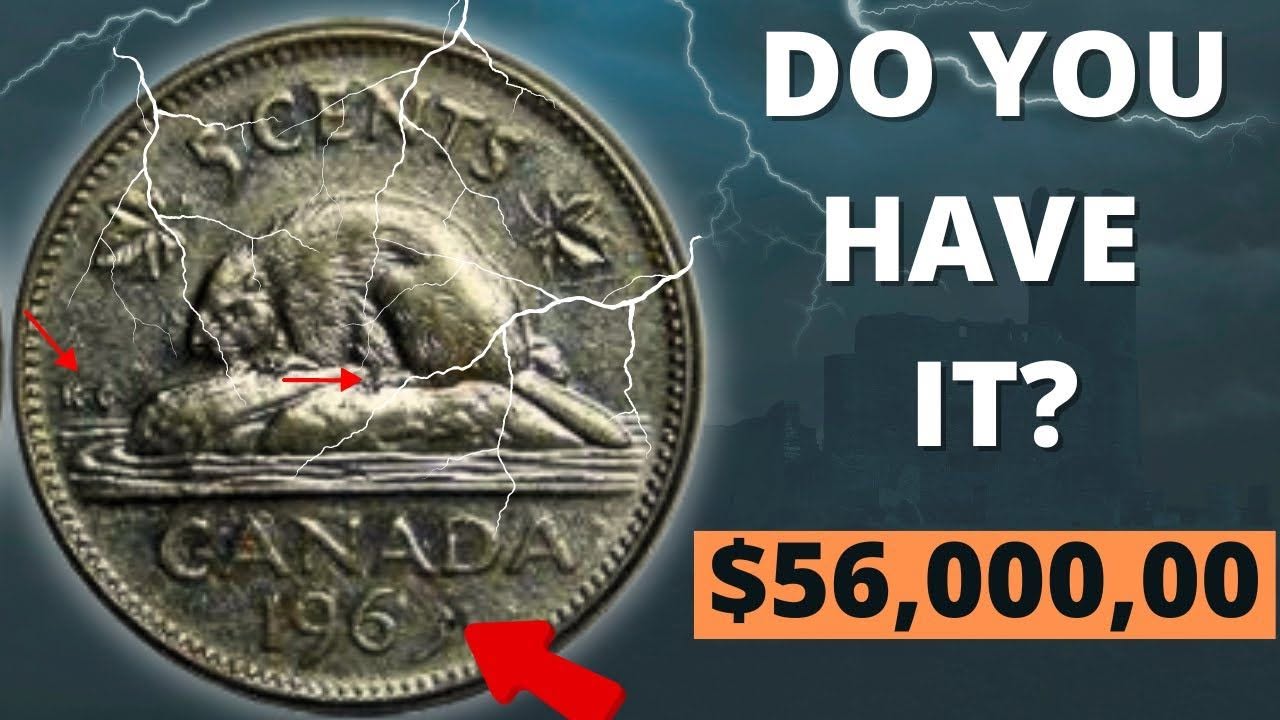
The Canadian 5-Cent Coin (commonly called the Canadian nickel) has a rich history spanning over a century. While millions pass through everyday commerce, rare metal transition errors, low mintages, and subtle die varieties make certain years exceptionally valuable to numismatists.
Below is a breakdown of the Top 5 Most Valuable Canadian 5-Cent Coins, including market valuations, key identification features, and what makes them prized rarities.
Top 5 Most Valuable Canadian Nickels Comparison
| Rank | Coin / Variety | Key Distinguishing Feature | Typical Market Valuation |
| 1 | 1921 Sterling Silver 5-Cent | Small silver composition; mass melt-down survivor | $5,000 – $100,000+ |
| 2 | 1944 Tombac Victory Nickel | Struck on brassy Tombac alloy instead of steel | $20,000 – $50,000+ |
| 3 | 1926 “Far 6” Five Cents | Last digit ‘6’ sits visibly farther from the maple leaf | $150 – $10,000+ |
| 4 | 1925 Canadian Nickel | Extremely low mintage year (approx. 200,000 minted) | $100 – $3,000+ |
| 5 | 1965 “Large Beads” Variety | Larger obverse rim beads paired with specific reverse dies | $100 – $2,500+ |
Deep-Dive Breakdown of the Top 5
1. 1921 Sterling Silver 5-Cent Coin (The “Holy Grail”)
-
Why It’s Rare: In 1921, Canada passed the Currency Act to transition the 5-cent coin from a small silver piece (known colloquially as a “fishscale”) to a larger 100% pure nickel composition. The Royal Canadian Mint ordered the remaining 3 million freshly minted 1921 silver coins to be melted down. Only about 400 to 1,500 survived, mostly sold as souvenirs.
-
How to Identify: Struck in 80% or 92.5% silver, measuring only 15.5 mm (significantly smaller than modern nickels).
2. 1944 Tombac Victory Nickel Error
-
Why It’s Rare: During World War II, nickel was reserved for military production. In 1943, Canada struck coins using “Tombac” (a copper-zinc brass alloy). By 1944, the Mint switched to chrome-plated steel. However, a tiny handful of 1944 “V for Victory” coins were accidentally struck on leftover 1943 Tombac planchets.
-
How to Identify: Golden-brass color rather than silver steel, dodecagonal (12-sided) shape, featuring the Morse code inscription around the rim.
3. 1926 “Far 6” Nickel
-
Why It’s Rare: The 1926 issue comes in two distinct die varieties: “Near 6” and “Far 6”. On the “Far 6” variety, the last digit of the date sits noticeably further away from the adjacent maple leaf on the right. High-grade examples are extraordinarily rare.
-
How to Identify: Check the gap between the top curve of the ‘6’ in “1926” and the lower maple leaf motif. A clear gap indicates the rare “Far 6”.
4. 1925 Canadian Nickel
-
Why It’s Rare: The 1925 nickel holds the lowest regular circulation mintage in the entire Canadian nickel series (only 202,289 struck) due to economic stagnation in the mid-1920s.
-
How to Identify: Standard King George V obverse and dual maple leaf reverse, stamped with the date “1925”. Even heavily worn circulated examples command significant premiums.
5. 1965 “Large Beads” Obverse Variety
-
Why It’s Rare: When the Royal Canadian Mint updated Queen Elizabeth II’s portrait in 1965 to the “Tiara” effigy, two rim bead sizes were produced: Small Beads and Large Beads. Combining the Large Beads obverse with specific reverse die pairings produced a scarcity that collectors actively hunt for.
-
How to Identify: Use magnification to count/examine the tiny beads running along the inner rim of the Queen’s profile; larger, bolder beads that sit closer to the rim edge denote the variety.
What to Look For When Inspecting Canadian Nickels
-
Professional Grading: High claims (like multi-thousand dollar values) require certification from established numismatic grading services such as PCGS, NGC, or ICCS (International Coin Certification Service).
-
Composition & Weight: Modern Canadian nickels shifted to multi-ply plated steel in 2000–2001. Older pure nickel coins weigh 4.54 grams, whereas silver or steel transition errors will deviate significantly on a precision scale.