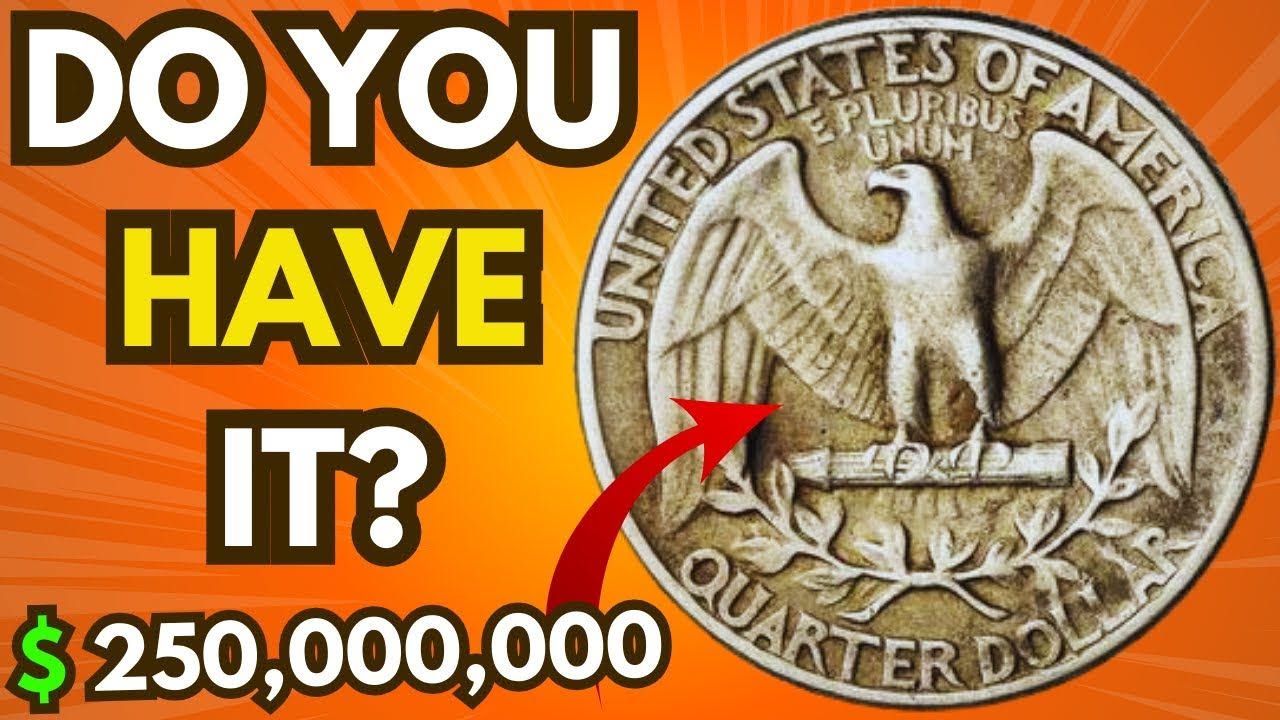
First minted in 1932 to commemorate the 200th anniversary of George Washington’s birth, the Washington Quarter is one of the most iconic and widely collected series in American numismatics. Designed by sculptor John Flanagan, the series transitioned from 90% solid silver (1932–1964) to a copper-nickel clad composition starting in 1965.
While millions of standard Washington quarters carry minimal value, key dates, extreme mint errors, and rare variety strikes command massive sums at auction.
Top 5 Most Valuable Washington Quarters Comparison
| Rank | Coin / Variety | Key Distinguishing Feature | High-Grade / Auction Record Value |
| 1 | 1932-D Washington Quarter | Lowest mintage regular-strike key date (436,800 minted) | $10,000 – $143,750+ |
| 2 | 1932-S Washington Quarter | Low San Francisco mintage inaugural key date (408,000 minted) | $5,000 – $52,800+ |
| 3 | 1950-D/S Over-Mintmark Quarter | “D” mint mark repunched directly over an underlying “S” | $500 – $29,375+ |
| 4 | 1943 Doubled Die Obverse (DDO) | Severe doubling on “IN GOD WE TRUST” & “LIBERTY” | $1,000 – $22,250+ |
| 5 | 1983-P Washington Quarter | Uncirculated condition rarity (no mint sets issued by U.S. Mint) | $100 – $1,500+ (Mint State) |
Detailed Breakdown of the Top 5 Valuable Quarters
1. 1932-D Washington Quarter (The King of Denver Quarters)
-
Why It’s Valuable: Struck during the Great Depression, the 1932-D quarter has a tiny mintage of only 436,800 pieces. Very few uncirculated examples were preserved by collectors at the time, making top-tier Mint State coins true rarities.
-
How to Identify: Check the reverse below the eagle’s wreath for a bold “D” mint mark.
-
Auction Record: An MS66 specimen certified by PCGS sold for a record $143,750.
2. 1932-S Washington Quarter (The San Francisco Key Date)
-
Why It’s Valuable: Similar to its Denver counterpart, the 1932-S boasts the lowest regular mintage in the entire series at just 408,000 coins. It is the premier key date for San Francisco quarters.
-
How to Identify: Look for an “S” mint mark on the reverse beneath the center of the wreath.
-
Auction Record: PCGS MS66 examples regularly fetch over $50,000 at major auctions.
3. 1950-D/S Over-Mintmark (D over S)
-
Why It’s Valuable: In 1950, a mint worker at the Philadelphia facility accidentally re-punched a Denver “D” mint mark onto a die that had already been stamped with a San Francisco “S”. This created one of the most famous over-mintmark varieties in 20th-century coinage.
-
How to Identify: Magnification reveals the top curve and upper portion of an underlying “S” protruding from behind and to the left of the primary “D” mint mark.
-
Auction Record: High-grade Mint State examples have sold for $29,000+.
4. 1943 Doubled Die Obverse (FS-101 / FS-103)
-
Why It’s Valuable: Created during World War II when a working hub shifted during the die-making process. This error displays dramatic, visible doubling across the front lettering.
-
How to Identify: Examine the obverse under a 10x loupe. You will see crisp secondary outlines on the letters of “LIBERTY” and the motto “IN GOD WE TRUST”.
-
Auction Record: Certified Gem MS67 specimens have commanded up to $22,250.
5. 1983-P Washington Quarter (Condition Rarity)
-
Why It’s Valuable: The U.S. Mint did not produce official Uncirculated Mint Sets in 1982 or 1983 due to budget cuts. Consequently, nearly all 1983-P quarters went straight into heavy circulation. Finding a pristine, uncirculated 1983-P with full original luster is exceptionally rare.
-
How to Identify: Features a “P” mint mark (introduced on quarters in 1980) on the right side of Washington’s neck obverse.
Key Tips for Inspecting Your Quarters
-
Check the Metal Content (Pre-1965): Quarters dated 1964 or earlier are composed of 90% solid silver. Even common dates carry base silver melt value.
-
Examine the Edge: Modern clad quarters (1965–present) reveal a copper strip around the reeded edge. Solid silver quarters have a clean, solid silver edge.
-
Use Professional Certification: If you find a potential 1932 key date or major doubled die error, send the coin to PCGS or NGC for professional grading and authentication.